
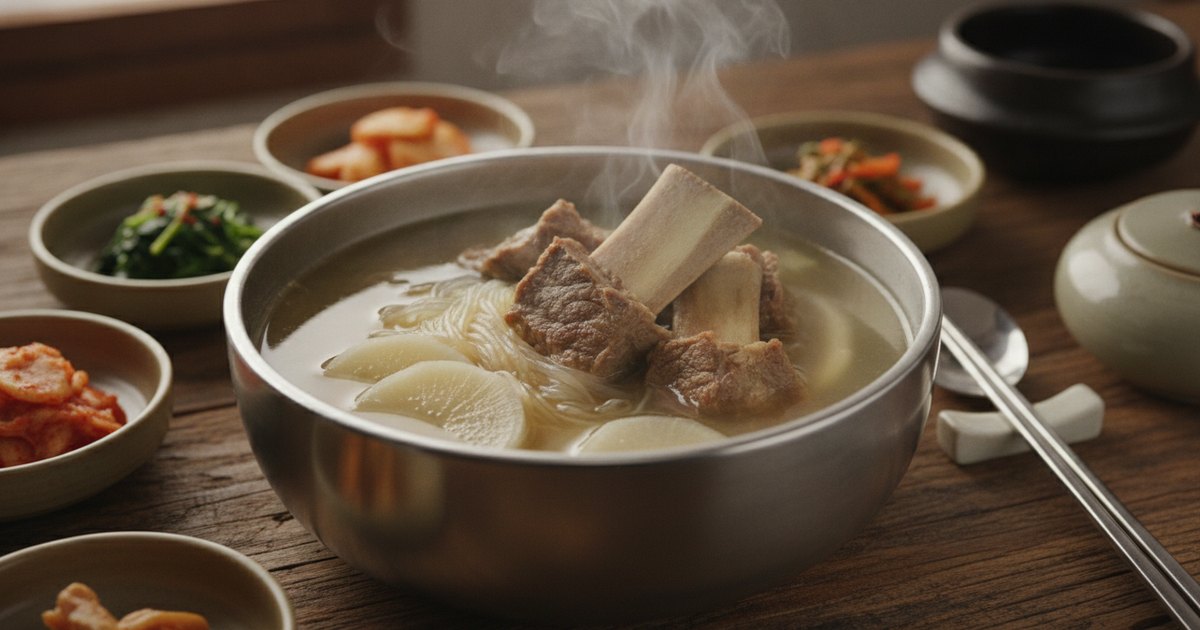
There are days when only something crystal-clear, deeply savory, and genuinely bone-warming will do. In Korea, that something is galbitang (갈비탕) — a slow-simmered beef short rib soup that manages to be both resolutely humble and quietly elegant at the same time.
Unlike the dark richness of a Western beef stew or the spice-forward intensity of doenjang jjigae, galbitang works by restraint. The broth is pale golden, nearly translucent, seasoned with a quiet hand. The ribs — bone-in, coaxed until they yield at a touch — are the centerpiece, surrounded by soft wedges of Korean radish. A scatter of sliced scallion on top, a few cracks of black pepper, and that's it. No red pepper paste. No elaborate sauce. Just deeply extracted beef flavor, clean and true.
That simplicity is harder to achieve than it looks. The difference between murky, gamey galbitang and the crystal-clear, restorative version is almost entirely about technique — specifically, the two-stage purification of the meat before the main simmer even begins. This guide walks you through every detail.
What Is Galbitang — and Why Is It Special?
Galbitang translates literally as "rib soup" (갈비 = rib, 탕 = soup or hot broth), and it belongs to Korea's category of 탕 (tang) dishes — rich, restorative broths traditionally served as a full meal rather than a side. Historically, galbitang appeared at formal family gatherings, ancestral rites (제사, jesa), and in royal court cuisine. That heritage shows in its character: this is a soup that prizes clarity and depth over boldness.
This is also proof that Korean cooking has far more range than its international reputation suggests. The same cuisine that gives us furiously spicy tteokbokki also produces this whisper-quiet, crystalline soup. The discipline required to keep galbitang's broth clear and clean-tasting is a point of pride in Korean home kitchens.
Today it's equally at home on weeknight tables and at celebratory family dinners. A pot started on Sunday afternoon will yield four deeply satisfying portions, and the broth only improves the next day — after the fat solidifies overnight and lifts cleanly off the surface.
The Ingredients: What You Need (and What's Negotiable)
The Non-Negotiables
Beef short ribs — bone-in, English-cut (the cut made perpendicular to the bone, leaving a flat piece of meat sitting atop a short bone section), in 5–7 cm (2–3 inch) pieces. The bone is not optional. It's the source of gelatin and marrow that give galbitang its subtle body — that barely-there lip-coating quality that distinguishes a proper Korean soup broth. For four servings, start with 1.1–1.4 kg (2.5–3 lbs).
Korean radish (무, mu) — the large, dense, ivory-green radish found at every Korean grocery. Cut it into generous chunks: they slowly absorb the beefy broth during the simmer and become meltingly tender by the time the soup is ready. The quantity is flexible: 250 g (9 oz) is the minimum; up to 450 g (1 lb) gives the broth a noticeably sweeter, more rounded quality that many people prefer.
Onion, whole garlic cloves, black peppercorns — all three appear in every version of this recipe across every serious Korean cooking source. Halved onion and whole garlic cloves mellow and sweeten as they simmer. Peppercorns add a warm, subtle heat to the background of the broth — aromatic rather than sharp.
Gukganjang (국간장, soup soy sauce) — this is the primary seasoning for galbitang and the ingredient most likely to be unfamiliar to Western cooks. Gukganjang is lighter in color, saltier, and more complex than regular dark soy sauce or tamari, and it seasons the broth without darkening it. Start with 1 tablespoon and adjust to taste at the end.
Minced garlic, added near the end — in addition to the whole cloves simmered in the broth, a tablespoon of minced garlic added in the final 10–15 minutes delivers a fresher, more assertive garlic presence in the finished soup. Most recipes include both.
The Optionals
Green onion stalks — commonly simmered in the broth for additional allium depth, but not universal. Use them if you have them; leave them out if you don't.
Fresh ginger — one or two thin slices in the broth (not more — this is emphatically not a ginger-forward soup) can help neutralize any residual gaminess in the meat. Multiple well-regarded recipes omit it entirely without any loss. Treat it as personal preference.
Dangmyeon (당면, glass noodles) — sweet potato starch noodles that turn silky and translucent in hot broth. A common and welcome addition, but not present in every recipe. Soak them in warm water for 30 minutes before adding to the soup, and — critically — do not store them in leftover broth. They absorb liquid aggressively overnight and turn gummy. Keep them separate.
Dried kelp (다시마, dashima) — an optional technique: steep one small piece in the finished broth for 5 minutes, then remove. It adds a subtle background umami without adding color or clouding the broth. Worth doing if you have dashima in your pantry.
Finding These Ingredients in Western Kitchens
English-cut short ribs are available at most mainstream supermarkets and butcher shops in Western countries. Look for pieces with good marbling and a visible bone. Flanken-cut (thin strips cut across multiple rib bones) can work but cooks faster and produces a slightly different texture; it's a reasonable substitute, not ideal.
Korean radish (mu) is sold at H Mart, Hanahreum, and most Asian supermarkets. Japanese daikon is the closest substitute — the flavor profile is nearly identical, though Korean mu tends to be denser and less watery. Western turnip is not a substitute; the flavor is too different.
Gukganjang is available at any Korean grocery store, usually labeled "soup soy sauce" or sometimes just by the Korean name. It keeps well on the shelf after opening. If you genuinely cannot find it, you can use a small amount of light (thin) soy sauce and increase the salt to compensate. Avoid using regular Kikkoman as your primary seasoning — it will darken the broth and skew the flavor.
Dangmyeon glass noodles are stocked at virtually every Asian grocery and increasingly at Whole Foods in the international foods aisle.
How to Make Galbitang: The Full Method
The entire technique of galbitang hinges on two distinct impurity-removal stages before the long simmer. Get these right, and a clear, deeply flavored broth follows almost automatically.
Stage 1: The Cold Soak
Place the short ribs in a large bowl and submerge them completely in cold water. Leave for at least one hour — longer if time allows, up to overnight in the refrigerator, changing the water once or twice. The water will turn progressively pink-red as blood leaches out of the meat. This is exactly what you want. Ribs that skip this step will produce significantly more foam during cooking and a cloudier, gamier-tasting broth. Drain and rinse the ribs before moving on.
Stage 2: Parboiling — the Most Important Step
Place the soaked ribs in your pot and cover with fresh cold water (not the soaking water — discard that). Bring to a full, vigorous boil over high heat and hold it there for 5–7 minutes. The surface will fill with gray-brown foam and fat — this is myoglobin, blood proteins, and soluble impurities being driven to the surface by the heat. Don't try to skim it; you're about to discard everything.
Drain it all out completely. Now: rinse each rib piece individually under cold running water, rubbing off any gray residue clinging to the meat with your fingers. Many recipes describe this step too briefly. It matters enormously. Any residue left on the ribs re-enters the broth and clouds it. Rinse the pot clean as well before proceeding.
Building the Broth
Return the cleaned ribs to the clean pot. Add 2.4 L (10 cups) of fresh cold water, along with the radish chunks, halved onion, whole garlic cloves, peppercorns, and any optional aromatics you're using (green onion, ginger).
Bring to a boil over high heat, then reduce immediately to a gentle, steady simmer — medium-low heat, lid slightly ajar. The surface should show a soft, consistent bubble. Not a rolling boil, not barely a ripple, but a quiet, persistent simmer. Skim the surface during the first 15–20 minutes as the last traces of foam appear, then leave it alone.
Simmer for 1.5–2 hours. The meat is ready when it pulls away from the bone under gentle pressure — you should be able to slip a chopstick or fork between the meat and bone with almost no resistance — but still holds its shape and hasn't dissolved into the broth. Visually, the broth should look pale golden and translucent. If you lift a spoonful to the light, you should be able to see through it.
Seasoning the Clear Broth
Remove the radish chunks and set them aside for serving. Discard the onion, green onion (if used), and ginger. Add the minced garlic to the still-simmering broth and cook for 5 minutes. Now season: stir in gukganjang and salt, then taste the broth carefully. It should be savory and clean, with a faint sweetness from the radish — a flavor that tastes complete and rounded rather than flat or sharp. Add more salt in small increments if needed.
If using soaked dangmyeon, drain them and add to the broth now. Cook 3–5 minutes until just translucent and tender. Serve immediately.
Pressure Cooker / Instant Pot Option
The soak and parboil are non-negotiable even with a pressure cooker — skip them and the broth will be murky and gamey regardless of how long you cook it. After cleaning the ribs, add them to the Instant Pot with all aromatics and reduce the water to 1.6–1.8 L (7–8 cups). Cook on HIGH pressure for 35–40 minutes, then allow natural pressure release for 15 minutes before opening. Season as above. The broth won't be quite as clear as stovetop — pressure agitates the liquid more than a gentle simmer — but the meat will be beautifully tender in a fraction of the time.
Serving Galbitang
Place 2–3 rib pieces and a few radish chunks in each deep bowl. Ladle hot, clear broth over them generously. Scatter sliced scallions across the top and add a pinch of ground black pepper — the pepper is understated in the broth but important in the final bowl.
Galbitang is always served with steamed short-grain rice on the side. You eat them alternately — a spoonful of broth, a bite of rice, a piece of tender meat — or dip the rice directly into the bowl. Small dishes of kimchi (especially aged, sour kimchi) and other banchan complete the meal; the acid of kimchi cuts through the richness of the beef broth in a way that's deeply satisfying.
If you enjoy Korean dishes built around beef short ribs, the next logical stop is galbi-jjim — braised short ribs in a soy and pear sauce that's as boldly flavored as galbitang is understated. And for another restorative Korean bone broth in a similar spirit, our gamjatang recipe — pork neck and potato soup — is every bit as comforting on a cold evening.
Make-Ahead and Storage
Galbitang is an ideal make-ahead dish. Refrigerate ribs and broth together for up to 4 days. Overnight, the fat will solidify into a pale cap on the surface — lift it off cleanly with a spoon before reheating. The broth deepens in flavor with each passing day.
Glass noodles: Always store dangmyeon separately from the broth. Left in the soup overnight, they absorb the liquid and turn into a bloated, gummy mass. Reheat the broth, then add freshly soaked noodles when serving.
Freezer: Galbitang freezes well without noodles for up to 3 months. Freeze in individual portions for the most convenient reheating.
Common Mistakes to Avoid
1. Shortcutting or skipping the soak and parboil. This combination is the single most common reason galbitang comes out murky, gamey, or foamy. The cold soak draws out blood proteins passively; the parboil drives out the rest with heat. Both are necessary, and the parboil alone is not sufficient to replace the soak. The additional detail that often gets lost: after draining the parboil, you must rinse each rib individually under cold running water. Gray residue on the surface of the meat will re-enter the broth if left there. It takes three extra minutes and makes a visible difference.
2. Simmering too hard once the broth is built. A rolling boil after the broth is assembled will emulsify fat droplets and protein fragments into the liquid, turning it permanently opaque and white-cloudy. Once this happens, it cannot be fully reversed. You can strain the finished broth through cheesecloth or a dampened paper towel–lined strainer to improve it somewhat, but prevention is the only real fix. Maintain a gentle simmer throughout — the surface should bubble softly, not churn.
3. Seasoning too early or too timidly. Gukganjang should go in at the very end of cooking — adding it early can give the broth a slightly harsh, soy-forward taste rather than the clean savoriness that makes galbitang distinctive. Separately: the finished broth before seasoning can taste surprisingly flat, and first-time cooks sometimes under-season because the broth already smells good. Taste carefully after adding gukganjang and salt, then adjust. The broth should taste pleasantly savory with a clean finish; if it still seems one-dimensional, a touch more salt is almost always the answer before adding anything more complex.
4. Letting the radish disintegrate in the broth. Korean radish chunks added from the start of a two-hour simmer will eventually soften beyond what's useful and begin to break apart, clouding the broth slightly and losing their pleasant texture. To avoid this: add the radish partway through the cook (after the first 45–60 minutes), or watch it carefully and remove the pieces while they're still intact — just tender, slightly translucent, yielding easily to a chopstick. Radish that gives the broth its sweetness without falling apart is the goal.
5. Boiling at the parboil stage with a lid on. A common instinct when trying to speed things up — but a covered pot during the parboil means the foam and impurities boil back over the sides and re-deposit on the ribs rather than being fully driven off. Keep the lid off for the parboil stage and let everything happen in the open pot.
6. Storing leftover glass noodles in the broth. As noted above, dangmyeon are hydroscopic — they'll absorb liquid aggressively even after cooking. Leave them in leftover galbitang overnight and you'll find either swollen, gummy noodles or a broth that's significantly thickened and reduced. Always store noodles and broth in separate containers, and make a fresh small batch of soaked noodles when reheating.
FAQ
Can I use boneless short ribs for galbitang? Technically yes, but the result will be different in an important way: the bone-derived gelatin is what gives galbitang broth its subtle body and that barely perceptible lip-coating quality. Boneless short ribs will produce thinner, less silky broth. If boneless is your only option, add a couple of beef marrow bones or knuckle bones to the pot alongside the meat to compensate. Bone-in English-cut ribs are worth hunting down at a Korean grocery or asking a butcher to cut for you.
My broth turned out cloudy. What went wrong? Two likely causes: either the heat was too high at some point during the simmer (a rolling boil emulsifies fat permanently), or the ribs weren't rinsed thoroughly enough after parboiling. For a quick fix on already-cloudy broth, strain it through a fine-mesh strainer lined with a dampened paper towel or cheesecloth — this won't make it crystal-clear, but it will improve it noticeably. For next time: keep the heat reliably low throughout the main simmer, and rinse those ribs carefully.
What's the difference between galbitang and seolleongtang? Both are clear Korean beef soups, but they're opposite in approach. Seolleongtang (설렁탕) is made by boiling ox leg bones, trotters, and brisket at a deliberately hard, rolling boil for many hours — the extended agitation is intentional, designed to emulsify collagen into a milky-white, opaque broth. Galbitang uses short ribs at a careful gentle simmer and aims for a clear, golden broth. Same tradition, fundamentally different technique and result.
Can I make galbitang in a slow cooker? Yes, after completing both the soak and the parboil/rinse stages. Transfer the cleaned ribs, aromatics, and 2 L (8 cups) water to the slow cooker and cook on HIGH for 4–5 hours or LOW for 7–8 hours. The broth will be slightly less clear than stovetop galbitang because the slow cooker maintains a somewhat more agitated environment, but the flavor will be excellent. Season with gukganjang and salt right before serving.
Is there a substitute for gukganjang if I can't find it? In a pinch, use a very small amount of light (thin) soy sauce and increase the salt to compensate for flavor. Avoid dark soy sauce or standard all-purpose soy sauce as your primary seasoning — they'll turn the broth noticeably brown. If you plan to cook Korean soups and stews regularly (and you should — they're among the most satisfying cold-weather cooking in the world), a bottle of gukganjang from H Mart is genuinely one of the best pantry investments you can make. It keeps for a long time and the flavor difference is real. ```