
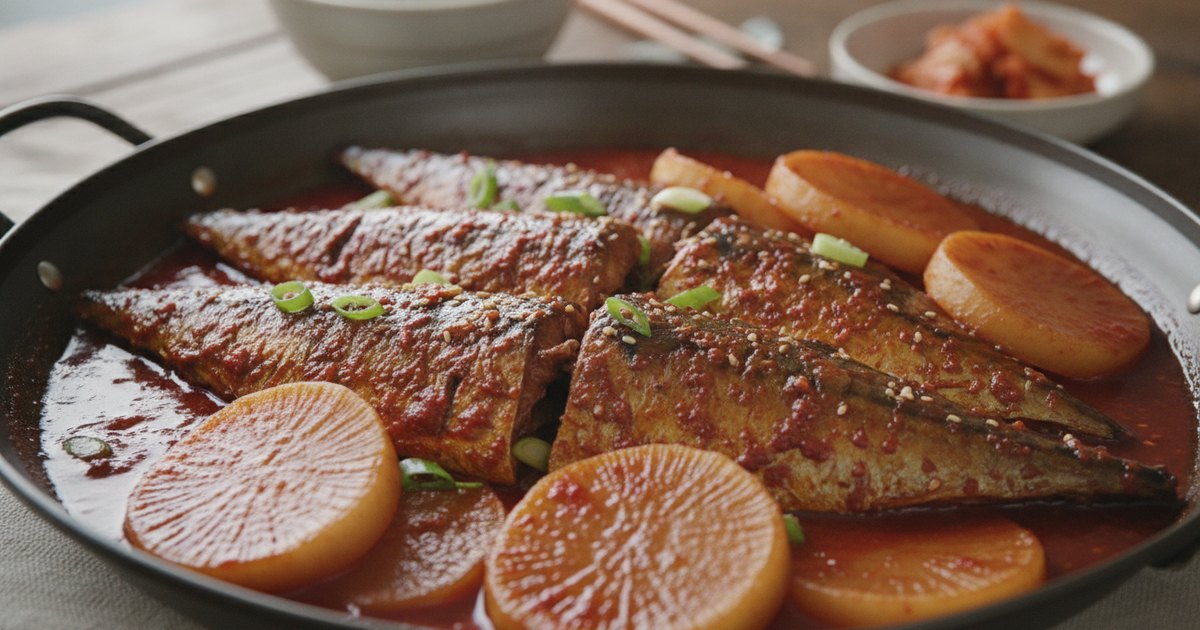
There's a dish in Korean home cooking that doesn't get nearly the international attention it deserves. Tteokbokki gets the street-food spotlight. Bulgogi wins over the grill-curious. But godeungeo jorim (고등어조림) — braised spicy mackerel — is what a lot of Korean families actually put on the table on a regular Tuesday night, and once you've eaten it properly, you understand why.
This is a dish that announces itself. The braising sauce — a dark, glossy tide of gochugaru, soy sauce, garlic, and umami — reduces into something intensely concentrated, coating every piece of mackerel and every cube of radish in flavor that goes several layers deep. It's bold and spicy and savory and just barely sweet, and it makes plain steamed rice taste like the best thing you've ever eaten.
For a Western home cook building out a Korean cooking repertoire, godeungeo jorim is genuinely achievable. You need about 40 minutes, one pan, and a short list of pantry ingredients. The technique is straightforward once you understand what you're actually doing — and that's what this guide is here to help you see clearly.
What Is Jorim? Understanding the Technique
Jorim (조림) is one of the foundational cooking methods in the Korean culinary canon, alongside bokkeum (stir-frying), jjim (steaming), gui (grilling), and jeon (pan-frying). The defining feature of jorim is a controlled, intentional reduction: food is simmered in a seasoned liquid — typically soy-based, chili-based, or both — until that liquid reduces dramatically and glazes the ingredients in a concentrated sauce.
The key distinction from a jjigae (찌개, stew) or guk (국, soup) is that a finished jorim dish has very little free liquid. You're not serving something in broth; you're serving something that has absorbed and transformed the broth into a coating. This matters for technique: you start the heat higher to get momentum, then manage it carefully through the reduction phase, watching the liquid change from thin and pourable to thick and clinging.
Historically, jorim was a practical preservation method. The combination of salt (from soy sauce or fish sauce), sugar, and dramatic liquid reduction created inhospitable conditions for bacteria in pre-refrigeration kitchens. The technique is still used today purely for flavor — but that practical legacy explains the intensity of the seasoning. Jorim isn't timid. It's built to be bold.
Why Mackerel? The Fish's Case for Itself
Mackerel (godeungeo, 고등어) is one of the most widely eaten fish in Korea, and it's been that way for a very long time. There are practical reasons: mackerel is abundant in Korean coastal waters, affordable year-round, and nutritionally dense with omega-3 fatty acids. But the culinary reason is the one that matters most here — mackerel has character.
It is an oily, full-flavored blue fish, and that fat content is exactly what makes it the ideal candidate for aggressive braising. Where a lean white fish might dry out or fall apart under this kind of heat and seasoning, mackerel stays moist and tender. The fat in the flesh also acts as a natural buffer against the heat and salt of the sauce, so neither overwhelms the other. You end up with a balance that's surprisingly nuanced for such a simple-looking dish.
The one thing that can put off unfamiliar cooks is mackerel's pronounced raw aroma. This is real, but it's also completely manageable — the salt pre-treatment described in the recipe handles most of it at the prep stage, and the braising sauce handles the rest. By the time godeungeo jorim is finished cooking, your kitchen smells of warm chili, caramelized garlic, and deeply savory spices. The funky raw-fish smell is long gone.
Sourcing Mackerel in the West
Best option: Korean or pan-Asian grocery stores. H Mart, 99 Ranch Market, Mitsuwa, and similar stores carry mackerel in multiple forms:
- Frozen whole mackerel: The most common and most reliable. Usually already gutted and cleaned — ask at the counter if you're not sure. Thaw overnight in the fridge or under cold running water. Quality is consistent and the price is very good.
- Fresh whole mackerel: Available seasonally at better-stocked stores. If buying fresh, cook it the same day you buy it. Eyes should be clear and bright, gills should be deep red, and the flesh should feel springy under your finger. A clean ocean smell is fine; any sour or ammonia note means skip it.
- Frozen fillets: A practical shortcut. Reduce the uncovered cook time by 3–4 minutes to avoid overcooking.
If you're nowhere near a Korean grocery: Whole Foods and upscale fish counters sometimes carry fresh Atlantic mackerel (labeled Boston mackerel), which works well. Spanish mackerel is also a good substitute — it has a similar fat content and flavor profile. Avoid canned mackerel for this dish; the texture can't withstand the braising process.
For the sauce ingredients, gochugaru is genuinely hard to substitute — the flavor and color are specific to Korean dried chilies. It's worth ordering online if local options are limited. For a full breakdown of Korean chili products, see our complete gochujang guide, which covers the broader spectrum of Korean chili staples.
The Braising Sauce: What Goes In and Why
Survey enough godeungeo jorim recipes and you'll find versions that range from three-ingredient minimalist to seven-component elaborate. Both approaches produce good results; they just produce different ones. Here's how to think about the sauce from the ground up:
The non-negotiable core — use these every time:
- Gochugaru (Korean chili flakes), 2 tbsp: The backbone of the dish's flavor and its characteristic deep red color. Coarse-grind gochugaru (굵은 고춧가루) gives a slightly rougher, more textural sauce; fine-grind produces a smoother glaze. Either works, but coarse is more traditional for jorim.
- Soy sauce (ganjang), 3 tbsp: Salt, depth, umami. Korean soy sauce has a slightly different character than Chinese light soy or Japanese shoyu — use it if you can, but the others will work in a pinch.
- Minced garlic, 1½ tbsp: Be generous. The garlic mellows significantly during braising but never disappears — it becomes a sweet, caramelized undercurrent by the end.
Strongly recommended additions:
- Korean tuna fish sauce (chamchi-aekjeot), 1 tbsp: This is the ingredient that separates a good version of this dish from an outstanding one. It adds a layer of oceanic umami that amplifies the mackerel's own flavor without reading as "fishy." Regular Korean anchovy fish sauce (aekjeot) at slightly lower quantity is a solid substitute.
- Ginger, 1 tsp: Cuts richness, brightens the sauce, and helps neutralize residual raw-fish aroma.
- Sugar, 1 tsp: Balances chili heat and promotes caramelization at the pan edges as the liquid reduces.
- Mirin or rice wine, 1 tbsp: Adds gentle sweetness and helps tenderize the fish proteins.
Optional depth-adders — pick one or two, not all:
- Gochujang, 1–2 tbsp: Adds body, gloss, and fermented complexity to the sauce. Produces a thicker, slightly darker result.
- Plum syrup (maesil-cheong), 1 tbsp: Fruity sweetness that plays well against the chili heat.
- Sesame oil, 1 tsp: Stirred in at the very end for a nutty, aromatic finish.
The Full Recipe
Ingredients (serves 2–3)
Fish and vegetables:
- 1 whole mackerel (about 350g / 12 oz cleaned weight), gutted and cut into 3–4 chunks approximately 5–6 cm (2–2.5 inches) wide
- 200g (7 oz) Korean radish (mu), peeled and cut into 1.5 cm (½-inch) cubes
- ¼ large onion (about 80g / 3 oz), sliced into half-moons
- 3 scallions, whites cut into 5 cm (2-inch) lengths; greens thinly sliced for garnish
- 1–2 fresh red or green chilies, thinly sliced (optional)
Braising sauce:
- 2 tbsp gochugaru (coarse grind preferred)
- 3 tbsp soy sauce (ganjang)
- 1½ tbsp minced garlic (~3–4 cloves)
- 1 tsp fresh ginger, grated
- 1 tsp sugar
- 1 tbsp Korean tuna fish sauce (chamchi-aekjeot) — optional but recommended
- 1 tbsp mirin or rice wine
- 120 ml (½ cup) water
- Pinch of black pepper
- ½ tsp salt (for pre-treating the fish)
- 1 tsp sesame oil (for finishing)
Instructions
Step 1 — Pre-treat the fish. Rinse the mackerel chunks under cold water. Pat dry, then sprinkle all surfaces lightly with the salt. Let sit 10 minutes — you'll see a light film of moisture draw out. Rinse again and pat completely dry. This step is short but important.
Step 2 — Mix the braising sauce. Combine gochugaru, soy sauce, garlic, ginger, sugar, fish sauce (if using), mirin, black pepper, and water in a bowl. Stir until the gochugaru is fully hydrated. The result should look like a loose, pourable red paste.
Step 3 — Layer the radish. Spread the radish cubes in a single even layer across the bottom of a wide, heavy pan or shallow pot. A 28–30 cm (11–12 inch) pan is ideal — you want the fish pieces spread out, not stacked.
Step 4 — Add the fish and pour the sauce. Place mackerel chunks skin-side up on the radish. Pour the braising sauce evenly over everything. Tuck onion slices and scallion whites around the fish.
Step 5 — Braise covered. Cover and bring to an active simmer over medium-high heat. Cook covered for 8–10 minutes. Listen for a confident bubbling sound — steady but not violent.
Step 6 — Baste and reduce. Remove the lid. Spoon the hot braising liquid over the top of the fish pieces. Reduce heat to medium and cook uncovered for 12–15 more minutes, basting every 3–4 minutes. Watch the sauce reduce from brothy to glossy. It's done when the liquid has thickened noticeably and the pan edges look caramelized.
Step 7 — Finish and serve. Add scallion greens and sliced chilies in the final 2 minutes. Drizzle with sesame oil. Swirl the pan gently once. Serve immediately with steamed white rice, with any remaining sauce spooned directly over the rice.
Serving and Pairing
Godeungeo jorim is a banchan — a side dish that's part of a larger spread — but it's also substantial enough to anchor a simple weeknight meal with just rice. Pair it with a mild, cooling side like a cucumber muchim or a simple bean sprout salad to balance the heat. A bowl of doenjang jjigae alongside is a very traditional combination.
If you're building a full banchan spread, godeungeo jorim pairs beautifully with gamja jorim (see our gamja jorim recipe) — both are jorim-style dishes, but the mild, slightly sweet braised potatoes provide a counterpoint to the spicy mackerel. And of course, rice. Always rice.
Make-Ahead and Storage
Godeungeo jorim actually improves the next day — the flavors deepen and integrate overnight. Store leftovers in an airtight container in the refrigerator for up to 2 days. Reheat gently in a covered pan with a splash of water over low heat; the fish is already cooked through and just needs warming. Do not microwave if you can avoid it — it tends to make the flesh rubbery and the sauce separates.
Freezing is not recommended; mackerel's texture becomes mushy once frozen after cooking.
Common Mistakes to Avoid
1. Skipping the Salt Pre-Treatment
Going straight from raw mackerel to the pan without the salting step leaves you with a dish that has a lingering raw-fish undertone even after cooking. The salt draws out surface proteins and excess moisture that are responsible for that aroma. Ten minutes is enough — don't skip it, and don't over-salt either (you're seasoning the sauce separately).
2. Using Too Much Water in the Sauce
The sauce should start concentrated, not thin. If you add too much water upfront thinking it will reduce away, you'll need much longer cook times and risk the fish becoming dry and overcooked before the liquid thickens. Stick to 120 ml (½ cup) for one fish. The mixture will look thick and intense going into the pan — that's exactly right.
3. Cooking Without the Radish Base Layer
Some shortcut versions skip the radish, placing the fish directly on the pan surface. The fish will stick, and the bottom pieces will scorch before the top is cooked through. The radish base is not optional — it's a functional part of the cooking method, acting as a natural rack that elevates the fish while also producing the most flavorful element of the whole dish.
4. Lifting the Lid Too Early
The covered phase is when the fish cooks through and the radish softens. If you open the lid every two minutes to check, you lose steam and the internal temperature drops, leading to uneven cooking. Trust the process: cover it, set a timer for 8 minutes, and leave it alone. You'll hear the bubbling and know it's working.
5. Aggressive Stirring During Reduction
Mackerel flesh is tender and will fall apart if disturbed too much during the uncovered reduction phase. Use a large spoon to baste — gently ladling liquid over the fish — rather than stirring. If a piece needs to be moved, use a spatula and support it from underneath. One crumbled chunk doesn't ruin the dish, but you want intact pieces for presentation.
6. Pulling the Dish Before the Sauce Is Truly Reduced
The most common timing error is serving godeungeo jorim when the sauce is still thin and brothy. It might look "done" because the fish is cooked through, but the flavor payoff comes from the reduction. The sauce is ready when: it coats the back of a spoon cleanly, the pan edges show caramelized deposits rather than a waterline, and the color has deepened from bright red to a darker, glossier crimson. If you're unsure, give it two more minutes.
Frequently Asked Questions
Can I use mackerel fillets instead of a whole fish cut into chunks?
Yes, and it's a perfectly reasonable shortcut. Fillets are already boneless (or nearly so), which some diners prefer. Reduce the uncovered cooking time by about 4–5 minutes since there's no bone structure moderating the heat. Watch carefully — fillets can go from perfectly cooked to dry quickly.
My sauce looks too thin even after 15 minutes uncovered. What happened?
The most likely culprits: either too much water was added upfront, or the heat is too low. Increase the heat slightly to medium-high and continue reducing, basting frequently. Don't walk away. The transition from "thin" to "glossy" can happen fast once it gets there, so watch the edges of the pan as your cue.
I can't find gochugaru at my local store. Can I substitute regular chili flakes?
Standard crushed red pepper flakes (the kind in Italian restaurants) are hotter and have a different flavor profile than gochugaru — you'll get more heat and less of the fruity, slightly smoky character that defines Korean chili dishes. Use about half the amount if substituting, and expect a sharper, less complex result. Order actual gochugaru online when you can; it's the single ingredient most worth having in your pantry if you cook Korean food regularly.
Is this dish very spicy? Can I reduce the heat?
At 2 tablespoons of gochugaru, the dish has a genuine, noticeable heat — but for most people who enjoy spicy food, it's very manageable. To reduce heat, drop to 1 tablespoon of gochugaru and add 1–2 tablespoons of gochujang instead (gochujang has chili but also fermented sweetness that tempers perceived heat). To increase heat, add a tablespoon of gochugaru or throw in sliced fresh chilies earlier in the cooking process.
What other fish work well in this recipe?
The sauce works with any oily, full-flavored fish that can hold up to braising. Hairtail (galchi) is the classic Korean alternative. Spanish mackerel, bluefish, or even salmon belly sections all produce excellent results. Lean white fish (cod, tilapia, sole) will work but tend to dry out and fall apart more easily — if using them, reduce the cooking time significantly. ```