
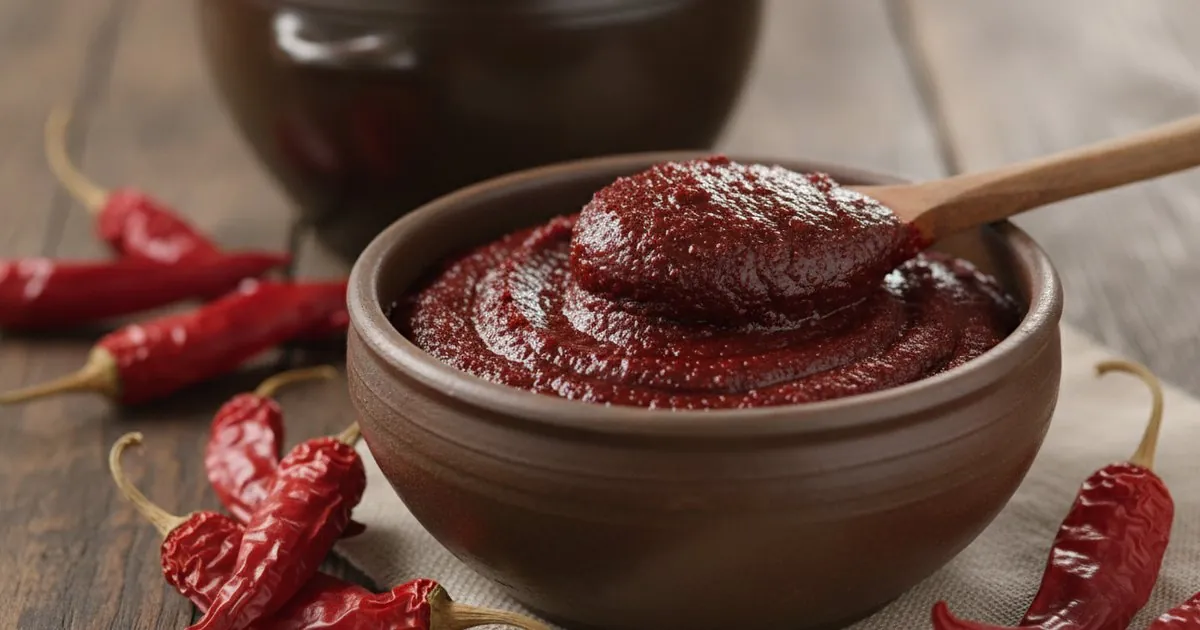
Open the refrigerator of almost any Korean household and you’ll find a tub of it on the shelf: the deep red, glossy paste that anchors more dishes than any other single ingredient in Korean cooking. Gochujang (고추장, pronounced go-choo-JANG) is a fermented chili paste that has been central to Korean cuisine for centuries. It is sweet, spicy, savory, and funky all at once — and it is absolutely unlike anything else in your pantry.
If you’re new to Korean cooking, understanding gochujang is step one. If you’ve been cooking Korean food for years and have a tub perpetually in your fridge, this guide will deepen your appreciation for what’s inside it. Either way, by the end of this article you’ll know exactly what to look for, how to use it, and why it deserves a permanent spot next to your soy sauce and sesame oil.
What Exactly Is Gochujang?
At its most basic, gochujang is a thick paste made from Korean red chili peppers, fermented soybeans, glutinous rice, and salt. But that description undersells it dramatically — the magic comes from fermentation, which transforms those humble ingredients into something with extraordinary complexity.
The four core components each play a distinct role:
- Gochugaru (Korean red pepper flakes): This is the ingredient that gives gochujang its signature heat and vivid brick-red color. Korean red peppers (cheongyang or similar cultivars) are milder and fruitier than, say, cayenne, with a natural sweetness underneath the heat.
- Glutinous rice (chapssal): Cooked sweet rice, or sometimes rice flour, provides the body and the initial sweetness. During fermentation, the starches in the rice break down into sugars — this is why gochujang tastes sweeter than a plain chile paste.
- Meju (fermented soybean powder): This is the umami engine. Meju is made by fermenting dried soybeans into bricks, then drying and grinding them. The proteins break down into amino acids during the process, creating the deep savory backbone that distinguishes gochujang from other chile pastes.
- Salt: The preservative that makes gochujang shelf-stable and controls the fermentation process.
Some modern commercial recipes also include barley malt syrup or wheat, but traditional recipes stick to these four.
The Fermentation Process: Where the Magic Happens
Traditional gochujang is made in late autumn or early winter, then fermented outdoors in jangdok (장독) — heavy ceramic crocks with wide mouths that are sealed with breathable cloth during the cold months. The crocks are placed in a sunny courtyard and left to ferment for anywhere from a few months to several years, cycling through winter cold and spring warmth.
This outdoor fermentation is not accidental. The temperature swings are crucial: cold temperatures slow fermentation and allow complex flavor compounds to develop gradually; warm periods accelerate microbial activity and help the starches break down further. The result is a paste with layers of flavor that fast-fermented or heat-processed versions simply cannot replicate.
Traditional gochujang made by a skilled jang (sauce) maker can ferment for three to five years. The longer it ferments, the deeper and more complex the flavor becomes. This is why artisan gochujang from traditional producers in Korea’s Sunchang region — famous as the home of gochujang — commands premium prices and is regarded as a national culinary treasure.
For the home cook, most commercially available gochujang is fermented for a much shorter period (weeks to a few months), but the basic process and the core flavors are the same.
What Does Gochujang Taste Like?
Describing gochujang to someone who hasn’t tried it is genuinely difficult, because there isn’t a close Western equivalent. Here’s a breakdown of the flavor experience:
The first thing you taste is sweetness. This surprises people who expect a straight-up hot sauce experience. The fermented rice creates a natural sweetness that hits before the heat, which is part of why gochujang is so addictive — your brain keeps going back for more.
Then comes the heat. It’s a warm, building heat rather than a sharp, immediate burn. Standard commercial gochujang lands around a 3-4 on a 10-point scale — assertive but accessible. This is significantly milder than sriracha in terms of raw Scoville rating, but more complex.
Underneath that is deep umami. The fermented soybean component gives gochujang a richness that resembles miso paste or aged doenjang — a savory depth that rounds out the sweetness and heat and makes the paste feel substantial rather than sharp.
Finally, a pleasant funkiness. All fermented foods have a characteristic tang, and gochujang is no exception. It’s subtle — more like aged cheese than pungent kimchi — but it’s there, and it’s part of what makes gochujang irreplaceable in Korean cooking.
The texture is thick and sticky, similar to tomato paste but smoother and more spreadable. It clings to food beautifully, which makes it ideal for glazes and marinades.
How to Cook with Gochujang
This is where things get exciting. Gochujang is remarkably versatile — it works in cooked dishes, marinades, dipping sauces, and even non-Korean applications.
Classic Korean Uses
Bibimbap sauce (yangnyeom gochujang): Mix 2 tablespoons gochujang with 1 tablespoon sesame oil, 1 teaspoon sugar, 1 teaspoon rice vinegar, and a splash of water. This is the definitive bibimbap topping, though it works on grain bowls, roasted vegetables, and virtually anything else that needs a flavor punch.
Tteokbokki: Gochujang is the primary flavoring in Korea’s most popular street food snack. Combined with a touch of gochugaru, sugar, and anchovy stock, it becomes the thick, glossy, sweet-spicy sauce that coats those gloriously chewy rice cakes. The sauce is unquestionably one of the best things ever created.
Ssamjang (wrap sauce): Combine equal parts gochujang and doenjang (fermented soybean paste), add minced garlic, sesame oil, and a small amount of sugar. This is served alongside grilled meats for wrapping in lettuce or perilla leaves — it has a more complex, slightly bitter edge than gochujang alone.
Kimchi jjigae (kimchi stew): A spoonful of gochujang added to well-fermented kimchi stew deepens the color and adds body. It’s not always included in traditional recipes, but it’s a common technique in home cooking.
Doenjang jjigae (soybean paste stew): Similarly, a small amount of gochujang can be stirred into the soybean paste base for color and a gentle heat.
Marinades and Glazes
Korean fried chicken glaze: One of the best uses of gochujang outside of traditional preparations. Mix 3 tablespoons gochujang with 2 tablespoons honey (or rice syrup), 1 tablespoon soy sauce, 1 tablespoon rice vinegar, and 3 cloves of minced garlic. Toss fried chicken in this sauce while still hot for a sticky, glossy, spicy-sweet coating that’s wildly addictive.
Pork or beef bulgogi variation: Replace some of the sugar and soy sauce in a standard bulgogi marinade with gochujang for a spicier, deeper-flavored version known as jeyuk bokkeum (spicy stir-fried pork).
Grilled vegetables: Thin gochujang with sesame oil and a little honey, then brush generously onto eggplant, zucchini, mushrooms, or corn before grilling. The sugars in the paste caramelize beautifully over high heat.
Beyond Korean Cooking
Once gochujang lives in your fridge, you’ll find yourself reaching for it in non-Korean contexts constantly:
- Spicy mayo: Stir 1 tablespoon gochujang into ¼ cup mayonnaise. Use as a sandwich spread, dipping sauce for fries, or drizzle over tacos.
- Pasta sauce depth: Add a teaspoon to a simple tomato sauce while it simmers. It won’t taste “Korean” — it’ll just taste better.
- Roasted sweet potatoes: Toss cubed sweet potatoes with olive oil, a tablespoon of gochujang, salt, and honey before roasting at 425°F / 220°C. The edges caramelize into something spectacular.
- Scrambled eggs or omelets: A small amount stirred in while cooking adds color and a gentle warmth.
- Salad dressings: Whisk into a simple vinaigrette (oil, vinegar, a touch of soy sauce, gochujang) for a dressing that’s interesting enough to rescue even boring salads.
- Soup bases: A teaspoon adds depth to tomato soup, lentil soup, or any hearty grain soup.
The rule of thumb is simple: if a dish feels like it needs more something — more depth, more warmth, more complexity — try gochujang before you reach for anything else.
Buying Guide: How to Choose
Supermarket vs. Korean Grocery
If you live near a Korean grocery store (H Mart, Hanahreum, Zion Market, local Korean markets), that’s your best option. The selection is incomparably better than what mainstream supermarkets carry, and prices are significantly lower. Most mainstream American grocery stores now carry at least one brand (usually CJ Haechandeul), which is a fine starting point if that’s all you have access to.
Online is also an excellent option — Amazon, Weee!, and H Mart’s online store all ship gochujang at reasonable prices. Since a tub lasts a year or more in the fridge, stocking up isn’t a problem.
Reading the Label
Ingredients matter. A good gochujang lists red pepper, glutinous rice (or rice flour), fermented soybean, salt, and possibly malt syrup as the first ingredients. Be cautious of products where corn syrup or sugar leads the ingredient list — these tend to be sweeter, less complex, and less useful for cooking.
Heat level labeling. Korean gochujang brands often indicate spiciness on the label:
- 순한 맛 (sunhan mat) = Mild
- 보통 맛 (botong mat) = Medium
- 매운 맛 (maeun mat) = Hot
- 매우 매운 맛 (maeu maeun mat) = Very Hot
For most cooking purposes, medium is the most versatile. Mild is good if you’re cooking for people who are sensitive to spice.
Recommended Brands
Sunchang Gochujang (순창고추장): Sunchang is a town in Jeollabuk-do Province that is synonymous with premium gochujang — there’s even a gochujang festival there. Gochujang bearing the Sunchang name tends to be traditionally fermented and has superior depth. Look for the Sunchang cooperative brand or smaller artisan producers from the region.
CJ Haechandeul (해찬들): The most widely available brand in North America. Reliable, consistent, and reasonably balanced between sweet and savory. A solid everyday option that you’ll find at almost any Korean grocery and many mainstream supermarkets.
Sempio (샘표): Another large Korean food brand with reliable quality. Slightly sweeter than CJ, which can be an advantage in glazes and sauces where you want that quality to come forward.
Jeontongsik (Traditional Method) labels: On premium Korean grocery shelves, you’ll sometimes find gochujang labeled as jeontongsik (전통식), meaning traditionally fermented. These are usually pricier but have noticeably more complexity. Worth trying if you’re curious about what gochujang tastes like at its peak.
Container Sizes
Gochujang typically comes in tubs ranging from small 200g containers to large 1kg packages. For your first purchase, a 500g tub is a good size — enough to experiment with without committing to a huge quantity. Once you discover how often you reach for it, upgrade to the large tub.
Storage
In the fridge, gochujang keeps for one to two years after opening. The high salt content and fermentation history make it naturally resistant to spoilage. The paste may darken in color over time — this is normal, not a sign of degradation.
A few storage tips:
- Always use a clean, dry spoon when scooping. Contamination with water or other food residues is the main threat.
- If the paste dries out at the surface, press a piece of plastic wrap directly onto the paste before replacing the lid.
- If you have a very large tub that you won’t finish quickly, dividing it into smaller containers and freezing portions is a perfectly good option. Gochujang freezes well and thaws quickly.
Unopened gochujang keeps indefinitely in a cool, dark pantry — fermented products are naturally shelf-stable before the seal is broken.
Substitutes (And Why You Should Just Buy the Real Thing)
If you’re in a pinch and can’t find gochujang, here are the closest approximations — ranked from most to least effective:
- Sriracha + white miso (2:1 ratio): The closest substitute in terms of flavor profile. Sriracha provides heat and some garlic notes; white miso adds fermented soybean depth. The texture and sweetness are different, but this works in a pinch for sauces and marinades.
- Sambal oelek + a small amount of sugar + soy sauce: Sambal provides the chile paste texture and heat. Adding sugar approximates the sweetness; soy sauce adds some savory depth. This works reasonably well in stir-fries but lacks fermented complexity.
- Tomato paste + cayenne + soy sauce + sugar: A distant approximation. Useful for adding color and some heat to stews, but won’t fool anyone familiar with the real thing.
None of these substitutes truly replicate gochujang. If you’re going to cook Korean food seriously — and you should, because it’s extraordinary — just order a tub. It ships fine, keeps for over a year, and costs about $5-8 for a quantity that will last months. See the pantry essentials list for other items worth stocking alongside it.
A Note on Gochujang vs. Gochugaru
People new to Korean cooking often confuse these two ingredients, so let’s be clear:
Gochujang is the fermented paste described throughout this article — thick, complex, sweet-spicy, and versatile.
Gochugaru (고추가루) is dried, coarsely ground Korean red pepper flakes — the ingredient that gives kimchi its color and heat, and that appears alongside gochujang in many recipes. They are completely different ingredients with different uses, though gochugaru is one of the components inside gochujang.
You need both in your Korean pantry. They are not interchangeable.
Common Misconceptions
Gochujang is just Korean hot sauce — and sriracha works as a substitute. This is probably the most consequential mistake a Western cook can make. Sriracha is a vinegar-based chili sauce; gochujang is a fermented paste with natural sweetness from rice, deep umami from fermented soybeans, and a slow-building heat. In dishes like tteokbokki or bibimbap sauce, gochujang’s thick texture and layered flavor are structural to the recipe. Swapping in sriracha produces a thinner, sharper, noticeably different result.
Gochujang and gochugaru are the same thing. As this article explains, gochugaru (Korean red pepper flakes) is one ingredient inside gochujang — not its equivalent. Gochugaru is simply dried, ground Korean chili with no fermentation. Gochujang contains gochugaru but adds glutinous rice, fermented soybean powder, and salt, then undergoes months of fermentation. The two have completely different textures, flavor profiles, and culinary functions and cannot be substituted for each other.
Chili peppers have always been central to Korean cooking. Surprisingly, chili peppers are a relatively recent arrival on the Korean peninsula. Most food historians place their introduction in the late 16th to early 17th century — likely brought via Japan during or after the Imjin War (1592–1598). Before chili peppers arrived, Korean cooks used other aromatics for heat, such as ginger and black pepper. Gochujang as we know it today developed gradually after Korean chili cultivation became established.
All commercial gochujang is the same spice level. Western supermarkets often stock only one or two brands, creating the impression that gochujang has a fixed heat. In Korea, gochujang is produced across a clear spectrum of heat grades — from 순한맛 (mild) to 아주매운맛 (extra hot). If you’ve found gochujang too timid or too intense for a dish, try a different heat grade before dismissing the ingredient entirely.
Gochujang spoils quickly after opening. Its high salt content, fermented composition, and low moisture level make gochujang exceptionally shelf-stable — this is precisely what allowed traditional Korean households to keep it in outdoor ceramic crocks for years. A tub stored in your refrigerator will typically last six months to well over a year. Surface darkening over time is normal oxidation, not spoilage.
Gochujang only belongs in Korean recipes. Gochujang’s combination of sweetness, umami, and moderate heat makes it a powerful flavor amplifier in any culinary tradition. It works in pasta sauces, roasted vegetable glazes, and braises in the same way miso or Worcestershire sauce does — adding fermented depth without necessarily announcing itself as “Korean.” The non-Korean applications mentioned in this article are a starting point, not an exhaustive list.
Frequently Asked Questions
Is gochujang very spicy? Standard commercial gochujang is moderately spicy — roughly equivalent to a mild-to-medium hot sauce. Most people who can handle sriracha can handle gochujang comfortably. That said, heat levels vary between brands and grades, so check the label for the spiciness rating. Very hot gochujang varieties can be genuinely intense.
Is gochujang vegan? Traditional gochujang’s four core ingredients (red pepper, rice, fermented soybean, salt) are all plant-based, making it vegan. However, some commercial brands add small amounts of fish sauce or other non-vegan ingredients, so check the label if this matters to you. Most major brands are vegan.
Can I use gochujang raw, without cooking it? Absolutely. While heat develops its flavor further (the sugars caramelize and the paste deepens in color), gochujang works perfectly well uncooked — in dressings, dipping sauces, and condiments. Bibimbap sauce, for example, is typically not cooked.
What’s the difference between cheap and expensive gochujang? The main differences are fermentation time and ingredient quality. Premium gochujang is fermented longer (often outdoors in traditional crocks), which develops deeper, more complex flavors. Budget brands are often fermented for shorter periods or use higher quantities of sweeteners to compensate for less flavor development. Both work fine for everyday cooking; the difference becomes more apparent in simple preparations where the paste is the star.
How do I know if my gochujang has gone bad? Gochujang rarely goes bad if stored properly in the fridge. Signs of spoilage include a sour off-smell (distinct from the normal fermented tang), visible mold growth on the surface, or a substantially changed texture. Normal darkening and a slightly sticky surface are not signs of spoilage.
What should I make first with gochujang? Start with the bibimbap sauce — it takes less than a minute to mix and is an instant revelation. Then move on to tteokbokki, which lets gochujang perform as the lead ingredient. After that, use it as a glaze for roasted meats or vegetables. By the end of your first week with it, you’ll understand why Koreans consider it indispensable.