
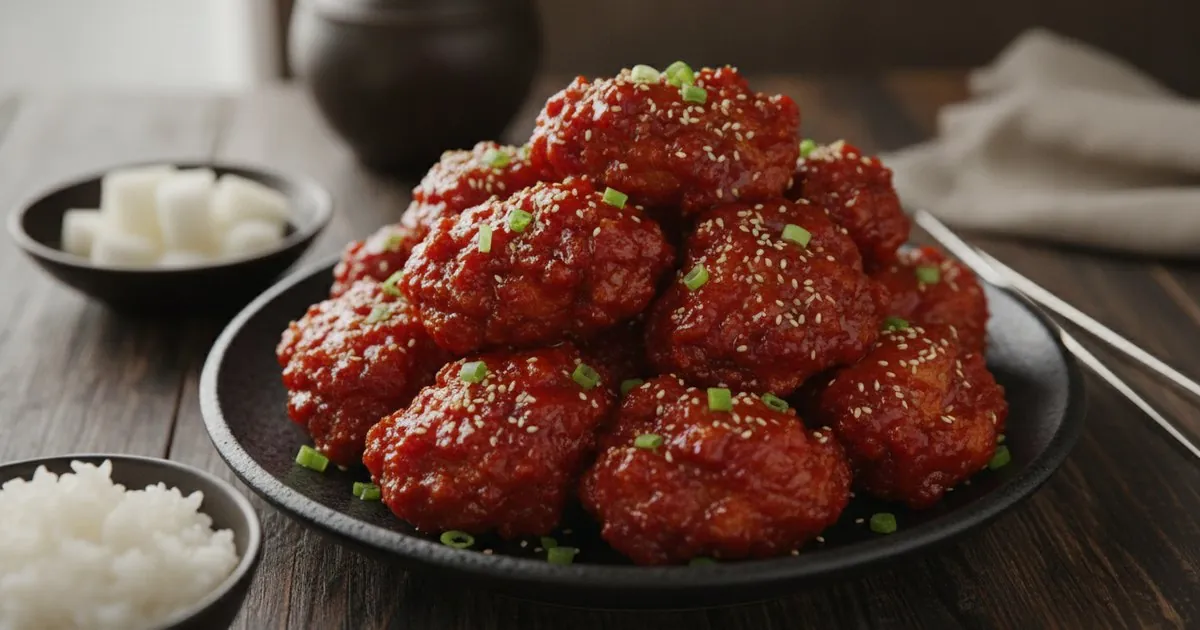
There is fried chicken, and then there is Korean fried chicken. The gap between them is not subtle. Where Southern American fried chicken is thick-battered, heavy, and rich, Korean fried chicken is extraordinarily thin-skinned, shatteringly crisp in a way that seems to defy the presence of oil, and glazed in a sauce that is at once sweet, spicy, tangy, and savory. It is, by almost any objective measure, the most technically accomplished fried chicken in the world — and once you understand why, you’ll never be satisfied with the ordinary kind again.
The secret, it turns out, is two fries.
What Is Korean Fried Chicken?
Korean fried chicken (KFC in Korea, though the locals call it chikin — 치킨 — or yangnyeom chicken when it’s glazed) is a style of fried chicken that emerged in South Korea in the 1970s and exploded into a full-fledged cultural phenomenon by the 1990s. It’s now one of South Korea’s most popular foods, consumed on television-watching nights, delivered in enormous quantities every weekend (South Korea has more fried chicken restaurants than McDonald’s worldwide, per capita), and paired almost universally with cold beer — a combination the Koreans lovingly call chimaek (치맥): chikin + maekju (beer).
There are several styles, but the most globally recognized is yangnyeom chicken (양념치킨) — pieces coated in a sticky, glossy sweet-and-spicy gochujang glaze. The name yangnyeom literally means “seasoned” or “marinated,” referring to the glaze that coats every piece in a lacquered, brilliant-red shell. It is outrageously good.
The Science of the Double Fry
The defining technique of Korean fried chicken is the double fry, and understanding it is the key to replicating the texture at home.
The first fry, done at a lower temperature (160°C / 320°F), cooks the chicken through. The meat reaches safe temperature, moisture is driven out from the interior, and the coating sets. But the coating at this stage is still somewhat soft — it hasn’t reached its full crispiness potential yet.
After the first fry, you rest the chicken for 5–10 minutes. During this time, residual steam continues to escape, and the thin coating firms up. This is essential. If you skip the rest and immediately go to the second fry, the steam trapped inside will make the coating soft.
The second fry, at high temperature (190°C / 375°F), is short — just 2–3 minutes. At this temperature, the exterior undergoes rapid Maillard browning and the remaining moisture in the coating evaporates explosively, creating a structure of tiny air pockets that snap when you bite through them. The result is a crust that is both thin and brutally crisp, without the thick, heavy batter you find in other traditions.
Why not just fry once at a high temperature? The outside would scorch before the inside was cooked through.
Potato Starch: The Korean Secret Ingredient
Most Western fried chicken recipes use all-purpose flour for the coating. Korean fried chicken almost universally uses potato starch (gamja jeonpun, 감자전분), or a blend of potato starch and flour.
Potato starch produces a different texture than flour. It creates a thinner, lighter, glassier coating that fries to a crystalline crispness. It also browns differently — more evenly, with fewer dark spots. And it holds its crunch longer after cooking, which is part of why Korean fried chicken can be delivered across the city and still arrive crispy.
If you can’t find potato starch, cornstarch is the closest substitute and produces excellent results. Tapioca starch also works. All-purpose flour alone will give you a thicker, heavier coating — still good, but not quite the Korean style.
Potato starch is widely available at Korean and Asian grocery stores and increasingly in mainstream grocery stores (often with the Asian ingredients or in the baking aisle). It’s inexpensive and lasts indefinitely in a cool, dry place.
The Yangnyeom Glaze: Breaking Down the Sauce
The yangnyeom glaze is a careful balance of several competing flavors:
Gochujang provides the base heat and fermented depth. It’s thick and sticky, making it ideal as a glaze ingredient.
Ketchup is a Korean fried chicken industry standard. Don’t skip it — its tomato sweetness, acidity, and body are essential to the right flavor profile. This is not a recipe where you substitute “higher quality” tomato products.
Honey or corn syrup provides sweetness and a glassy finish. Korean mulyeot (rice or corn syrup) gives the best gloss; honey gives a slightly floral note. Either is correct.
Soy sauce adds salt and umami.
Rice vinegar cuts through the sweetness and adds brightness.
Garlic and ginger are aromatics. They’re added raw to the sauce (which is cooked briefly), so they lose their harshness but retain their flavor.
The sauce should be made ahead and can be kept refrigerated for up to a week — the flavors develop as it sits, and having it already prepared removes one step from the final frying process.
For a deeper dive into the fermented pepper paste that forms this sauce’s backbone, see our complete gochujang guide.
Glazed vs. Soy-Garlic vs. Plain
Yangnyeom (glazed spicy) is the most famous style, but it’s not the only option in a Korean fried chicken restaurant:
Soy-garlic (간장 마늘): A sweet, garlicky, non-spicy glaze made with soy sauce, garlic, and sugar. Deeply savory, slightly less vibrant-looking but extraordinarily flavorful. The best choice for those who don’t eat spicy food.
Original (후라이드): No glaze at all — just the double-fried chicken with a light seasoning coating. This showcases the pure crunch of the double-fry technique. Dip in a side of sauce rather than tossing.
Half-and-half (반반): Ordering half original and half yangnyeom is extremely popular in Korea, allowing you to experience both styles in one order. At home, this is easy to replicate by dividing the batch.
Cheese: A recent trend, especially popular on food social media: pull the glazed chicken through a pool of melted mozzarella before eating. The cheese creates dramatic strings and softens the heat.
Connection to Korean Pop Culture
Korean fried chicken has become internationally famous partly through Korean pop culture — K-dramas frequently feature characters eating fried chicken delivery on the floor in front of the TV, and K-pop idols discussing their love of chimaek. If you’ve watched My Love From the Star, Reply 1994, or any of a dozen other popular Korean dramas, you’ve seen the ritual: big styrofoam containers of chicken, a cold can of beer or fizzy drink, and the unmistakable image of comfortable, unpretentious indulgence.
This cultural context is part of why Korean fried chicken traveled so quickly around the world when Korean Wave content began reaching global audiences in the 2010s. Viewers wanted to replicate not just the food but the feeling. For more on how Korean food connects to K-pop culture, see our guide on what BTS eats — chimaek is a recurring favorite across all seven members.
Setting Up Your Home Frying Station
Deep frying at home intimidates people, and that’s understandable — hot oil requires attention and respect. But with the right setup, it’s manageable and deeply worth the effort:
The pot: Use a deep, heavy pot — a Dutch oven is ideal. It should hold at least 4 inches of oil with at least 4 inches of clearance above the oil line (to prevent overflow if the oil bubbles up). Do not use a shallow pan.
The oil: Neutral oils with high smoke points are best — vegetable, canola, peanut, or refined coconut. Do not use olive oil or sesame oil for deep frying. You’ll need about 4 cups (950 ml) to achieve proper depth.
The thermometer: A clip-on candy/fry thermometer is essential. Oil temperature control is the difference between crispy and soggy. If you don’t have one, invest $15 — it changes your frying results immediately.
The rack: A wire cooling rack set over a sheet pan is critical. Do not rest fried chicken on paper towels — the steam gets trapped underneath and softens the bottom.
Oil disposal: Let used oil cool completely, then strain it through a fine mesh strainer. Store in an airtight container in the fridge. You can reuse frying oil 2–3 times. Dispose of old oil by pouring it into a sealed container and putting it in the trash — never down the drain.
Variations
Honey butter chicken: Toss with melted butter, honey, salt, and a pinch of garlic powder instead of the yangnyeom glaze. This was a viral sensation in Korea in 2014 and remains enormously popular.
Dakgangjeong (sweet crispy chicken): A similar concept but typically made with bite-sized boneless pieces and a glaze that’s heavier on the sweetness with less gochujang heat. Often garnished with peanuts.
Baked version: Spread coated chicken on a well-oiled rack and bake at 220°C (425°F) for 25–30 minutes, flipping halfway through. Spray with cooking spray before baking. The result is good but not identical — you’ll get crispiness without the characteristic lightness of the double-fried version.
Storage and Reheating
Korean fried chicken is best eaten immediately, but here’s how to handle it if you have leftovers:
- Refrigerate in an airtight container for up to 2 days.
- Reheat in an oven or air fryer at 200°C (400°F) for 8–10 minutes, turning once. This restores significant crispiness. Do not microwave — it will make the coating rubbery.
- The glaze: Glazed chicken softens faster than plain. If you want longer-lasting crispiness, serve the sauce on the side and dip rather than toss.
Common Mistakes to Avoid
Skipping the rest between the two fries. This is the single most common reason home cooks end up with soft Korean fried chicken. After the first fry, the coating is still holding trapped steam from the chicken’s interior — if you immediately plunge the pieces into the second fry, that steam never escapes and you bake softness into the crust. Rest the chicken on a wire rack (not paper towels, which trap steam underneath) for the full 5–10 minutes. You’ll see wisps of steam rising off the pieces — that’s exactly what needs to leave before the second fry.
Overcrowding the oil. Adding too many pieces at once drops the oil temperature sharply, and the coating absorbs oil instead of frying crisply. The water in the chicken can’t flash off fast enough, so the exterior becomes greasy and dense rather than glass-thin. Fry in batches small enough that the oil temperature recovers within about 30 seconds of adding the chicken. A thermometer is not optional here — it’s the only way to confirm both frying stages are at the right temperature (160°C for the first, 190°C for the second).
Second fry at the wrong temperature. Going too low on the second fry means you’re just reheating the chicken, not triggering the rapid moisture expulsion that creates the shattering crust. Going too high scorches the potato starch coating before the air-pocket structure can form. Hold at 190°C / 375°F firmly — this is the narrow band where the Maillard reaction and moisture flash happen simultaneously.
Tossing the chicken in sauce immediately out of the oil. The pieces are still releasing steam in the first minute out of the fryer. If you glaze them the instant they emerge, residual steam softens the coating from the inside out. Let the chicken rest on the rack for a full minute after the second fry, then toss in the yangnyeom sauce and serve immediately after glazing — the window between “sauced and crisp” and “sauced and soft” is short.
Substituting “better” tomatoes for the ketchup. The article notes this, but it bears repeating as a troubleshooting point: if your yangnyeom sauce tastes flat or too aggressively spicy, ketchup is likely missing or under-measured. Its acidity, residual sweetness, and starch body balance the gochujang and anchor the sauce’s glossy texture. Fresh tomato or tomato paste behave differently and throw off the consistency.
Sauce that’s too thick to coat evenly. If the glaze seizes up on the chicken in uneven clumps, it’s been over-reduced or the gochujang ratio is too high. Add a tablespoon of water and warm the sauce gently before tossing — it should coat the back of a spoon and flow slowly, not sit stiffly.
Frequently Asked Questions
What’s the best cut of chicken for Korean fried chicken? Wings are the most traditional — the ratio of crispy skin to meat is highest, and they cook evenly. Drumettes and flats are both excellent. Boneless thigh pieces (cut into chunks) are the choice for dakgangjeong-style. Bone-in thighs and drumsticks work but take longer to cook through; use a meat thermometer.
Can I make this without a deep fryer or thermometer? A thermometer really is important for this recipe — the double fry depends on specific temperature stages. If you don’t have one, a good heuristic: dip a wooden chopstick into the oil. If small steady bubbles form around it, the oil is around 160°C (320°F). If vigorous bubbles form, it’s around 190°C (375°F).
My coating is falling off during frying. What’s wrong? This usually means the chicken was too wet, or the coating wasn’t pressed on firmly enough. After brining, let excess liquid drip off but don’t pat dry. Press the starch coating onto the chicken firmly, then let the coated pieces rest on a rack for 5 minutes before frying. Also, do not move the chicken in the oil for the first 2–3 minutes — let the coating set before you agitate it.
Is there a gluten-free version? The potato starch coating is naturally gluten-free. Use tamari instead of soy sauce and a gluten-free gochujang (CJ’s Haechandle gochujang contains wheat; many other brands are gluten-free — always check). The ketchup should be gluten-free (most major brands are). With these substitutions, this recipe is fully gluten-free.
Where can I order Korean fried chicken in the US if I want to try it before making it? Korean fried chicken chains have expanded significantly in the US. Bonchon, bb.q Chicken, Kyochon, and Two Two Chicken all have US locations. Many Korean-American neighborhoods have independent Korean fried chicken restaurants that are equally good. Delivery apps in cities with Korean communities (LA, NYC, Chicago, Houston, Atlanta) will surface many options.
How spicy is the yangnyeom glaze? At the proportions in this recipe, it’s a medium heat — clearly spicy, with a slow build, but not overwhelming for most adults. The sugar and ketchup temper the gochujang significantly. For a milder version, use 2 tablespoons of gochujang instead of 3 and increase the honey by 1 tablespoon. For maximum heat, increase gochugaru (red pepper flakes) to taste.