
There’s no celebrity group on the planet that has done more for Korean food than BTS (방탄소년단). Across thousands of hours of reality content, VLive streams, in-ear camera footage, and variety show appearances, these seven men have eaten their way into the hearts of millions of fans who now know what samgyeopsal tastes like, how to pick the right ramyeon noodles, and why Korean fried chicken deserves its own global holiday.
This is the definitive deep-dive into what every BTS member eats — the dishes they keep coming back to, the flavors that remind them of home, and the Korean food moments that sent fans straight to their nearest H-Mart.
Why BTS and Food Go Together
Before the individual members, it’s worth understanding why BTS food content hits differently. Korean food culture is fundamentally social — you eat together, you share from the same plates, you grill together at the table. BTS’s group dynamic mirrors that perfectly. Their most beloved eating moments aren’t individual — they’re group dinners at a Korean BBQ restaurant, arguments over who gets the last piece of galbi, and competitions to see who can finish their ramyeon first.
The BTS effect on Korean food exports is well-documented. When members mention a dish, it sells out. When they eat at a restaurant, the line wraps around the block for weeks. The Korean food industry even coined the term “BTS effect” to describe how dramatically their endorsements — intentional or accidental — can spike sales.
But beyond hype, the reason fans actually cook these recipes is simpler: the food looks genuinely delicious, eaten with genuine joy. There’s no performance in how BTS eats. They eat because they’re hungry and they love the food.
The Universal: Korean BBQ Brings Everyone Together
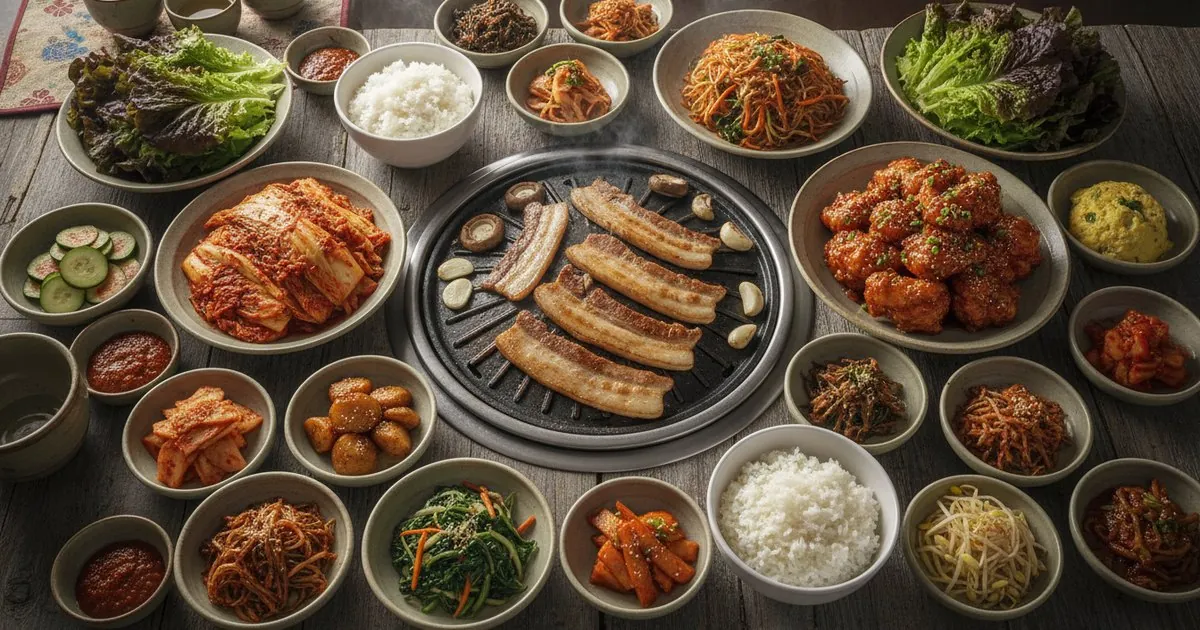
If there’s one dish that unites every single BTS member, it’s samgyeopsal (삼겹살) — grilled pork belly. In dozens of filmed group meals, whenever the choice is left open, Korean BBQ almost always wins. And within Korean BBQ, samgyeopsal is the democratic choice: it’s affordable, it’s social, and it’s absurdly delicious.
The experience of eating samgyeopsal is the point. A tabletop grill goes in the center, sliced pork belly hits the hot grate, the fat renders and crisps, and then you wrap a piece in fresh perilla or lettuce with a dab of ssamjang (spicy fermented paste), a sliver of raw garlic, and maybe a bit of kimchi. Every bite is a construction project. It’s communal, it’s tactile, and it rewards attention.
Want to try it yourself? Our guide to Korean BBQ at home walks you through everything — grill setup, banchan pairings, and the right way to wrap your ssam.
Now, on to the individuals.
Jin (김석진) — Korean Fried Chicken and Galbijjim
Jin is the member most associated with food as a personality trait. He co-owns a restaurant in Seoul, he’s documented his cooking across years of content, and he eats with an almost theatrical enthusiasm that’s made him the group’s de facto food personality.
Korean Fried Chicken (치킨)
Jin’s love for Korean fried chicken is the stuff of legend. Korean fried chicken — “chimaek” when paired with beer, or just “chicken” in Korean shorthand — is a category unto itself. Double-fried for maximum crunch, it comes in a dizzying range of sauces: sweet soy garlic, spicy yangnyeom, honey butter, soy cream. The skin is thin and crackly in a way that puts American fried chicken to shame, and the meat stays juicy because of the double-fry technique.
Jin has been filmed ordering chicken countless times, and his enthusiasm for it is palpable. It’s a late-night food, a celebratory food, a “we just finished a tour leg” food. In Korea, chicken delivery is a cultural institution — the kind of thing you call in when you want to celebrate something or decompress from something.
Check out our step-by-step Korean fried chicken recipe to make the double-fry version at home.
Galbijjim (갈비찜) — Braised Short Ribs
If Korean fried chicken is Jin’s everyday love, galbijjim is his special-occasion one. Braised beef short ribs, slow-cooked until the collagen breaks down and the meat slides off the bone, in a sauce built from soy sauce, sugar, garlic, Asian pear, and sesame oil — this is Korean home cooking at its most celebratory.
Galbijjim is the dish Korean parents make when their kids come home. It takes hours and it’s worth every minute. Jin has mentioned it as one of his favorites, and it tracks: he’s the member most likely to appreciate dishes that reward patience and technique.
RM (김남준) — The Thoughtful, Adventurous Eater
RM approaches food the way he approaches everything — with intellectual curiosity and genuine appreciation for craft. He’s the member most likely to seek out a specific regional dish in a new city, to ask the chef about the ingredients, to remember exactly where he ate something years later.
Samgyeopsal is a reliable favorite for RM — he’s been filmed at Korean BBQ more times than is worth counting. But what distinguishes his eating is range. He’s shown appreciation for traditional banchan (side dishes) served in Korean home cooking, the small plates of kimchi, namul (seasoned vegetables), and pickled vegetables that frame a Korean meal. Most international fans focus on the main dishes, but RM gets that the banchan are often where the real flavor complexity lives.
He’s also an enthusiastic eater of seasonal Korean produce — the kind of eating that follows the agricultural calendar, with different vegetables and preparations marking different times of year.
Suga (민윤기) — Jjajangmyeon and Serious Meat
Suga is from Daegu, a city in the southeast of Korea with a legendary food culture. Daegu people have strong opinions about food, and Suga is no exception.
Jjajangmyeon (짜장면) — Black Bean Noodles
Jjajangmyeon is Korea’s most beloved delivery food — a dish of Chinese-Korean origin featuring thick, chewy wheat noodles topped with a rich, dark sauce made from chunjang (fermented black bean paste), pork, and onions. It’s not the kind of thing you make at home; it’s the kind of thing you order when you’re too tired to do anything else, when you’ve just moved into a new apartment, when you’re hungover.
Suga has mentioned jjajangmyeon as a favorite multiple times. It’s a comfort food with strong nostalgic associations for most Koreans, and Suga’s food preferences generally lean toward deeply flavorful, substantial dishes.
Galbi (갈비) — Short Ribs
Multiple members have confirmed that Suga is the most passionate meat eater in BTS. Galbi — grilled short ribs, either on the bone or boneless — is his go-to at Korean BBQ. Where samgyeopsal is the democratic crowd-pleaser, galbi is the premium order, marinated overnight in soy sauce, garlic, Asian pear or kiwi (for tenderizing), and sesame oil before hitting the grill.
J-Hope (정호석) — Kimchi and Chicken
J-Hope is the member most likely to eat anything with visible joy, which makes his food content particularly fun to watch. His genuine enthusiasm extends to both Korean staples and international food, though he always comes back to Korean fundamentals.
Kimchi (김치) — The Foundation
J-Hope has been vocal about his love for well-fermented kimchi — the kind that’s been aging long enough to develop a deep sourness that goes well beyond fresh kimchi’s simpler heat. This is not the subtle appreciation of someone who tolerates kimchi for cultural reasons. He actually loves the taste of kimchi, especially the funkier, more developed versions.
Kimchi appreciation at that level is a marker of someone who grew up eating it seriously. Fresh kimchi is easier to love; aged kimchi rewards experience.
Dakgalbi (닭갈비) — Spicy Stir-Fried Chicken
Dakgalbi is a stir-fried chicken dish cooked in a spicy gochujang-based sauce with cabbage, sweet potato, scallions, and tteok (rice cakes). It originates from Chuncheon, in Gangwon Province — not J-Hope’s hometown, but a dish he’s returned to repeatedly. It’s interactive (you cook it at the table in a cast-iron skillet), it’s spicy, and it’s deeply satisfying in the way that slightly-charred, sauce-coated chicken always is.
Jimin (박지민) — Kimchi Fried Rice and Japchae
From Busan, Korea’s great port city, Jimin brings a coastal sensibility to his eating — appreciation for seafood, comfort in simple preparations, and a connection to regional Korean flavors that run deeper than Seoul’s cosmopolitan food scene.
Kimchi Fried Rice (김치볶음밥)
Kimchi fried rice is the dish you make when you have leftover rice and well-fermented kimchi and you want something that takes ten minutes and tastes like you spent an hour. It’s one of Korea’s great weeknight meals — tangy from the kimchi, rich from the butter or sesame oil, savory from the soy sauce, and completed by a fried egg on top with a runny yolk that becomes the sauce when you break it.
Jimin’s association with kimchi fried rice fits his general food character: he prefers foods that are straightforward in preparation but big in flavor, that don’t perform complexity for its own sake. It’s real food.
Make it at home with our kimchi fried rice recipe — takes about 15 minutes and uses kimchi you probably already have.
Japchae (잡채) — Glass Noodles with Vegetables
Japchae is the elegant cousin at every Korean family gathering — glass noodles made from sweet potato starch, stir-fried with a rainbow of vegetables (spinach, carrots, mushrooms, bell pepper) and often beef, seasoned with soy sauce and sesame oil. It’s slightly sweet, deeply savory, and has a texture — slippery, springy noodles — unlike anything in Western cooking.
Jimin has shown consistent appreciation for japchae, which appears at virtually every Korean celebration meal. It’s the kind of dish that encodes memory: eat it enough times at holidays and birthdays and it becomes inseparable from those feelings.
Check out our full japchae recipe for the traditional preparation.
V (김태형) — Japchae and Korean Wagyu
V (Taehyung) has the most premium food taste in the group, and he’s unapologetic about it. His food content often features high-end Korean BBQ restaurants serving Hanwoo beef — Korea’s prized domestic cattle that produces marbling comparable to Japanese wagyu. When V eats Korean BBQ, he’s eating the good stuff.
Hanwoo Beef — The Best Korean BBQ
Hanwoo beef is expensive, beautifully marbled, and intensely flavorful. At a premium Korean BBQ restaurant, cuts like chadolbaegi (thinly sliced beef brisket) and woo samgyup (thinly sliced beef belly) are grilled tableside and eaten within seconds of coming off the heat. V has mentioned Hanwoo as his favorite food, which is both very Korean and very understandable once you’ve had it.
The difference between supermarket beef and quality Hanwoo at a Korean BBQ restaurant is not subtle. It’s the difference between fine wine and table wine — same category, different universe.
Japchae — V and Jimin’s Shared Love
Like Jimin, V has a documented love for japchae. Two members independently favoring the same dish says something about japchae’s appeal — it hits multiple flavor notes simultaneously (sweet, savory, umami), and the texture is uniquely satisfying. For V, who tends toward richer, more luxurious flavors, japchae’s glossy, richly seasoned noodles fit the pattern.
Jungkook (전정국) — Samgyeopsal, Buldak Ramen, and Banana Milk
Jungkook has the most extensively documented eating habits in BTS, thanks to his regular cooking and eating livestreams where he literally prepares food on camera and eats it while talking to fans. He’s turned mundane acts — making ramyeon at 2 AM, grilling samgyeopsal, opening a banana milk — into content that millions of people watch with genuine enjoyment.
Samgyeopsal — His First Love
Jungkook’s relationship with samgyeopsal is perhaps the most documented food relationship in K-pop. He’s been filmed eating it more than any other member, in more contexts, across more years of content. It’s his comfort food, his celebration food, his “I’m hungry after the gym” food.
The social aspect matters for Jungkook. He’s the member who most visibly enjoys sharing food, who gets genuine pleasure from cooking for others and watching them eat. Samgyeopsal is perfect for that — the tabletop grill means everyone participates, everyone gets equal access, and the act of eating together is the whole point.
Buldak Ramen — The Viral Heat Challenge
Jungkook’s connection to Buldak Ramen (Fire Noodles, 불닭볶음면) is now internet canon. The neon-red packaging, the two-step cook, the moment of tasting the most aggressively spicy instant noodle Korea has ever produced — it’s become shorthand for Korean food bravado.
But Jungkook doesn’t eat Buldak for the performance of suffering through it. He actually likes it. His version — sometimes mixing different Buldak flavors, always adding extras — is the launch point for our Jungkook’s Bulgeuri Ramen recipe, which covers the exact two-packet mix (Buldak + Neoguri) that he made famous.
Banana Milk (바나나 우유)
No list of Jungkook food moments is complete without Binggrae Banana Milk — the iconic barrel-shaped bottle of banana-flavored milk that has been a Korean convenience store staple since 1974. Jungkook’s love for it is entirely genuine and exactly the kind of endearing, specific detail that ARMY latches onto.
After his banana milk association became well-known, sales reportedly surged in markets popular with Korean tourists. This is the BTS effect in its purest form: a specific, unglamorous, affordable product that a member genuinely loves, suddenly becoming a cultural touchstone for millions of fans.
Korean Foods BTS Has Made Globally Famous
Beyond the members’ individual favorites, certain dishes gained significant international visibility through BTS content over the years:
Korean Convenience Store Culture — Multiple Run BTS! episodes and individual vlogs have shown the members navigating Korean convenience stores (CU, GS25, 7-Eleven Korea), introducing international fans to triangle kimbap, ramen cups, hot bar items, and the peculiar midnight joy of eating a corn dog outside a convenience store at 2 AM.
Chimaek (치맥) — Chicken and beer, Korea’s sacred pairing. J-Hope’s preference for Sprite over beer has generated years of debate, but the chicken half of the equation has introduced millions to Korean fried chicken’s superior crunch.
Mukbang culture — BTS’s eating content normalized the mukbang format for international audiences years before it became a global media category. Watching people eat enthusiastically while talking to a camera felt alien to non-Korean audiences until BTS made it look like the most natural thing in the world.
Start Cooking
The best way to understand why BTS loves these foods is to make them yourself. Some easy starting points:
- Korean BBQ at home — Samgyeopsal for the whole group
- Japchae — The glass noodle dish both V and Jimin love
- Korean fried chicken — Jin’s ultimate comfort food
- Kimchi fried rice — Jimin’s ten-minute weeknight meal
- Jungkook’s Bulgeuri Ramen — The famous two-packet mix
Korean food is built for exactly this — sharing it, talking about it, cooking it together. Whether you’re a longtime ARMY or someone who just stumbled onto BTS content and found yourself suddenly craving samgyeopsal, the door is open.
Common Misconceptions
Korean fried chicken is basically the same as American fried chicken. Western readers often assume fried chicken is fried chicken, but the Korean version is a genuinely different category. The double-fry technique produces a dramatically thinner, crispier crust that stays crunchy long after delivery — nothing like the thick, soggy batter on reheated American fast food. The sauces (sweet soy garlic, spicy yangnyeom, honey butter) are flavor profiles developed specifically for this dish, not afterthoughts.
Jjajangmyeon is Chinese food. It isn’t, exactly. Jjajangmyeon evolved from Chinese zhajiangmian through Chinese immigrant communities in Incheon in the early 20th century, but it developed into something categorically distinct — sweeter, milder, and built around a specific Korean-processed black bean paste called chunjang. Modern jjajangmyeon belongs to Korean-Chinese cuisine (jungang yori), a hybrid culinary tradition with its own identity. Ordering it expecting Chinese flavors will surprise you.
Samgyeopsal is just Korean bacon. Both come from pork belly, but samgyeopsal is fresh and entirely uncured — no salt cure, no smoke, no preservatives. The resemblance to bacon ends at the cut. Samgyeopsal is grilled live at the table, portioned with scissors while cooking, and assembled into wraps with condiments chosen bite by bite. The eating experience is communal and interactive in a way that has nothing in common with a strip of breakfast meat.
BTS’s food moments are coordinated marketing. Many of the viral food events that drive the so-called BTS effect — the dishes that sell out after appearing in content — come from unscripted reality shows, VLive streams, and behind-the-scenes footage rather than formal brand partnerships. Members eating ramyeon after rehearsal or debating who gets the last piece of galbi at a group dinner are not advertisements. The organic quality of those moments is precisely why fans trust them and why the downstream impact on sales can be so pronounced.
Banchan are Korean appetizers, meant to be eaten before the main dish. Western dining habits treat side dishes as a pre-meal course to be cleared, but banchan are designed to be eaten in active combination with every bite of the meal. The logic is balance and contrast — a sharp bite of kimchi alongside grilled pork, a cooling spoonful of seasoned spinach with rice. Eating them first and pushing the plates aside discards the entire flavor architecture of a Korean table. RM’s appreciation for banchan, noted in the article, reflects exactly this — understanding that the small plates are often where the real complexity lives.
Frequently Asked Questions
What is BTS’s most-eaten food on camera? Samgyeopsal (Korean grilled pork belly) appears most frequently across all members’ content. It’s the dish they return to for group meals, celebrations, and casual dinners alike. Korean BBQ is fundamentally a social eating format, which suits BTS’s group dynamic perfectly.
Does Jungkook really drink banana milk that much? Yes — his love for Binggrae Banana Milk is genuine and well-documented across years of VLives and variety appearances. It’s not a promotional association; it predates any formal brand relationship and has become one of his most recognizable personal quirks.
What is “chimaek” and why does BTS eat it? Chimaek (치맥) is the combination of Korean fried chicken (치킨, chicken) and beer (맥주, maekju). It’s a beloved Korean evening ritual — you order chicken delivery, open some beer, and eat together while watching TV or talking. J-Hope famously prefers Sprite over beer, making “chickenSprite” a beloved fan meme.
What is Jungkook’s Bulgeuri Ramen exactly? It’s a mix of two instant noodle packets — Buldak Ramen (the extremely spicy fire noodles) and Neoguri (a milder, seafood-flavored ramyeon) — cooked together and combined. The Neoguri cuts the brutal heat of Buldak into something more manageable and adds a savory seafood depth. See our full recipe at Jungkook’s Bulgeuri Ramen.
Is Korean BBQ actually what they eat, or is it a TV thing? Korean BBQ is legitimately one of the most popular dining formats in Korea across all demographics. It’s not a performance for camera — it’s genuinely what Koreans eat for group dinners. BTS filming themselves doing Korean BBQ is the equivalent of Americans filming themselves at a backyard barbecue. It’s just what you do.
How can I eat like BTS at home without a Korean grocery store nearby? Start with dishes that use pantry staples you can order online: gochujang paste, doenjang (fermented soybean paste), sesame oil, and soy sauce are the foundation of most Korean cooking and are available on Amazon or international grocery delivery services. From there, kimchi fried rice and instant ramen variations are the most accessible entry points.