
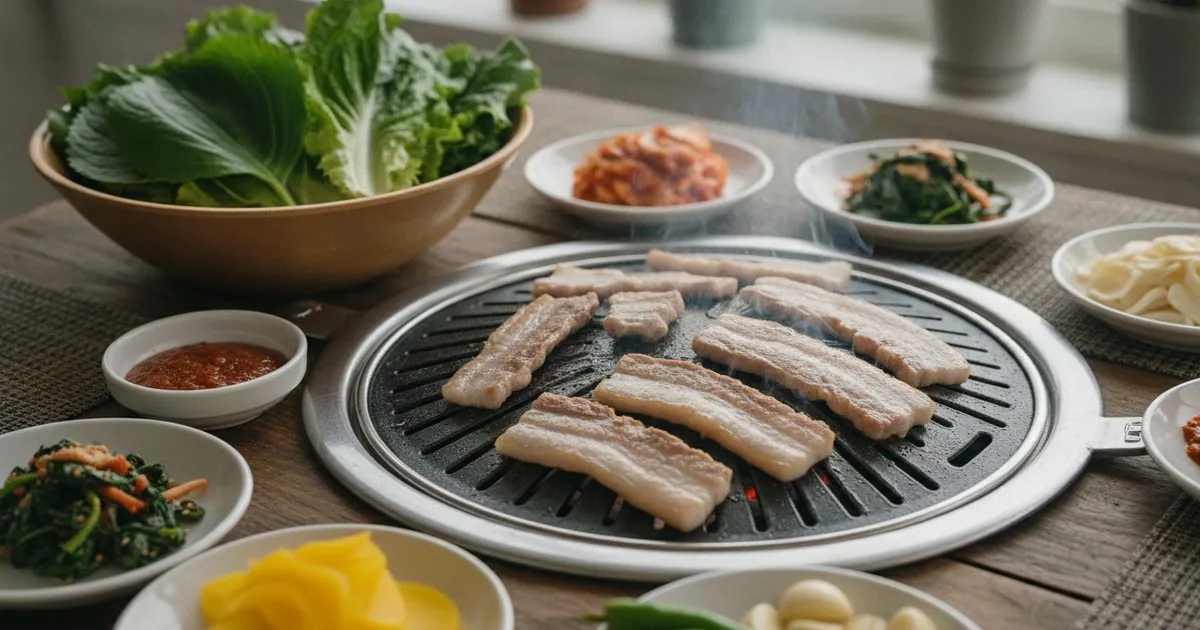
Imagine a meal where the cooking happens at the table, the food keeps arriving in waves, conversation pauses only long enough to fold a lettuce leaf into a perfect bundle and pop it whole into your mouth. Imagine thin slices of pork belly crisping over live heat, the fat rendering into something amber and translucent, the edges catching a char that perfumes the entire room. Imagine a dozen small dishes surrounding the grill — fermented cabbage, garlicky spinach, sesame-glossed bean sprouts, a thick dark paste that smells of the sea and the earth — all of it converging in the two seconds between picking up a leaf and biting through it.
This is samgyeopsal (삼겹살): Korean pork belly BBQ. And it is one of the most joyful ways to eat on earth.
It is also, happily, one of the most accessible Korean dishes to make at home. Unlike some Korean foods that require deep pantry infrastructure and years of technique, samgyeopsal is essentially grilled pork belly. The elevation comes from the ritual: the accompaniments, the communal preparation, the folding, the sharing. This guide gives you everything you need to recreate the full Korean BBQ restaurant experience in your own kitchen or on your backyard grill.
What Is Samgyeopsal?
Samgyeopsal (삼겹살) literally translates as “three-layer meat” — a reference to the three visible layers of fat and muscle in a cross-section of pork belly. It is uncured, unmarinated, unseasoned pork belly, grilled over high heat at the table and eaten wrapped in lettuce leaves with a pungent fermented dipping paste called ssamjang.
The simplicity is not a limitation — it’s the point. Korean BBQ philosophy trusts the quality of the ingredient. Pork belly is fatty enough to baste itself as it cooks, rich enough to stand up to the intensity of kimchi and raw garlic without being overwhelmed, and forgiving enough that even imperfect cooking produces something delicious.
Samgyeopsal vs. Bulgogi vs. Galbi: Korean BBQ encompasses many cuts and preparations. Bulgogi (불고기) is thin-sliced marinated beef, typically sirloin or ribeye. Galbi (갈비) is marinated beef short ribs. Samgyeopsal is unmarinated pork belly. Chadolbaegi (차돌박이) is thinly shaved beef brisket. All are eaten in the same way — grilled at the table and wrapped in leaves — but samgyeopsal is the most casual, the most everyday, and arguably the most beloved.
Why Samgyeopsal Is Perfect for Home Cooking
At a Korean BBQ restaurant, the grill is built into the table, ventilation fans descend from the ceiling, and the server may rotate the grill grate every 20 minutes for hygiene. The experience is optimized for ease and pleasure.
At home, you don’t have a table grill or a ventilation system. But you do have:
- A grill pan, cast iron skillet, or outdoor grill
- Kitchen scissors (non-negotiable — the scissor step is both traditional and genuinely useful)
- An exhaust fan, or the willingness to open windows
The one thing you genuinely cannot replicate at home is the restaurant’s live charcoal grill (most upscale Korean BBQ places use charcoal; casual ones use gas). But a screaming-hot cast iron pan produces excellent results — perhaps not identical, but deeply satisfying.
Ventilation is the main practical challenge. Pork belly renders a lot of fat, and that fat creates smoke. Run your exhaust fan on high. Open a window. An outdoor grill eliminates this problem entirely and gives you the bonus of real char flavor.
The Equipment: Tabletop Grills
If you want the authentic table-grilling experience at home, you have options:
Gas tabletop grill (butane): A portable butane stove with a round grill plate sits on your dining table and is the closest replication of the restaurant experience. These are inexpensive (under $40 for a basic setup) and widely available at Korean grocery stores and Amazon. The butane canisters cost about $1–2 each and one lasts for a full dinner. This is the setup most Korean home cooks use for BBQ nights.
Electric tabletop grill: Less authentic but easier to control and produces less smoke. Works well for indoor use. Popular in apartment settings.
Portable induction burner + cast iron pan: Put a portable induction burner on your table with a cast iron skillet or grill pan. Less authentic-looking but very functional.
Outdoor gas or charcoal grill: The best for smoke, char flavor, and ventilation. Use a grill basket or cast iron grate to prevent smaller pieces falling through.
The Pork: Shopping and Preparation
What to look for: Pork belly sold for Korean BBQ is sliced thicker than bacon — about 1 cm (⅜ inch) is ideal. Too thin and the pieces curl and burn before rendering properly. Too thick and the fat won’t render fully in the time the outside takes to brown.
Korean grocery stores (H Mart, Zion Market, Galleria Market, and many independent Korean supermarkets) sell pork belly pre-sliced for samgyeopsal, usually in 1–2 lb packages in the refrigerated meat section. This is the easiest option.
At mainstream Western grocery stores, pork belly is often sold as a whole slab. Ask the butcher counter to slice it for you — most will do this at no charge. Alternatively, slice it yourself with a sharp knife (freeze for 30 minutes first to firm it up).
Skin-on vs. skinless: Traditional samgyeopsal in Korea is skin-on. The skin renders into something chewy and fatty that has devoted fans. Most Western grocery store pork belly is skin-on. Korean grocery stores often sell both. If you’re new to this dish, skinless is easier for a first try; the skin can take longer to chew through and the texture surprise can be off-putting if you’re not expecting it.
Quantity: Koreans eat a lot of samgyeopsal. Plan for 200–250g (7–9 oz) of raw pork per person as a main dish alongside banchan and rice.
Ssamjang: The Indispensable Dipping Paste
Ssamjang (쌈장) is the soul of the Korean BBQ table. It is a thick, deeply savory, pungent paste made primarily from doenjang (된장, Korean fermented soybean paste) cut with gochujang, sesame oil, garlic, and aromatics.
Doenjang is similar in concept to Japanese miso — both are made from fermented soybeans — but it is significantly stronger, more pungent, and earthier. The fermentation time is longer, the flavor is more assertive, and it occupies a central role in Korean cooking in a way that miso doesn’t in Japanese cuisine. If you haven’t cooked with doenjang before, ssamjang is an excellent introduction: the other ingredients temper its intensity into something balanced and completely addictive.
You can buy premade ssamjang at Korean grocery stores (it comes in a green container, typically). The commercial version is good and is what most Korean BBQ restaurants in Korea use. Making your own takes five minutes and tastes even better because you can calibrate to your taste.
The garlic and chili: When building your ssam, you add a thin slice of raw garlic directly onto the pork. For Western palates encountering this for the first time, raw garlic can seem aggressive. In the context of the full ssam — with the rich pork, the fermenting kimchi, the mellow ssamjang — it works. Start with half a slice if you’re unsure and build from there.
The fresh green chili (cheongyang gochu, 청양고추, in Korea) adds a sharp, clean heat. In the West, substitute with thinly sliced jalapeño or serrano. It’s optional, but the fresh heat is a different character than the fermented heat of the ssamjang, and the contrast is excellent.
The Art of Wrapping Ssam
Ssam (쌈) means “wrap,” and the verb ssamda (쌈다) means “to wrap” — the act of gathering multiple elements into a single, coherent mouthful is so culinarily important in Korea that it has its own dedicated vocabulary.
The canonical ssam for samgyeopsal:
- Hold a lettuce leaf (or perilla leaf) in your non-dominant hand, cupped like a bowl.
- Add a small scoop of rice — about one tablespoon. Don’t overfill; you need room.
- Lay one or two pieces of grilled pork on the rice.
- Add a small smear of ssamjang — about half a teaspoon.
- Add one thin slice of raw garlic and a sliver of green chili.
- Add a small pinch of kimchi.
- Fold the sides of the leaf in, then fold the bottom up, creating a packet.
- Eat the whole thing in one bite. This is not optional — the rule exists because the whole ssam is calibrated to be one perfect mouthful.
Perilla leaves (kkaennip, 깻잎) — large, flat, slightly anise-scented leaves — are often used alongside or instead of lettuce. Their flavor is distinctive and more assertive than lettuce, adding an herbal note that pairs beautifully with pork. They’re available at Korean grocery stores and some Asian markets.
Banchan: The Supporting Cast
The small side dishes (banchan, 반찬) that surround the grill are not optional garnishes — they’re integral to the meal. A good Korean BBQ at home should have at least four or five:
Kimchi (필수, essential): The fermented, spicy cabbage is the cornerstone. Older, more fermented kimchi (“ripe” kimchi) is preferred for BBQ nights — its tanginess cuts through the rich pork fat.
Bean sprout namul (콩나물 무침): Blanched bean sprouts seasoned with sesame oil and garlic. Clean, crunchy, cooling.
Spinach namul (시금치 나물): Blanched spinach with soy sauce, sesame oil, and garlic. Earthy and savory.
Pickled radish (치킨무): The white, vinegar-pickled daikon cubes that show up at Korean fried chicken restaurants also appear at Korean BBQ. They’re sweet, sour, and refreshing — essential palate cleansers between bites.
Doenjang jjigae (된장찌개, soybean paste stew): Many Korean BBQ meals include a small pot of doenjang stew with tofu and vegetables. The hot, deeply savory stew provides contrast to the grilled meat and is eaten with spoons between bites of ssam. It’s optional for a simplified home setup but makes the meal feel more complete.
Samgyeopsal in Korean Culture
Samgyeopsal is one of the most culturally loaded foods in South Korea. The “samgyeopsal day” — the third day of the third month (3/3, March 3) — is an unofficial national holiday, a day when Koreans eat pork belly to mark the occasion (the wordplay: sam sounds like the Korean word for 3, gyeop relates to layers). Pork belly consumption spikes measurably on this day.
The dish has been embraced enthusiastically across all demographics, but its association with relaxed, unpretentious social eating makes it especially beloved by younger generations. BBQ nights with friends are a central social institution — the combination of shared cooking, the intimacy of sitting close around a small table, the passing of food across a grill, and the inevitable beer or soju that accompanies the meal creates a particular kind of social warmth that’s genuinely hard to replicate with any other food format.
Samgyeopsal is named as a favorite meal by fans across the full spectrum of Korean entertainment culture. In interviews, BTS members have repeatedly cited samgyeopsal nights as their preferred form of group bonding — the entire act of grilling together and sharing the wraps is noted as a ritual of connection. For more on Korean food and its relationship to K-culture, see our guide to what BTS eats.
Maekju (Beer) and Soju: Drink Pairings
Korean BBQ is almost always eaten with drinks, and the canonical choice is chimaek — specifically maekju (Korean lager-style beer) or soju, or the devastating combination of the two mixed together as a somaek (소맥).
Korean beer styles (Kloud, Terra, Hite, Cass) are clean, light, and low-bitterness — designed to not compete with food flavor, which makes them perfect with the bold, funky tastes of Korean BBQ.
Soju (소주) is a clear, slightly sweet spirit typically around 16–25% ABV. It’s served ice-cold in small glasses. The etiquette: you don’t pour for yourself, only for others, and you receive pours with two hands. The ritual is part of the pleasure.
For non-drinkers: sikhye (식혜, sweet rice punch) or oksusu cha (corn tea) are traditional non-alcoholic companions. A cold glass of either is genuinely refreshing with grilled pork.
For the gochujang element that appears throughout a Korean BBQ spread — from the ssamjang to any spicy banchan — our gochujang guide covers everything you need to know about buying, storing, and using this essential Korean ingredient.
Tips for a Successful Korean BBQ Night at Home
Mise en place: Have every banchan, the ssamjang, the rice, and the washing greens all set up before you light the grill. Once grilling starts, you won’t want to leave the table.
Grill in small batches: Don’t pile all the pork on the grill at once. Render 4–5 pieces, cut and distribute them, then grill the next batch while people are eating and building their ssam. This keeps the food hot and the meal paced like a restaurant.
Replace the grill grate. At Korean BBQ restaurants, the grill grate is replaced partway through the meal because the rendered fat gets dark and imparts off-flavors. At home, wipe out the pan between batches with a folded paper towel held with tongs.
The scissors are essential. A pair of dedicated kitchen scissors stationed at the grill is non-negotiable. Scissors cut through the pork cleanly without pressing the fat out (as a knife would) and are infinitely faster for table-side cutting. Many Korean households have a pair of scissors reserved exclusively for food use.
Set the temperature high. Korean BBQ is high-heat cooking. You want to render the fat quickly and get caramelization and char in the few minutes the outside is cooking. A medium-heat pan will give you gray, unappetizing pork.
Storage and Notes on Leftovers
Unlike most leftovers, cold grilled pork belly is actually excellent:
- Refrigerate leftover cooked pork belly in an airtight container for up to 3 days.
- Reheat in a hot dry skillet for 1–2 minutes per side — this re-crisps the exterior significantly.
- Use in fried rice: Chop leftover samgyeopsal into small pieces and use in kimchi fried rice (kimchi bokkeumbap). This is an excellent use of leftovers and arguably better than the original meal.
- Ssamjang: Keeps refrigerated for up to 2 weeks. Use it as a dip for vegetables, a spread for sandwiches, or a seasoning paste for soups.
Common Mistakes to Avoid
Starting with a pan that isn’t hot enough. Samgyeopsal needs ferocious heat from the first contact. If your cast iron or grill plate isn’t screaming hot before the pork goes on, the fat begins to melt and pool instead of render crisp — the slices end up braising in their own grease rather than searing. Preheat your pan for at least 3–4 minutes over high heat until a drop of water vaporizes on contact instantly. The first sizzle when pork hits the surface should be loud and immediate.
Slicing the belly too thin. The 1 cm (⅜ inch) thickness isn’t arbitrary. Thinner slices curl and char at the edges before the interior fat has time to render, leaving you with chewy, greasy ribbons rather than the amber, crisp-edged result you’re after. If your pre-sliced package looks more like thick-cut bacon than a proper slab, ask the butcher to cut thicker — or do it yourself after a 30-minute freeze to firm the meat enough for clean cuts.
Overcrowding the cooking surface. Piling the slices on top of or right against each other drops the surface temperature and traps steam. Work in batches that give each piece at least a centimeter of clearance. Yes, this means the first round is done before you’ve cooked everything — that’s fine; the scissors-and-rest period while the second batch cooks keeps the first batch from getting cold if you keep it moving to a warm corner of the plate.
Not draining pooled fat mid-cook. Pork belly renders a significant amount of liquid fat onto the grill surface. Once it starts pooling, the meat is frying in deep fat rather than grilling — the texture turns soft and oily instead of crisp. Tilt the grill plate or use a folded paper towel held with tongs to blot excess fat every few minutes. At a restaurant the server does this automatically; at home it’s the cook’s job.
Cutting with scissors too early. The scissor step happens after the initial sear has set a crust, not before you’ve put the meat on. Cutting raw or barely-cooked pork belly into pieces causes them to lose their shape on the grill and fall apart. Let each slice cook until the fat is mostly rendered and the underside is golden — usually 3–4 minutes — then flip, let the second side color, and cut into bite-sized pieces in the final 60–90 seconds.
Forgetting to season the pork as it finishes. Samgyeopsal is unmarinated, but that doesn’t mean it goes unseasoned at the table. A light pinch of coarse salt and a dip of sesame oil with black pepper (chamgireum-sogeum, 참기름소금) applied to the finished pieces just before wrapping is traditional and transforms the flavor. Relying entirely on ssamjang for all the salt means under-seasoned pork that the paste overwhelms rather than complements.
Frequently Asked Questions
Can I use bacon instead of pork belly? In a pinch, thick-cut bacon is a reasonable substitute. The texture and fat distribution are similar. However, bacon is cured and typically smoked, which changes the flavor significantly — it will taste more like a Western-style dish. If you want the authentic samgyeopsal experience, seek out actual pork belly.
Do I have to marinate the pork? No, and for samgyeopsal, you shouldn’t. The whole point of samgyeopsal versus marinated cuts like bulgogi is the simplicity of unseasoned, unadorned pork. The flavor comes from the high-heat caramelization and the contrast with the intensely flavored accompaniments. Marinating it would muddle the dish.
What if I don’t like fermented foods? Can I skip the doenjang? The ssamjang relies heavily on doenjang. If fermented flavors are genuinely not for you, you can make a simplified version with just gochujang, sesame oil, and garlic — it’s not the same, but it’s still good. However, I’d encourage trying actual ssamjang at least once; many people who find miso too strong find doenjang-based ssamjang more palatable in the context of grilled pork.
How do I know when the pork belly is properly cooked? Visual and tactile cues: the fat should be rendered from opaque white to translucent amber-gold, the exterior should be caramelized (not gray), and the edges should have some char. When you press a piece with tongs, it should feel firm rather than squishy. Pork belly is extremely forgiving — it has enough fat that it’s almost impossible to make it genuinely dry or overcooked at these thicknesses.
Is there a version using beef instead of pork? Yes — 삼겹살 style cooking is also done with beef cuts like chadolbaegi (shaved brisket) or 업진살 (thin-cut beef short rib). The eating ritual and accompaniments are identical; only the protein changes. Many Korean BBQ restaurants serve multiple meats at once.
What’s the difference between doenjang and Japanese miso? Both are fermented soybean pastes, but doenjang is typically more pungent, saltier, and earthier than most Japanese miso. Korean doenjang is fermented in clay pots outdoors for months to years; the traditional process produces a very assertive flavor. White (shiro) miso is the most different — it’s sweet and mild. Red miso (aka miso) is the closest Western substitute in terms of boldness, though still not identical. For ssamjang specifically, doenjang is the right choice; substituting miso will give a different but still tasty result.