
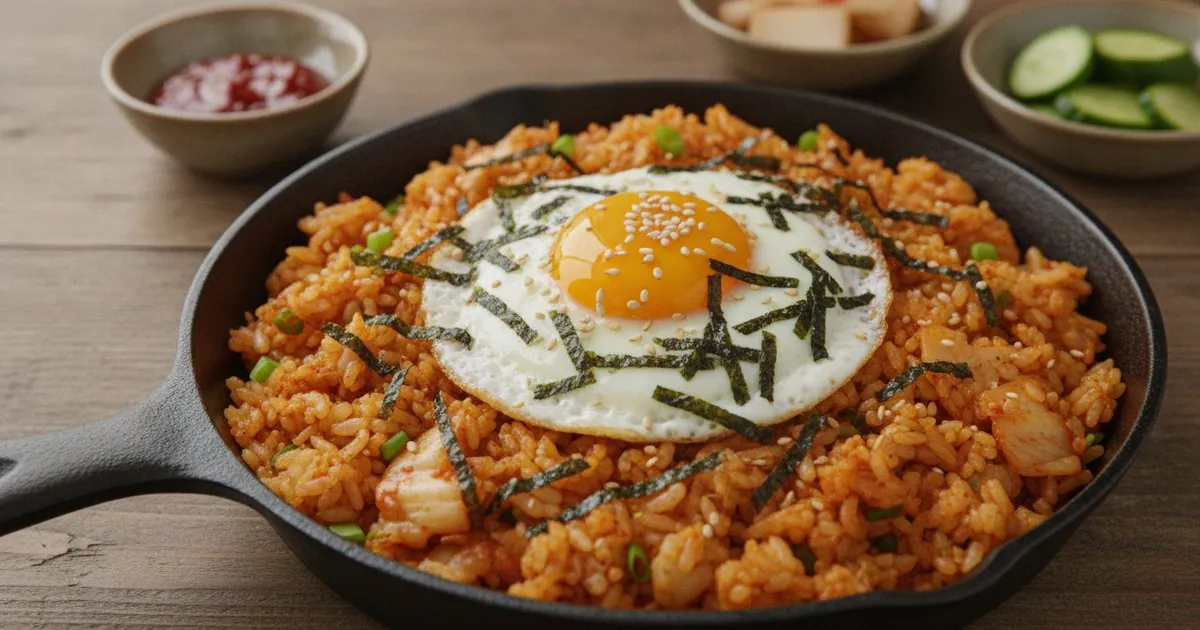
There are meals that sustain you, and then there are meals that save you. Kimchi fried rice — known in Korean as kimchi bokkeumbap (김치볶음밥) — firmly belongs in the second category. It is the dish you make at 10 p.m. when the fridge looks bare, when you have leftover rice from last night and a jar of kimchi that’s been fermenting quietly in the back corner. It comes together in under 25 minutes, and it tastes, improbably, like you spent the afternoon cooking.
This is one of Korea’s most beloved comfort foods: smoky, savory, faintly sour, and finished with a runny fried egg that breaks over the rice like a golden sauce. It is also, importantly, the dish that BTS member Jimin has cited as his personal favorite food — which tells you something about its universal appeal. If you want to understand what everyday Korean home cooking tastes like, this is your most direct route.
What Is Kimchi Fried Rice?
At its simplest, kimchi bokkeumbap is day-old rice stir-fried with chopped kimchi, gochujang, and a splash of soy sauce. But the soul of the dish depends on a few things most recipes don’t explain properly: the age of your kimchi, the temperature of your pan, and the patience to let things caramelize before you start stirring.
The rice absorbs the funky, fermented liquid from the kimchi, the gochujang adds a deep brick-red heat, and the high heat of a screaming-hot pan does what it always does to fried rice — it creates those irresistible browned, slightly crispy bits at the bottom called nurungji (누룽지). A drizzle of sesame oil at the end lifts everything and gives the dish its characteristic Korean aroma.
For a deeper look at the ingredient at the heart of this dish, see our guide on how to make kimchi.
The Key: Use Aged Kimchi
The single most important thing you can do to improve your kimchi fried rice is use well-fermented (aged) kimchi rather than fresh. Fresh kimchi is bright, crunchy, and mild — wonderful in its own right, but not ideal here. Aged kimchi — what Koreans call mukeunji (묵은지) — is softer, more intensely sour, and deeply umami. When it hits a hot pan, it caramelizes in ways fresh kimchi simply can’t.
As a rule of thumb: if your kimchi has been in the fridge for more than three weeks, it’s ready for fried rice. If it’s been sitting for a month or two and has developed a funky, wine-like tang, even better. The kimchi juice (the brine) is equally important — it seasons the rice and intensifies the sour-savory flavor profile in a way that nothing else can replicate.
Can’t wait that long? Buy a jar and let it sit at room temperature for a day, then refrigerate for another week. Or simply use what you have — even younger kimchi makes a delicious fried rice, it just won’t have quite the same depth.
Why Day-Old Rice Matters
This applies to virtually all fried rice, not just Korean: fresh rice is your enemy. Freshly cooked rice is moist, sticky, and fragile. When it hits a hot pan, it steams rather than fries, and the grains clump together into a gluey mass that’s impossible to separate. Day-old rice, stored uncovered in the refrigerator overnight, loses most of its surface moisture. The grains are drier, firmer, and separate easily — perfect for achieving the distinct, individual rice textures that define great fried rice.
If you genuinely don’t have leftover rice, spread freshly cooked rice on a sheet pan, fan it vigorously, and refrigerate it for 30-45 minutes before frying. It’s not identical to proper day-old rice, but it gets you close enough.
What Gochujang Adds
Kimchi already brings heat and fermented depth to this dish. So why add gochujang too? Because gochujang does something different from raw heat: it adds sweetness, body, and a thick, sticky quality that helps the sauce cling to every grain of rice. It also deepens the color from pale orange to a rich, glossy red that looks as good as it tastes.
Don’t add too much — one tablespoon is plenty. You want the kimchi to remain the star, with gochujang playing a supporting role. If you’ve never used gochujang before, our complete gochujang guide covers everything from brands to storage to substitutions.
Tips for Weeknight Success
Get your pan truly hot. This is non-negotiable. A lukewarm pan gives you steamed, soggy fried rice. A screaming-hot wok or cast-iron skillet gives you caramelized, smoky fried rice. Set your burner to high, let the pan heat for at least 90 seconds before adding oil, and don’t walk away.
Don’t overcrowd the pan. This recipe makes two servings. If you need to feed four people, make two separate batches rather than doubling in one pan. A crowded pan drops in temperature immediately and your fried rice will steam instead of fry.
Add the sesame oil last. Sesame oil has a low smoke point and burns quickly. More importantly, its aromatic compounds are volatile — cooking it for too long destroys the flavor. Add it off the heat or in the final 30 seconds of cooking.
The fried egg is not optional. Or rather, you can skip it, but you’d be making a mistake. The yolk becomes a sauce that coats the rice, mellows the spice, and adds a richness that makes the whole dish feel complete. Fry it in the same pan you used for the rice, right after you’ve plated it, so you pick up all the residual flavor.
Variations
Spam kimchi fried rice: The most popular addition in Korea is canned spam (Spam is genuinely beloved in Korean cuisine, a legacy of American military influence in the 1950s). Cut it into small cubes and fry until golden before adding the kimchi. The saltiness pairs perfectly with the sour rice.
Bacon or pork belly: A more Western-friendly option. Crispy bacon bits or sliced pork belly work beautifully here. Cook the meat first, use the rendered fat to fry the kimchi, and finish with the rice.
Vegetarian kimchi fried rice: Skip the meat entirely and use vegan kimchi (made without the fish sauce or fermented shrimp that traditional kimchi contains). Add a handful of diced tofu or frozen corn for texture and body.
Cheese on top: A recent trend in Korea — and genuinely excellent — is topping your kimchi fried rice with a slice of processed cheese (like Kraft singles) or a handful of shredded mozzarella. Cover the pan for 1-2 minutes to let the cheese melt. Rich, gooey, and slightly absurd in the best way.
Kimchi fried rice with tuna: Canned tuna (drained well) is another classic Korean pantry addition. Stir it in alongside the kimchi. The mild fish flavor amplifies the umami without overpowering anything.
Where to Buy the Ingredients
Kimchi: The best kimchi for fried rice is napa cabbage kimchi (baechu kimchi). Any Korean grocery store, H Mart, or Zion Market will carry multiple brands. Maangchi’s Kimchi or Choi’s Kimchi are excellent widely-available brands. For online ordering, try Umami Insider or simply search Amazon for “baechu kimchi.”
Gochujang: Widely available now at most mainstream grocery stores (Whole Foods, Wegmans, Sprouts) in the international aisle. Look for the red tub — CJ Haechandle and Sempio are reliable brands. Korean grocery stores carry a wider range, including the excellent Sunchang Gochujang.
Short-grain rice: Look for Korean rice brands like Koshihikari, Nishiki, or Kokuho Rose at any Asian grocery or mainstream supermarket.
Storage
Kimchi fried rice keeps reasonably well but is definitely best eaten fresh. If you have leftovers, let them cool completely before transferring to an airtight container. Refrigerate for up to 2 days. Reheat in a skillet with a tiny splash of water to loosen, or in the microwave covered with a damp paper towel. The texture won’t be quite as good as fresh, but the flavors actually intensify overnight, which partly compensates.
Do not freeze kimchi fried rice — the rice texture suffers badly after freezing and thawing.
Common Mistakes to Avoid
Using rice that’s too fresh — or too wet. Day-old refrigerated rice is the foundation of good kimchi bokkeumbap, but even “leftover” rice can betray you if it was stored covered while still warm. Trapped steam condenses back into the grains, leaving you with clumps that steam in the pan instead of frying. Store leftover rice uncovered, or with the lid cracked, so surface moisture can escape. If you’re using the sheet-pan shortcut for fresh rice, spread it thin and give it a full 45 minutes — not 20.
A pan that isn’t genuinely hot enough. This is the most common reason kimchi fried rice turns out soft, pale, and one-dimensional. Without high heat, the kimchi sweats rather than caramelizes, the rice steams in the liquid, and you lose the smoky depth — and any hope of nurungji at the bottom. Heat your wok or cast-iron skillet over high for a full 90 seconds before adding oil. It should be visibly shimmering and just beginning to smoke. If your stove has a BTU limit, use cast iron over a wok — it holds heat better on lower-output burners.
Adding gochujang straight to the dry pan. Gochujang contains sugars that scorch almost instantly on contact with high heat. If you drop a tablespoon directly onto the hot pan and let it sit, it will burn bitter before the rice even goes in. Instead, stir the gochujang into the kimchi or rice off to the side of the pan, or add it once the kimchi has released some of its liquid — the moisture slows scorching and helps the paste distribute evenly across every grain.
Stirring constantly and missing the nurungji. The instinct to keep the rice moving is understandable, but it prevents the crispy browned layer that makes this dish memorable. Once the rice is in and broken up, press it firmly against the pan with a spatula and leave it alone for 60–90 seconds. You’ll hear a subtle crackle. That’s the nurungji forming. Resist the urge to stir until it does.
Over-seasoning with soy sauce. Kimchi is already salted during fermentation, and the kimchi brine you add intensifies that further. Adding a full tablespoon of soy sauce without tasting first is a reliable path to an oversalted dish. Start with half a teaspoon, taste after the rice is incorporated, and adjust from there. Finish with a small pinch of salt rather than more soy if you need it — it’s easier to control.
Adding sesame oil in the middle of cooking. Sesame oil is a finishing oil, not a cooking oil. Its aromatic compounds burn off quickly under high heat, and what remains can turn acrid. Add it in the final 30 seconds or off the heat entirely — those few seconds are enough to coat the rice and release the nutty fragrance that defines the dish’s aroma.
Frequently Asked Questions
Can I use white rice instead of short-grain Korean rice? Yes. Long-grain white rice (like jasmine) actually fries up very well because its lower starch content means the grains stay more separate. The flavor and texture will be slightly different — less chewy, a bit drier — but it makes a perfectly good kimchi fried rice. Brown rice works too, though it takes longer to cook initially.
My kimchi fried rice isn’t getting crispy. What am I doing wrong? Almost certainly a pan temperature issue. Make sure your pan is fully preheated over high heat before adding oil, and that your rice is as dry as possible (day-old refrigerated rice is ideal). Also, resist the urge to stir constantly — let the rice sit undisturbed for 30-60 seconds at a time so it can form those caramelized bits.
Can I make kimchi fried rice without gochujang? Yes, though the dish will be less complex. You can substitute a small amount of sriracha (about half a teaspoon) combined with a pinch of sugar and a drop of soy sauce. It won’t be exactly the same, but the fried rice will still taste great. Or simply omit the gochujang and let the kimchi carry all the seasoning.
Is kimchi fried rice spicy? It depends on how much gochujang and spicy kimchi you use. Traditional kimchi bokkeumbap has a moderate heat level — noticeable but not overwhelming for most palates. If you’re sensitive to spice, use mild kimchi (some brands offer it), reduce the gochujang to half a tablespoon, and skip the kimchi juice, substituting a small amount of rice vinegar for tang instead.
What’s the difference between kimchi fried rice and regular fried rice? The kimchi fundamentally changes the flavor profile. Where Chinese-style fried rice is savory and neutral, kimchi fried rice is tangy, funky, spicy, and fermented. The kimchi brine seasons the rice in a way that no amount of soy sauce can replicate. The sesame oil finish is also distinctly Korean rather than Chinese in character.
Can I make this ahead for meal prep? You can cook the rice and prepare all the components in advance, but I’d strongly recommend frying each serving to order rather than pre-cooking the entire batch. Kimchi fried rice loses its texture and crispiness as it sits. If you must prep ahead, fry the rice through step 5, stop before adding sesame oil and garnishes, and refrigerate. Reheat in a very hot pan with a splash of water and finish with the sesame oil and a fresh egg.