
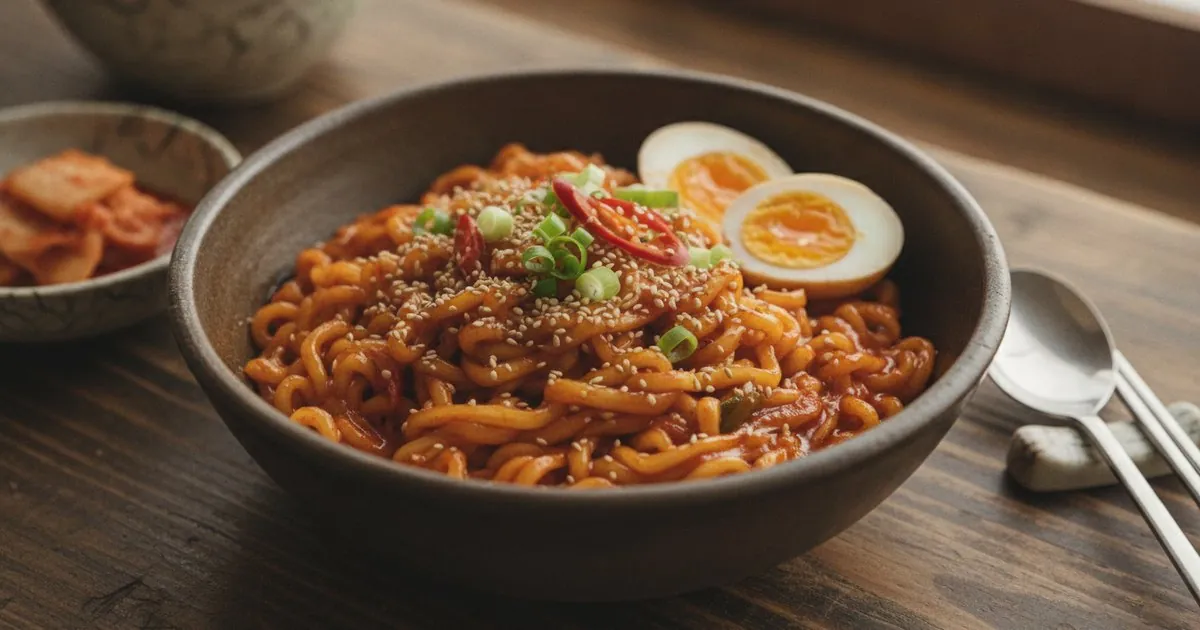
At some point between midnight and 2 AM, BTS’s Jungkook sat down in front of a camera, boiled some water, and made a bowl of ramen from two packets instead of one. He called it Bulgeuri Ramen — a portmanteau of the two brands: Buldak (불닭) + Neoguri (너구리) — and the internet has not stopped talking about it since.
This is not an exaggeration. The specific combination of Buldak Ramen (the frighteningly spicy “fire chicken” noodles) and Neoguri Ramyeon (a milder, seafood-flavored noodle) went from a casual livestream moment to a viral food trend within days. Korean convenience stores reported spikes in Neoguri sales. K-pop food content creators devoted videos to it. ARMY across the world started combining their instant noodle packets to find the right ratio.
And here’s the thing: once you actually make it, you understand exactly why.
What Is Bulgeuri Ramen?
Let’s back up and make sure we have the ingredients right, because both of these noodles have their own devoted fan bases.
Buldak Ramen (불닭볶음면)
Buldak means “fire chicken” in Korean. The ramen named after it — made by Samyang Foods — is one of the most aggressively spicy instant noodles you can find in a Korean convenience store. The original is not playing around with its heat level. The “2x Spicy” version is borderline punishing.
What makes Buldak distinctive beyond the heat is its sauce format. Unlike most instant ramyeon (which gives you a powder broth), Buldak uses a thick, glossy, deep-red liquid sauce that coats the noodles. It’s umami-heavy, slightly sweet, and devastatingly spicy. The noodles themselves are chewier and thicker than standard instant ramen.
The Buldak fire noodle challenge — where people film themselves eating an entire packet and reacting to the heat — has been a YouTube staple for years. But eating Buldak as a challenge food misses the point of how Koreans actually enjoy it: as part of a combination, tamed with additions, customized to a manageable heat level.
Neoguri Ramyeon (너구리)
Neoguri (made by Nongshim) is a completely different beast. The name translates to “raccoon” — the mascot on the package — and the flavor is mild, savory, and seafood-forward. The soup powder makes a genuinely good broth: slightly kelpy, deeply savory, with a gentle spice that’s nothing like Buldak’s assault.
Neoguri’s noodles are thick and have a distinctive chewiness — Nongshim calls them “udon-style,” and that’s not far off. They’re wider and more substantial than most instant ramyeon noodles.
The two-packet combination makes logical sense once you understand both components: Buldak provides the punch, the fire, the glossy sauce coating. Neoguri provides the broth, the depth, the kelp-seafood base, and a noodle texture that softens Buldak’s intensity into something you actually want to eat an entire bowl of rather than gasp through.
The Ratio Question
Here’s where Bulgeuri Ramen gets interesting as a recipe rather than just a “throw two packets together” situation. How much of each sauce you use determines the whole character of the bowl.
- Full Buldak sauce + Neoguri broth powder: Extremely spicy. For experienced spice eaters who want the full fire experience with the Neoguri’s flavor complexity underneath.
- Half Buldak sauce + Neoguri broth powder: This is the sweet spot for most people. You get clear Buldak fire and flavor, the Neoguri rounds it beautifully, and you can actually taste what you’re eating.
- Quarter Buldak sauce + Neoguri broth powder: Mild-ish, great for people new to Korean spice levels but who want to understand what the combination is about.
The recipe above uses half the Buldak sauce as a starting point. Taste after adding and adjust — the beauty of making this at home (vs. a convenience store cup version) is that you control the heat.
Why the Cheese Matters
Adding cheese to instant ramyeon is so common in Korea that it’s practically default behavior. But with Bulgeuri Ramen specifically, cheese does something important: it acts as a heat buffer.
The fat in the cheese literally coats your mouth and tongue, creating a physical barrier between the capsaicin (the active heat compound in the Buldak sauce) and your pain receptors. This is the same reason dairy is the antidote for spicy food — fat, not water, neutralizes capsaicin.
Practically speaking, processed cheese slices melt fastest and creamiest, creating a sauce-like layer over the noodles. Mozzarella gives you the satisfying cheese pull. Either works; processed cheese is the more authentic Korean convenience store choice.
The Egg Situation
Adding an egg to ramyeon is another Korean universal. The egg serves a few purposes:
Protein: Instant ramen alone is carbs and salt. An egg adds substance and keeps you full longer (important at midnight).
Richness: The yolk — especially a runny one — becomes a sauce element that enriches the spicy broth and adds a creamy quality.
Visual: A perfectly set soft egg with the yolk starting to run is a visual upgrade that makes this feel like an actual meal rather than a late-night snack.
Cook the egg directly in the broth rather than separately. Push the noodles to the side, crack the egg into the broth, and let it cook to your desired doneness. Two minutes gets you a soft yolk; three minutes gets you mostly set. The broth gives the egg whites a slightly savory flavor they wouldn’t have if poached in plain water.
Optional Upgrades
The recipe above is the foundation. These additions turn Bulgeuri Ramen from midnight snack to a proper meal:
Spam / Luncheon Meat: Pan-fried spam cubes are a wildly popular ramyeon addition in Korea. The salty, slightly crispy meat adds both protein and textural contrast. Pan-fry the cubes until they have a light caramelized crust before adding to the bowl.
Enoki Mushrooms: These thin, delicate mushrooms cook almost instantly in the hot broth and add an earthy note that balances the spice. Add them in the last 30 seconds of cooking.
Butter: Adding a small knob of butter to spicy ramyeon sounds wrong until you try it. The butter creates an unctuous richness that complements the heat in a way that’s deeply satisfying. It’s a common Korean hack for “luxurifying” instant noodles.
Dried Seaweed (Gim): Torn sheets of roasted seaweed on top add a light, slightly smoky, ocean flavor that reinforces the Neoguri’s seafood base.
Bulgeuri vs. Regular Buldak: The Actual Difference
If you’ve tried Buldak on its own and found it difficult to get through, Bulgeuri Ramen is the version that lets you actually enjoy the flavors rather than just survive the heat.
Buldak on its own is bold, spicy, and good — but it’s a one-note experience where the heat dominates everything. The Neoguri addition creates layers: seafood umami underneath, fire on top, the creaminess of the cheese threading through, the egg adding a gentle richness. It’s a more complex bowl.
This is the insight behind the combination, and why it caught on beyond just “Jungkook made it.” It’s actually a better bowl of ramen. The sum is greater than the parts.
Storage and Notes
- Eat immediately. Instant noodles are one of the few foods that genuinely must be eaten right away. The noodles absorb liquid and get soft-mushy within minutes of cooking. There is no Bulgeuri Ramen leftovers situation.
- Buldak sauce packs are spicy by themselves. If you’re not sure about your heat tolerance, add a small amount, stir, taste, and add more gradually.
- Neoguri comes in a non-spicy version (seafood flavor, orange packaging) if you want the noodle character without any extra heat on top of the Buldak.
Where to Find These Noodles
Both Buldak Ramen and Neoguri Ramyeon are widely available:
- Korean grocery stores (H-Mart, Zion Market, Hana in the US)
- Asian grocery stores generally
- Amazon and online retailers
- Increasingly, mainstream supermarkets like Walmart and Target carry Buldak Ramen specifically due to its viral profile
If you can only find one, Buldak without Neoguri is still Buldak — legitimately spicy and satisfying with cheese and egg. But the combination is worth seeking out.
More Instant Noodle Culture
If you’re now deep in the world of Korean instant ramyeon, the next stop is understanding the convenience store context where a lot of this eating actually happens. Our guide to Korean convenience store food covers the full culture — from eating ramen at the store counter to the specific combinations (kimbap + ramen, corn dog + ramen) that are canonical Korean late-night experiences.
And for more on what Jungkook eats beyond ramen, our full deep-dive What BTS Eats covers every member’s favorites, from samgyeopsal to banana milk.
Common Mistakes to Avoid
Following Buldak’s package instructions for the water. Buldak Bokkeummyeon is a bokkeum (stir-fry) noodle — the package tells you to drain nearly all the cooking water before adding the sauce. In Bulgeuri Ramen, you’re making a soup using Neoguri’s broth powder, so don’t drain. Use Neoguri’s water quantity (around 550ml) as your soup base, cook both noodle portions together, and stir the Buldak sauce directly into the broth. Draining first leaves you with almost no broth and a too-concentrated, paste-like result.
Dumping in the full Buldak sauce packet without tasting first. The ratio section above exists for a reason. Buldak’s capsaicin is fat-soluble and keeps building as you eat — the full packet into a single bowl hits differently than it reads on paper. Start with half, taste a noodle or two, then add more. Once that sauce is in the broth, you cannot pull the heat back out.
Overcooking the noodles. Both Buldak and Neoguri use thick noodles that hold heat and keep cooking in residual broth even after the flame is off. Pull them at the lower end of the cook time — around 3–4 minutes together — and serve immediately. Overcooked Bulgeuri turns into a gummy, starchy bowl that loses the substantial chew that makes this combination worth eating in the first place.
Adding cheese to hard-boiling broth. Cheese dropped into a rolling boil seizes up and turns grainy rather than melting into a creamy layer. Kill the heat or let the broth settle to a gentle simmer before laying the cheese slice on top, then cover the pot for 30 seconds. The residual heat does all the melting work without breaking the cheese proteins into an unpleasant texture.
Cracking the egg in at the wrong moment. Add it too early and the yolk sets hard before the noodles finish cooking; too late and you’re eating half-set whites. The right window: once the noodles have cooked about 2 minutes, gently push them aside, crack the egg directly into the broth, cover, and cook another 2 minutes for a soft yolk. Don’t stir — let the whites set as a single unit rather than breaking into threads throughout the soup.
Skipping Neoguri’s dried flake packet. Neoguri includes a separate packet of dried seafood and vegetable flakes — squid, fish cake, greens. These are not decorative. Add them with the broth powder at the start so they rehydrate fully during cooking. Leaving them out makes the soup taste flat and one-note, stripping out exactly the kelp-seafood depth that makes Neoguri the right counterpart to Buldak’s fire.
Frequently Asked Questions
What exactly is Bulgeuri Ramen? It’s a combination of two Korean instant noodle products: Buldak Ramen (불닭볶음면, the extremely spicy “fire chicken” noodles by Samyang) and Neoguri Ramyeon (너구리, the milder seafood-flavored noodles by Nongshim). The portmanteau “Bulgeuri” combines “Bul” from Buldak and “geuri” from Neoguri. BTS’s Jungkook popularized the combination through his livestreams.
Is it actually as spicy as regular Buldak? It’s significantly less spicy than eating a full packet of Buldak on its own, especially if you only use half the Buldak sauce packet (which the recipe recommends as a starting point). The Neoguri’s mild seafood broth dilutes the heat considerably, and adding cheese further reduces the perceived spiciness. It’s still notably spicy — probably a 6-7 out of 10 — but not the face-melting experience of pure Buldak.
Can I make this with the 2x Spicy Buldak version? Yes, and it’s how serious spice lovers approach it. Use only a quarter of the 2x Spicy sauce packet as your starting point, then taste and add more. The 2x Spicy version has a slightly different (more intensely smoky) flavor profile that can be excellent in the combination.
Can I use any other ramyeon in place of Neoguri? You can experiment with other mild, seafood-flavored ramyeon — Shin Ramyun (but use only part of the spice packet since it’s already spicy), Ansungtangmyun (anchovy-based), or even plain ramyeon noodles with your own broth. But Neoguri specifically is recommended because its thick udon-style noodles and kelp broth create the best textural and flavor contrast with Buldak’s sauce format.
Why does everyone add cheese to Korean ramen? Cheese in ramen is extremely common in Korea — it’s not a western fusion thing, it’s just how people eat ramen. The fat in the cheese counters the spice, the creaminess contrasts the salty/spicy broth, and melted cheese over noodles is objectively good. Processed cheese slices (like Kraft singles) melt fastest and integrate most smoothly into the broth.
Where can I watch Jungkook actually make this? His cooking and eating livestreams have been posted and reposted extensively across YouTube, Twitter/X, and TikTok under searches for “Jungkook ramen” or “Jungkook cooking livestream.” The specific Bulgeuri Ramen moment became a widely-shared clip. Many ARMY accounts have preserved and timestamped these moments for exactly this kind of culinary research.