
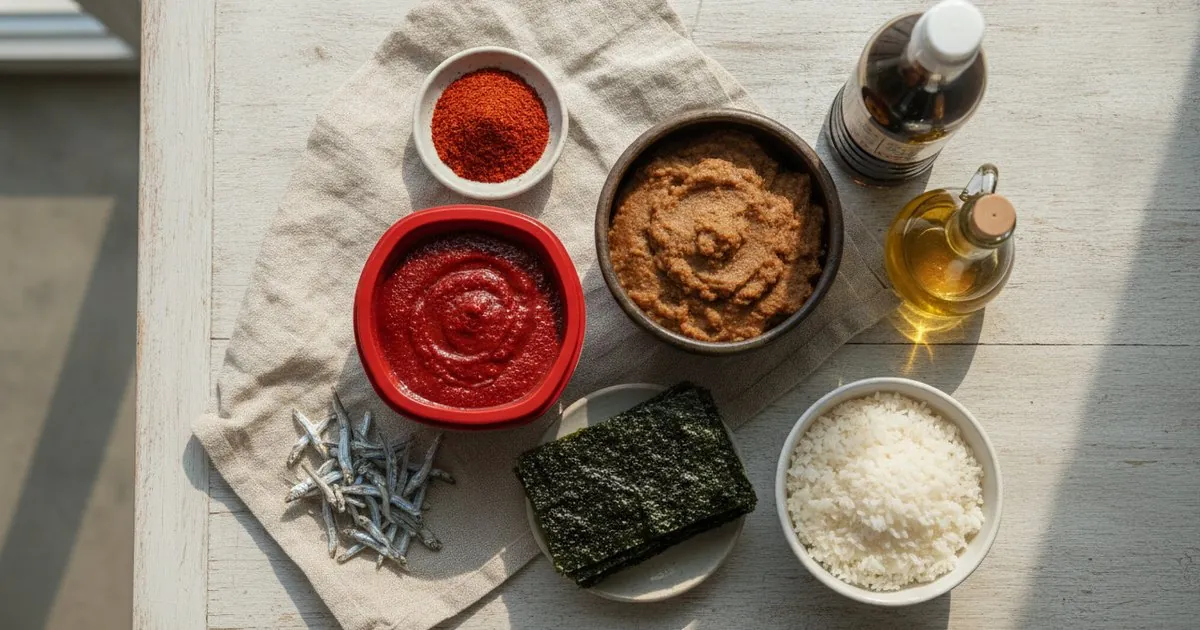
The first time most Westerners try to cook Korean food at home, they hit the same wall: the recipe calls for three ingredients they’ve never heard of, they have to make a special trip to an Asian grocery store, and by the time they’re standing in the aisle trying to read unfamiliar labels, the whole project starts to feel overwhelming.
Here’s the good news: Korean cuisine draws on a relatively small core pantry. Once you stock these 10 ingredients, you’ll have the foundation to cook an enormous range of authentic Korean dishes — from quick weeknight stir-fries to slowly fermented side dishes. Most of these items keep for months (some for years) and are available at any Korean grocery store, at H Mart locations across North America, or online via Amazon, Weee!, or the H Mart website.
This is your shopping list. Let’s break down each item.
1. Gochujang (고추장) — Fermented Chili Paste
If you had to choose just one Korean pantry ingredient, it would be gochujang. This thick, brick-red fermented paste is made from Korean red chili peppers, glutinous rice, fermented soybeans, and salt — and the fermentation process transforms those simple ingredients into something with extraordinary depth: simultaneously sweet, spicy, savory, and slightly funky.
Gochujang goes into tteokbokki, bibimbap sauce, kimchi jjigae, Korean fried chicken glazes, marinades for pork and beef, and approximately a hundred other things. It also works beautifully outside Korean cooking — stirred into mayo, brushed onto roasted vegetables, or added to tomato-based pasta sauces for depth.
What to buy: Look for the CJ Haechandeul brand (widely available and reliable) or Sunchang gochujang (slightly more traditional and complex). Medium heat is the most versatile starting point. It comes in tubs ranging from 200g to 1kg — start with 500g.
Where to find it: Any Korean grocery store, H Mart, many mainstream supermarkets (Asian foods section), Amazon. We have a complete guide to gochujang that covers everything from fermentation to cooking applications if you want to go deeper.
How long it keeps: One to two years refrigerated after opening. Practically forever unopened.
2. Gochugaru (고추가루) — Korean Red Pepper Flakes
Gochugaru is the ingredient that gives kimchi its color and heat. These coarsely ground dried Korean red pepper flakes are distinctly different from Italian red pepper flakes or cayenne — they’re milder, fruitier, slightly sweeter, and have a beautiful brick-red color that tints everything they touch.
Do not substitute regular red pepper flakes. The flavor and heat profile are genuinely different, and dishes like kimchi, sundubu jjigae (soft tofu stew), and dakgalbi (spicy chicken stir-fry) simply don’t taste right without the real thing.
Gochugaru comes in two textures: fine ground (고운 고추가루, for sauces where you want it to blend smoothly) and coarse ground (굵은 고추가루, the standard for kimchi and most dishes). For your first purchase, coarse is more versatile.
What to buy: Look for bags labeled 고추가루 (gochugaru) at a Korean grocery store. Brands like Nongwoo or Korean Sun are reliable. Buy a larger bag (500g-1kg) — you’ll use it faster than you expect, and it freezes well.
Where to find it: Korean grocery stores and H Mart are the best options. Online is fine too. Avoid the small jars at mainstream supermarkets — they tend to be old, pale, and disappointingly mild.
How long it keeps: 6 months in a sealed container in a cool, dark place; 1-2 years in the freezer without quality loss.
3. Doenjang (된장) — Korean Fermented Soybean Paste
Doenjang is Korea’s answer to Japanese miso — but they’re not the same thing, and they’re not interchangeable in Korean recipes. Where miso tends to be smooth, relatively mild, and comes in several varieties calibrated for specific uses, doenjang is chunky, assertively pungent, deeply fermented, and complex in a way that takes some getting used to.
It’s the base of doenjang jjigae (soybean paste stew, a staple of every Korean household), a key component of ssamjang (the sauce served with grilled meat), and a flavoring element in various banchan (side dishes). It’s also one of those ingredients where the strong smell in the jar bears almost no resemblance to the rich, savory depth it adds to cooked food.
What to buy: Sempio or Haechandeul are reliable brands for everyday doenjang. Traditional block doenjang (chunky, with visible soybean pieces) is superior in flavor but can be harder to find — look for it at Korean grocery stores.
Where to find it: Korean grocery stores and H Mart. Miso paste is emphatically not a substitute in Korean recipes (though it can work in a pinch in some contexts).
How long it keeps: 1-2 years refrigerated. It darkens over time but doesn’t go bad quickly due to its high salt content.
4. Korean Soy Sauce (간장, Ganjang)
You might already have soy sauce in your pantry, but Korean cooking uses soy sauce differently than Chinese or Japanese cuisine, and some recipes specifically benefit from using Korean varieties.
Korean soy sauce (ganjang) comes in two main types that Korean cooks use for different purposes:
Soup soy sauce (국간장, gukganjang): Saltier, lighter in color, and used primarily to season soups, stews, and light-colored dishes where you want seasoning without darkening the color. Made from 100% fermented soybeans.
Regular soy sauce (진간장, jinganjang): Similar to the all-purpose Japanese soy sauce (shoyu) you might already own, and used for marinades, stir-fries, and dipping sauces. Brands like Sempio, Chung Jung One, and CJ are all reliable.
For beginners, a single bottle of regular Korean soy sauce (or good-quality Japanese soy sauce) handles most recipes. Adding a bottle of soup soy sauce comes later when you start making Korean soups and stews regularly.
What to buy: Sempio 701 or Chung Jung One regular soy sauce as a starting point. These are widely available and excellent quality.
Where to find it: Any Korean grocery store, Asian supermarkets, and increasingly in mainstream grocery stores. Japanese soy sauce (Kikkoman, Yamasa) works adequately in recipes that call for ganjang.
5. Sesame Oil (참기름, Chamgireum)
Korean sesame oil is one of those ingredients where quality makes an enormous difference. Korean roasted sesame oil is darker, nuttier, and more intensely flavored than the pale sesame oil common in Chinese cooking. It’s used almost exclusively as a finishing oil — drizzled over bibimbap, stirred into dressings, added to marinated dishes just before serving — not for high-heat cooking (the flavor compounds that make it special burn off at high temperatures).
A small bottle goes a long way. Even a few drops transform a bowl of plain rice or a simple cucumber salad.
What to buy: Ottogi or Wang are both excellent Korean sesame oil brands. The dark amber color is what you’re looking for — if it’s pale yellow, it’s not the Korean-style roasted version.
Where to find it: Korean grocery stores, H Mart, and most well-stocked Asian supermarkets. Price is generally a quality signal here — cheaper versions tend to be diluted or lower-quality oil.
How long it keeps: 6-12 months in a cool, dark place (or refrigerated). The flavor fades with time, so buy a smaller bottle unless you use it frequently.
6. Fish Sauce (액젓, Aekjeot)
Korean fish sauce is most often anchovy-based (멸치액젓, myeolchi aekjeot) and used to add deep umami to kimchi, soups, and various side dishes. It’s quite different from Thai or Vietnamese fish sauce — Korean versions tend to be less pungent and slightly more complex.
If you already cook Southeast Asian food and have fish sauce on hand, it works as a substitute in most Korean recipes. But if you want the authentic flavor in kimchi, Korean anchovy fish sauce is worth having separately.
What to buy: Sempio or Haechandeul anchovy fish sauce. Red Boat (Vietnamese) is an acceptable substitute.
Where to find it: Korean grocery stores and H Mart stock the Korean varieties. Vietnamese fish sauce is easier to find at mainstream grocery stores.
How long it keeps: 1-2 years refrigerated after opening. Keeps almost indefinitely unopened.
7. Rice Cakes (떡, Tteok)
Korean rice cakes are made from steamed and pounded rice flour, with a dense, chewy texture that’s utterly unlike anything in Western cooking. The cylindrical variety (garaetteok) is what you need for tteokbokki — Korea’s extraordinarily popular spicy rice cake dish — and also for tteok-mandu-guk (rice cake soup). Thin oval slices are used in soups and stir-fries.
Rice cakes have no strong flavor of their own — they’re a vehicle for absorbing whatever sauce they’re cooked in, which is part of their genius. They soak up gochujang sauce, broth, and seasoning and become deeply flavorful throughout.
What to buy: Look for fresh or refrigerated cylindrical tteok (often labeled “tteokbokki tteok” or “rice cake for tteokbokki”). Frozen works fine too and lasts longer. Avoid instant rice cakes sold in small packets for snacking — different product.
Where to find it: Korean grocery stores (refrigerated or frozen section), H Mart, and some mainstream Asian grocery stores. Online options are available but shipping fresh tteok can be complicated; frozen ships better.
How long it keeps: Fresh tteok: 3-5 days refrigerated. Frozen: 3-6 months. Soak refrigerated or frozen tteok in warm water for 10-15 minutes before cooking to soften them.
8. Dried Anchovies and Kelp (멸치 + 다시마, Myeolchi + Dasima)
These two ingredients together make anchovy-kelp stock (myeolchi-dasima yuksu), the foundation of many Korean soups, stews, and sauces. Think of it as Korean dashi — a clean, deeply savory broth that adds backbone to tteokbokki sauce, sundubu jjigae, and countless other dishes.
Making the stock is simple: combine a handful of large dried anchovies (remove the heads and guts if desired for a less intense flavor) with a piece of kelp (about 4×4 inches) in 2-3 cups of cold water. Bring to a near-simmer, then remove the kelp after 5 minutes (it gets slimy if overcooked). Simmer the anchovies for another 10-15 minutes, then strain. That’s it.
You can also use plain water or chicken broth in recipes that call for anchovy stock, but the real thing adds a depth of flavor that’s noticeably different.
What to buy: Look for large dried anchovies (국물용 멸치, gukmulyong myeolchi — “for broth” anchovies, as opposed to the smaller ones used as snacks) and dried kelp (다시마, dasima) in the dried goods section of Korean grocery stores. These are very affordable and sold in large bags.
Where to find it: Korean grocery stores and H Mart. Dried anchovies may also be found at Japanese grocery stores under the name niboshi.
How long it keeps: 6-12 months in a sealed container in a cool, dry place.
9. Gim (김) — Dried Seaweed Sheets
Gim (sometimes labeled “nori” in Japanese) is one of the most snackable foods in the Korean pantry. Thin sheets of dried seaweed, lightly toasted and seasoned with sesame oil and salt, are eaten as a side dish with rice, used to wrap rice balls (jumeokbap), and crumbled over soups and bibimbap as a garnish.
Koreans also eat gim as a standalone snack — individually portioned seasoned sheets that are wildly addictive, especially for children (though adults are equally defenseless against them). If you’ve ever bought Trader Joe’s roasted seaweed snacks, you’ve had gim.
In cooking, gim adds a briny, umami-rich note wherever it’s used. It’s also nutritionally impressive — high in iodine, vitamins B12 and K, and various minerals.
What to buy: For cooking and wrapping, buy full-size gim sheets (the same format as Japanese nori). For snacking, look for individually portioned seasoned gim packs. Dongwon and CJ are reliable brands.
Where to find it: Korean grocery stores, H Mart, Asian supermarkets, and mainstream grocery stores (increasingly common in the snack or international aisle). Japanese nori is identical for most purposes.
How long it keeps: 6-12 months in a sealed container. Keep dry — moisture makes it limp immediately.
10. Short-Grain White Rice (쌀, Ssal)
Korean cuisine is fundamentally built around rice, and the variety matters. Korean short-grain rice (also called japonica or sushi rice) cooks up sticky and slightly chewy — completely different from long-grain rice, which stays separate and fluffy. In Korean cooking, that slight stickiness is essential: it helps rice clump into every bite, soak up sauces and banchan, and hold together when you’re eating with chopsticks.
Korean rice brands like Koshihikari, Nishiki, and specifically Korean brands like Haenaru or Cheonhajang are all excellent choices. Japanese short-grain rice (Calrose is widely available) works identically for Korean cooking.
What to buy: Any short-grain Japanese or Korean rice labeled “japonica,” “short-grain,” or “sushi rice.” A 10 or 20-pound bag is typical for Korean households — you will go through it.
Where to find it: Korean grocery stores, H Mart, Asian supermarkets, and mainstream grocery stores (Nishiki and Kokuho Rose are common). Rinse the rice 2-3 times before cooking until the water runs mostly clear.
Where to Buy All of This
H Mart is the most accessible option for most people in North America — a nationwide chain with excellent selection of all these ingredients at very reasonable prices. Their online store ships nationwide.
Local Korean grocery stores often have even better selection and lower prices than H Mart, and the staff can help you find specific items. Search Google Maps for “Korean grocery” near you.
Weee! is an excellent online Asian grocery delivery service that carries nearly everything on this list with reliable shipping.
Amazon carries most of these items, though prices are sometimes higher than grocery stores. For pantry staples like gochujang and sesame oil, it’s a convenient option if you don’t live near a Korean grocery.
Building Your Korean Pantry Over Time
You don’t have to buy everything on this list at once. Here’s a practical sequencing if you’re starting from scratch:
First purchase (start cooking immediately): Gochujang, gochugaru, soy sauce, sesame oil, short-grain rice. With these five items you can make bibimbap, simple stir-fries, marinades, and basic rice dishes.
Second purchase (expand your range): Doenjang, fish sauce, dried anchovies and kelp. These open up soups, stews, and proper kimchi-making.
Third purchase (complete the pantry): Rice cakes, gim, and specialty items for specific recipes you want to tackle.
Once you have these staples, the gochujang guide will help you use your most versatile ingredient more creatively, and the kimchi recipe will put your gochugaru and fish sauce to immediate use in the most essential Korean fermented food.
Korean cooking rewards a well-stocked pantry. Make the initial investment, and you’ll find yourself with the tools to cook some of the most flavorful, satisfying food on the planet — any night of the week.
Common Misconceptions
Gochujang is just a spicy condiment, like Sriracha or hot sauce. Gochujang is a fermented paste, not a sauce — and the fermentation is the whole point. The months-long process involving glutinous rice and fermented soybeans produces sweetness, umami, and a layered complexity that no bottle of hot sauce replicates. Using Sriracha as a 1:1 substitute in bibimbap or tteokbokki leaves you with heat but none of the depth that makes those dishes taste Korean.
Gochugaru is interchangeable with whatever red pepper flakes you have in the spice drawer. Italian-style crushed red pepper is primarily cayenne — sharper, more one-dimensional heat with none of the fruity, slightly sweet undertone that makes gochugaru distinctive. Cayenne also contains significantly more capsaicin per gram, so swapping it in equal amounts will make your kimchi aggressively hot without the right flavor. There is no truly adequate substitute; gochugaru is worth tracking down.
Doenjang is the same as miso and can be used interchangeably. Both are fermented soybean pastes, but the fermentation methods and resulting flavors are quite different. Traditional doenjang undergoes a longer, coarser fermentation and tends to be considerably more pungent and complex than most miso varieties. Korean recipes built around doenjang — particularly doenjang jjigae — are calibrated to that specific flavor profile. White miso will produce a noticeably milder, sweeter result; it is a functional substitute in a pinch, but not an equivalent one.
These pantry items will go bad before you can use them. Because gochujang, doenjang, and Korean soy sauce are fermented and heavily salted, they are remarkably shelf-stable. Gochujang keeps one to two years in the refrigerator; doenjang is similarly long-lived. This makes buying larger quantities sensible rather than wasteful — you will almost certainly use them up before quality degrades.
One soy sauce covers all Korean cooking. As the article notes, Korean cuisine actually uses two functionally different soy sauces: soup soy sauce (gukganjang), which is saltier and lighter in color, and regular soy sauce (jinganjang), which behaves more like the all-purpose Japanese shoyu most Western cooks already own. Using regular soy sauce to season a clear Korean soup will darken it noticeably and change the flavor balance — a small but real distinction once you start cooking Korean soups regularly.
You need to live near a Korean grocery store to cook this food. H Mart has expanded substantially across North America, and platforms like Weee! and Amazon carry all of these core staples with reliable shipping. The barrier to stocking a Korean pantry from scratch has dropped significantly.
Frequently Asked Questions
Can I find these ingredients at a regular grocery store? Some of them, yes — gochujang, sesame oil, and soy sauce are increasingly available at mainstream supermarkets (Whole Foods, Kroger, Trader Joe’s, etc.) in the Asian foods section. But for gochugaru, doenjang, fish sauce, dried anchovies, and rice cakes, a Korean grocery store or H Mart is your best bet. The selection and prices are dramatically better there.
How do I store gochugaru after opening the bag? Transfer it to an airtight container and keep it in a cool, dark place for up to 6 months, or in the freezer for up to 2 years. Gochugaru’s color and flavor fade noticeably with age, so buying smaller quantities more frequently produces better-tasting food than buying a large bag that sits for a year.
Are any of these ingredients gluten-free? Traditional doenjang and gochujang can contain wheat in some commercial formulations — check the label carefully if gluten is a concern. Many brands now make gluten-free versions. Korean soy sauce (like regular soy sauce) typically contains wheat, but tamari is a gluten-free substitute. Gochugaru, sesame oil, fish sauce, rice cakes (made from pure rice flour), gim, and rice are naturally gluten-free.
What’s the difference between Korean and Japanese sesame oil? Both are made from roasted sesame seeds and are broadly similar. Korean sesame oil (chamgireum) tends to be slightly darker and more intensely roasted — more assertive in flavor. Japanese sesame oil varies by brand but is often slightly lighter. Either works fine in Korean recipes; if you use Japanese sesame oil, you might add a small amount more to compensate for the lighter flavor.
Can I build a Korean pantry on a tight budget? Absolutely. The cost per meal of cooking Korean food at home is very low once you have the pantry assembled. A large bag of rice, a tub of gochujang, a bag of gochugaru, and a bottle of sesame oil can cost under $30 total and will last several months. The initial investment in pantry items is front-loaded, but ongoing costs are minimal compared to buying prepared Korean food.