
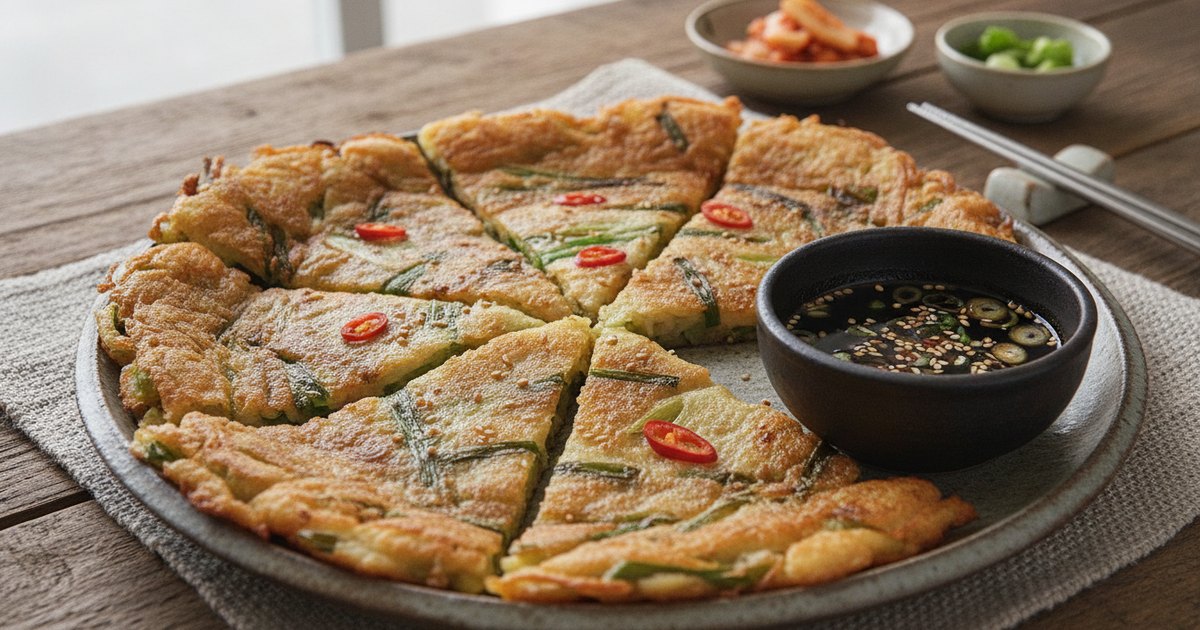
Pajeon (파전) is one of those dishes that delivers every single time. Golden and lacy at the edges, fragrant with green onion, shatteringly crispy on the outside and just slightly tender within — it is comfort food in the most direct Korean sense. It also happens to be one of the most achievable dishes in the entire Korean repertoire for home cooks.
If you've ordered pajeon at a Korean restaurant and wondered how they get it so impossibly crispy — or if you've tried making it at home and ended up with something more like a sad, soggy crepe — this guide is for you. Every variable that matters gets covered here: flour ratios, water temperature, oil quantity, heat management, the flip, the drain. Get these right and the results speak for themselves.
What Is Pajeon, Exactly?
The name breaks down simply: pa (파) means scallion (green onion), and jeon (전) is the broad Korean category for pan-fried battered foods — everything from sliced zucchini to kimchi to stuffed mushrooms falls under this umbrella. So pajeon, at its core, is a scallion pancake.
But calling it a pancake undersells it. Unlike Chinese scallion pancakes, which are laminated dough-based, rolled, and folded, pajeon is a battered, shallow-fried savory pancake where the scallions are embedded into the batter and run in long strands across the surface. The result is part pancake, part fritter — a texture that sits somewhere between a very thin crepe and a crispy tempura-battered vegetable, with enough chew in the middle to feel satisfying.
In Korean food culture, jeon holds a special place. There's a well-documented cultural association between the sound of rain on rooftops and the sound of pajeon sizzling in oil — the rhythms are similar enough that pajeon ingredient sales in Korea literally spike during rainy weather. It's festive food, too: jeon appears on Korean holiday spreads for Chuseok (autumn harvest festival) and Seollal (Lunar New Year). And it's quintessential anju — food served alongside alcohol, particularly makgeolli (milky rice wine) or a cold beer.
The Pajeon Family: Which Version Are You Making?
"Pajeon" technically refers to the plain scallion version, but the term gets used loosely to describe a whole family of pa-based pancakes. Here's the breakdown:
Plain Pajeon (파전): Just scallions, batter, oil, and a dipping sauce. The purist version. Faster, simpler, and often crispier because there's no moisture from seafood weighing the batter down. This is the recipe we're focusing on in this guide.
Haemul Pajeon (해물파전): Scallions plus mixed seafood — typically shrimp, squid, and mussels or oysters. This is the version you'll find in most Korean restaurants. Richer and more substantial, but it requires more careful oil management to get a proper crust given the seafood's water content. If you want to go that route, our dedicated Haemul Pajeon guide maps out the full process.
Dongrae Pajeon (동래파전): A regional specialty from the Dongrae district of Busan. Uses thin young spring onions (jjokpa), often includes minari (water dropwort), and is widely considered by Koreans to be the apex expression of the dish.
Kimchi Jeon (김치전): Swaps scallions for chopped, well-fermented kimchi. Tangy, spicy, deeply savory — it deserves its own guide.
Master the plain version first. Everything transfers.
The Ingredients That Actually Matter
The Scallions
Use genuine scallions — the thin, long green onions without bulbous white ends. In the US, these are sold as "green onions" or "scallions" in virtually every grocery store. You want two full bunches, roughly 220g (7.8 oz) after trimming. Look for scallions with firm, bright green tops; limp or yellowing stalks will turn mushy instead of crisping up in the pan.
Cut them into 7.5cm (3-inch) lengths on a slight bias. The diagonal cut gives the pancake better structural integrity — the scallions interlock rather than slide — and increases the surface area that browns against the pan. If your scallions are thick (wider than a pencil), halve them lengthwise so everything cooks at the same rate.
The Flour Blend: Two-Flour Magic
All-purpose flour alone produces a chewy, slightly dense result. The fix is cornstarch — replacing about a quarter of the flour weight with it. Cornstarch inhibits gluten formation and creates a more shattering, tempura-like crust when fried. The recipe here uses ¾ cup flour plus 3 tablespoons cornstarch, which hits the sweet spot.
If your local Korean grocery stocks buchimgaru (부침가루, Korean pancake mix), you can substitute 120g (1 cup) of that for the flour, cornstarch, baking powder, salt, and sugar — it already has starch and seasoning built in.
Cold Sparkling Water — Non-Negotiable
This is the single biggest factor separating crispy pajeon from rubbery pajeon. The water must be cold, straight from the fridge. Cold liquid slows gluten development in the batter, keeping the final texture lighter. Sparkling water goes a step further: the CO₂ bubbles create micro air pockets in the batter that expand slightly in hot oil, producing a lacier, more irregular, more shatteringly crispy edge. The difference is audible — sparkling-water batter makes a louder, more aggressive sizzle in the pan.
Plain still water works, but pull it straight from the fridge and use it immediately.
Oil — Don't Skimp Here
Pajeon is not a low-oil recipe. You need enough oil in the pan so the pancake essentially shallow-fries rather than dry-fries — about 2 tablespoons to start each pancake in a 25cm (10-inch) pan, with more added around the edges after flipping. The total across four pancakes comes to about 75ml (5 tbsp). Use a neutral, high-smoke-point oil: canola, vegetable, or grapeseed all work well. Avoid olive oil, which burns at the temperatures needed for a proper crust and adds a flavor that fights the scallions.
Getting the Pan Right
A 25–28cm (10–11 inch) non-stick skillet gives the most reliable results for home cooks; cast iron works beautifully once well-seasoned. Stainless steel is risky unless you're experienced with high-heat management — even a well-oiled stainless pan can stick if the temperature drops slightly when cold batter hits the surface.
Preheat the oil until it shimmers — this takes 60 to 90 seconds over medium-high. Drop a tiny bit of batter into the pan: it should sizzle immediately and hold its shape. If it spreads into a flat puddle or sizzles weakly, the pan isn't hot enough. A cold pan means the pancake absorbs oil instead of frying in it, and the result is greasy and soft.
Once the batter is in, leave it alone. Three to four minutes of uninterrupted contact is what builds the crust. You'll know it's ready to flip when the edges look dry and slightly translucent, and when you slide a spatula under a corner and the pancake lifts cleanly with a defined golden-brown underside. That crust should be the color of the skin on a well-fried egg — deep amber, not pale beige.
After flipping, add another half tablespoon of oil around the rim and tilt the pan to let it slide underneath. Press the pancake down gently with the back of the spatula — you want maximum contact between the surface and the pan. You'll hear a satisfying re-intensification of the sizzle.
The Dipping Sauce: Cho Ganjang (초간장)
The standard pajeon dipping sauce is cho ganjang — soy sauce brightened with vinegar. It cuts through the richness of the fried pancake cleanly and completely. The formula is simple: soy sauce and rice wine vinegar as the base, diluted with a little water, balanced with a small amount of sugar, and finished with sesame seeds and sesame oil. A pinch of gochugaru adds color and a gentle back-of-the-throat warmth.
Make it before you start cooking so the flavors have time to meld — even 10 minutes makes a difference. Use rice wine vinegar specifically; apple cider vinegar is sharper and can dominate the soy, while balsamic is too sweet and too thick. For a full primer on gochugaru — what to look for, where to buy it, and how to use it — see our gochugaru guide.
Sourcing Ingredients in Western Kitchens
Most of what you need for plain pajeon is available at any grocery store:
- Scallions: Everywhere. Grab the ones with the most vibrant, upright green tops.
- Cornstarch: Any brand; it's the same product across the board.
- Sparkling water: Plain club soda or unflavored seltzer works perfectly. Avoid flavored varieties.
- Rice wine vinegar: Whole Foods, most mid-range supermarkets, and any Asian grocery store. Labeled "rice vinegar" or "rice wine vinegar" — both work.
- Korean pancake mix (buchimgaru): H Mart or any Korean grocery. If you haven't been to H Mart yet, our H Mart shopping guide is a good place to start before your first trip.
- Gochugaru: Korean grocery stores; also widely available online. Don't substitute standard red chili flakes — the flavor and heat profile are quite different.
- Toasted sesame oil: Most supermarkets stock this now. Korean or Japanese brands tend to have a more pronounced, nutty flavor than generic options.
Common Mistakes to Avoid
1. Batter That's Too Thick
If your batter looks like American pancake batter — ribboning off the spoon, clearly holding its shape — it's too thick. Pajeon batter should flow like heavy cream: thin, pourable, slightly translucent. Thick batter produces a doughy, bread-like interior instead of the light, lacy crust you want. Add cold sparkling water one tablespoon at a time and stir gently until the batter thins out to the right consistency.
2. Overmixing the Batter
Count your strokes: 15 to 20 is the target. The moment the dry flour disappears, stop. Overmixing activates gluten, turning your batter into something elastic that fries up chewy and dense rather than crispy and light. Small lumps in the batter are not a problem — they resolve in the pan without any trace. A smooth, lump-free batter is a sign you've gone too far.
3. Using Warm or Room-Temperature Water
Warm water speeds gluten development dramatically, even in a quickly mixed batter. It also reduces the effectiveness of the sparkling water's carbonation by accelerating CO₂ release before the batter ever hits the pan. Keep your water in the fridge right until you need it. If your kitchen is warm, set the mixing bowl over a larger bowl filled with ice for 5 minutes before you start.
4. An Under-Oiled Pan
The most common reason home cooks end up with soggy pajeon is not using enough oil. When you pour the batter in, you should see oil actively shimmering around the edges of the pancake, not a barely-there slick. If the pan looks dry, add another tablespoon immediately — don't wait. The pancake needs to fry in the oil, not cook in it. After flipping, actively tilt the pan to direct fresh oil underneath the cooked side.
5. Flipping Too Early
The urge to flip is strong, but fight it. Lift one edge of the pancake with a spatula: if it sticks or tears even slightly, or if the underside shows any pale beige patches, set it back down and wait another 60 to 90 seconds. A properly built crust releases cleanly, almost sliding off the spatula. You'll also smell the difference — a ready-to-flip pajeon smells deeply toasty and savory, not raw or eggy.
6. Resting on Paper Towels
Paper towels create a steam trap. The hot pancake releases moisture, which gets trapped between the surface and the towel, and within 60 seconds your crispy crust has softened. Always drain pajeon on a wire rack set over a sheet pan. If you're making multiple batches and need to keep the first ones warm, place the rack in a 100°C / 210°F oven — the dry circulating air keeps them crispy far better than any covered plate.
FAQ
Can I make pajeon gluten-free?
Yes, with some adjustments. Substitute the all-purpose flour with a 1:1 gluten-free baking flour blend (one that already includes xanthan gum) and keep the cornstarch as written. The texture will be slightly more fragile, so reduce the pancake size to around 15–18cm (6–7 inches) to make flipping easier. Rice flour is another solid option — try a 50/50 blend of rice flour and cornstarch as a starting point. Expect a lighter, slightly more brittle texture than the wheat version, which many people actually prefer.
Can I make the batter ahead of time?
The dipping sauce can be made up to a week ahead and keeps refrigerated. The batter, however, should be made right before cooking. Even without additional mixing, gluten continues to develop as batter sits, making the pancake tougher over time. More importantly, the sparkling water loses its carbonation within 15–20 minutes, significantly reducing the lacy, airy quality of the crust. Prep your scallions a few hours ahead if you like, but mix the batter to order.
What's the best pan for pajeon at home?
A non-stick skillet gives the most reliable, beginner-friendly results — no sticking risk even if your heat or oil quantity is slightly off. Cast iron is excellent once well-seasoned: it holds heat evenly and produces an exceptionally uniform crust. Avoid stainless steel unless you're practiced with high-heat pan management; a temperature drop from cold batter can cause sticking that tears the pancake on the flip. Whatever pan you use, preheat it fully before adding oil.
How do I reheat leftover pajeon so it's still crispy?
Skip the microwave entirely — it steams the pancake into a limp, sad version of itself. The right method: dry non-stick skillet, medium-high heat, no extra oil needed (sufficient oil was absorbed during the original cooking). Place the refrigerated pancake in the pan, press flat with a spatula, and heat 2 minutes per side. The crust fully revives. Leftovers keep refrigerated for up to 2 days; beyond that the scallions start to weep and the texture suffers.
Can I add other vegetables or protein?
Absolutely. Thinly sliced zucchini, julienned carrot, or bean sprouts all work well alongside or instead of some of the scallions. Keep the total volume of add-ins roughly equal to what the recipe calls for in scallions so the batter-to-filling ratio stays balanced. If you're adding kimchi, squeeze out as much liquid as possible first — excess kimchi brine will make the batter too wet and prevent crisping. For shrimp, squid, and mussels added to the mix, head straight to our full Haemul Pajeon guide — the seafood version has a few extra steps worth covering in detail. ```