
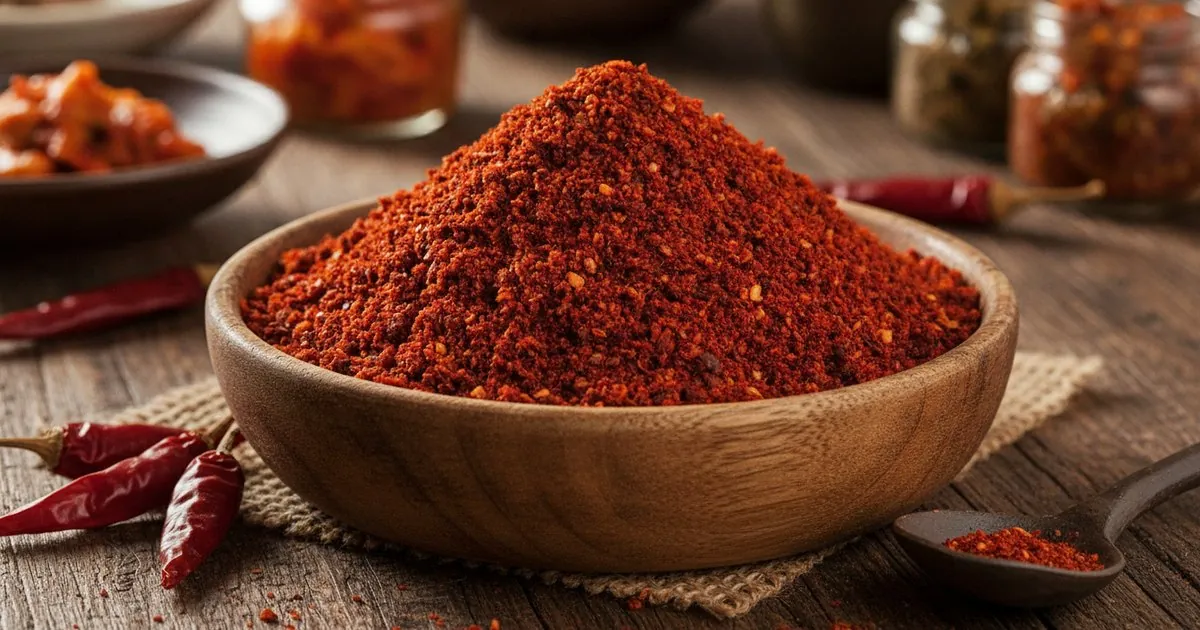
If there is a single ingredient that defines the look, the taste, and the soul of modern Korean cooking, it is gochugaru (고추가루). That brilliant brick-red powder — coarser than cayenne, fruitier than paprika, and more complex than any supermarket chili flake — is the reason kimchi glows red, tteokbokki sauce clings to every rice cake, and Korean BBQ marinades develop their characteristic deep, smoky sweetness on the grill. Without it, you are not really cooking Korean food.
And yet, gochugaru remains one of the most misunderstood and misused ingredients in Western kitchens. People substitute cayenne (too sharp, no sweetness), reach for generic chili powder (wrong flavor profile entirely), or buy the wrong grind without realizing it. This guide fixes all of that. By the end, you will know exactly what gochugaru is, where it came from, how to buy the right kind, how to store it properly, and — most importantly — how to use it in ways that actually work.
What Is Gochugaru, Exactly?
The name breaks down simply: gochu (고추) means chili pepper, and garu (가루) means powder or ground. So literally, gochugaru is “ground chili pepper.” But that translation undersells it enormously.
Authentic gochugaru is made from a specific variety of Korean red chili peppers — long, moderately spicy cultivars that are sun-dried or air-dried, then seeded and ground. The result is a flake or powder with a very particular character: mildly to moderately spicy, noticeably sweet and fruity, with a subtle smokiness that develops during drying. The color is a vivid, saturated red-orange — not the dark maroon of ancho chili or the bright orange of cayenne. When you rub a pinch between your fingers, it should feel slightly oily and leave a deep red stain; that oil is part of where the flavor lives.
One important distinction: products labeled “Korean red pepper powder” (a very fine grind, almost like paprika) are a different product, specifically used for making gochujang paste. Gochugaru proper has visible texture — the standard coarse grind looks like coarse breadcrumbs, while the medium or “fine flake” grind resembles standard chili flakes. Both are gochugaru. The ultra-fine powder is not.
A Surprisingly Recent History
Here is the fact that surprises almost everyone: Korean chili peppers are not native to Korea. Chili peppers originated in the Americas and reached Korea via one of the most consequential food journeys in culinary history.
The most widely accepted route: chili peppers traveled from the Americas with Portuguese and Spanish traders, made their way to Japan, and then arrived in Korea during — or shortly after — the Imjin War (1592–1598), the Japanese invasions of Korea under Toyotomi Hideyoshi. The first documented reference to the pepper in Korean writing appears in the Collected Essays of Jibong (지봉유설, 1614), a scholarly encyclopedia that describes the plant as wae-gaeja (왜개자) — literally “Japanese mustard,” a deeply unflattering term that reflects just how suspicious Koreans were of this foreign introduction.
And the suspicion ran deep. Early Korean accounts record that some people believed the peppers were a poisonous weapon the Japanese had deployed during the invasion — and that people died from eating or inhaling them. The association was hostile enough that the name itself carried that hostility.
Fast-forward roughly 150 years, and the picture is almost unrecognizable. By the time of King Yeongjo’s court in 1768, gochugaru had spread throughout the country and embedded itself in daily cooking. The transformation from suspected poison to national staple happened within a few generations.
Perhaps the most striking evidence of how recent this shift was: the oldest surviving Korean cookbook, Eumsik dimibang (음식디미방, 1670), contains no mention of red chili flakes or powder at all. And pre-chili kimchi was white — 백김치 (baek kimchi). The iconic red kimchi that now defines Korean food culture is, in historical terms, only about 250 to 300 years old.
Red pepper also acquired a powerful spiritual dimension in Korean folk culture. According to the National Folk Museum of Korea, dried red peppers were hung at gates during disease outbreaks and ritual ceremonies. After the birth of a son, a straw rope threaded with red peppers, pine branches, and charcoal was displayed at the entrance of the home — a folk announcement and protective charm. Red was associated with the sun, and spiciness was believed to repel evil forces and cleanse impurity. These are documented shamanistic folk practices from historical records, not modern beliefs, but they illustrate how completely the chili pepper was absorbed into Korean culture — spiritually as well as gastronomically — in just a few centuries.
Flavor Profile: What You’re Actually Tasting
Understanding gochugaru’s flavor in detail makes you a better cook with it. The key components:
- Heat level: Roughly 1,000–8,000 Scoville Heat Units, depending on the batch and region. Most mainstream gochugaru lands in the 4,000–6,000 SHU range — noticeably spicy, but with a slow build rather than an immediate burn. For comparison, cayenne is typically 30,000–50,000 SHU.
- Sweetness: This is the quality most people don’t expect. Good gochugaru has genuine sweetness — almost like a sweet bell pepper or mild paprika — which is what makes it so versatile as both a flavoring and a coloring agent.
- Fruitiness: A fresh batch has a clean, slightly fruity brightness. Stale gochugaru loses this and tastes flat and dusty.
- Smokiness: A background quality from the drying process — not as pronounced as smoked paprika, but present.
- Color: The dye compounds in gochugaru (primarily capsanthin) are oil-soluble. This means blooming gochugaru in warm oil unlocks both flavor and that extraordinary color.
Grades and Grinds: Which One Do You Need?
Korean grocery stores and online retailers typically stock gochugaru in two grinds:
Coarse Gochugaru (굵은 고추가루 — gulguen gochugaru)
Texture like coarse cornmeal or coarse breadcrumbs. This is the standard grade for kimchi — the visible texture is part of the kimchi paste’s character. Also used in bibimbap sauce, dipping pastes, and dishes where you want the flakes to be perceptible.
Fine Gochugaru (고운 고추가루 — goun gochugaru)
A more uniformly fine grind, similar in appearance to standard chili flakes or mild paprika. Better for sauces, marinades, soups, and stews where you want the color and heat to integrate smoothly without visible flake texture. Also better for sprinkling on finished dishes.
Many cooks keep both on hand. If you can only buy one, fine gochugaru is more versatile across cooking applications.
Where to Buy Gochugaru
Best Option: H Mart or Any Korean Grocery
H Mart carries multiple brands and grinds, often in large 500g (about 1 lb) or 1 kg (2.2 lb) bags. Look for brands like Taekyung, Wang, or Haioreum. Color should be bright red-orange, not dark brown. Smell it through the bag if you can — you want a clean, sweet, faintly smoky aroma, not a dusty or rancid smell. For a full shopping walkthrough, see our H Mart Shopping Guide.
Online
Amazon, Weee!, and Umami Insider all carry reputable brands. Order at least 200g (7 oz) — the smaller packets available at some online retailers are disproportionately expensive per gram and go stale faster once opened.
Whole Foods / Mainstream Grocers
Some Whole Foods carry gochugaru in the international foods aisle or spice section (brands like Sempio or Mother-in-Law’s). It works, but verify the grind type and freshness date. The selection is more limited and prices are higher.
What NOT to Substitute
- Cayenne pepper: 5–8× hotter, no sweetness, will dominate and distort any dish
- Generic “chili flakes” or crushed red pepper: Made from different pepper varieties, hotter and sharper, lacking the fruity sweetness
- Gochujang: A fermented paste — completely different product; you cannot substitute one for the other
- Paprika: Closer in heat level, but lacks the specific flavor compounds; can work in a pinch for color in non-critical applications
How to Store Gochugaru
Gochugaru’s enemies are heat, light, oxygen, and moisture. The oils that carry its flavor and color are volatile and degrade quickly under poor storage.
- Short-term (up to 2 months): An airtight container in a cool, dark pantry or cupboard is fine.
- Medium-term (2–6 months): Refrigerator in an airtight jar or zip-lock bag. The cold significantly slows oxidation.
- Long-term (6+ months): Freezer is the correct choice. Gochugaru freezes exceptionally well — the low moisture content means it does not clump significantly, and it can be scooped directly from frozen. Many Korean households buy in bulk (1 kg / 2.2 lb bags) and freeze the majority immediately.
A fresh batch should smell fragrant and faintly fruity. If it smells flat, dusty, or — worse — faintly rancid (a sign the oils have oxidized), it is past its prime. Stale gochugaru will give your kimchi and sauces a dull, muddy color instead of that vivid red.
How to Cook With Gochugaru
Bloom It in Oil
For the deepest color and flavor in stir-fries and sauce bases, add gochugaru to warm (not screaming hot) oil and let it sizzle gently for 30–60 seconds before adding other ingredients. The oil picks up the capsanthin dye and transfers it throughout the dish. Use medium-low heat — gochugaru burns quickly and turns bitter at high temperatures.
In Kimchi
Gochugaru is non-negotiable here. The standard ratio for a basic kimchi paste is roughly 2–4 tablespoons (16–32g) per medium head of napa cabbage, but this varies widely by recipe and personal taste. For the full method, see our complete how to make kimchi guide.
In Tteokbokki
The classic tteokbokki sauce is built on gochujang for body and fermented depth, but gochugaru is often added alongside it for extra heat and that vivid red color. A ratio of roughly 2 parts gochujang to 1 part gochugaru (by volume) is a common baseline. See our tteokbokki recipe for the full sauce breakdown.
In Marinades
Gochugaru is a key component in Korean BBQ marinades — its sweetness caramelizes beautifully on the grill, and the color creates that characteristic char on bulgogi and galbi. It works equally well in wet marinades (dissolved into sauce) and dry rubs.
In Soups and Stews
Jjigae (Korean stew) recipes — like kimchi jjigae and sundubu jjigae — rely on gochugaru dissolved directly into the broth for heat and color. It works best when added early and given time to hydrate and distribute.
Common Mistakes to Avoid
1. Using Cayenne as a 1:1 Substitute
This is the most common error, and it derails a dish completely. Cayenne is 5–8 times hotter than gochugaru and has none of the sweetness or fruitiness. If you substitute cayenne at equal volume in a kimchi paste, the result will be aggressively hot, one-dimensional, and missing the flavor character entirely. If gochugaru is unavailable, a blend of sweet paprika + a small amount of cayenne (roughly 4:1 ratio) is a more functional approximation, though still not equivalent.
2. Burning It in Oil
Gochugaru has significant natural sugar content, which means it scorches fast. The tell is unmistakable: the oil turns dark brown-black and the kitchen fills with an acrid, bitter smell (not the sweet, toasty aroma you want). This happens when you add gochugaru to oil that is too hot. The fix: Always bloom gochugaru off the peak heat — add it to warm oil and reduce the flame, or push the pan off the burner briefly. The oil should sizzle gently around the flakes, not violently spit.
3. Confusing Gochugaru With Korean Chili Powder (Fine-Ground)
The ultra-fine Korean red pepper powder sold for making gochujang paste is a different product with a different pepper variety and grind. Using it as a 1:1 substitute in kimchi will give you a pasty texture and different flavor. Check the label and the texture: gochugaru has visible grain and structure; the fine powder is almost silky. They are not interchangeable.
4. Not Adjusting for Freshness
Gochugaru from different batches and brands varies significantly in heat and potency. A fresh bag from a high-turnover Korean grocery may be noticeably hotter and more fragrant than the same brand bought six months later from a store with slow turnover. Always taste your gochugaru before committing to a recipe amount, especially for kimchi where it defines the dish. Start at the lower end of the recipe range and adjust.
5. Storing It Incorrectly and Using Stale Product
Stale gochugaru is a silent saboteur. The flavor loss is gradual, so cooks often don’t notice until a batch of kimchi comes out pale and flat-tasting. The diagnostic check: a vibrant, fresh batch will stain your fingers deeply red within seconds of contact. If the color transfer is weak and the smell is flat, it’s past its prime. The fix: Freeze surplus immediately; buy from stores with high Korean-food customer turnover (better stock rotation).
6. Using Only Fine Grind for Kimchi
Fine gochugaru integrates more evenly into sauces, but for kimchi, the coarse grind matters. The texture of the paste, how it coats the cabbage leaves, and ultimately the visual result all benefit from the coarser flakes. If your kimchi paste looks more like a smooth sauce than a textured paste, you likely used fine grind. Use coarse for kimchi specifically, and save the fine grind for soups and marinades.
Frequently Asked Questions
Is gochugaru the same as gochujang?
No — they are completely different products. Gochugaru is the raw dried and ground chili flake. Gochujang is a fermented paste made from gochugaru (fine grind), glutinous rice, fermented soybeans, and salt. Gochujang has a deep, complex, sweet-salty-fermented flavor profile; gochugaru is more straightforward heat and fruity pepper character. You cannot substitute one for the other. For a deep dive into the paste, see our gochujang guide.
How spicy is gochugaru compared to regular chili flakes?
Gochugaru is significantly milder than the crushed red pepper flakes commonly used in Italian or Mexican cooking. Those flakes are typically made from cayenne or similar high-heat varieties and run 30,000–50,000 SHU. Gochugaru averages 4,000–8,000 SHU — more comparable to a mild-to-medium jalapeño. The heat also builds more slowly and dissipates more cleanly, which is part of why Korean food can layer so much gochugaru without becoming overwhelmingly hot.
Can I make gochugaru at home?
Yes, with the right pepper variety. Korean chili peppers (Capsicum annuum cultivars bred in Korea) are occasionally available as seeds from specialty suppliers. If you can grow and dry them, grind in a spice grinder or blender after fully drying. However, the pepper variety genuinely matters — you will not replicate the flavor with cayenne or Anaheim peppers, even with the same drying method. For most home cooks, buying from H Mart or online is far more practical.
How much gochugaru is too much for beginners?
There is no fixed answer, but a useful rule of thumb: start at half the recipe amount the first time you cook a dish. You can always add heat; you cannot remove it. Once you have tasted the dish at the halfway point and understand the heat contribution, adjust to your preference. Most traditional Korean home cooking is made for palates accustomed to the flavor — Western palates new to gochugaru often find standard recipe amounts genuinely spicy.
Does gochugaru work in non-Korean dishes?
Absolutely. The fruity sweetness and moderate heat make gochugaru an excellent addition to any application where you want color and warmth without the harsh sharpness of cayenne: pasta sauces, roasted vegetables, egg dishes, and even compound butters. Think of it the way some cooks use smoked paprika — as a flavor-building spice that also brings color. The main thing to keep in mind is that it blooms well in oil, so add it early in fat-based cooking for best results.
Gochugaru is, in the end, not just an ingredient — it is the defining flavor signature of a cuisine that only adopted it in the last few centuries and then built an entire culinary identity around it. Getting it right in your kitchen is one of the highest-leverage moves you can make if you want to cook Korean food authentically. Buy the right grind, store it properly, and taste it fresh — everything else follows from there.