
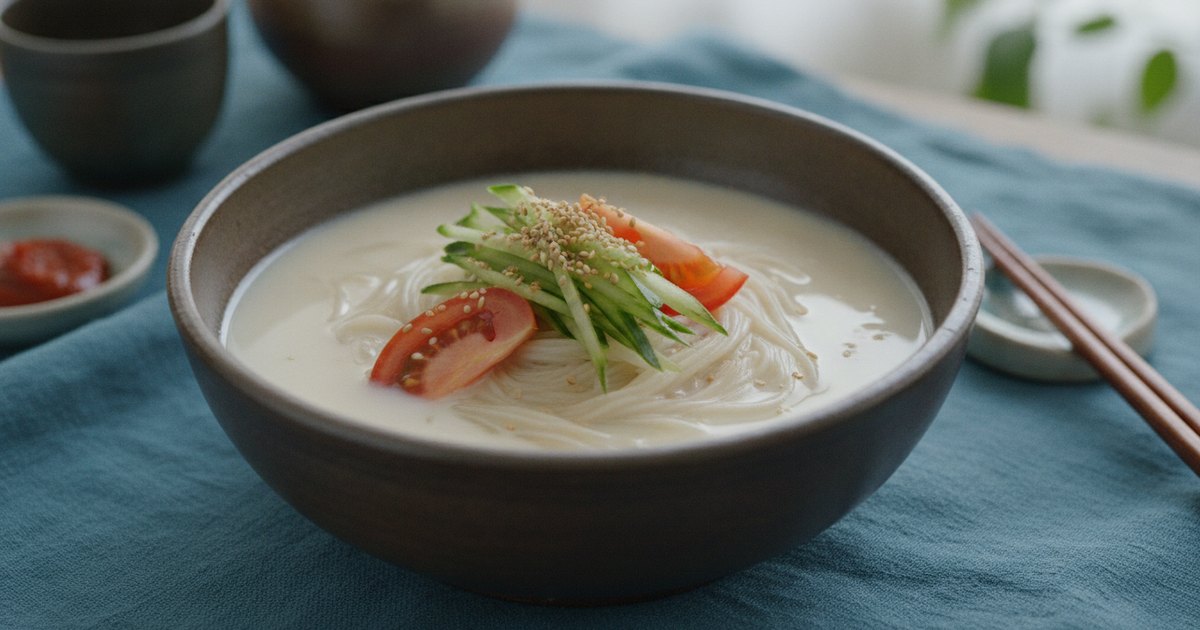
When the humidity peaks and the air sits thick and still, there's one dish that cuts through summer heat in Korea better than almost anything else: kongguksu (콩국수). It's deceptively simple — an ice-cold, snow-white soybean milk broth poured over a nest of thin wheat noodles, crowned with julienned cucumber, bright tomato slices, and a few cubes of ice that melt slowly into the bowl. The broth is creamy, faintly nutty, and savory in the quietest, most unshowy way. The first time you eat it, nothing about the short ingredient list prepares you for how deeply satisfying it is.
Kongguksu is one of Korea's most beloved summer foods, and it remains dramatically underrepresented in the Western K-food conversation. If you've already worked through the spicy classics like tteokbokki or the tangy brightness of bibim guksu, kongguksu is the cooling, gentle counterpoint your summer cooking rotation genuinely needs.
What Is Kongguksu (콩국수)?
The name is straightforward: kong (콩) means soybeans, and guksu (국수) means noodles. But the real centerpiece is the broth — konggukul (콩국물), a freshly made soy milk that shares almost nothing in flavor with the fortified, shelf-stable cartons sold at Western grocery stores.
Korean culinary historians trace kongguksu back to the Joseon dynasty, when soybeans were a foundational protein across the peninsula. The dish sits within the broader category of naengmyeon (cold noodles) in Korean culinary taxonomy, though it has a distinct identity from spicy bibim guksu or the beef-broth-based mul naengmyeon. Notably, kongguksu is naturally and entirely plant-based in its classic form — no meat stock, no fish sauce, nothing animal-derived except an optional egg garnish. It's one of the rare traditional Korean dishes that requires zero modification to be vegan.
In Korea, kongguksu is firmly a seasonal dish. From early summer through August, restaurants post handwritten signs advertising freshly made konggukul, and serious establishments prepare it daily because the broth doesn't hold well at room temperature and its flavor begins to deteriorate after a couple of days. That freshness is part of the point.
The flavor profile is distinctive and worth describing carefully: savory from the soybeans, subtly bitter in a pleasant way, faintly sweet from the pine nuts and sesame, and with a creamy richness that coats the tongue without any heaviness. Served ice-cold in a hot kitchen, it's genuinely restorative.
The Ingredients You Need
Soybeans (백태, Baektae)
The hero of the dish. You want dried yellow soybeans — in Korean they're called baektae (백태), meaning "white beans," though they cook up pale yellow. For 4 servings, you'll use 1 cup (180 g / 6.3 oz) of dried beans, which will roughly double in size after overnight soaking.
Finding them in Western kitchens: Any Korean grocery store (H Mart, Lotte Plaza, Zion Market) carries baektae in 1–2 lb bags for a few dollars. Bob's Red Mill sells dried yellow soybeans nationwide, and they work perfectly. What to avoid: black soybeans (geomeun kong) will turn the broth a grayish-lavender (they make a beautiful variation, but it's a different dish), canned soybeans change the texture and can make the broth gummy, and edamame has entirely the wrong flavor profile.
Pine Nuts and Sesame Seeds
These two additions transform the broth from simple bean water into something genuinely layered. Pine nuts (잣, jat) contribute a buttery, resinous sweetness; toasted sesame seeds bring a roasted depth that you can smell in the finished broth before you even taste it. The range across recipes is wide — from 1 tablespoon to ¼ cup of pine nuts — but 3 tablespoons (30 g) hits the sweet spot: noticeable but not dominating.
Pine nuts are expensive everywhere. Walnuts, blanched almonds, or dry-roasted peanuts work as partial or full substitutes and create slightly different but equally delicious broths. Some cooks use a combination of soybeans and peanuts as the broth base entirely.
Noodles
The near-universal choice is somyeon (소면), a dried thin wheat noodle essentially identical to Japanese somen. Each serving uses 80–100 g (about 3–3.5 oz) of dried noodles. They cook in 2–3 minutes, they're inexpensive, and their slippery, delicate texture drinks up the broth beautifully.
One dissenting perspective worth flagging: a minority of Korean cooks argue that somyeon is too fine-textured and "disappears" into a thick konggukul broth, preferring chewier buckwheat noodles (메밀국수, memil guksu) for more contrast. This is a legitimate alternative, but the overwhelming majority of home cooks and restaurants use somyeon — and it works wonderfully when handled correctly.
Sourcing: Somyeon is available at Korean grocery stores and increasingly at larger Asian supermarkets. Japanese somen noodles at Whole Foods or World Market are identical and interchangeable.
Garnishes
- Cucumber: Julienned thin. English cucumbers and Kirby (pickling) cucumbers are the best Western options. Korean cucumbers (oi) are ideal if you can find them. The crunch against the creamy broth is essential contrast.
- Tomato: Counterintuitive, but traditional. The acidity cuts through the richness of the soy broth in a way that's genuinely needed. Sliced ripe tomatoes or halved cherry tomatoes both work.
- Ice cubes: Non-negotiable. Three to five cubes directly in the bowl maintain the broth temperature and create a gentle dilution as they melt, which keeps the broth from becoming too dense by the last sips.
- Hard-boiled egg (optional): The creamy yolk contrasts beautifully with the cold, savory broth and adds protein.
How to Make Kongguksu: Step-by-Step
The Day Before: Soak Your Soybeans
This is the step that determines the quality of your broth more than any other, and it requires nothing more than planning ahead. Place the dried soybeans in a large bowl, cover with cold water by at least 2 inches (5 cm), and leave at room temperature overnight — a minimum of 6 hours, 8 hours is ideal. By morning, the beans will have swollen to nearly twice their size. Press one between your fingers: it should yield easily and feel uniformly soft all the way through with no hard, dry center. That's your signal they're ready.
Cook the Soybeans
Drain and rinse the soaked beans, then transfer to a medium saucepan with fresh cold water covering them by about 1 inch (2.5 cm). Bring to a boil over high heat, skimming off the white foam that rises in the first few minutes — this is coagulated protein, and removing it produces a cleaner-tasting broth. Reduce to a steady simmer.
How long to cook? The answer genuinely varies by preference and source. A shorter simmer of 7–10 minutes produces a brighter, more grassy, livelier soy flavor. A longer simmer of 20–25 minutes rounds out the bitterness and yields a mellow, creamy, rounder broth. For a first attempt, the longer cook is more forgiving and produces the familiar flavor most people associate with kongguksu. Either way, the beans should be fully tender when pressed but not disintegrating.
Peel the Skins
Once the beans are cooked and cool enough to handle, take the time to remove the skins. Rub handfuls of beans between your palms over a large bowl of cold water — the papery outer skins slip free and float to the surface. Pour off the water and skins, refill, and repeat 2–3 times. Technically optional, but the difference is real: the broth goes from pale beige with a faintly bitter edge to clean, bright white with a noticeably smoother, silkier character. If your broth consistently tastes bitter and you can't figure out why, incomplete skin removal is almost certainly the cause.
Blend the Broth
Add the peeled, cooked soybeans, pine nuts, and sesame seeds to a blender. Start with 2 cups (480 ml) of cold water — always cold — and blend on high for 60–90 seconds until the mixture becomes thick and creamy. Add another 2–3 cups (480–720 ml) of cold water and blend again until completely smooth. The finished broth should be opaque white and pourable, roughly the consistency of whole milk or thin cream. Pull a spoonful out and run your finger through it: if you detect any graininess, keep blending. If the broth feels too thick, add cold water in small increments until it reaches the right consistency.
Strain, Season, and Chill
Pour the broth through a fine-mesh strainer or double layer of cheesecloth into a large bowl, pressing gently. Discard the remaining solids. Stir in ¾ teaspoon of fine sea salt and taste carefully. The broth should be lightly savory with a clean, nutty sweetness. Add more salt in small increments if it tastes flat, or a pinch of sugar to smooth any lingering bitterness. Refrigerate, covered, for at least 30 minutes — the broth must be thoroughly cold before serving. The good news: the broth keeps well for up to 48 hours in the refrigerator, making this a great make-ahead component.
Cook and Rinse the Noodles
Bring a large pot of unsalted water to a vigorous boil. Add the somyeon and cook for 2–3 minutes, stirring once or twice. Taste a strand at the 2-minute mark: you're looking for just-tender noodles that still have a slight chew. They'll continue softening in the cold broth. Drain immediately and rinse under cold running water for a full 30–45 seconds, tossing with your hands constantly. The noodles are ready when they feel silky, completely cold, and no longer sticky or starchy to the touch. This rinse is not a quick swish — it's an active step that directly determines texture in the finished bowl.
Assemble and Serve
Twirl each portion of cold noodles into a neat bundle and place in a deep bowl. Ladle 1 to 1½ cups (240–360 ml) of chilled soy broth over the noodles — be generous, the broth is the dish. Arrange julienned cucumber and tomato on top. Add 3–5 ice cubes per bowl. Finish with a pinch of toasted sesame seeds and a few whole pine nuts if using. Serve immediately, with a small dish of fine salt on the table — seasoning preference varies considerably by region and by individual, and the Korean tradition of letting people adjust at the table is exactly the right call here.
The Shortcut Method (When You Forgot to Soak)
If you decide to make kongguksu the same afternoon, here's a legitimate 10-minute shortcut: blend 300 g (10.5 oz) of soft or silken tofu with 1½ cups (360 ml) of plain unsweetened soy milk, 65 g (½ cup) of dry-roasted peanuts, 2 tablespoons of toasted sesame seeds, and 1 teaspoon of salt until completely smooth. Chill for 20 minutes and serve over noodles with the usual garnishes. The flavor profile is different — less grassy and raw-soy-forward, more neutral and rich — but it's genuinely good. The critical detail: the soy milk must be unsweetened. Sweetened soy milk, even those labeled "original," will make the broth taste like a dessert in the worst possible way.
Variations Worth Trying
- Black soybean broth (검은콩 국수): Substitute all or half the soybeans with black soybeans. The broth turns a striking pale lavender-grey and delivers a richer, earthier flavor. It's a real showstopper visually.
- Peanut and walnut additions: Incorporating walnuts or dry-roasted peanuts alongside the soybeans adds an extra dimension of nuttiness and makes the broth slightly thicker and more filling.
- Buckwheat noodles: Swap somyeon for memil guksu (메밀국수) for more textural contrast. The earthy nuttiness of buckwheat pairs beautifully with the clean soy broth.
If you enjoy Korea's approach to beating the heat with creamy, cold textures, you might also explore our guide to bingsu, Korea's iconic shaved ice dessert — that same philosophy of layering cold, sweet, and creamy to survive summer heat runs through both dishes.
Common Mistakes to Avoid
1. Under-soaking the beans → grainy, chalky broth Soybeans that haven't soaked long enough won't break down properly in the blender, no matter how long you run it. The telltale signs: the broth has a sandy, slightly gritty texture on the tongue, and it looks off-white and chalky rather than clean, uniform cream. The only real fix is time. If you forgot to soak overnight, use the quick-soak method: boil the dried beans for 2 minutes, turn off the heat, cover, and let sit for 1 hour. It's not as good as an overnight soak, but it gets you close enough.
2. Skipping or rushing the skin removal → bitter, grayish broth Soybean skins contain tannins. Leave them in and they contribute a distinct bitterness and a grayish-beige tint to what should be a clean white broth. If your konggukul tastes noticeably astringent or looks dull in color, incomplete skin removal is almost certainly the cause. Do the water-floating step at least twice, pouring off both water and floating skins each time.
3. Blending with warm water or skipping the chill → a separated, watery broth Konggukul is an emulsion, and heat is the enemy. Using the hot cooking water to blend, or skipping refrigeration and serving the broth at room temperature, causes the fat and liquid components to separate — you end up with a watery, slightly curdled-looking broth by the time the bowl reaches the table. Always blend with cold water. Always refrigerate for at least 30 minutes. If the broth looks separated in the bowl before the person eats it, the issue is temperature.
4. Not rinsing the noodles thoroughly → gluey broth, sticky noodles Somyeon releases a significant amount of surface starch during cooking. If you don't rinse the noodles under cold running water long enough — and "long enough" means a full 30–45 seconds of active tossing, not a quick 5-second splash — that starch transfers directly into the broth, making it cloudy and gluey in a way that obscures the clean flavor. The noodles should feel completely silky and non-sticky between your fingers before you consider them done rinsing.
5. Overcooking the noodles → mushy, indistinct texture Somyeon noodles are fine and cook fast. Two minutes of boiling is often all they need; three minutes is usually the maximum before they start to turn soft. Remember that they'll continue to absorb liquid and soften after they hit the cold broth in the bowl. Pull them while they still have a clear, slight chew, rinse immediately, and they'll be perfect by the time they're eaten.
6. Using sweetened soy milk in the shortcut method → cloying, dessert-flavored broth If you're making the tofu-and-carton-soy-milk shortcut, this is the single most common error. Many mainstream soy milk brands — including products labeled "original" or "classic" — contain added sugar. Check the nutrition label before buying: you want 0 g or at most 1 g of sugar per serving. Sweetened soy milk makes the broth taste unmistakably sweet, and no amount of extra salt will bring it back into savory territory.
Frequently Asked Questions
Is kongguksu naturally vegan? Yes — in its classic form, kongguksu is fully plant-based: soybeans, pine nuts, sesame seeds, salt, and wheat noodles. No meat stock, no fish sauce, no animal products. It's one of the few traditional Korean dishes that requires no modification whatsoever to be vegan. Just check your somyeon label if egg-free matters to you (most dried somyeon contains only wheat flour and water, but it varies by brand). The hard-boiled egg garnish is always optional and easy to skip.
Can I make the soy broth ahead of time? Absolutely, and it's actually the smart move. The broth keeps well in the refrigerator for up to 48 hours. Some natural separation may occur as it sits — just stir or shake before serving. Beyond 2 days, the flavor begins to dull and develop a faint fermented quality. For the best taste, make it the day before or the morning of.
My broth turned out too thick. How do I fix it? Whisk in additional cold water, a few tablespoons at a time, until you reach a pourable consistency — roughly the thickness of whole milk. There's no perfect ratio because bean yield varies by batch, age of the beans, and how long they were soaked. Thinning the broth with cold water is completely normal and doesn't compromise quality.
Where can I find somyeon noodles? H Mart and Korean grocery stores always carry them in the dried noodle aisle. If you don't have a Korean market nearby, Japanese somen noodles (same type of noodle, spelled differently) are available at Whole Foods, Japanese grocery stores, and online. Avoid substituting angel hair pasta — the starch content and texture are meaningfully different, and it doesn't rinse clean the same way.
Can I make kongguksu gluten-free? The soy broth is naturally gluten-free. The noodle is the only variable. For a gluten-free version, use 100% buckwheat soba (check the label carefully — many commercial soba brands blend wheat and buckwheat flour) or rice vermicelli. Rice noodles absorb the broth similarly to somyeon and the dish works well, though the texture is slightly different. If using soba, look for brands that list only buckwheat on the ingredient panel. ```