
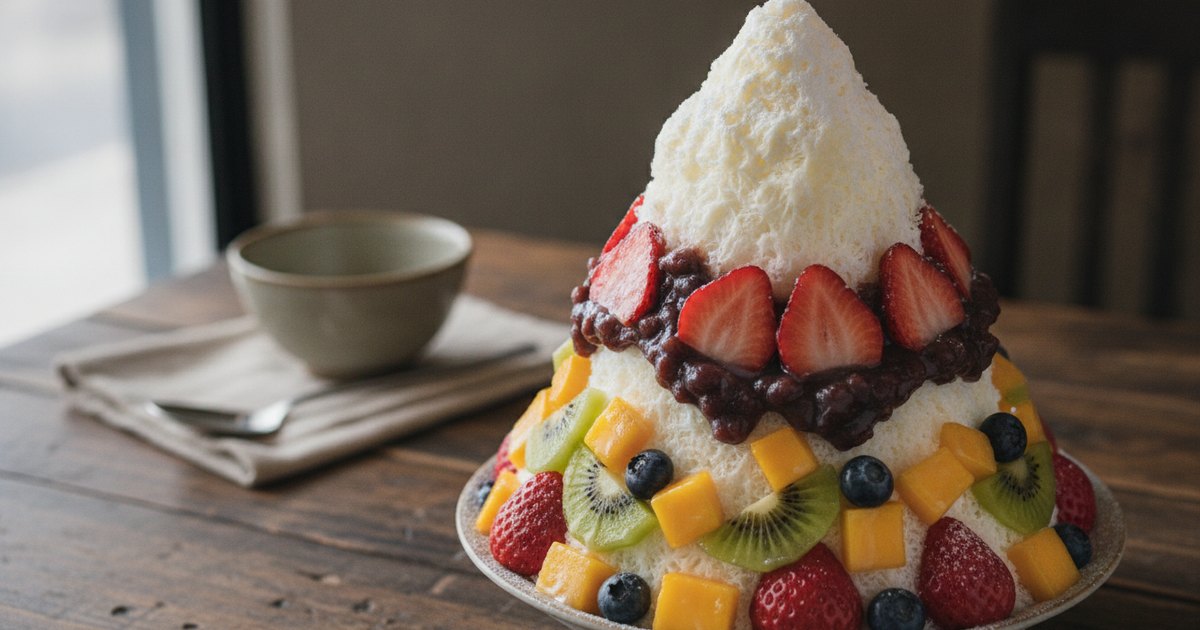
Bingsu (빙수) is Korea's answer to summer heat — a dramatic, heaped mountain of finely shaved ice buried under sweet red beans, chewy rice cakes, fresh fruit, and a generous drizzle of condensed milk. Walk past any Korean dessert café between June and August and you'll see these towering bowls being ferried to every table, condensation beading on their sides.
What makes great bingsu extraordinary isn't any single topping. It's the texture of the ice itself. Authentic Korean bingsu doesn't crunch like a snow cone or melt into a soggy cup of flavored water. When it's done right, the ice shaves down into something closer to powdery snow — so fine and airy that it dissolves on your tongue in a cool, milky melt. That's the target this recipe is aimed at. Once you've tasted the difference between coarse crushed ice and properly shaved milk ice, you'll understand why Koreans are so particular about it.
A Dessert Born from Royal Ice
Bingsu's origins trace back to the Joseon Dynasty (1392–1897), when ice harvested from frozen rivers and stored in royal icehouses called binggo (빙고) was a privilege of the court and upper aristocracy. The earliest versions were strikingly simple: shaved ice with honey, pine nut paste, or thin-sliced fruit. Ice was genuinely scarce, its distribution officially regulated, and ordinary people rarely tasted it.
The democratization of bingsu came with modern refrigeration in the 20th century. Patbingsu (팥빙수) — "pat" meaning adzuki red beans — became the definitive standard version, beloved by everyone from schoolchildren to grandparents. Street vendors and bunsik (snack shop) cooks sold it affordably at every turn.
The next leap came with Korea's café boom in the 2000s and 2010s. Dessert cafés began refining the ice base itself, mixing whole milk and condensed milk before freezing to produce a denser, creamier, more delicate shave. Seasonal fruit bingsu — mango, strawberry, peach — became fashionable. Signature bingsu at upscale Seoul cafés now regularly sell for 20,000–40,000 KRW (roughly $15–$30 USD). What began as royal court food has become one of Korea's most recognizable culinary exports, with devoted fans from Los Angeles to London.
The Two Pillars: Ice Base and Red Beans
Every great bingsu rests on exactly two foundations. Nail both and the rest is just customization.
The Milk Ice Base: Why It Changes Everything
Plain water ice gives you refreshing crunch but melts into a bland puddle within minutes. Milk ice — made by freezing a blend of whole milk, cold water, and a small amount of sweetened condensed milk — is categorically different. The milk fat allows the shaver to tear the frozen block into finer, softer flakes. The faint built-in sweetness means the toppings need less work, and the finished texture is that signature cloud-like snow that defines modern Korean café bingsu.
The ratio that works reliably: 480 ml (2 cups) whole milk + 480 ml (2 cups) cold water + 30 ml (2 tbsp) condensed milk, frozen at least 5–6 hours until fully solid. For a richer, more café-style base, some recipes use significantly more condensed milk in the base and reduce the drizzle on top — a satisfying trade-off if you want deep, milky sweetness baked into every bite of ice.
How to tell when the block is ready: Press your fingernail into the center of the frozen block. If it leaves any impression at all, the block isn't fully frozen through. Partially frozen ice produces wet, clumping slush. You need the whole thing solid.
The Red Bean Topping (팥 / Pat)
Canned sweetened adzuki beans are a fully legitimate shortcut — see the sourcing section below. But cooking from dried beans gives you textural control that no can can match. The finished beans should be completely tender — press one between thumb and finger and it yields with zero chalky resistance at the center — but they should hold their shape as distinct, whole beans, not collapse into mush. You want whole beans in a light syrup, not a paste.
The discard step (a quick 5-minute boil followed by draining) is not skippable — that first cooking water pulls out saponins and tannins that give a noticeably harsh, slightly soapy bitterness to the finished dish. After discarding it, the flavor of the beans becomes clean and mild. Sweeten moderately; the condensed milk you drizzle on top is doing considerable sweetening work, and oversweetened beans are the most common first-timer mistake.
One lb / 454 g of dried adzuki beans yields approximately 5–6 cups of cooked sweetened beans — far more than you need for two servings. That's a feature, not a bug. Refrigerate the rest and you have bingsu toppings ready for the whole week.
The Full Recipe
Makes 2 generous servings | Active time: ~25 minutes · Freeze time: 5–6 hours (plan ahead)
Step 1 · Make the Milk Ice Base
Whisk together 480 ml (2 cups) whole milk, 480 ml (2 cups) cold water, and 30 ml (2 tbsp) sweetened condensed milk until fully combined. Pour into two shallow, freezer-safe containers — silicone loaf pans or zip-lock bags laid completely flat both work beautifully. Freeze for at least 5–6 hours, or overnight. Shallow containers freeze more evenly and faster than deep ones.
Step 2 · Cook the Sweet Red Beans
Rinse 454 g (2½ cups) dried adzuki beans under cold water. Place in a pot, cover generously with cold water, and bring to a boil. Cook at a rolling boil for 5 minutes, then drain and discard this water entirely — don't skip it.
Return the beans to the pot with 1.9 L (8 cups) fresh cold water. Bring to a boil, reduce heat to medium-low, and simmer partially covered for 50–60 minutes. Check doneness by pressing a single bean between your thumb and finger: it should yield completely smooth with no resistance, no dry starchy center.
Drain most of the cooking liquid, leaving about 120 ml (½ cup) in the pot. Add 65 g (⅓ cup) granulated sugar, 80 ml (⅓ cup) honey, and 2.5 ml (½ tsp) fine sea salt. Stir over low heat for 3–5 minutes until the sugar dissolves and the liquid reduces to a light, glossy syrup. Taste it: the beans should be pleasantly sweet, not cloying. Cool completely before assembling. Store refrigerated for up to 5 days.
Step 3 · Prep Your Toppings Before You Shave
This sounds obvious but it matters: have everything measured, sliced, and staged before you touch the ice. Slice your 80 g (about 6) strawberries. If your bingsu tteok (mini rice cake cubes) feel stiff, drop them in hot water for 30 seconds, then drain — they'll turn pliable and tender immediately. Measure out 45 g (⅓ cup) blueberries, 30 ml (2 tbsp) misugaru, and your condensed milk drizzle. Once the ice is shaved, you have maybe 5–7 minutes before texture degrades.
Step 4 · Shave the Ice
Remove the frozen milk-ice block from the freezer at the very last moment. With a bingsu machine or snow-cone maker: feed the block through directly; these machines are purpose-built for this and give the finest results. Without a machine: break the solid block into rough chunks and pulse in a high-powered blender in short, 10–15 second bursts, checking texture after each pulse. You are looking for fine, dry-looking, powdery snow — the moment it looks light and fluffy, stop immediately. Over-blending turns it to slush in seconds. A box grater also produces excellent, finely textured ice for small batches.
Step 5 · Assemble and Serve
Spoon the shaved ice into a wide, deep bowl — pile it loosely and tall, like a little snowdrift, not packed down flat. Height and lightness are the goal; don't compress it. Arrange your red beans, strawberries, blueberries, and rice cakes over and around the mound. Drizzle 60 ml (4 tbsp) sweetened condensed milk generously over the top. Dust with misugaru. Add a small scoop of vanilla ice cream to crown it if you want the full café experience. Eat immediately.
Toppings: Build Your Bingsu Your Way
The combination above is classic patbingsu, but bingsu is deeply personal and Koreans customize freely. A few principles worth knowing:
Non-negotiable (in our view): Sweet red beans, condensed milk drizzle, bingsu tteok. These three define the dish at its core.
Worth adding: Misugaru is an underrated classic outside Korea — roasted multigrains ground into a nutty, earthy powder that contrasts the sweetness brilliantly. It's traditional and worth seeking out.
Modern riffs: Mango bingsu swaps strawberries for ripe mango chunks and sometimes uses a coconut milk–water base. Matcha bingsu stirs 5–7 g (1–1½ tsp) matcha into the condensed milk drizzle and pairs beautifully with red bean ice cream. Cornflakes add a surprising crunch that's become something of a Korean bingsu institution.
If you love Korean sweets generally, the same interplay of contrasting textures and layered sweetness runs through hotteok (sweet stuffed Korean pancakes) and dalgona candy — Korea has a remarkably sophisticated dessert and snack culture that's just beginning to break through internationally.
Sourcing Ingredients in a Western Kitchen
Adzuki beans: Widely available. Whole Foods, natural food stores, and well-stocked supermarkets carry them (often labeled "azuki beans"). Any H Mart or Korean grocery will stock them prominently, usually in 1 lb bags.
Sweetened condensed milk: Standard supermarket shelf item everywhere — Eagle Brand or any store brand works identically.
Bingsu tteok (빙수떡): These small, individually wrapped, often brightly colored chewy rice cake cubes are sold at Korean grocery stores and H Mart, typically in the refrigerated section near the tteok. If unavailable, cut a garaetteok (plain rice cake cylinder) into small cubes and microwave for 15 seconds to soften. For a full guide to Korean pantry essentials and where to find them, our H Mart shopping guide covers everything you need.
Misugaru: Look at Korean groceries under "misugaru" or "roasted grain powder." No substitute is exact, but a small amount of malted milk powder approximates the toasty, nutty character reasonably well.
Bingsu machine: Dedicated shavers (available from Cuisinart, Nostalgia, and Korean brands on Amazon, ranging from $25–$80) give the finest texture. A strong blender works well. What doesn't work: a standard blender run for too long, or a manual ice crusher (too coarse).
Common Mistakes to Avoid
1. Shaving a block that isn't fully frozen through This is the most common cause of disappointing bingsu. If the frozen block has a soft center — or if it sat on the counter for a few minutes before you shaved it — the result is wet, clumping slush, not dry snow. The block needs to be completely solid from surface to core. When in doubt, check the center: it should be opaque white all the way through, with no translucent or softer-looking sections. If using a blender, work from fully frozen chunks and stop the moment you see fine powder.
2. Skipping the first-water discard when cooking beans Red bean skins contain saponins and tannins that produce a noticeable harsh bitterness — slightly soapy, slightly astringent — when you cook the beans in their first water. The fix is trivially easy: boil five minutes, drain completely, start fresh. Don't rationalize skipping it to save time. The flavor difference is significant.
3. Oversweetening the red beans The beans are one of several sweet elements in the finished bowl — condensed milk drizzle, sweet ice base, possibly ice cream. If your bean syrup tastes very sweet straight from the pot, it will taste cloying assembled. Taste the beans critically at the sugar step and aim for "pleasantly sweet," leaving room for the other elements to contribute. You can always drizzle more condensed milk; you can't un-sweeten beans once they're cooked.
4. Letting the shaved ice sit before assembling Bingsu is a dessert that tolerates no procrastination. In even an air-conditioned kitchen, properly shaved ice loses its feathery texture and starts to consolidate into slush within 5–7 minutes. Assemble the moment the ice is shaved, with all toppings already staged and ready to go. This is not a dish you prep ahead and plate at your leisure.
5. Using low-fat or non-dairy milk for the ice base Skim milk and low-fat dairy produce a noticeably wetter, coarser shave because there's less fat to create that smooth, fine-flake texture. Whole milk is important here, not a rounding error. If you need a dairy-free option, full-fat canned coconut milk blended 60:40 with water is the best substitute — it shaves more finely than any low-fat dairy alternative and adds a pleasant tropical note.
6. Packing the ice down into the bowl Bingsu should be piled loosely and high — the airy, cloud-like structure is both visually correct and functionally important. Pressing or tamping the ice down collapses the structure, forces out air pockets, and dramatically accelerates melting. Use a light hand: spoon the shaved ice gently and let it build naturally into a mound.
Frequently Asked Questions
Can I make bingsu without a shaving machine? Yes, and it works well. A high-powered blender (Vitamix or equivalent) with short, controlled pulses gets you surprisingly close to machine-shaved texture. A box grater drawn across the frozen block's surface also produces fine, clean ice and is particularly good for smaller batches where you want precise control. What doesn't work well: a standard home blender run for more than a few seconds (it over-processes into slush), or a manual lever-style ice crusher (the result is too coarse and chunky for bingsu).
Can I use canned red beans instead of cooking from scratch? Absolutely. Korean grocery stores sell canned sweetened adzuki beans (look for danpatso or labels showing 단팥) that are already cooked and sweetened — open and spoon directly onto the bingsu. Plain canned adzuki beans can be quickly simmered with a little sugar, honey, and salt for 10 minutes to make an acceptable quick version. Scratch-cooked beans will always have better texture and a more nuanced flavor, but canned is a completely respectable shortcut, especially on a weeknight.
How long does each component keep? Assembled bingsu must be eaten immediately — there are no leftovers. But the components store well separately: sweetened red beans keep refrigerated for up to 5 days and freeze well for up to 3 months. Milk-ice blocks keep in the freezer indefinitely. Make larger batches of both components and assemble individual servings fresh throughout the week.
What's the difference between bingsu and Japanese kakigōri? They share a common historical ancestor — both are shaved ice desserts — but have diverged significantly. Kakigōri typically uses plain water ice flavored with brightly colored simple syrups (strawberry, melon, matcha), while Korean bingsu uses a milk or condensed milk base for richer, creamier ice and features toppings like adzuki beans, chewy rice cakes, and misugaru that add textural complexity. Korean bingsu is also typically served in dramatically larger portions, often designed to be shared.
My ice mountain keeps melting too fast. What am I doing wrong? Usually one of two causes: either the kitchen is too warm (the ice melts no matter what if it's 30°C/86°F in the room — serve immediately and eat quickly), or the ice base didn't freeze fully through and has more liquid content than it should. Freezing in shallow, wide containers rather than deep bowls speeds up the freeze and helps the block reach consistent full-depth solidity. Chilling your serving bowls in the freezer for 5–10 minutes before assembly also helps — a room-temperature ceramic bowl actively warms the ice from the bottom. ```