
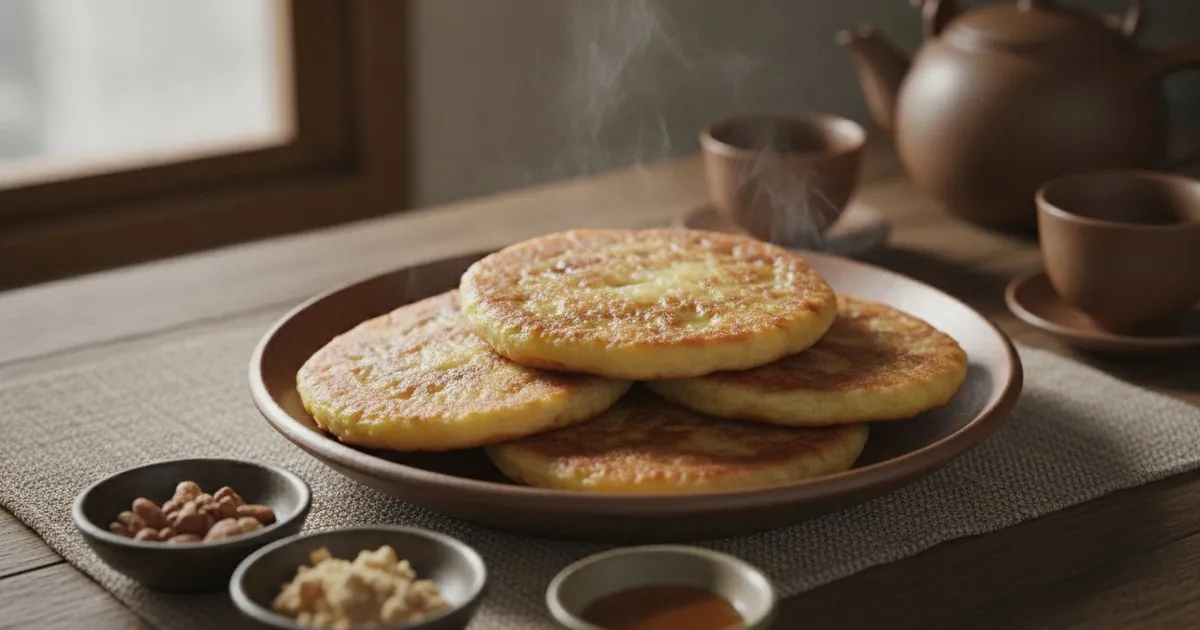
Imagine standing on a narrow alley outside a Seoul winter market at dusk. Your breath is fogging. A street vendor scoops a plump dough ball from a bowl, sets it hissing into a puddle of oil, then — with a deeply satisfying thunk — presses it flat with a round metal tool. Within sixty seconds, the aroma of caramelizing brown sugar and cinnamon drifts toward you. You hand over a few hundred won, receive a golden disc cradled in a small paper cup, and take your first bite. The exterior crackles. The filling flows like hot caramel. You immediately want another one.
That is hotteok (호떡) — Korea’s most beloved winter street snack. And while it’s most magical eaten outside in the cold, it is absolutely, joyfully makeable in your own home kitchen, any time of year.
What Is Hotteok (호떡)?
Hotteok is a yeast-leavened, pan-fried pancake stuffed with a sweet filling — classically dark brown sugar, ground cinnamon, and crushed roasted nuts. The dough rises like bread, then gets pressed flat on a hot, oiled pan, creating a slightly crispy, deeply golden exterior that gives way to a chewy interior and a filling so hot it flows like syrup on the first bite.
The name itself is a clue to its origins. 호 (ho) comes from a Chinese character associated with “foreign” or peoples of the northern and western frontiers, and 떡 (tteok) simply means a dough-based snack or rice cake. Hotteok was introduced to Korea by Chinese immigrants during the late 19th century and wasted no time becoming a permanent fixture of Korean snack culture.
Today, hotteok is best understood as 길거리 음식 — Korean street food — sold from pojangmacha (포장마차) tents and outdoor market stalls from late November through February. Two spots are especially famous: Namdaemun Market and Insadong in Seoul draw crowds of locals and tourists alike, while Gwangbokdong Food Street in Busan has developed a distinct regional riff called 씨앗호떡 (ssiat hotteok) — filled with a medley of seeds and nuts — that now has its own devoted following across the country.
The Magic Is in the Filling
The soul of hotteok is almost insultingly simple: dark brown sugar blended with cinnamon and a handful of chopped roasted peanuts. When that mixture hits the heat of an oiled pan, it melts into a thick, bubbling caramel that threads through the nuts and perfumes the dough from the inside out. The result sits somewhere between a praline and a caramel sauce, and it is — not to overstate things — one of the great food experiences Korea has to offer.
Some cooks stir in a teaspoon or two of honey or 조청 (Korean grain syrup) to bind the filling together, making it slightly more cohesive and richer. I almost always add it. You can also include roasted sunflower seeds or pine nuts for extra texture, or swap in walnuts for a slightly more bitter, earthy note. The base of brown sugar and cinnamon is non-negotiable. Everything else is yours to play with.
Ingredients: What You Need and Where to Find It
The Dough
The hotteok dough has one essential character: it is intentionally wet and sticky. This is not a flaw in your technique — it is the technique. Lean into it.
- All-purpose flour — 300g (2½ cups): Standard AP flour is all you need. No bread flour, no specialty grains.
- Glutinous rice flour / 찹쌀가루 — 50g (⅓ cup): Often called sweet rice flour in English, this is what gives the skin its signature stretchy, chewy quality. It is a common addition in many hotteok recipes, but it is not universal — plenty of perfectly good hotteok are made with all-purpose flour alone. If you have access to it, it’s worth using; if not, don’t let it stop you. Find it at H Mart, 99 Ranch, or any Asian grocery store. Mochiko (the Japanese equivalent) and Bob’s Red Mill Sweet White Rice Flour (sold at Whole Foods and on Amazon) both work well as substitutes.
- Instant dry yeast — 4g (1¼ tsp): Use instant yeast and you can skip the proofing step entirely — mix it straight into the dough with the other ingredients. If you only have active dry yeast, dissolve it in the warm water and let it sit for 5–10 minutes until foamy before proceeding.
- Warm water — 280–300ml (1¼ cups): Target 38–40°C (100–104°F) — warm to the inside of your wrist, not hot. Too hot kills the yeast.
- Sugar, salt, neutral oil: Standard pantry items. Any neutral oil — vegetable, canola, sunflower — works fine.
For a full rundown of Korean pantry staples worth keeping on hand, check out our Korean Pantry Essentials guide.
The Classic Brown Sugar-Cinnamon-Nut Filling
- Dark brown sugar — 120g (⅔ cup packed): Korean recipes traditionally use 흑설탕 (dark sugar) or 황설탕 (golden sugar). American dark brown sugar is an excellent substitute and easy to find anywhere.
- Ground cinnamon — 5g (2 tsp): Korean cinnamon (계피, gyepi) has a slightly more pungent, camphor-like edge compared to American cinnamon — if you can find it at an Asian grocer, try it. Regular cinnamon from any supermarket is totally fine.
- Roasted peanuts — 40g (3 Tbsp), roughly chopped: Pre-roasted is convenient and perfectly good. Chop them medium-fine so they distribute through the filling without tearing the dough when you press it.
- Optional add-ins: Roasted sunflower seeds (20g / 2 Tbsp), chopped walnuts or pine nuts (20g / 2 Tbsp), and honey or grain syrup (10ml / 2 tsp) as a binder.
How to Make Hotteok: Step by Step
The hands-on time here is genuinely minimal — most of the 90-minute window is just the dough quietly doing its job while you make the filling, clean up, and watch the clock impatiently.
Phase 1: Make the Dough (Active Time: ~10 Minutes, Plus 60–75 Minutes Rising)
In a large bowl, combine the warm water, sugar, and instant dry yeast and give it a quick stir. Add the tablespoon of neutral oil. In a separate bowl, whisk the all-purpose flour, glutinous rice flour, and salt together, then add the dry ingredients to the liquid.
Stir everything with a wooden spoon until a shaggy dough forms, then knead it in the bowl for about 2 minutes until it’s mostly cohesive. Expect the dough to feel far wetter and stickier than any bread dough you’ve worked with before. This is correct. Resist every instinct to add more flour — a dough that’s too stiff makes hotteok that’s dense and chewy in the wrong way.
Cover the bowl tightly with plastic wrap and leave it somewhere warm to rise for 60–75 minutes until roughly doubled in size. On a cold day, the oven-with-just-the-light-on trick works beautifully, creating a gentle 24–26°C (75–80°F) environment without any actual heat.
Phase 2: Prepare the Filling (5 Minutes)
Mix together the dark brown sugar, cinnamon, and chopped peanuts. Stir in any optional seeds, nuts, or grain syrup until everything is well combined. That’s genuinely it. This filling keeps well in a sealed container in the refrigerator for up to a week — a great make-ahead move if you want hotteok ready to go on a weeknight.
Phase 3: Shape and Fill (~15–20 Minutes for 8–10 Pieces)
Here is the part that surprises first-timers: there is no flour on the work surface. In hotteok-making, oil is the anti-stick agent, full stop. Keep a small dish of neutral oil next to your cutting board and re-oil your hands before shaping each piece.
Using oiled fingers, pull off a portion of the risen dough — about 60–65g (roughly 2 oz), the size of a golf ball. Flatten it in your oiled palm into a disc roughly 9–10cm (3½–4 inches) across. Place about 1½ tablespoons (20–22g) of filling in the center — enough to be generous without making the dough impossible to seal.
Gather the edges up and over the filling and pinch them together firmly to form a completely airtight seal. Roll the sealed side downward. The seal is critical: any gap means leaking filling, and leaking sugar on a hot pan burns fast and darkly.
Phase 4: Pan-Fry to Golden Perfection
Heat a 25–28cm (10–11 inch) non-stick skillet or well-seasoned cast iron pan over medium heat. Add about 1 tablespoon of oil and swirl it to coat the surface. The pan is ready when a small piece of dough dropped in makes a calm, steady sizzle — not aggressive spitting and popping.
Place 2–3 filled pieces in the pan, sealed-side down. Don’t crowd the pan; you need room to press. After about 30 seconds, use a flat-bottomed spatula, a small heavy pan lid, or ideally a dedicated 호떡누르개 (hotteok press) — a simple wooden-handled tool with a round flat head, available at H Mart or on Amazon for around $8–10 — to press each piece firmly into a flat disc about 12–13cm (5 inches) across.
Cook for 1½–2 minutes until the underside is a deep, even golden brown, then flip and press again. The second side takes about the same time. You’ll know they’re done when you can see the filling starting to bubble at the sealed edges. Transfer to a plate and let them rest for at least 1–2 minutes before anyone eats one — the filling is genuinely, seriously hot straight off the pan. Add a fresh splash of oil to the pan and repeat with the remaining pieces.
Pro Tips for Perfect Hotteok at Home
A few things I’ve learned through a lot of trial, error, and the occasional smoke alarm:
Oil your hands — repeatedly. Re-oiling between pieces isn’t optional. Dry hands tear the dough, and torn dough means the filling escapes. Keep that oil dish in reach.
Don’t rush the rise. A full 60–75 minutes at the right temperature is worth it. Short-changed fermentation means less flavor and a denser, tougher skin. If you want to prep ahead, do a cold overnight rise in the refrigerator (8–12 hours) instead — the flavor is actually superior.
Medium heat, not high. Hotteok needs time in the pan to cook through. High heat gives you a burnt exterior with a raw, doughy center. Medium heat and patience is the approach.
Seal with intention. Before each hotteok goes in the pan, do a quick pinch test. If you can feel any gap in the seam, pinch it closed again. Thirty extra seconds of sealing saves a lot of cleanup.
Make extra. Hotteok reheats well in a dry non-stick pan over medium-low heat, pressed gently until warmed through and re-crisped. Make a double batch and thank yourself the next morning.
Hotteok Variations Worth Trying
Once you have the classic dialed in, the template is surprisingly flexible:
- 씨앗호떡 (Ssiat Hotteok) — Busan Style: Supplement or replace the peanuts with a generous mix of roasted seeds — sunflower, pumpkin, sesame. This is the Busan version, and the nutty, seed-forward filling is deeply satisfying. Some vendors press the seed mixture into the top surface rather than enclosing it inside the dough.
- Cheese Hotteok: Tuck a small cube of mozzarella or a tablespoon of shredded cheese into the center of the filling. Melted cheese folding into caramelized brown sugar is an experience that sounds alarming and tastes extraordinary.
- 야채호떡 (Savory Vegetable Hotteok): Skip the sugar entirely. Fill with stir-fried glass noodles (당면), shredded cabbage, carrots, and a splash of soy sauce. Completely different character — lighter and savory — but equally craveable.
- Sweet Potato or Custard Hotteok: A spoonful of sweet potato paste or thick pastry cream makes a beautiful modern variation that’s gained traction in Korean bakeries and cafés.
If hotteok has you interested in exploring Korean street food further, our deep dive on tteokbokki is the natural next stop — another pojangmacha staple that’s equally simple to recreate at home and equally impossible to eat just once.
Common Mistakes to Avoid
Adding too much flour because the dough “feels wrong.” Hotteok dough is supposed to be wet, sticky, and almost unworkable by hand — that’s stated plainly in the recipe above, and it’s the single most important thing to internalize. When new cooks feel that stickiness, the instinct is to dust in more flour to make it manageable. Resist completely. Extra flour produces a tough, bready skin instead of the soft, chewy exterior the glutinous rice flour is there to create. Wet hands and a lightly oiled bowl are your tools here, not more flour.
Killing the yeast with water that’s too hot. The target is 38–40°C (100–104°F) — the dough warm to the wrist, not the tap set to “hot.” Water above 49°C (120°F) begins to kill instant dry yeast reliably. If your dough doesn’t puff and develop a slightly airy texture after 60–75 minutes, this is almost always why. Check your water temperature with an instant-read thermometer if you’re unsure; guessing “warm enough” is how flat, dense hotteok happens.
Sealing the filling sloppily, then pressing down too hard. If the brown sugar-nut filling isn’t fully enclosed in the dough before you place the pancake in the pan, it will bleed out into the oil and burn — turning from caramel to bitter carbon within seconds. Pinch the gathered edges firmly and rotate the ball to confirm there’s no open seam. Then, when you press with the spatula or hotteok press, apply steady, even pressure rather than a sudden hard smash. A rough press can burst a weak seal and send filling straight into the oil.
Cooking on heat that’s too high. Hotteok needs medium to medium-low heat — hot enough to brown the exterior in 2–3 minutes per side, slow enough to let the filling fully melt inside. High heat produces a dark, almost burnt crust with a cold, grainy sugar center that hasn’t had time to liquefy. If the pancake is browning in under 90 seconds, pull the heat down immediately. The filling is ready when you can feel a slight give in the center when you press gently.
Under-roasting or coarsely chopping the peanuts. Raw peanuts stay waxy and add no flavor contrast to the brown sugar. Use pre-roasted, or dry-toast them in a skillet until fragrant before chopping. The chop size also matters: chunks too large will tear the dough wall during the pressing step, while peanut dust disappears into the sugar without adding any textural counterpoint. Aim for medium-fine — pieces roughly the size of a small pea.
Not using enough oil in the pan. Hotteok is pan-fried, not pan-seared on a nearly dry surface. A thin, stingy film of oil produces pale, unevenly browned pancakes that stick. Add enough oil to form a shallow puddle — roughly 1–2 tablespoons per batch — and swirl to coat the pan before each round. The exterior should sizzle audibly the moment the dough touches the surface. That sizzle is your confirmation that the crust will set properly rather than steam and go soft.
Frequently Asked Questions
Can I make hotteok dough in advance?
Yes, and it’s actually a great approach. After mixing the dough, cover it tightly and refrigerate it overnight (8–12 hours) instead of doing the room-temperature rise. Remove it from the fridge about 20–30 minutes before you plan to shape, to take the chill off slightly. The cold, slow fermentation builds more flavor in the dough than the faster method.
Is glutinous rice flour required?
No. Many hotteok recipes — including classic and traditional ones — use only all-purpose flour. Adding sweet rice flour gives the skin a stretchy, distinctly chewy quality that many people love, but it is not a make-or-break ingredient. If you want to try it both ways before committing to buying a bag, make a half batch without it first to set a baseline.
Why is my filling leaking out during cooking?
Almost always a sealing issue. The edges of each dough ball need to be pinched together firmly with no gaps before the hotteok goes in the pan. If the seal is holding but the dough is tearing, your hands probably need more oil. Also check your heat — if the pan is too hot, the dough firms up before you can press it fully flat, which can crack the seal.
What’s the best pan to use?
A flat-bottomed non-stick skillet is the most accessible and works well. A well-seasoned cast iron pan is even better — the superior heat retention gives a more even, consistent golden crust. Avoid pans with ridged or uneven bottoms, which make flat pressing difficult.
Can I freeze hotteok?
Yes. Let them cool completely, then freeze between sheets of parchment paper in a sealed bag or container. To reheat, place them in a dry non-stick pan over medium-low heat, pressing gently, for 3–4 minutes per side until warmed through and re-crisped. They won’t be quite as ethereally good as fresh off the pan, but they’re still a very solid Tuesday morning breakfast.
Hotteok is one of those recipes that gives back a lot more than it asks for. The ingredient list is short, the technique is forgiving once you understand the oil-not-flour approach, and the result — that combination of molten caramelized sugar, warm cinnamon, and roasted nuts wrapped in soft, chewy, golden dough — is genuinely one of the great simple pleasures of Korean cooking.
Clear an afternoon, get the dough going, and prepare to fill your kitchen with a smell that will immediately make everyone in your household wander toward the kitchen asking what’s happening. The answer, of course, is hotteok. And there’s plenty for everyone.