
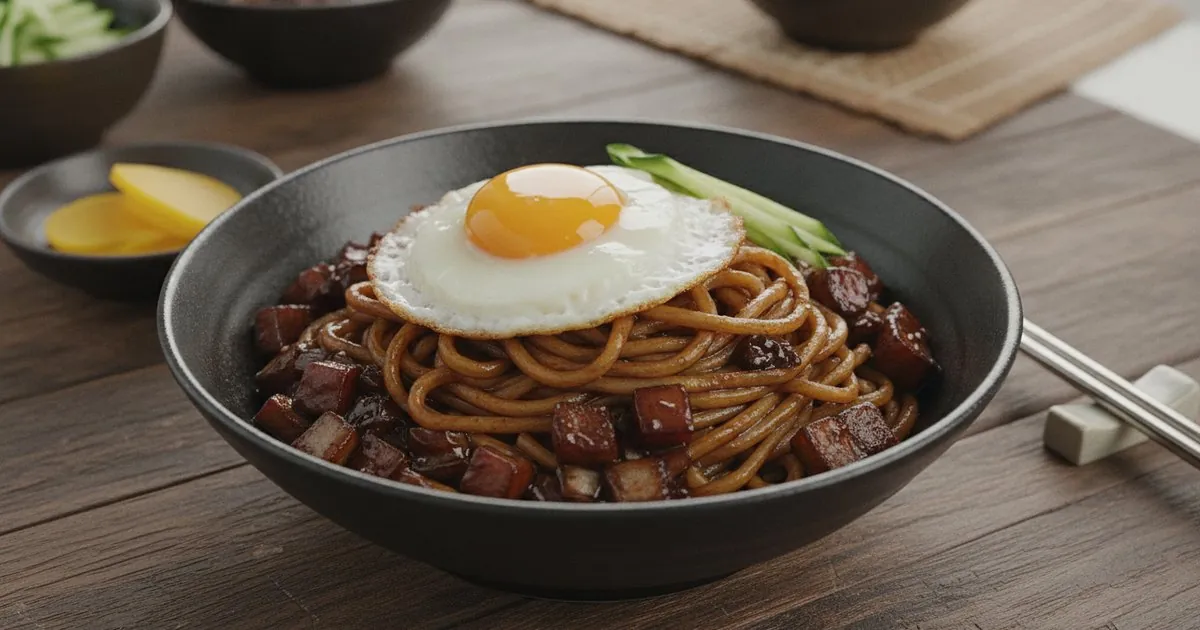
On any given weekday evening across South Korea, jajangmyeon is on a lot of kitchen tables — and even more doorsteps. It’s consistently ranked among the most-ordered delivery meals in the country, and once you make it yourself, that becomes less surprising and more inevitable. This is the kind of dish that hooks you immediately: thick, springy wheat noodles heaped with a sauce that is simultaneously glossy, ink-black, savory, faintly sweet, and deeply, almost unreasonably satisfying.
Jajangmyeon (짜장면) is Korea’s great comfort food. It’s the dish you order when you’re moving into a new apartment, the meal that appears in K-dramas whenever a character needs consolation, and the subject of its own unofficial holiday. And it is — truly, with a bit of attention to a few key techniques — something you can nail in a home kitchen in under an hour.
The Story Behind the Black Sauce
Jajangmyeon’s roots trace directly to the Chinese dish zhajiangmian (炸醬麵), brought to Korea by Shandong Chinese immigrants who settled in Incheon’s port district in the late 19th century. The earliest versions were served in the restaurant kitchens of Incheon’s Chinatown — still the oldest in Korea — adapted to local tastes a little at a time over decades.
The Koreanization was extensive. The original Chinese version uses tianmian (sweet wheat paste), is considerably drier and chunkier, and tends toward saltiness over sweetness. As the dish evolved in Korean kitchens, it became something fundamentally different: the sauce grew glossier and more pourable; a specifically Korean fermented black soybean paste called chunjang (춘장) replaced the Chinese paste; starch thickener entered the sauce; and sugar became standard. The noodles grew thicker and chewier. Pork belly fat — rendered and rich — became the preferred protein vehicle.
By the mid-20th century, jajangmyeon had become embedded in Korean identity in a way few dishes manage. Instant versions appeared in the 1960s. The dish’s place in Korean pop culture is remarkable: April 14th is informally called “Black Day” (블랙데이), a day when single Koreans who received no gifts on Valentine’s Day gather to eat jajangmyeon together in cheerful commiseration. It shows up in enough K-dramas to constitute a trope.
The Korean version and its Chinese ancestor are now so different that they’re really two separate dishes that share a name. What you’re making at home is firmly in the Korean tradition — and the technique that makes it Korean is a specific, non-negotiable first step that sets the tone for everything that follows.
Key Ingredients — What to Buy and Where
Chunjang (춘장) — The One Essential
Chunjang is a Korean fermented black soybean paste, and there is no real substitute for it. Straight from the tub, it smells aggressively funky — dark, earthy, sharp, with a raw fermented punch that can be off-putting. This is exactly as it should be. That rawness is why the very first step in every authentic recipe is to fry the paste in hot oil before anything else enters the pan. The oil fry removes the acrid edge, deepens the color, and transforms the aroma from harsh to mellow and complex.
The most widely available brand outside Korea is Haechandle (해찬들), sold in a cylindrical dark tub. You’ll find it at H Mart, Korean grocery stores, and most large Asian supermarkets. If you’re navigating an H Mart for the first time, our H Mart shopping guide can make the paste and sauce aisle a lot less overwhelming. Online, Hmart.com and Weee! both carry it reliably.
If you truly cannot source chunjang, a combination of Chinese fermented black bean paste (douchi) and a small amount of hoisin sauce can approximate some of the flavor — but the result will differ noticeably. For the real dish, find the real paste.
The Noodles
Fresh jajangmyeon noodles are thick wheat noodles with a satisfying, springy chew. They’re sold refrigerated at Korean grocery stores, often simply labeled “jajangmyeon noodles” or “Korean wheat noodles.” For 4 servings, you’ll need about 700g (24 oz) — a generous portion. Fresh udon is the best substitute when jajangmyeon noodles are unavailable; the thickness and chew profile are very similar.
Dried wheat noodles work in a true emergency, but the texture gap is noticeable. The chew and slight elasticity of a fresh noodle is part of what makes jajangmyeon feel right.
Pork Belly or Shoulder
Fat is flavor here. Pork belly is traditional because the fat renders into the sauce and contributes richness throughout. Shoulder (Boston butt) is a solid leaner alternative. Avoid lean loin — it dries out in the sauce and contributes nothing to the texture. You want 225g (8 oz) for 4 servings, cut into small cubes around 1.2cm (½ inch), so each piece cooks through quickly over high heat.
The Vegetables: Onion is King
Every serious jajangmyeon recipe agrees on one thing: if you only have a single vegetable, make it onion. A full large onion — about 300g (10 oz) — melts into the sauce and contributes the natural sweetness that balances the fermented paste. Do not reduce this quantity.
Zucchini and green cabbage are the traditional supporting vegetables. Potato is a common addition in many home recipes; if you use it, microwave the cubed potato for 2–3 minutes before adding it to the pan, or it won’t cook through in the time the rest of the sauce needs. Shiitake or button mushrooms add an earthy note and are worth including if you have them.
Making the Sauce: Key Techniques Explained
The full recipe with step-by-step instructions is in the recipe card above. But two techniques deserve closer attention because they’re where most home cooks run into trouble.
The Chunjang Pre-Fry: Do Not Skip This
Heat 3 tablespoons of neutral oil in your widest pan over medium heat. Add the chunjang paste and stir it almost constantly for 2–3 full minutes. Watch for two signals that tell you it’s done: the paste will deepen from muddy brown to a glossier, denser black, and the smell in your kitchen will shift from sharp and assertive to warm and rounded, like something roasted rather than raw. If you stop too early, the sauce will carry a bitter, acrid edge all the way to the bowl. Some recipes use lard or rendered pork fat in place of neutral oil here — if you have it, use it. The added depth is real.
High Heat on the Pork — No Exceptions
The marinated pork needs a genuinely hot pan. Place it in a single layer and let it sit for 60–90 seconds before touching it. You’re listening for a sizzle that stays loud and steady, and looking for edges that turn from pink to brown. If you hear the sizzle drop and see liquid pooling around the meat within the first 30 seconds, your pan isn’t hot enough and you’re steaming the pork instead of searing it. The fix: drain the liquid off, let the pan recover its heat on high for another minute, and continue.
The Starch Slurry: Slow Down
Add the starch slurry to a simmering — not violently boiling — sauce, pouring it in a thin stream while stirring constantly. The sauce thickens quickly and you can always add more, but you can’t easily thin a sauce that’s gone gluey. Go in increments.
Common Mistakes to Avoid
1. Skipping the Chunjang Pre-Fry
If you dissolve the chunjang directly into the sauce liquid without frying it first, the raw paste’s bitterness and acrid fermented edge carry through to the finished dish. The sauce ends up sharp, astringent, and flat-tasting despite everything else going right. There is no correcting this after the fact — the pre-fry is structural, not optional.
2. Pale, Gray, Steamed Pork
This happens when the pan isn’t hot enough or the pork is too crowded. The first sign is liquid weeping out of the meat within seconds of hitting the pan, followed by gray, soft-textured pieces with no browning. This pork will taste bland and add nothing to the sauce. Solution: use your largest pan, get it ripping hot before the pork goes in, and if you have a small pan, cook the pork in two batches rather than one.
3. Overseasoning Before Tasting
Chunjang is already salty. Soy sauce is salty. Before reaching for any extra seasoning, taste the sauce after the stock and fried paste have been simmering together for a few minutes. Many batches need no added salt at all. Adding more soy sauce without tasting first turns the sauce brackish and can obscure all the layered flavor you built in the earlier steps.
4. Starch Slurry Added to a Hard Boil
Pouring slurry into a sauce that’s boiling hard creates lumps — the starch hydrates unevenly when hit by violent heat before it has a chance to disperse. Drop the heat to a vigorous simmer (edges bubbling, not a full rolling boil), then pour the slurry slowly in a steady stream while stirring. If lumps form anyway, you can often work them out by pressing against the side of the pan with the back of a spoon.
5. Cooking the Noodles Too Early
Jajangmyeon noodles sitting in a drained pot will clump, over-soften, and stick together within minutes. Time the noodles to finish cooking when the sauce is just about done. After draining, the brief cold rinse isn’t optional — it stops the cooking immediately and washes off surface starch that would otherwise glue the noodles into a mass.
6. Letting the Finished Bowls Sit
This is probably the most common home-cook error, and it ruins perfectly good work. Once the sauce is ladled over the noodles, the noodles begin absorbing it rapidly. Within 10–15 minutes, you can go from a beautifully sauced bowl to a clumped, over-absorbed mass. If serving is delayed, keep the sauce in one pot and the noodles in another, and combine only at the moment of eating. Reheat the sauce gently with a splash of water to loosen it if needed.
Serving and Pairing
Jajangmyeon is almost always a standalone meal — the sauce is rich and filling enough that it needs little else. The traditional accompaniments are yellow pickled radish (danmuji, 단무지), whose clean brine and mild tang cut beautifully through the sauce’s richness, and a small dish of raw onion slices dressed with a splash of rice vinegar — the acidity makes the sauce taste even deeper and more complex by contrast.
If you want to build out the meal further, a light clear soup on the side — or any acidic, crunchy side dish — gives your palate a reset between bites of the rich sauce. A small banchan spread works wonderfully here; if you want to explore what to serve alongside Korean noodle dishes, our banchan guide covers the essential side dishes worth having on the table.
Frequently Asked Questions
Can I make jajangmyeon without pork? Yes, easily. Replace the pork with firm tofu (press it dry and cube it before searing) or thick-sliced mushrooms — king oyster or shiitake are ideal because of their meatiness and the way they brown in a hot pan. The sauce base itself is already pork-free; you’re just swapping the protein. Add a touch more soy sauce to compensate for the umami that rendered pork fat would have contributed.
What’s the difference between jajangmyeon and jjajangbap? Same sauce, different carb. Jjajangbap (짜장밥) is the identical black bean sauce served over steamed white rice rather than noodles. It’s a common order in Korean-Chinese restaurants (중식당) when diners want the flavor without the heavier noodle portion. The sauce recipe is identical — you just skip the noodle-cooking step and ladle over rice instead.
Can I substitute Chinese black bean sauce for chunjang? You can, but the dish will taste noticeably different. Chinese fermented black bean sauce (made from salted whole beans) tends to be saltier and less sweet, with a different fermentation character than Korean chunjang. The result will be edible but won’t have the rounded sweetness and depth that defines Korean jajangmyeon. Chunjang is available at most Korean grocery stores and is worth seeking out before you resort to substitutes.
How long does leftover sauce keep, and can I freeze it? The sauce alone keeps in the refrigerator for 3–4 days and freezes well for up to 2 months. Reheat it gently over low heat with a small splash of water or stock to restore its consistency. Never store noodles that have already been sauced — they will absorb all the liquid and turn into a gluey mass. Always store sauce and cooked noodles separately, and even then, the noodles are best eaten fresh.
My sauce tastes bitter even though I followed the recipe. What went wrong? Almost certainly the chunjang wasn’t fried long enough or the oil wasn’t fully hot when the paste went in. Undercooked chunjang carries its raw bitterness all the way to the finished sauce and there’s limited recovery. For the current batch: add sugar in small increments (½ tsp at a time, stirring and tasting), dilute slightly with more stock, and simmer longer — extended heat does help mellow bitterness somewhat. A small knob of unsalted butter stirred in off-heat can round off harshness as a last-resort fix. For next time, make sure the oil is properly shimmering before the paste goes in, and cook it a full 3 minutes with constant stirring.
Jajangmyeon rewards focus on a handful of specific moments: the chunjang pre-fry, the heat on the pork, and the slurry timing. Get those three things right and you’ll land on something deeply satisfying — the kind of bowl that makes it immediately obvious why South Korea has been ordering this dish by the millions for over a century.