
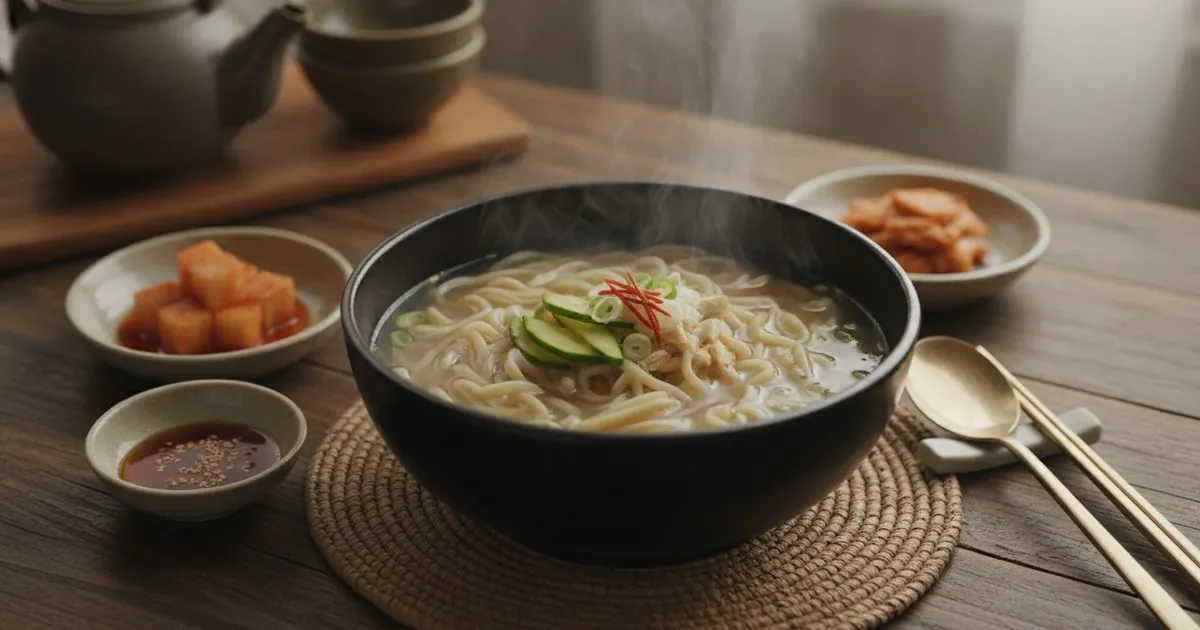
Kalguksu (칼국수, pronounced kahl-gook-soo) translates literally to “knife noodle soup” — a name that announces exactly how the noodles are made. No pasta machine, no extruder, no dried noodle packet. You roll the dough flat and cut it by hand with a kitchen knife, and those thick, slightly rough-edged ribbons are precisely what make kalguksu so satisfying: they catch the broth, they have texture, and they taste unmistakably homemade.
This is Korean comfort food in its most grounding form. On cold evenings, after long days, or whenever you want something that feels genuinely nourishing, kalguksu delivers in a way that few other dishes can. It’s also one of the more approachable Korean dishes to make entirely from scratch — the dough requires no special equipment, the anchovy broth takes about 15 minutes, and the whole bowl comes together in under 90 minutes start to finish (including dough rest time). The recipe below uses the classic anchovy-kelp broth (myeolchi-dashima yuksu), which is the most common home version across Korea, though we’ll walk through the chicken and clam variations too.
What Makes Kalguksu Different from Other Noodle Soups
The defining feature of kalguksu isn’t the broth — it’s the noodle itself. These are fresh, hand-cut noodles made from a simple all-purpose flour dough with no egg. That means they’re slightly denser than egg noodles, and they have a pleasantly rustic, irregular edge from the knife cut. As they cook, a thin layer of surface starch dissolves into the broth, thickening it gently and giving the finished soup a glossy, velvety texture that boxed noodles simply can’t replicate.
The broth tradition is equally important. Unlike ramen — which relies on long-simmered pork or chicken bone broth — kalguksu is typically built on a lighter, cleaner foundation: a quick-drawn anchovy and kelp stock (myeolchi-dashima yuksu) that takes just 15 minutes but delivers remarkable depth. This broth has a characteristic clean savoriness, bright with the iodine-tinged sweetness of the sea without ever tasting fishy.
The Three Classic Broth Styles
Before you start cooking, it’s worth knowing which direction you want to take the soup:
Anchovy-Kelp (Myeolchi Kalguksu) — The everyday home standard. Quick to make, clean-tasting, and genuinely delicious. This is the version in our recipe below, and the best starting point if you’re new to kalguksu.
Chicken (Dak Kalguksu) — A richer version built on a simmered whole-chicken broth with onion, garlic, ginger, and scallion. The chicken is typically shredded and returned to the bowl. This style takes about 45–60 minutes of simmering for the broth, but rewards patience with a deeply savory, milky-white stock. Chicken kalguksu is very popular in Korean restaurants, particularly in the Andong and Gyeonggi regions.
Clam (Bajirak Kalguksu) — The briny coastal version, especially popular in seaside cities. Manila or littleneck clams are purged in salted water, then simmered open in a combination of their own released juices and a base anchovy stock. The result is a layered, oceanic broth with the clean sweetness of fresh shellfish. It’s the most intensely flavored of the three, and worth seeking out fresh clams for.
All three share the same hand-cut noodle and the same vegetable palette: Korean zucchini, carrot, onion, and scallion.
Ingredients You Need (and Why)
All-purpose flour — Standard supermarket AP flour is exactly right. Korean home cooks use it; you should too. Bread flour makes the noodles too chewy; cake flour makes them too soft. Stick with AP.
Guk ganjang (국간장, Korean soup soy sauce) — This is lighter in color than regular soy sauce but saltier and more pungent. It seasons the broth without darkening it. It’s available at any Korean grocery (like H Mart — see our complete H Mart shopping guide for what to grab while you’re there). If you absolutely can’t find it, use a combination of light regular soy sauce (half the quantity) and a pinch more salt.
Dried soup anchovies (국물멸치, guk myeolchi) — These large, silver-gray dried anchovies are sold in bags at Korean groceries and are distinct from the tiny Thai or Southeast Asian dried anchovies. Look for plump, silver-metallic ones; avoid any that look yellowish or smell strongly rancid. Remove the heads and pull out the dark intestinal tract before using to prevent bitterness.
Dried kelp (dashima / 다시마) — You may know this as Japanese kombu, and they’re the same thing. A small piece is all you need. Remove it before the broth simmers too long.
Korean zucchini (애호박, aehobak) — Lighter in color and slightly less watery than regular green zucchini. If you can’t find it, regular zucchini works fine — just don’t let it over-cook, as it softens faster.
How to Make the Noodle Dough
The dough ratio here is 360g (3 cups) flour to approximately 180ml (¾ cup) water, with ¼ tsp salt and an optional teaspoon of neutral oil. (Note: different Korean recipes vary slightly on the water ratio — some go drier, some go a touch wetter. What matters more is the feel of the finished dough.)
Combine the flour and salt, add the oil if using, then add the water in stages. The dough will look ragged and dry at first — that’s correct. Knead it firmly for 8–10 minutes on a clean surface. You’re looking for a dough that’s smooth, slightly springy, and holds its shape cleanly when cut. It should feel noticeably firmer than Italian pasta dough. If it tears when you pull a small piece, it needs more kneading. If it’s sticking to your hands, add flour by the half-teaspoon.
The rest is non-negotiable. Wrap the dough tightly and let it rest at room temperature for at least 30 minutes. This allows the gluten strands to relax, which makes rolling dramatically easier and prevents the sheet from springing back and tearing. A 1-hour rest is even better.
When rolling, use plenty of flour on both surfaces and work gradually outward. Target a thickness of 2–3mm (about ⅛ inch). When cutting, a sharp heavy knife (a Chinese cleaver works beautifully here) cuts more cleanly than a lightweight blade. Work in confident, steady strokes.
Making the Broth
Start the anchovies and kelp in cold water — this cold-start extraction method pulls flavor out more gently and evenly than dropping them into boiling water. You want a simmer of exactly 15 minutes: long enough to develop the golden color and savory backbone, short enough that no bitterness develops from the kelp.
The finished broth should be clear, not murky. It should smell lightly of the sea — more like ocean air than raw fish. If it smells sharply fishy or muddy, the anchovies simmered too long, or the anchovies themselves were stale. Season with guk ganjang first (it adds savoriness and a faint color), then fine salt to taste, then garlic.
Variations and Regional Notes
Kalguksu has deep regional roots across Korea. The Chungcheong province style tends toward a more robust, well-seasoned broth. Andong kalguksu, from the Gyeongbuk region, is famous for its slightly thicker noodles and deeply savory chicken broth. Coastal versions from Tongyeong or Sokcho lean heavily on seafood — clams, mussels, and even dried pollack make appearances.
For Western home cooks, the anchovy broth version is the most practical entry point, but if you want to try the clam variation, pair it with our recipe for haemul pajeon (Korean seafood pancake) to build a full seafood-forward Korean meal.
Where to Find Ingredients in Western Kitchens
H Mart, Zion Market, or any Korean/Asian supermarket — Your best source for all specialty items: guk ganjang, guk myeolchi, dashima, aehobak, and dried mini shrimp. These stores typically carry them in bulk for reasonable prices.
Whole Foods / mainstream grocery — AP flour, carrots, scallions, onion, and regular zucchini are all readily available. Some Whole Foods carry kombu in the Japanese section (it’s the same as dashima).
Online — Amazon and Weee! carry guk myeolchi and dashima. Guk ganjang is harder to find online but Sempio brand ships reliably.
Common Mistakes to Avoid
1. Not resting the dough long enough. Under-rested dough is stiff and springy. When you try to roll it, it fights back and tears in ragged patches rather than stretching smoothly. The fix isn’t more kneading — it’s more time. If your dough tears repeatedly during rolling, cover it and wait another 15 minutes. You’ll notice the difference immediately.
2. Rolling the noodles too thick. The most common beginner error. A 4–5mm noodle looks manageable on the board but turns gummy and doughy at the center when cooked, while the outside is already done. Target 2–3mm. Use a ruler the first time if you’re unsure — this precision pays off in texture.
3. Overcooking the kelp and anchovies. Both ingredients turn bitter if they’re simmered beyond their window. Kelp in particular releases bitter compounds past the 15-minute mark. The color signal: a properly timed anchovy-kelp broth is clear and golden, not dark brown or murky. Set a timer and pull everything on schedule.
4. Skipping flour when cutting, then dumping noodles into the pot in a clump. If the cut noodles stick together before they hit the broth, they’ll stay stuck — you’ll end up with a solid lump cooking on the outside while the inside is still raw. Dust liberally between folds, then separate the strands into loose nests immediately after cutting. Shake off excess flour just before dropping them into the pot.
5. Cooking the noodles too long. Fresh hand-cut noodles cook quickly — usually 3–5 minutes — but they keep cooking from residual heat even after you turn off the flame, and they continue absorbing broth in the bowl. Pull them off the heat when they’re just barely cooked through: tender all the way to the center with the faintest resistance. If you wait until they feel “done done,” they’ll be mushy by the time they reach the table.
6. Under-seasoning the broth and not adjusting at the end. Anchovy broth is mild by default — that’s its character, not a flaw — but it needs to be seasoned assertively to taste complete. The combination of guk ganjang (for savoriness and umami) plus fine salt (for clean salinity) is intentional: guk ganjang alone can make the broth too dark and slightly bitter in larger quantities. Season in layers, and always taste again right before serving because the noodles absorb salt from the broth as they cook, which can make the final bowl taste blander than the broth alone.
Frequently Asked Questions
Can I use dried store-bought noodles instead of making fresh ones? You can — look for fresh or dried kalguksu noodles at Korean grocery stores (they’re sold in both fresh refrigerated and dried formats). Dried kalguksu noodles are also sometimes labeled “kal guksu noodles” or “knife-cut noodles.” Cook them separately according to package directions and add to the broth just before serving to prevent over-absorption. That said, the handmade version is meaningfully better: the slightly rough surface holds the broth differently and the texture is in a different category.
What’s the difference between kalguksu and sujebi? Both are Korean hand-made wheat noodle soups in similar broths, but the shape is different. Kalguksu noodles are rolled flat and cut into strips with a knife. Sujebi (수제비) uses a softer, slightly wetter dough that’s torn by hand directly into the broth in irregular, flat pieces — more like dumplings than noodles. The sujebi dough is also slightly thicker and chewier. Both dishes share the same anchovy-kelp broth base.
Can I make the dough ahead of time? Yes. The rested, wrapped dough can be refrigerated for up to 24 hours. Let it sit at room temperature for 15–20 minutes before rolling — cold dough is stiffer and harder to work with. Do not freeze raw dough; the ice crystals damage the gluten structure.
What can I substitute for Korean zucchini (aehobak)? Regular green zucchini works well. Avoid very large zucchini, which can be watery and seedy — choose small to medium ones and cut them into thin matchsticks. The flavor difference is subtle; texture is more important, so don’t let it over-cook regardless of which variety you use.
How should I serve kalguksu as part of a bigger Korean meal? Kalguksu is traditionally a one-bowl meal on its own, not served as part of a banchan spread the way rice dishes are. The classic accompaniment is kimchi — baechu kimchi (napa cabbage) or kkakdugi (cubed radish kimchi) both cut through the mild, starchy broth beautifully. If you’re building a fuller table, check out our banchan guide for simple side dishes that pair naturally with mild soup-forward Korean meals.