
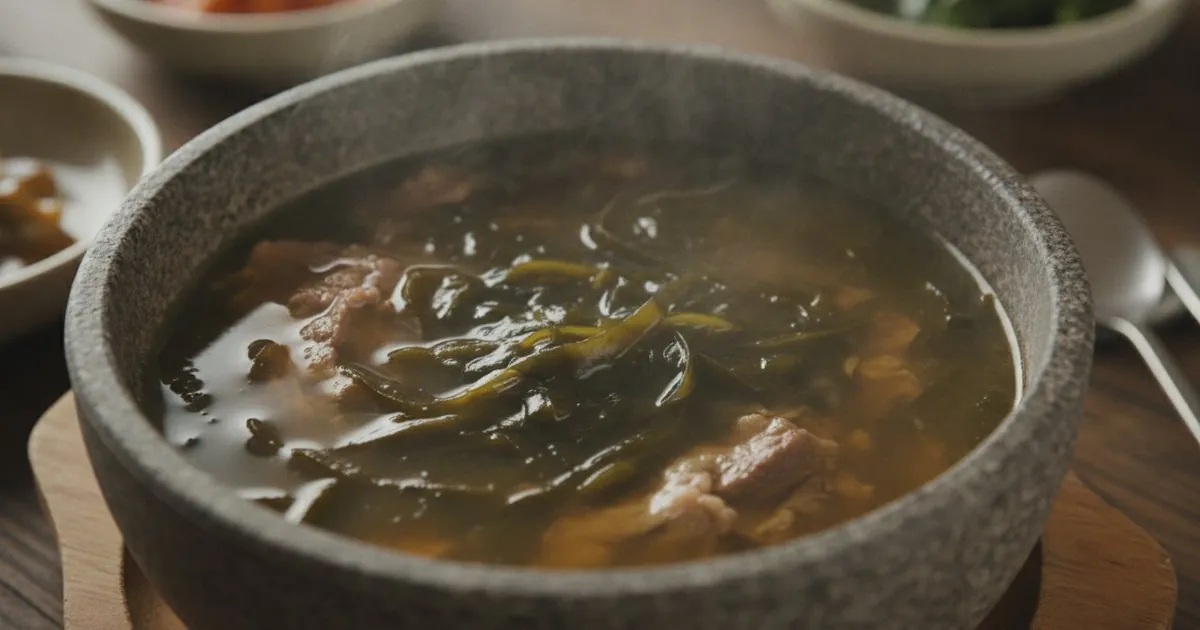
Miyeok guk (미역국) is one of those soups that Koreans carry inside them their entire lives. In the West, birthday food typically means cake, candles, and maybe a special restaurant dinner. In Korea, the centerpiece of any birthday — from a baby’s first to an elder’s hundredth — is a steaming bowl of seaweed soup. Silky, dark-green strands of rehydrated miyeok float in a clear, golden broth alongside tender ribbons of beef brisket, seasoned simply with Korean soup soy sauce and sesame oil. It’s deeply savory, gently oceanic, and warming without feeling heavy.
On paper, this recipe looks almost embarrassingly simple. And it genuinely is easy to make. But simple doesn’t mean there’s nothing to learn. The difference between a muddy, flat bowl and one that’s properly crave-worthy comes down to a handful of specific techniques: how long you soak the seaweed, whether you sauté the beef first, which soy sauce you use, and how long you let everything simmer together. This guide covers all of it — with measurements in both metric and cups, sourcing tips for Western kitchens, and every troubleshooting detail that matters.
What Is Miyeok? (And Why the Form Matters)
Miyeok (미역) is a brown seaweed — Undaria pinnatifida — sold dried in Korean and Japanese grocery stores. You may know it by its Japanese name, wakame, which is the same species. But the form you want for this soup is guk-yong miyeok (국용 미역): soup-grade miyeok, sold as thick, leathery, tightly compressed sheets or folded bundles. This is meaningfully different from the pre-cut, thin, lightly salted wakame you sometimes see in Japanese miso soup kits — that product is far too delicate for a 30-minute simmer and will disintegrate into slime.
Soup-grade miyeok is sold at virtually every H Mart, Korean grocery, and most large Asian supermarkets in the US. Look for packaging labeled “Dried Seaweed for Soup” or the Korean characters 미역. Brands like CJ and Ottogi are reliable and widely available on Amazon. If you can only find Japanese whole-leaf dried wakame, that will work — reduce your soaking time by about 5 minutes, since Japanese wakame tends to be cut thinner and rehydrates faster.
The Birthday Tradition and Its Postpartum Roots
If you ask a Korean why they eat seaweed soup on their birthday, the answer is almost always some version of the same thing: “It’s what my mother ate after giving birth to me.”
That’s the real origin. Miyeok guk has been the cornerstone food of sanhujori (산후조리) — Korean postpartum recovery — for centuries. Miyeok is genuinely rich in iodine, calcium, and folate, and Korean tradition held that new mothers should eat this soup continuously for several weeks after delivery to replenish minerals, support milk production, and restore strength after labor. The association between this soup and the act of giving birth became so deeply embedded in the culture that eating it on your birthday turned into an annual ritual of gratitude to your mother.
Today, miyeok guk is eaten year-round as a workaday everyday soup. It shows up at Korean breakfast tables, in school lunchboxes, and as part of the broader banchan spread that anchors a Korean meal. But the birthday context is where it carries the most emotional weight. The first bowl on your birthday morning is almost always miyeok guk.
Ingredients, Explained
Dried Miyeok — Quantity Matters More Than You Think
For four servings, you need only 20–25g (¾ oz) of dried miyeok. That looks like almost nothing — a loose handful of crinkled, papery sheets — but it will expand to roughly six to eight times its dry volume once rehydrated. This is not an ingredient where more is better. Too much seaweed crowds the pot, thins the broth, and pushes the flavor into territory that tastes more like the bottom of a tide pool than a refined soup. Weigh it if you can; eyeballing tends to lead to overshooting.
Beef — Cut and Thickness
The traditional choice is beef brisket or chuck. Both are collagen-rich cuts that become tender and silky during the simmer, and both release gelatin into the broth that gives it a subtle body. Brisket delivers slightly richer flavor; chuck is easier to find at a standard American grocery store. Either works.
Use 150–200g (about 5–7 oz) for four servings. Korean soups tend to use meat as a seasoning and flavor contributor rather than a primary protein; the seaweed is the star. Slice the beef thinly — about ¼ inch (6 mm) thick — and always cut across the grain so the muscle fibers are short and the beef stays tender rather than stringy.
Soup Soy Sauce — Gukganjang (국간장)
This is the most important specialized ingredient in the recipe, and it’s worth the effort to find it. Gukganjang (Korean soup soy sauce, sometimes labeled joseon ganjang) is lighter in color, saltier, and more pungent than regular soy sauce. It seasons the broth savory and clear without turning it brown or sweet. Regular soy sauce contains more sugar and has a deeper, more caramelized fermentation character that makes the broth look murky and taste slightly off. If you absolutely cannot find gukganjang, a mix of 1 tablespoon regular soy sauce plus 1 teaspoon fish sauce is closer than regular soy sauce alone. But gukganjang is available at any H Mart, Korean grocery, or on Amazon — it’s worth stocking.
Sesame Oil
Toasted sesame oil does two things here: it provides the fat for sautéing (building flavor in the base) and it perfumes the entire broth with a nutty warmth. Use 1 tablespoon (15ml) of good-quality toasted sesame oil. Kadoya is the widely available benchmark; it’s sold at most Asian grocers and in the international aisle of many Whole Foods locations. Do not substitute untoasted sesame oil, which lacks the characteristic roasted aroma.
Garlic
Most recipes — and this one — use 2 teaspoons (about 2–3 cloves) of minced garlic. It’s worth noting that a small number of experienced Korean cooks deliberately leave garlic out of miyeok guk, arguing it overpowers the clean, oceanic character of the seaweed. We’ve found that 2 teaspoons adds savory depth without overwhelming the broth. If you want the cleanest, most delicate seaweed flavor, start with 1 teaspoon and build from there.
How to Make Miyeok Guk — Step by Step
Phase 1: Rehydrate the Miyeok (15–20 Minutes)
Place the dried miyeok in a large bowl and cover generously with cold water. Within 2–3 minutes it will begin to unfurl — what looked like a compact, crumpled handful will bloom into a mass of dark, slippery fronds. Leave it alone for 15–20 minutes total, checking that there are no stiff, still-dry spots at the thickest parts. Once fully softened and pliable throughout, it’s ready.
Don’t walk away and forget about it. Soaking beyond 30 minutes starts to strip out the seaweed’s natural flavor, leaving you with bland, waterlogged fronds that make the finished soup taste flat. When in doubt, check it at 15 minutes — the texture you want is supple and slick, not stiff, but also not falling apart.
Drain, rinse under cold running water 2–3 times, then cut into 2–3 inch (5–7 cm) pieces if the strands are very long. Squeeze out the excess water gently with your hands.
Phase 2: Build the Flavor Base
Set a medium pot over medium-high heat. Add the sesame oil and let it heat until it shimmers and smells toasty — about 30 seconds. Add the beef in a single layer and let it sit undisturbed for a full minute so it develops actual color on one side. Then stir-fry for another 1–2 minutes until no longer pink, with light browning at the edges. The pot should be sizzling audibly and energetically. A quiet, steaming pot means the heat is too low and the beef is steaming rather than searing — you’ll lose flavor.
Add the minced garlic and stir for 30 seconds until fragrant. Add the drained miyeok and stir-fry everything together for 1–2 minutes. Watch the color: the seaweed shifts from a dark, almost black-olive green to a slightly brighter forest green, and the aroma transforms from raw and oceanic to savory and toasty.
Phase 3: Simmer to Build the Broth
Pour in 7–8 cups (1.65–1.9L) of water. Raise the heat to high and bring to a full, rolling boil — this takes 5–7 minutes. Once boiling, reduce heat to medium-low, add 2 tablespoons of gukganjang, and stir. Simmer with the lid slightly ajar (about 1–2 inches open) for 25–30 minutes.
As the soup simmers, watch the broth. It starts clear and slightly greenish, then gradually deepens to a pale, clear amber-gold as the beef releases its flavor. By 25 minutes it should smell savory and faintly nutty, with a distinctly oceanic undercurrent from the seaweed.
Phase 4: Season and Serve
After 25–30 minutes, taste the broth carefully. It should be savory enough to enjoy on its own, gently oceanic, and subtly nutty — not aggressively salty, not flat, and not fishy. Adjust with additional gukganjang in small increments (a half-teaspoon at a time), or with plain salt. If you want more umami complexity, add 1 tablespoon of fish sauce now, stir, and taste again. Serve immediately in individual bowls alongside steamed short-grain white rice.
Variations Worth Trying
The beef version is the everyday classic, but miyeok guk is extraordinarily versatile:
- Shellfish version (조개 미역국): Replace beef with small clams or mussels. Skip the sauté — add shellfish directly to boiling water with the rehydrated miyeok, simmer 10–15 minutes, and season with gukganjang and fish sauce. The broth is lighter, cleaner, and more briny.
- Tuna can version: A practical weeknight shortcut — drained canned tuna in water replaces beef. Sauté it briefly in sesame oil, then proceed as normal. It’s quick, easy, and surprisingly satisfying.
- Perilla seed version (들깨 미역국): Stir 2 tablespoons of ground perilla seed powder (deulkkae garu, sold at Korean grocers) into the soup during the last 5 minutes of simmering. This Jeolla-style variation makes the broth silkier, slightly creamy, and earthier. The combination of miyeok and perilla is one of the underrated flavor pairings in all of Korean cooking.
If you love exploring Korean soups and stews beyond miyeok guk, the earthy, intensely savory doenjang jjigae — fermented soybean paste stew with tofu and vegetables — is a natural next step.
Common Mistakes to Avoid
1. Over-Soaking the Miyeok
Leaving the miyeok to soak for 45 minutes or longer is probably the most common error new cooks make. The seaweed’s natural flavor compounds — the same ones that give the finished soup its clean, oceanic depth — begin leaching out into the soaking water after about 25–30 minutes. The result is bland, waterlogged fronds that make the finished broth taste flat and slightly like pond water rather than the sea. Fix: Time the soak. Fifteen to twenty minutes in cold water is enough for most commercial soup-grade miyeok. If your miyeok is still stiff at the center after 20 minutes, it may be a thicker grade — check every 5 minutes and stop as soon as every part is pliable. Discard the soaking water.
2. Using Regular Soy Sauce Instead of Gukganjang
Regular soy sauce contains more sugar and has a darker, more complex fermented character. Using it instead of gukganjang turns the broth brown and slightly sweet, and the soup loses the clear, pale amber color that is visually characteristic of a well-made miyeok guk. The flavor profile shifts toward a generic soy-forward soup rather than something distinctively Korean. Fix: Source gukganjang. It’s available at H Mart, most Korean grocery stores, and on Amazon. If you’re truly stuck, use 1 tablespoon regular soy sauce plus 1 teaspoon fish sauce per 2 tablespoons of gukganjang called for. This isn’t perfect but it’s closer than regular soy sauce alone.
3. Skipping the Sauté Step
Miyeok guk is not a “put everything in water and boil” soup. The step of searing the beef in hot sesame oil — and then briefly stir-frying the drained miyeok in that same fat — builds the entire flavor foundation of the dish. Skipping this and adding raw beef and miyeok directly to cold water produces a thin, one-dimensional broth with no real depth. Fix: Respect the sauté. The pot must be hot enough that the beef sizzles on contact, and the miyeok needs that 1–2 minutes of direct heat to intensify from raw-tasting to savory. Don’t rush this step by using a cold pot or low heat.
4. Adding Too Much Miyeok
The dramatic expansion of dried seaweed surprises many first-time cooks. What looks like a small amount dry becomes a substantial volume after soaking, and it continues to absorb water during simmering. Adding “a bit more” at the start results in a finished soup that’s more seaweed than broth — texturally overwhelming, and the broth ends up thin because there isn’t enough liquid relative to the volume of seaweed. Fix: Measure by weight. Twenty to twenty-five grams (¾ oz) dried is the right amount for 4 servings. A kitchen scale removes all guesswork here.
5. Under-Seasoning After Simmering
Miyeok absorbs salt during simmering. A broth that tasted adequately seasoned at the 5-minute mark can taste noticeably flat by the time it’s finished cooking. Many cooks add all their soy sauce at the start and never taste again, which is how you end up with a soup that’s technically seasoned but hollow-tasting. Fix: Add your soy sauce in two stages — most of it when you start the simmer, and the final adjustment in the last 2–3 minutes before serving. Always taste the finished broth with a spoon before ladling into bowls. It should be savory enough to be satisfying on its own, not just functional.
6. Simmering With the Lid Fully On or Fully Off
A tightly covered pot traps too much steam, which can cloud the broth and make it taste stewed rather than clean. A fully uncovered pot over a 30-minute simmer loses significant volume to evaporation, concentrating the soup and making it too salty and too dark. Fix: Simmer with the lid slightly ajar — about 1–2 inches open — so a moderate amount of steam escapes. You want a gentle, steady simmer that keeps the broth clear and pale gold, not a roiling boil.
FAQ
Can I make miyeok guk ahead of time?
Yes — and it often tastes better the next day as the flavors meld further. Store in an airtight container in the refrigerator for up to 3 days. Reheat gently over medium-low heat, adding a splash of water if the broth has thickened overnight. Be aware that the seaweed continues to soften the longer it sits in the broth; if you strongly prefer a firmer seaweed texture, store the broth and seaweed separately and combine only when reheating.
I can’t find gukganjang anywhere. What’s the best substitute?
The most workable substitute is 1 tablespoon regular soy sauce plus 1 teaspoon fish sauce for every 2 tablespoons of gukganjang the recipe calls for. This gets you closer to the saltier, more savory, less sweet profile of gukganjang than regular soy sauce alone. That said, gukganjang is worth seeking out — it’s inexpensive, shelf-stable, and useful for many Korean soups and braises beyond this one.
Can I make this vegetarian or vegan?
Absolutely. Omit the beef entirely (or use firm tofu, added in the last 10 minutes of simmering), skip the fish sauce, and season with gukganjang and salt. The broth will be lighter and more delicately oceanic without the beef’s richness, which is actually a lovely version in its own right. Adding a small piece of dried kombu to the simmering water, removed before serving, adds umami depth that partially compensates for the absent meat.
Why did my broth turn dark brown?
Almost certainly a soy sauce issue. Gukganjang keeps the broth a clear, pale amber; regular soy sauce turns it noticeably darker and more opaque. The second possibility is that you used too much soy sauce overall. If the broth looks dark but doesn’t taste overpoweringly salty, dilute with a little more water and rebalance seasoning with plain salt rather than more soy sauce.
Is this the same as Japanese miso soup with wakame?
They use the same seaweed species but are very different preparations. Japanese wakame in miso soup is typically pre-cut, thin, and briefly rehydrated — it’s added to an already-made dashi-and-miso broth and barely cooked. Korean miyeok guk uses thick, whole-leaf dried miyeok that’s soaked, sautéed in sesame oil with beef, and then simmered for 30 minutes in a clear, gukganjang-seasoned water broth. The textures are different (Korean miyeok is chewier and silkier), the flavors are different (savory-nutty versus miso-umami), and the cooking methods are entirely distinct.