
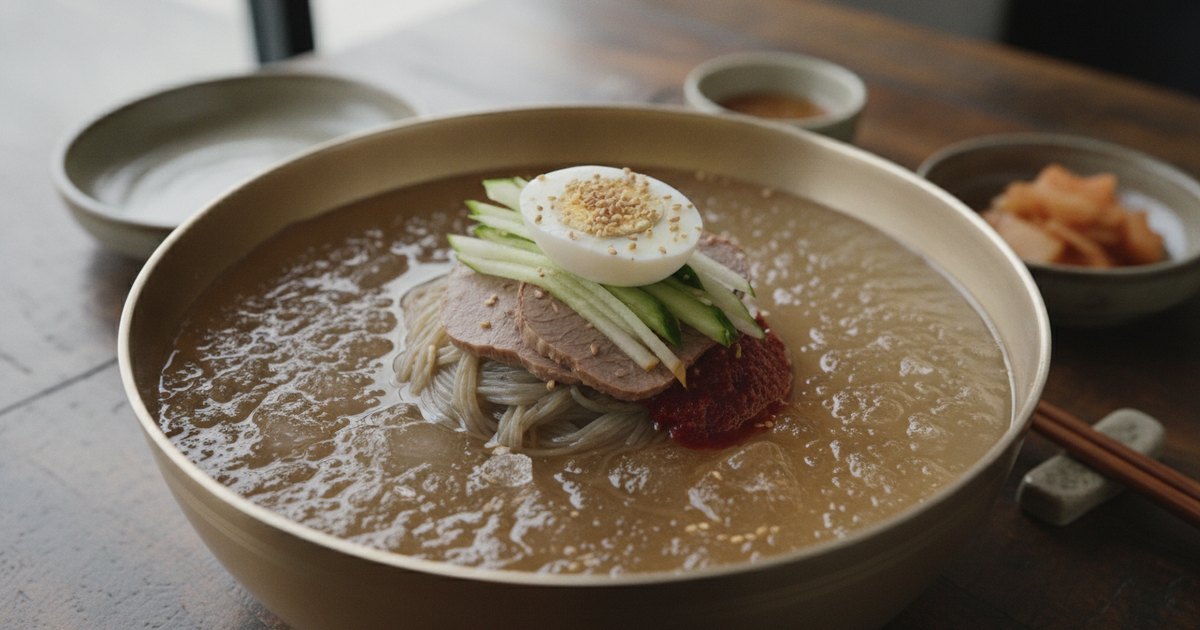
There is a particular kind of relief that naengmyeon delivers on a sweltering day — the kind that feels almost architectural in its precision. A cold, semi-slushy broth fills the bowl. A mountain of springy buckwheat noodles sits in the center, topped with thin shards of pear, cool cucumber ribbons, and half a hard-boiled egg. A small dish of sharp yellow mustard arrives on the side. The broth is simultaneously savory, subtly sweet, and pleasantly sour. The noodles have an earthy, faintly nutty flavor and a dense, springy chew that is genuinely unlike anything else in the Western noodle repertoire.
This is naengmyeon (냉면), Korea's definitive summer dish — a meal with a history stretching back centuries and a devoted following that borders on obsessive. Once you understand the logic of the dish, making it at home becomes not just achievable but deeply satisfying. This guide covers both major styles, the noodles, the broth, the toppings, and every significant pitfall you might hit along the way.
Two Dishes, One Name: Mul vs. Bibim Naengmyeon
The word 냉면 (naengmyeon) literally means "cold noodles," but it describes a family of dishes rather than a single recipe. Two preparations dominate:
Mul Naengmyeon (물냉면) — literally "water cold noodles." The noodles are served in a generous volume of icy, lightly tangy broth. This is the Pyongyang-origin style that spread across the peninsula and became a national institution. The broth in traditional preparations is commonly made with beef stock, dongchimi (동치미, water kimchi brine), or a blend of both — the dongchimi contributing a naturally fermented, clean tang that's distinct from simple vinegar. For home cooks without dongchimi on hand, a well-seasoned beef broth finished with rice vinegar delivers a genuinely excellent result.
Bibim Naengmyeon (비빔냉면) — "mixed cold noodles." No broth here. The noodles are tossed in a bold red sauce built on gochugaru, gochujang, sesame oil, garlic, and sugar. This is the Hamhung-style preparation from Korea's northeastern coastal region, and it traditionally uses noodles with an even higher starch content for a more aggressively chewy texture. A related preparation, hoe naengmyeon (회냉면), is the bibim style topped with marinated raw or lightly poached seafood.
A third regional style — Jinju naengmyeon from South Gyeongsang Province — uses a seafood-enriched broth and is considered a regional specialty, rarely found outside dedicated restaurants even within Korea.
This guide provides a complete recipe for mul naengmyeon and a full bibim sauce formula. Understand both, and you have the full picture.
The Noodles: Why This Is Not Soba
The most important ingredient in naengmyeon is the noodle itself — and understanding its composition explains why Japanese soba is not a workable substitute, despite the visual similarity.
Naengmyeon noodles are typically a blend of buckwheat flour and starches — most commonly potato starch, sweet potato starch, or both. Some commercial products also include wheat flour. This combination is what creates the noodle's signature texture: springy, dense, and almost rubbery in the most satisfying sense. When you bite a correctly cooked naengmyeon noodle, there should be real, physical resistance — a snap and release. Soba noodles, made from buckwheat and wheat flour without the binding starches, cook to a softer, more delicate structure that breaks apart in cold broth rather than holding its shape.
What to buy, and where:
| Form | Cook time | Notes |
|---|---|---|
| Dried (건냉면) | 3–5 min | Widest availability; shelf-stable; easiest to source |
| Fresh/refrigerated sari (냉면사리) | ~40 sec–2 min (check package) | Best texture when fresh; highly perishable |
| Frozen | Brief thaw, then cook | Available in some Asian supermarkets |
Look for brands like Cheongsu (청수) or Pulmuone (풀무원), both widely available at H Mart and through online Korean grocers. The ingredient list should lead with buckwheat (메밀). For households that need a gluten-free option, 100% buckwheat naengmyeon noodles do exist, though they have a somewhat more fragile texture and cook differently.
Quantity: Plan for 100g (3.5 oz) dried noodles per person. Fresh noodles weigh more due to moisture content — check the package for per-serving guidance.
Building the Mul Naengmyeon Broth
The broth is where mul naengmyeon succeeds or fails. A restaurant-quality bowl arrives at the table with broth that is clear, pale amber, faintly gelatinous as it melts, and precisely balanced between savory, sweet, and sour. Getting there at home involves two clear phases.
Phase 1: The Beef Base
Use brisket or shank — around 450g (1 lb) for four servings. Brisket is fattier and richer; shank produces a leaner, slightly cleaner broth. Both will work.
The critical first step is skimming. Start the beef in cold water (cold, not hot — this is deliberate; it draws impurities out slowly as the water heats). Bring it to a boil over high heat and watch carefully. For the first five to eight minutes, a significant volume of gray-brown foam rises to the surface. This is coagulated protein and blood from the meat. Remove it methodically with a wide, flat spoon. If you don't, it disperses into the broth and produces a murky, slightly gamey result that cannot be corrected later.
Once the foam stops forming, add your aromatics: smashed garlic, half an onion, a few ginger slices, green onion stalks, and black peppercorns. Simmer gently — not at a rolling boil, which clouds the broth — for 1 to 1.5 hours, until the beef yields to a chopstick without resistance.
Phase 2: Dongchimi or Vinegar Finish
In traditional mul naengmyeon, the strained beef broth is mixed with dongchimi brine (the fermented liquid from Korean water radish kimchi) for its unique, clean, slightly fizzy sourness. If you have access to dongchimi — available at many H Mart locations in the refrigerated kimchi section — a roughly 1:1 blend of beef broth and dongchimi creates a noticeably more layered result.
Without dongchimi, rice vinegar is your tool. Add it gradually after straining: 3–4 tablespoons (45–60 ml) per four servings is a reasonable starting point, but season by taste rather than measurement. The finished broth should taste bright, savory, and clearly tangy at room temperature — deliberately over-seasoned, because once it's chilled and partially frozen, much of that edge softens.
Seasoning Order
Strain the broth through fine-mesh lined with cheesecloth. Then season in this sequence: soup soy sauce (guk ganjang — lighter and more saline than regular soy sauce, used specifically for seasoning broths and soups; substitute a smaller amount of regular light soy sauce if needed) → salt → sugar → rice vinegar. Taste and adjust until the broth is unmistakably good and slightly assertive. It needs to survive the deep chill.
The Essential Toppings
Naengmyeon toppings are deliberate and restrained. Each one has a specific textural or flavor role:
- Sliced brisket — the same beef used to make the broth, sliced cold and thin against the grain. Silky, deeply savory, with a slight gelatinous quality from the collagen.
- Korean or Asian pear — paper-thin slices, placed delicately on top. The pear delivers a clean sweetness and a watery, crisp crunch that cuts through the richness of the beef. No substitute does exactly the same job; if you can't find Korean or Asian pear (배, bae), a very ripe Bartlett or Bosc pear is your best fallback.
- Julienned cucumber — cool, neutral, crunchy. English cucumber works best; it has fewer seeds and a thinner skin.
- Hard-boiled egg — halved, placed cut-side up for visual structure. The yolk adds richness when broken and mixed into the broth.
- Kimchi (optional) — a spoonful of well-fermented, funky kimchi set beside the noodles is traditional in some versions. Check our complete kimchi-making guide if you want to make your own for this.
At the table: Korean yellow mustard (gyeoja, 겨자) — significantly sharper and more sinus-clearing than American yellow mustard; English Colman's mustard is the closest Western substitute — and a small pitcher of rice vinegar for individual adjustment. Kitchen scissors are conventional for cutting the long, elastic noodles to a manageable length before eating.
Bibim Naengmyeon — The Spicy, No-Broth Version
If making broth from scratch feels like a project for another day, bibim naengmyeon is the entry point. You skip the broth entirely; the sauce does all the work.
Bibim sauce (for 2 servings):
- 2 Tbsp gochugaru (Korean red chili flakes)
- 1 Tbsp gochujang
- 1 Tbsp rice vinegar
- 1 Tbsp soy sauce
- 1 Tbsp toasted sesame oil
- 1 Tbsp sugar (adjust to taste)
- 1 tsp minced garlic
- 1 tsp toasted sesame seeds
Whisk everything together until a thick, uniform, deeply red sauce forms. Tasted alone, it should seem almost aggressively intense — that's correct. It needs to coat and season an entire bowl of noodles. If you're sourcing ingredients for the first time, the gochujang guide on kfoodlab covers which brands to buy and how to store the paste.
Cook and rinse the noodles exactly as described in the recipe above — the rinse is just as important here. Drain thoroughly (extra moisture makes the sauce watery), then toss with the sauce in the bowl itself, using tongs to coat every strand until the noodles are uniformly red. Top with cucumber, pear, and egg. When you break the egg yolk and work it into the dish, it rounds the heat and adds a creamy richness that takes the bowl to a different level.
Eat immediately. The sauce absorbs into the noodles within minutes, and they firm up as they sit, losing the glossy, sauced quality that defines the dish at its best.
Where to Find Naengmyeon Ingredients in Western Kitchens
If you live near an H Mart or a well-stocked Korean grocery, nearly everything on this list will be on the shelves. If not, online Korean grocers (Hanahreum USA, Gochujar) are reliable for pantry items. Our H Mart shopping guide covers the store layout and what to look for on each aisle.
| Ingredient | Where to find | Western substitute |
|---|---|---|
| Naengmyeon noodles (dried or fresh) | H Mart, online Korean grocery | No true substitute — seek the real thing |
| Soup soy sauce (guk ganjang) | H Mart | Light soy sauce in smaller quantity |
| Gochugaru | H Mart, some Whole Foods international aisle | No precise substitute; omit or use Aleppo pepper loosely |
| Gochujang | H Mart, Whole Foods, many mainstream supermarkets now | See gochujang guide |
| Korean or Asian pear | H Mart, Asian supermarkets | Ripe Bartlett or Bosc pear |
| Korean yellow mustard (gyeoja) | H Mart; online | English (Colman's) dry mustard mixed with water |
| Korean radish (mu) for broth | H Mart | Daikon — very close in flavor and texture |
For the beef, any Western supermarket carries brisket and shank. No specialty sourcing is needed.
Common Mistakes to Avoid
1. Not Skimming the Foam — and Getting a Murky, Gamey Broth
When cold beef and water come to a boil together, a substantial volume of gray-brown foam rises within the first several minutes. This is protein and myoglobin from the meat. If it isn't skimmed off before it disperses, the broth turns cloudy and develops a background note of meatiness that no amount of seasoning will fix. Keep a wide spoon ready from the moment you turn on the heat, and skim continuously during those first five to eight minutes.
2. Serving the Broth Cold Instead of Icy
Mul naengmyeon broth is meant to arrive at the table at or near partially frozen — almost a slush. If you serve it simply chilled from the refrigerator, the dish loses its essential character: it becomes cold soup with noodles rather than naengmyeon. Pour the seasoned broth into a shallow container and put it in the freezer one to two hours before serving, until ice crystals form throughout. Ladle it into bowls before it freezes solid, breaking up the slush as you go.
3. Under-Rinsing the Noodles
Naengmyeon noodles release a substantial amount of surface starch during cooking. If you drain and move directly to the bowl, that residual starch makes the noodles gummy, sticky, and prone to clumping into a single mass. The rinse — cold running water, palms rubbing the noodles vigorously together, continued until the water runs completely clear — is what produces the clean, firm, non-starchy texture that defines the dish. It takes a full minute, sometimes longer. Don't cut it short.
4. Seasoning the Broth at Serving Temperature Without Accounting for the Chill
Cold dramatically reduces perceived flavor intensity. A broth that tastes well-balanced, perhaps even slightly assertive, at room temperature will taste flat and watery when served partially frozen. Deliberately season the broth to the point where it seems slightly over-seasoned before it goes into the freezer. Salt, tang, and sweetness all fade when very cold; building in that cushion is the professional move.
5. Using Soba Noodles — Or Overcooking the Right Noodles
Japanese soba noodles do not hold their structure in cold broth. They go soft, lose their chew, and disintegrate at the edges. Even with authentic naengmyeon noodles, overcooking is an easy mistake: the difference between springy and mushy can be 60 seconds. Start tasting at the 3-minute mark. The noodles should have a decisive snap when you bite through them — cooked through with absolutely no raw starchy center, but still very much al dente. They will not hold patiently in a warm pot the way pasta does; drain the moment they're ready.
6. Dressing Bibim Noodles Too Early
The bibim sauce is oil- and sugar-based, which means it absorbs quickly into porous starch noodles. If you toss the noodles and then plate for guests, the sauce will have soaked in by the time they eat, leaving behind a dull, unevenly coated bowl with firmed-up noodles. Toss and serve within two to three minutes, maximum.
Frequently Asked Questions
Can I make the mul naengmyeon broth ahead of time? Yes — and it actually benefits from resting. Made a day or two ahead, the flavors meld noticeably, and any residual fat solidifies at the surface of the chilled broth, making it easy to skim off before serving. The broth freezes well for up to a month; portion it into 4-cup containers for quick weeknight naengmyeon.
Is naengmyeon gluten-free? Most commercial naengmyeon noodles contain some wheat flour in addition to buckwheat and starches, so they are not gluten-free by default. Fully buckwheat naengmyeon noodles are available at larger H Mart locations and specialty Korean grocery online stores — look for "100% mealmil" (100% 메밀) on the package. These differ slightly in texture and cook time, so check the package instructions.
What does mul naengmyeon broth actually taste like? Is it like ramen broth? It's quite different from ramen. The broth is lighter, clearer, and less rich — it reads as savory but with a defined sourness and gentle sweetness that ramen broths generally don't have. The overall effect is clean and refreshing rather than warming and rich. Think of it as the opposite tonal register from tonkotsu.
Can I use the leftover noodles the next day? Cooked naengmyeon noodles don't reheat or revive well — the texture is fundamentally a same-day phenomenon. Cook only what you'll eat immediately. The broth, on the other hand, keeps refrigerated for up to three days and improves as it sits.
What's the correct way to eat naengmyeon in a restaurant — or at home? Use the scissors the restaurant provides (or your own kitchen scissors at home) to cut the long noodles before eating. Without cutting, managing them is genuinely difficult. Add gyeoja and rice vinegar from the condiment bottles on the table to your personal taste — most people find the right balance somewhere after the first few bites. There is no wrong amount; it's meant to be adjusted individually. ```