
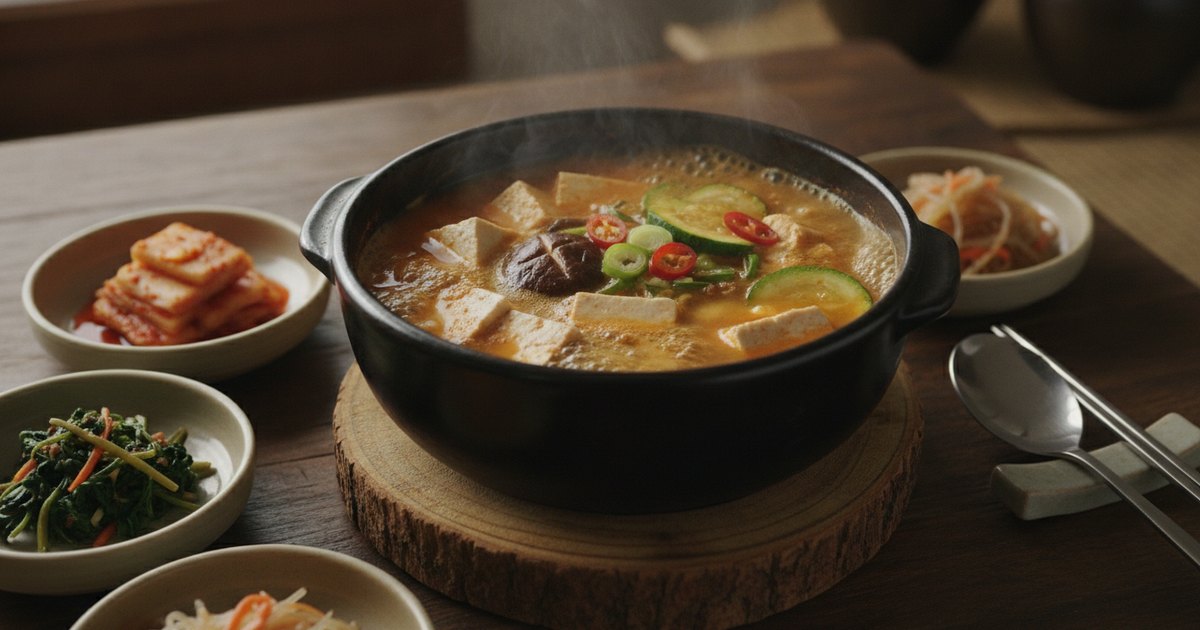
Doenjang jjigae (된장찌개) is Korea's definitive comfort food — a deeply savory, fermented soybean paste stew that appears on virtually every Korean table, every single day. If kimchi is the mascot of Korean cuisine, doenjang jjigae is its quiet backbone: humble in appearance, complex in flavor, and utterly irreplaceable in the rhythm of Korean home cooking.
The stew has a pungent, assertive aroma when you first lift the lid — that's the fermented doenjang doing exactly what it's supposed to do. But the moment it hits the bowl alongside a scoop of plain white rice, something shifts. The sharp edges soften, the earthiness deepens, and what you're left with is one of those profoundly satisfying combinations where every element exists in service of the whole. Silky tofu, just-yielding zucchini, and a broth that's at once briny, umami-forward, and warming — this is a bowl of food that has sustained generations of Koreans, and for good reason.
This guide covers everything you need to make it well: the two authentic approaches to building the broth, every ingredient with real quantities (in both metric and US measurements), a step-by-step recipe with the diagnostic details that actually matter, and the specific mistakes that separate a flat, harsh jjigae from a great one.
What is Doenjang, and Why Does It Define This Stew?
Doenjang (된장) is Korea's fermented soybean paste — a close relative of Japanese miso, but with a more earthy, funky, and complex character. It's made from cooked soybeans formed into blocks called meju, which are fermented over months (sometimes years) before being packed into paste form. The result is a condiment dense with umami-producing glutamates, savory depth, and a fermented complexity that no shortcut can replicate.
For this stew, the doenjang isn't just seasoning — it is the dish. The ratio you use, when you add it, and how much you adjust it at the end determine virtually everything about the final flavor. Not all doenjang is the same: mass-produced Korean brands like Haechandle or Sempio are milder and saltier, and they're perfectly suited to everyday cooking. Traditional jaerae doenjang (made in small batches using centuries-old methods) has a more intense, complex funkiness — worth seeking out once you've made the stew a few times and want to explore the flavor's ceiling.
For a complete breakdown of how to buy, store, and cook with the paste beyond this recipe, see our doenjang guide.
Two Authentic Schools of Doenjang Jjigae
One of the first things you'll notice when researching this dish is that recipes disagree — sometimes significantly — on how to build the broth. This isn't a case of some recipes being wrong. These reflect two distinct and genuinely authentic styles practiced across different Korean households.
School 1: Anchovy-Kelp Stock (The Traditional Foundation)
This approach makes a quick stock by simmering dried large anchovies (myulchi) and a piece of dried kelp (dashima) in rice-rinsing water before anything else goes into the pot. The stock adds a layered, oceanic umami base that transforms the doenjang from simply salty to genuinely dimensional. This is considered the more traditional technique — the one you're more likely to encounter in Korean cooking classes and older home cook recipes — and it's worth the extra 10 minutes.
The stock liquid itself matters. Rice-rinsing water (ssaltteumul) — specifically the milky second rinse from washing raw rice — contains a small but meaningful amount of starch that gives the broth a slightly velvety body. It's subtle, but it changes how the doenjang integrates into the liquid, making the broth feel more cohesive and less watery. Use the second rinse: swirl the rice vigorously, discard that first cloudy wash, then catch the second rinse water before cooking.
A note on anchovy prep: use large dried anchovies, not the tiny table-snack variety. They should be semi-transparent and gray, with a clean sea smell — not yellow or sharp. Before using, pull off the heads and remove the dark intestinal thread running along the belly. The innards are the primary source of bitterness in a stock gone wrong.
School 2: Sauté-First (Weeknight Fast)
No separate stock-making step. Instead, the protein — usually pork belly or thinly sliced beef — is sautéed directly in the pot, sometimes with a little doenjang and gochugaru, before water is added. The rendered fat from the meat creates a naturally rich broth with a different character: meatier, slightly oily in a satisfying way, and faster to build. Many Korean home cooks use this method on weekday evenings without a second thought, and the result is equally authentic — just different.
Ingredients: A Complete Breakdown
The recipe card above has exact quantities for 2–3 servings. These notes explain why each ingredient matters.
For the broth: Anchovies and kelp are removed after the stock is made, so their role is purely flavor extraction. Don't skip deveining the anchovies — you will taste the difference. Plain cold water works fine if you don't have rice-rinsing water available, but try the rice water version at least once to understand what it contributes.
The paste: Start with 2 tablespoons (30g) of doenjang for a mild stew, or up to 3 tablespoons (40g) if you prefer a more assertive result. You can always adjust at the end, but you cannot pull salt back out of a stew. Gochugaru adds gentle heat and color; it's optional but recommended for the classic look. Some beef-based versions also include 1 teaspoon of gochujang alongside the doenjang — this adds sweetness, deeper red color, and more heat, and is particularly common in restaurant-style versions.
Garlic is added late, which runs counter to the instinct of most Western cooks. In this stew, garlic added in the last 5 minutes contributes a bright, pungent lift that early-added garlic cannot. Early garlic sweetens and mellows; late garlic sharpens and brightens. The stew needs the latter.
For the vegetables: Korean zucchini (hobak, 애호박) is lighter green, slightly sweeter, and softer-skinned than common Western varieties — worth seeking out if you're near a Korean grocery. Regular zucchini is a fine substitute; just slice it slightly thinner. Firm tofu holds its shape best; medium-firm works but requires gentler handling. Onion is standard in most versions, though some traditional recipes omit it on the grounds that its sweetness can overpower the fermented paste — a reasonable debate, and one worth resolving to your own taste.
How to Make Doenjang Jjigae: The Why Behind Each Step
The full recipe is in the card above. Here are the sensory cues and reasoning that make the difference between following a recipe and understanding what you're doing.
Stock color and smell are your indicators. After 5–7 minutes of gentle simmering, your anchovy-kelp stock should be a clear, pale golden color — think weak tea, not murky brown. It should smell savory and vaguely oceanic, not aggressively fishy or sulfurous. If the smell at this stage is sharp or unpleasant, your anchovies are likely too old. Discard and start with fresh ones.
Add doenjang off full heat. Adding paste directly to a full rolling boil creates a slightly harsh, grainy result because the proteins in the paste seize rapidly. Pulling the pot off the burner for 30 seconds, then stirring the doenjang in, gives it a moment to disperse more smoothly before the heat returns.
The staggered vegetable timing is load-bearing. Onion and zucchini go in first and get 3–4 minutes of active cooking. Zucchini is done when it looks just translucent at the cut edges but still pushes back when pressed with a spoon. That's the window for tofu. If you wait until the zucchini is fully soft before adding tofu, both will be overcooked by the time the stew reaches the table.
Serve actively bubbling. Doenjang jjigae is traditionally served in a ttukbaegi — a heavy earthenware pot that retains heat and keeps the stew visibly simmering at the table. If you don't have one, use your warmest bowls and move fast. The stew should arrive with visible movement, not just warm.
Sourcing Ingredients in Western Kitchens
Korean grocery stores (H Mart, Zion Market, Hanahreum) stock everything: doenjang in multiple brands, large dried anchovies (look for the kind specifically labeled for stock, not seasoned table snacks), dashima, gochugaru, Korean zucchini, and ttukbaegi clay pots. Our H Mart shopping guide walks through the store layout and what to look for in each section.
At Whole Foods or general supermarkets:
- Doenjang → Japanese white or red miso. Miso is milder and sweeter. Use the same volume but expect a softer, less funky result.
- Gochugaru → crushed red pepper flakes. Use about half the quantity; the heat is sharper and the color won't be as vibrant.
- Dried anchovies → dashi packet or 1 teaspoon anchovy paste. Not identical, but provides a workable umami base.
- Korean zucchini → regular zucchini. Slice thinner to account for the larger diameter.
- Firm tofu → most supermarket firm tofu works fine. Press it gently in paper towels for 5 minutes if it seems very wet.
Variations Worth Trying
The classic recipe is the best starting point, but doenjang jjigae is forgivingly adaptable.
Pork belly version: Sauté 100g (3.5 oz) of thinly sliced pork belly until just rendered before adding water. The fat creates a richer, silkier broth that's deeply satisfying in cooler months.
Seafood version: Add 200g (7 oz) of small clams or a handful of shrimp in the final 3–4 minutes. The shellfish release their own broth into the stew, creating a layered, oceanic depth that pairs beautifully with doenjang.
Mushroom-forward version: A mix of sliced shiitake mushrooms (added with the zucchini) and enoki mushrooms (added at the end) makes a meatless version that doesn't feel like a concession. The shiitake contribute glutamates that reinforce the doenjang's umami.
Potato addition: One small potato (about 100g / 3.5 oz), sliced thin, added alongside the zucchini, absorbs broth and adds body to the stew — good if you want something more substantial.
Common Mistakes to Avoid
Doenjang jjigae is forgiving in many ways, but there are specific failure modes that show up repeatedly. Here's what actually goes wrong — and how to diagnose it.
1. Loading in all the doenjang at the start and over-salting the stew
Doenjang intensifies significantly as it simmers, because water evaporates but the fermented solids don't. If you add 3 tablespoons at the beginning and cook for 20 minutes without adjusting, the stew can finish tasting harsh, sharp, and one-dimensionally salty — the fermented funk overwhelms rather than enriches. The fix: start with 2 tablespoons (30g), taste at the 10-minute mark, and add more in ½-teaspoon increments only if needed. When hot, the stew should taste slightly mild — it intensifies once you're eating it between bites of plain rice.
2. Failing to remove the anchovy innards and cooking kelp too long
These are the two most common sources of bitterness in a doenjang jjigae broth. The dark intestinal strand in large dried anchovies releases a bitter, metallic note into the stock if not removed — it takes about 10 seconds per anchovy to pinch out, and it matters. Separately, dried kelp (dashima) begins releasing a slimy, astringent quality if simmered beyond about 8–10 minutes. Remove both the anchovies and the kelp promptly after the stock turns golden. Set a timer if you have to.
3. Boiling the tofu hard
When firm tofu is added to a full, rolling boil and left at that temperature, two things happen: the exterior becomes spongy and porous (it absorbs broth rather than holding its own texture), and the interior turns slightly rubbery. You'll notice the tofu looks bloated and starts to break apart at the edges. Once the tofu goes into the pot, reduce heat immediately to a steady simmer — active but not aggressive. The visual you're looking for is lazy, intermittent bubbles at the surface, not a churning boil.
4. Adding garlic at the beginning
This is the most common misstep for cooks trained in European traditions. Garlic added with the broth at the start of cooking mellows completely — it sweetens, loses its pungency, and essentially disappears into the background. This gives the stew a flat quality that's hard to diagnose unless you know what you're missing. Add minced garlic in the last 5 minutes of cooking. It should still be perceptible as garlic when the stew reaches the table — that bright, aromatic back-note is a signature of well-made doenjang jjigae.
5. Using old or rancid dried anchovies
Dried anchovies have a shelf life, and old ones will ruin your stock. Fresh-good anchovies smell of the ocean — clean and saline. Rancid ones smell sharp, fishy in an unpleasant way, or faintly of ammonia. If the smell is off before you make the stock, no amount of good doenjang will cover it. Store dried anchovies in the freezer (they keep well for months this way) and buy them from stores with reasonable turnover — Korean grocery stores are your best bet.
6. Letting the stew sit before serving
Doenjang jjigae does not hold. Left at temperature for 10–15 minutes after cooking finishes, the tofu continues cooking and becomes spongy, the zucchini turns soft and loses its slight bite, and the garlic and scallion aromatics — the most volatile components — dissipate. Time your cooking so the stew comes off the heat and goes directly to the table. If you must hold it, use the lowest possible heat setting for no more than 5 minutes, and do not add the scallion until just before serving.
Frequently Asked Questions
Is doenjang the same as Japanese miso?
They are close relatives but not the same. Both are fermented soybean pastes, but Korean doenjang is generally coarser in texture, darker, and more intensely fermented than Japanese miso. White miso is noticeably sweeter and milder; red miso is closer in intensity but still different in flavor profile. You can substitute miso in a pinch, but the stew will taste softer, less funky, and more restrained — recognizably similar but not quite the same dish.
Can I make doenjang jjigae vegetarian or vegan?
Yes, easily and authentically. Replace the anchovy-kelp stock with plain water or a kelp-only stock (simmer just the dashima for 5–7 minutes, no anchovies). Omit any meat. The stew's flavor will be somewhat simpler but the tofu and doenjang together provide substantial umami and protein. Vegetarian doenjang jjigae is common in Korean Buddhist temple cuisine, where it's been made for centuries without any animal products.
How do I store and reheat leftovers?
Refrigerate in an airtight container for up to 3 days. Reheat gently on the stovetop over medium-low heat, adding a splash of water — about 2–3 tablespoons (30–45ml) — since the stew thickens as the tofu absorbs broth overnight. Do not microwave in earthenware (clay pot). The tofu texture will soften further after refrigeration, which many people find perfectly acceptable. Do not freeze — tofu becomes spongy and grainy after thawing.
What should I serve alongside doenjang jjigae?
Steamed short-grain white rice is non-negotiable — the stew is designed to be eaten with rice, not just alongside it. Most bites involve both together. A few simple banchan round out the meal: kimchi is the obvious companion, but a mild bean sprout salad (kongnamul muchim) or blanched and seasoned spinach (sigeumchi namul) contrast nicely with the stew's intensity. For a full breakdown of how to build a banchan spread, see our banchan guide.
Why does my doenjang jjigae smell so strong?
The pungent, fermented aroma is entirely normal and is actually the sign of quality doenjang doing what it's supposed to do. The smell softens dramatically once the stew is simmering and even more so when you're eating it alongside plain rice. If the smell is sharp in an unpleasant way — more like ammonia than like earthy funk — either the doenjang has spoiled (check the expiration date and whether it was properly sealed in the refrigerator) or the dried anchovies were rancid. Trust your nose; a good doenjang jjigae should smell bold, not bad. ```