
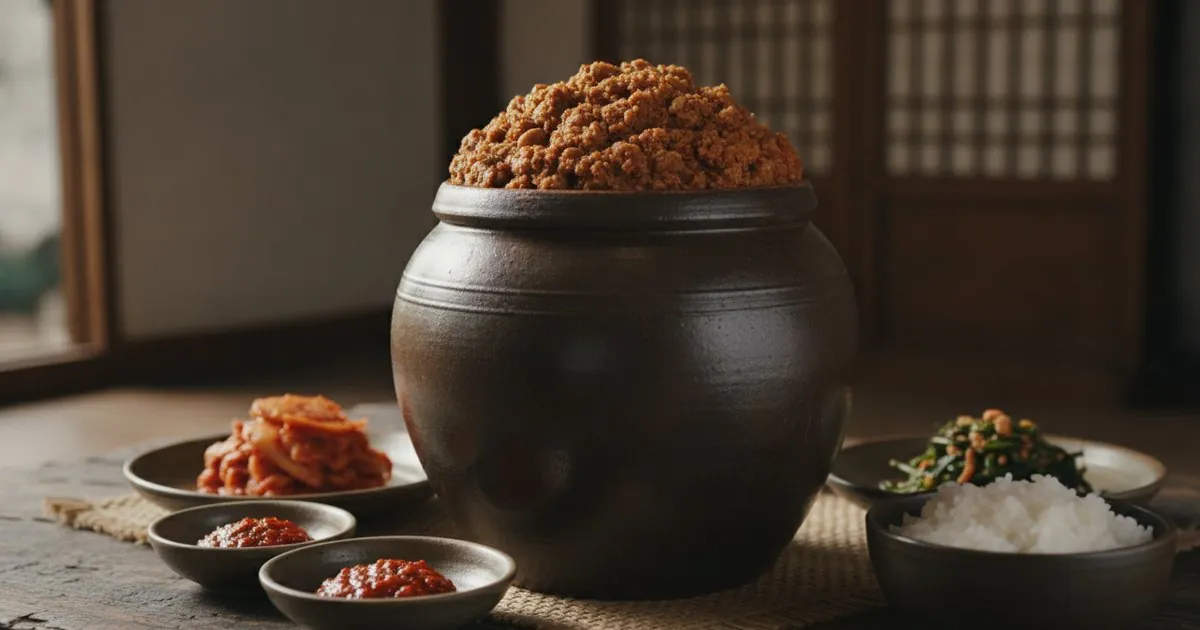
If you’ve ever opened a tub of doenjang for the first time, you know the moment. The lid comes off and you get hit with something pungent, funky, almost aggressively earthy — a smell that makes you pause and wonder what you’ve gotten yourself into. Then you taste a tiny bit on your fingertip and the complexity stops you cold: savory, salty, faintly sweet, with a deep, almost meaty richness that lingers on your tongue long after. That’s the magic of doenjang (된장), and once you understand it, you’ll wonder how you ever cooked without it.
This guide covers everything a Western home cook needs to know: what doenjang is, where it comes from (spoiler: it’s ancient and UNESCO-recognized), how it’s made, how it differs from miso, and most importantly, how to use it in your kitchen right now.
What Is Doenjang? The “Thick Sauce” at the Heart of Korean Cooking
The name 된장 (doenjang) translates literally as “thick sauce” — doen (된) meaning thick or stiff, jang (장) meaning sauce or condiment. That name tells you a lot. While ganjang (간장), Korean soy sauce, flows freely, doenjang is its dense, concentrated cousin: a chunky, matte-brown paste that packs an enormous amount of flavor into every spoonful.
Doenjang is one of three foundational Korean jang condiments. The trio — doenjang, ganjang, and gochujang (red chili paste) — forms the flavor backbone of Korean cuisine. If you’ve already explored our gochujang guide, you know how central these fermented pastes are to the Korean pantry. Doenjang is the oldest and arguably the most complex of the three.
It’s made from just two ingredients: soybeans and brine (salt and water). No wheat, no grain starter, no additives in the traditional form. This simplicity is deceptive — the depth of flavor comes entirely from time, wild fermentation, and microbial transformation.
One nutritional note worth knowing: doenjang is rich in lysine, an essential amino acid that’s scarce in rice and other grains. For a culture historically built on rice as a staple, doenjang wasn’t just a flavoring — it was a critical nutritional counterpart.
A History 1,700 Years in the Making
Doenjang’s roots go deep enough to make most Western food traditions look recent.
The oldest written reference appears in a 3rd-century CE Chinese text noting that “Goguryeo people are good at brewing fermented soybeans” — Goguryeo being one of the ancient Korean kingdoms. Fourth-century tomb murals from Goguryeo depict fermentation vessels, and by the 7th century, doenjang and other jang condiments had entered the written record of royal life. The Samguk Sagi, a Korean chronicle compiled in 1145 CE, records doenjang being served at the wedding banquet of King Sinmun of Silla in 683 CE. So yes, doenjang has been at the table for literally more than 1,300 years of documented Korean history.
During famine years in 1018 and 1052 CE, historical records document doenjang being distributed as famine relief — a fact that underscores just how essential this paste was to Korean survival, not merely to its cuisine.
By the Joseon Dynasty (1392–1910), jang-making had become a deeply ritualized household practice. Royal palaces maintained dedicated storerooms overseen by court ladies, and the officials responsible for managing the palace jang supply held higher court status than general kitchen staff. That’s how seriously this condiment was taken. In ordinary households, jang-making knowledge passed from mothers-in-law to daughters-in-law as a cornerstone of domestic life.
UNESCO Recognition in 2024
In December 2024, at the 19th Session of the UNESCO Intergovernmental Committee in Asunción, Paraguay, Korea’s jang-making culture received its most significant international recognition: inscription on the UNESCO Representative List of Intangible Cultural Heritage of Humanity. The full listing name is “Knowledge, beliefs and practices related to jang making in the Republic of Korea.”
It became Korea’s 23rd UNESCO Intangible Cultural Heritage and only the second food-related entry after kimjang (kimchi-making). The UNESCO committee noted that “the communal act of jang-making generates a sense of peace and belonging for the communities concerned” — language that captures why this is about so much more than a condiment. Korea Heritage Service official Choi Eung-chon put it plainly: “Jang-making is a legacy rooted in everyday Korean culture that carried family history and tradition, passed over generations.”
How Traditional Doenjang Is Made: The Meju System
Understanding how doenjang is made explains why it tastes the way it does — and why it’s fundamentally different from Japanese miso.
The process begins in early November with soaking and boiling whole soybeans until they’re very soft. These cooked beans are then mashed and shaped by hand into dense blocks called meju (메주). The meju bricks are dried and hung from house eaves — or kept in warm ondol (underfloor-heated) rooms — wrapped in rice straw, for roughly three to four months. During this hanging period, wild molds, yeasts, and bacteria from the environment colonize the meju. The rice straw itself encourages this wild fermentation; no commercial starter culture is added.
Around February or March, the hardened, mold-covered meju bricks are submerged in brine inside large earthenware crocks called onggi (옹기). They ferment in the liquid for another 40–90 days. Here’s where it gets clever: after this second fermentation, the liquid is strained off and becomes ganjang — Korean soy sauce. The remaining solids are packed into crocks and fermented further, sometimes for months or even years, becoming doenjang. Two products, one process.
This is the critical distinction from Japanese miso: traditional doenjang uses no grain (no rice, no barley) and relies entirely on wild fermentation rather than a controlled inoculation with a single mold strain (Aspergillus oryzae for miso). The result is a flavor profile that’s considerably more pungent, complex, and variable than miso.
Doenjang vs. Miso: What’s Actually Different
This comparison comes up constantly, and it matters for cooking decisions.
| Doenjang | Miso | |
|---|---|---|
| Base | Soybeans only | Soybeans + rice, barley, or other grain |
| Fermentation | Wild (meju) | Controlled (Aspergillus oryzae starter) |
| Flavor | Bold, pungent, earthy, complex | Milder, sweeter, more consistent |
| Texture | Chunky, coarse | Smooth, uniform |
| Age | Months to years | Weeks to months (typically) |
Can you substitute miso for doenjang? In a pinch, yes — but know that miso will taste noticeably sweeter and less funky. If you use miso in doenjang jjigae (Korean soybean paste stew), the flavor will be softer and more “polite” than the original. For authentic Korean dishes, doenjang is irreplaceable.
Buying and Storing Doenjang in a Western Kitchen
Where to buy: Korean grocery stores like H Mart are your best option — look for the refrigerated section or the condiment aisle. The most commonly available brands in the US include Haechandle, Sempio, and Chungjungone. Some Whole Foods and larger Asian grocery chains carry it, though selection is limited.
What to look for on the label: The phrase “재래식 된장” (jaeraeisik doenjang) indicates a traditionally made product. Mass-produced varieties are perfectly usable for everyday cooking. Aged varieties (숙성 된장, sukseong doenjang) are worth seeking out for more complex flavor.
Storage: Doenjang keeps for a very long time. An unopened tub is shelf-stable; once opened, store it in the refrigerator, tightly sealed. It will remain good for 6–12 months in the fridge, often longer. The surface may darken slightly — that’s oxidation, not spoilage. Taste before using: it should smell deeply savory and funky, not rotten or off in an acrid way.
How to Cook with Doenjang: Where to Start
Doenjang Jjigae (된장찌개) — Korean Soybean Paste Stew
This is the gateway dish. It’s a deeply savory, warmly funky stew made with doenjang, tofu, zucchini, mushrooms, and often clams or pork, all simmered in an anchovy-and-kelp broth. Doenjang jjigae is weeknight comfort food at its finest — served alongside rice and a spread of banchan (Korean side dishes), it’s a complete meal. Start with roughly 2–3 tablespoons (30–45 g) of doenjang for a pot serving four people, thinned into 500 ml (2 cups) of broth.
Ssamjang (쌈장) — Wrapping Sauce
Mix doenjang with gochujang, sesame oil, garlic, and a little sweetener (sugar, honey, or corn syrup) to make ssamjang — the thick, spicy-savory dipping paste that gets served with Korean grilled meats. A basic ratio: 2 tablespoons doenjang + 1 tablespoon gochujang + 1 teaspoon sesame oil + 1 teaspoon sugar + 1 minced garlic clove. This is the sauce that makes Korean BBQ unforgettable.
Doenjang as a Marinade Component
Doenjang adds extraordinary depth to meat marinades. Combine 1–2 tablespoons (15–30 g) with soy sauce, sesame oil, garlic, and ginger for a marinade for pork belly, beef short ribs, or chicken thighs. The enzymes in the fermented paste also work as a natural tenderizer.
As a Soup Base Booster
Even when you’re not making jjigae specifically, a small spoonful of doenjang — around ½ to 1 teaspoon (2.5–5 g) — dissolved into any broth or soup adds a savory depth that’s hard to achieve any other way. Think of it the way a European cook might use a spoonful of good miso to finish a broth, but with more punch.
Common Mistakes to Avoid
1. Adding Doenjang Too Early (and Boiling It to Death)
Doenjang should be added to soups and stews relatively early to develop flavor, but prolonged hard boiling destroys its more delicate aromatic compounds and makes the dish taste flat and one-dimensional. For jjigae, add doenjang after your broth base is established, then simmer gently for 10–15 minutes — not a rolling boil, and not for 45 minutes. Diagnostic: if the stew tastes sharp and salty but strangely hollow, it’s been overcooked. Fix it by removing from heat and dissolving a small additional spoonful of fresh doenjang directly into the finished dish.
2. Using Too Much in One Shot
Doenjang is highly concentrated. Western cooks unfamiliar with fermented pastes often discover too late that a tablespoon too many makes a dish almost impossibly salty and bitter. The bitterness — not just saltiness — is the giveaway that you’ve overdone it. Always start with less than you think you need (1 tablespoon for a 2-serving dish), taste, and adjust. You can always add more; you can’t take it out.
3. Substituting Miso 1:1 Without Adjusting
If you’re using miso as a doenjang stand-in, don’t substitute at the same volume. Miso is milder and sweeter, so you’ll need roughly 1.5 times the amount of miso to approximate doenjang’s intensity — and even then, the flavor profile won’t be the same. More importantly, if you use the same volume of doenjang in a recipe designed for miso, you’ll find the result overwhelmingly pungent.
4. Not Blooming the Aromatics First
In doenjang jjigae and other dishes, many home cooks just dissolve doenjang directly in water and call it done. The dish is better when you briefly sauté doenjang in a small amount of sesame oil or neutral oil (about 30 seconds over medium heat) before adding broth. This blooms the fat-soluble flavor compounds and rounds out the paste’s sharp edges. You’ll notice the aroma changes from raw and pungent to something richer and more rounded — that’s the signal that it’s ready.
5. Treating the Tub as Shelf-Stable Once Opened
An opened tub of doenjang left on the counter or in a warm pantry will develop off-flavors relatively quickly. Refrigerate after opening and keep it sealed. If you notice an ammonia-forward sharpness that wasn’t there before, the paste has likely spoiled or dramatically over-oxidized. Fresh doenjang smells savory-funky-earthy. Spoiled doenjang smells aggressively acrid, almost chemical. Trust your nose.
6. Forgetting to Balance Saltiness from Other Ingredients
Doenjang itself is salty, but if your dish also includes soy sauce, salted anchovies, or salty kimchi, the cumulative salt load can quickly become overwhelming. Taste the doenjang first before you add any other sodium source, and hold back on salt, soy sauce, and fish sauce until you’ve established the doenjang base. Add additional seasoning only at the end, in small increments.
FAQ
Q: Is doenjang the same thing as miso?
No — though they’re both fermented soybean pastes, they’re distinct products with meaningfully different flavors and production methods. Traditional doenjang uses only soybeans and brine, relies on wild fermentation via meju bricks, and is considerably more pungent and complex than most Japanese miso, which uses a grain component (rice or barley) and a controlled mold starter.
Q: Where can I buy doenjang in the United States?
H Mart is the most reliable source with the widest selection. Korean grocery stores, select Asian supermarkets, and some Whole Foods locations carry it. Online retailers including Amazon carry major brands like Sempio and Haechandle. Look for a tub in the refrigerated condiment section or on the non-refrigerated shelf.
Q: How long does doenjang last once opened?
Stored tightly sealed in the refrigerator, opened doenjang will remain good for at least 6–12 months, often longer. The surface may darken from oxidation — this is normal. Trust your nose: good doenjang smells deeply savory and earthy. If it smells acrid or ammonia-forward in an unpleasant way, discard it.
Q: Can I use doenjang raw, or does it need to be cooked?
Both. Doenjang is used raw in ssamjang (mixed with gochujang and served as a dipping sauce) and in dressings. It’s also cooked in stews, soups, and marinades. Raw doenjang has a sharper, more pungent flavor; a brief bloom in oil or gentle simmering mellows and deepens it considerably.
Q: What does doenjang taste like compared to something I might already know?
The closest Western analog is a very aged, funky parmesan or a pungent blue cheese in terms of intensity and savory depth — but the flavor profile is distinctly its own. Think: earthy, deeply savory (umami-forward), slightly salty, with a complexity that takes a few seconds to fully register. Once you’ve tasted a good bowl of doenjang jjigae, the flavor becomes immediately recognizable as irreplaceable.