
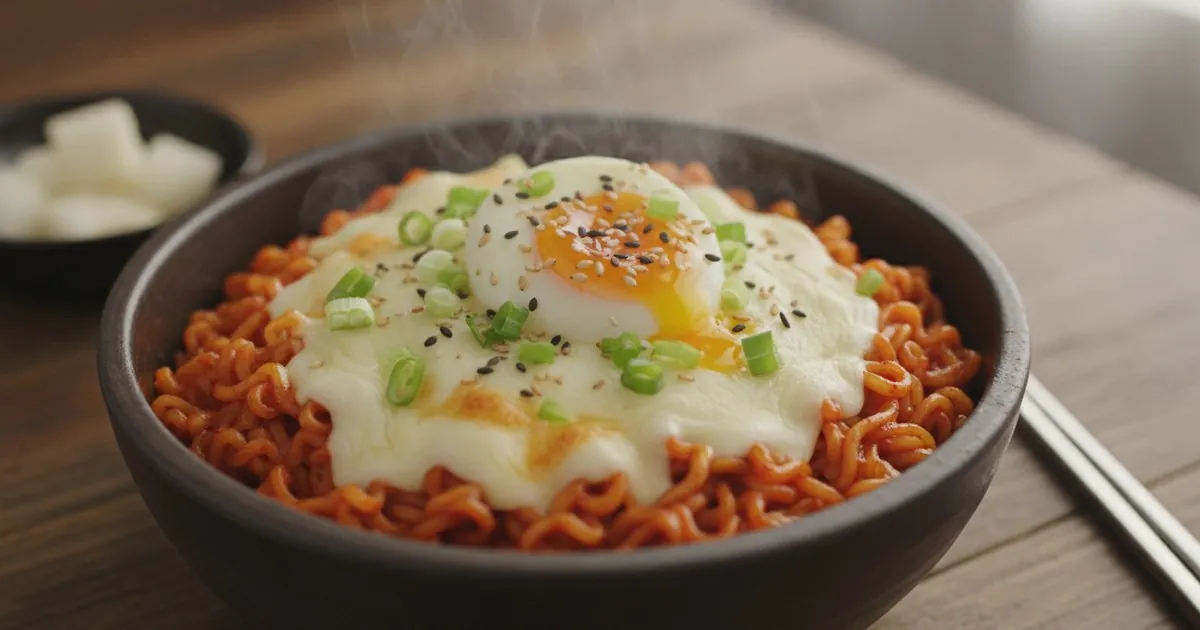
If you’ve ever bought a pack of Buldak Ramen (불닭볶음면 — literally “fire chicken stir-fry noodles”) because the packaging looked interesting and the YouTube fire noodle challenge videos made it seem like an experience, and then you opened it and made it and stared at your bowl with mild existential concern — this guide is for you.
Buldak Ramen is genuinely one of the best instant noodles ever made. It’s also genuinely extremely spicy. The challenge format in which people film themselves suffering through a bowl is a western misunderstanding of what this product is actually for — not a test of pain tolerance, but a starting point for creativity.
Koreans don’t typically eat Buldak straight from the packet and call it a meal. They use it as a sauce, a base, a flavor component that gets modified, diluted, combined, and improved. These 8 hacks are how Buldak is actually eaten by people who love it rather than endure it.
First: Understanding Buldak
Buldak Ramen is made by Samyang Foods and has been available since 2012. It comes in a distinctive red and black package and features two components: thick, springy noodles that are pre-steamed and dried, and a sauce packet (not a powder — this is important). The sauce is a deep, glossy red made from gochujang, gochugaru, sugar, chicken flavor, and an alarming quantity of capsaicin extract.
The sauce format is what makes Buldak uniquely hackable. Unlike broth-based instant noodles where you’re working with a liquid you can’t easily thicken, Buldak’s sauce is a concentrate that you control. You can use the whole packet or half. You can dilute it or add fat to it. You can mix it with cream, with cheese sauce, with other sauces. It’s a component, not a finished dish.
This is the mindset shift. Once you see Buldak sauce as an ingredient rather than the final product, a lot becomes possible.
There’s also a large product family — Original, 2x Spicy, Carbonara, Cheese, Cream, Curry, Jjajang (black bean), Carbo-Cheese — that Samyang has released over the years. These hacks primarily start from Original Buldak, but most principles apply across the line.
Hack 1: Buldak Carbonara (불닭 카르보나라)
The most famous Buldak variant is the Buldak Carbonara packet — pink-packaged, with a creamy sauce that combines the fire chicken heat with a carbonara-esque dairy flavor. But you can make a much better version yourself.
The method: Cook the Buldak noodles. Drain all but about 2 tablespoons of cooking water. Add the Buldak sauce (full or half packet, your choice), then immediately whisk in 2 egg yolks off the heat (off the heat is essential — you want the yolks to thicken the sauce without scrambling). Add 30g grated Parmesan cheese. Toss vigorously until the sauce coats every noodle in a glossy, creamy, spicy coating.
The result is legitimately excellent — like real carbonara in fire noodle form. The egg yolk rounds the sharpness of the sauce, the Parmesan adds umami and salt, and the residual starch from the noodles provides the emulsification that holds it all together.
Heat level: Using the full sauce packet with egg yolk and cheese is approximately 60% of original Buldak’s heat. The fat and protein significantly reduce perceived spiciness.
Hack 2: Cheese Buldak (치즈 불닭)
This is the most common Buldak modification in Korea and arguably the most satisfying. Add cheese — specifically, processed cheese slices (like Kraft singles or the Korean equivalent) or shredded mozzarella — directly onto the finished noodles and let them melt.
Why it works: The fat in the cheese physically binds to capsaicin molecules, coating your taste receptors and blocking the pain signal. This is the same mechanism behind “dairy neutralizes spice” — fat, not water, is the antidote. Processed cheese melts fastest and integrates most smoothly; mozzarella gives you the satisfying cheese pull.
The technique: After draining and saucing the noodles, lay 2-3 slices of processed cheese over the hot noodles in your bowl (or the pot). Wait 30-45 seconds without stirring. Then fold the softened cheese through the noodles so it becomes the sauce. Alternatively, mozzarella can be added and the pan covered for 30 seconds to create a melted layer on top.
Heat level: Approximately 40-50% of original Buldak. Very manageable for most people who aren’t regular spice eaters.
Hack 3: Cream Buldak (크림 불닭)
If cheese takes Buldak down to 40-50% heat, cream takes it further — and creates something genuinely luxurious.
The method: Cook the Buldak noodles normally. While they cook, heat 60-80ml of heavy cream in a small saucepan or microwave until just simmering. Drain the noodles, add the Buldak sauce, then pour the warm cream over and toss. The cream emulsifies with the oil-based Buldak sauce into a smooth, pink-orange coating.
You can also add cream directly to the pot after draining — the residual heat of the pot is usually enough to warm it. The key is using the cream warm so it incorporates smoothly rather than curdling.
Garnish: A twist of black pepper, a tiny drizzle of extra cream on top, and a scallion make this look and taste like a legitimate restaurant dish.
Heat level: Approximately 30-40% of original Buldak. The cream is a very effective heat buffer.
This is essentially the “rose sauce” concept applied to fire noodles — gochujang-based red sauce diluted with cream to create the pink “rose” color that’s been enormously trendy in Korean food.
Hack 4: Bulgeuri Style (불거리 — The Jungkook Mix)
We’ve covered this in detail at Jungkook’s Bulgeuri Ramen, but it belongs in this list: mixing Buldak with Neoguri Ramyeon (the seafood-flavored noodles) creates a combination that cuts the heat and adds depth.
The short version: cook both packets together, use the Neoguri’s soup powder as the broth component and roughly half the Buldak sauce as the flavor component. The seafood umami of the Neoguri rounds the aggressiveness of the Buldak into something with multiple flavor dimensions rather than pure heat.
Heat level: Approximately 40-50% of straight Buldak at the half-sauce ratio. Adjustable based on how much Buldak sauce you use.
Hack 5: Rabokki Buldak (라볶이 불닭)
Rabokki is the combination of ramen + tteokbokki (ra + bokki), and it’s a Korean staple. Adding Buldak to the rabokki format creates something that is spicy from two sources — the gochujang in the tteokbokki sauce and the Buldak sauce — and deeply satisfying.
The method: Make a simplified tteokbokki sauce (2 tablespoons gochujang, 1 tablespoon soy sauce, 1 tablespoon sugar, 1 teaspoon minced garlic, 300ml water) and bring it to a simmer. Add 200g rice cakes (tteok) and cook until soft, about 8-10 minutes. Add the cooked, drained Buldak noodles (sauce included, or sauce on the side to add gradually). Simmer together for 2-3 minutes.
The Buldak sauce in this context gets diluted by the tteokbokki broth, which is a mercy. The result is spicy from two angles but manageable, with the chewy rice cakes providing textural contrast to the noodles.
Heat level: Depends on how aggressively spicy your tteokbokki base is, but typically 50-60% of original Buldak.
Hack 6: Buldak Butter Noodles (버터 불닭)
This one is simple, elegant, and perhaps the most efficient heat reducer on this list. Add butter.
The method: Cook and drain the Buldak noodles. Add the sauce. Then add 1-2 tablespoons of unsalted butter and toss vigorously over very low heat until the butter is fully incorporated into the sauce. The butter creates an unctuous, smooth coating that carries the Buldak flavor while significantly reducing its thermal impact.
The fat in the butter does the same work as cheese or cream — it physically reduces heat perception — but it also adds a rich, vaguely European quality to the dish that works surprisingly well with the fire chicken flavor. A pinch of salt on top (the Buldak sauce is savory but the butter dilutes the salt) and some black pepper complete it.
Optional addition: A fried egg, sunny-side up, laid over the finished noodles. The yolk breaks and runs into the butter-buldak sauce and creates a third sauce component that ties everything together.
Heat level: Approximately 50-60% of original Buldak at 2 tablespoons of butter.
Hack 7: The Cold Buldak (냉 불닭) — Summer Version
This one is counterintuitive but very good. Serve the noodles cold.
The method: Cook the Buldak noodles normally. Drain and immediately rinse under cold water (as cold as you can make it) until the noodles are fully chilled. Drain again thoroughly. Add the Buldak sauce, a tablespoon of sesame oil, a teaspoon of rice vinegar, and a small amount of honey or sugar. Toss to coat. Top with julienned cucumber, shredded nori, sesame seeds, and sliced scallion.
Cold noodles with spicy sauce is a well-established Korean format — naengmyeon (cold buckwheat noodles) and bibim guksu (cold noodles with gochujang dressing) are traditional summer dishes. This applies that same logic to Buldak.
The cold temperature itself reduces heat perception (cold receptors partially compete with heat receptors), and the additional sesame oil and vinegar rebalance the sauce into something that tastes appropriate served cold — tangier, more refreshing.
Heat level: Approximately 60-70% of original Buldak. The cold reduces perceived heat, but not as dramatically as dairy or fat additions.
Best served: On very hot days when you want something spicy but the idea of a steaming hot bowl isn’t appealing.
Hack 8: The Full Topping Treatment
The final hack isn’t about the sauce — it’s about what you put on top. Buldak at its best is dressed with a full topping array that transforms it from “instant noodles” into “a bowl of something you’d pay $15 for at a noodle bar.”
The canonical topping kit:
- Soft-boiled egg (jammy, 6-7 minute, jammy yolk): The most important single topping
- Spam or luncheon meat: Pan-fried cubes until caramelized on all sides. Add a teaspoon of soy sauce and sugar in the last 30 seconds for a lacquered glaze
- Scallions: Thinly sliced, added raw at the end for freshness and crunch
- Toasted sesame seeds: A tablespoon scattered over the finished bowl
- Dried seaweed (gim): Crumbled sheets add a smoky, oceanic note
- Toasted garlic: 2-3 cloves thinly sliced and fried in a little oil until golden. Scattered over the bowl adds crunch and mellow garlic depth
- Nori (김) strip: Fold a half-sheet of nori into the bowl while eating to create impromptu seaweed-and-noodle bites
With the full topping treatment, even full-sauce Buldak becomes a satisfying bowl with enough textural and flavor complexity that the heat is contextualized rather than dominant.
The Heat Scale: Choosing Your Approach
Here’s a practical guide to matching the hack to your spice tolerance:
| Tolerance Level | Recommended Approach | Heat Level |
|---|---|---|
| Very low | Cream Buldak or Carbonara | 30-40% original |
| Low | Cheese Buldak | 40-50% original |
| Medium | Bulgeuri (Jungkook mix) or Butter Buldak | 50-60% original |
| Medium-high | Rabokki Buldak or Full Toppings | 60-70% original |
| High | Cold Buldak or Original with toppings | 70-90% original |
| Unhinged | 2x Spicy straight, full sauce | 100%+ original |
Which Buldak Flavor to Start With
Samyang’s Buldak family has expanded considerably. If you’re new:
- Original (red package): The reference point. Everything else is a variation of this.
- Carbonara (pink package): The pre-made creamy version. Less control than making your own, but convenient.
- Cheese (yellow package): Pre-made cheese version. Good but the hack above is better.
- 2x Spicy (black and red package): Not a beginner product. Approach with caution and dairy.
- Curry (yellow-orange package): Significantly milder in perceived heat, with an interesting fusion flavor.
Building Your Buldak Pantry
If you’re going to explore Buldak hacks seriously, keep these on hand:
- Several Buldak packets (buy in bulk — it’s cheaper and they keep forever)
- Neoguri packets for the Bulgeuri combination (see Jungkook’s Bulgeuri Ramen)
- Processed cheese slices
- Heavy cream
- Good butter (unsalted)
- Eggs
- Spam or good luncheon meat
- Sesame oil
- Toasted sesame seeds
- Scallions
With this pantry, you can execute all 8 hacks at any time. And once you’ve tried all of them, you’ll understand why Korean convenience store culture treats Buldak as a starting point rather than a finished dish — see Korean convenience store food for the full picture of how these noodles fit into a broader food culture.
Common Misconceptions
Buldak is a soup noodle, so you add the sauce to hot water like broth. This is one of the most common first-timer errors. Buldak Ramen (불닭볶음면) is a stir-fry noodle — the 볶음 (bokkeum, “stir-fried”) in the name signals this directly. You cook the noodles, drain most of the water, and toss them with the thick sauce concentrate. There is no broth component. Treating it like a soup-style instant ramen produces a watery, oddly diluted bowl that is simply the wrong dish.
The fire noodle challenge represents how Buldak is eaten in Korea. Challenge videos show people suffering through a plain, unmodified bowl as a pain tolerance test, and this framing has shaped Western assumptions about the product. In Korea, Buldak is routinely modified — with cheese, cream, eggs, additional noodles, and other sauces — or used as a sauce component in larger recipes. The challenge format travels well online precisely because it is dramatic; the actual eating culture around Buldak is far more creative and casual.
Water is the best way to manage the heat. Capsaicin, the compound responsible for chili burn, is fat-soluble rather than water-soluble. Water does not bind to capsaicin or neutralize it — it can actually redistribute it across your mouth and throat. Dairy fat (milk, cream, cheese), egg yolk fat, and other lipids are what physically carry capsaicin away from your taste receptors. This is the chemistry behind every dairy-based hack in this article, not just a matter of preference or tradition.
The packaged Buldak Carbonara variant and the homemade version are equivalent. The Samyang Carbonara packet is a real and popular product, but it relies on a pre-blended powdered dairy component. The homemade method — egg yolks emulsified off the heat, Parmesan, starchy cooking water — produces a texturally different result: silkier, richer, and more cohesive. They are worth treating as distinct preparations rather than the same thing in different packaging.
Buldak’s extreme heat comes entirely from Korean chili peppers. The sauce does contain gochujang and gochugaru, but a significant share of its intensity comes from added capsaicin extract — a highly concentrated form of the active compound. This is why Buldak’s heat can feel sharper and more immediate than dishes built purely from chili paste or dried pepper, hitting quickly rather than accumulating gradually.
The non-Original variants are lesser, marketing-driven products. Samyang’s Buldak line — Cheese, Cream, Jjajang, Curry, Carbonara, and others — represents genuinely distinct flavor directions, not diluted imitations. Many Korean consumers regularly eat the Cream and Carbonara varieties as straightforward weekday meals. Dismissing them as gimmicks misunderstands the range the product family actually covers and limits the hacks available to you.
Frequently Asked Questions
Is Buldak Ramen actually that spicy? Yes, the original is genuinely very spicy — it’s been measured at approximately 4,400 Scoville Heat Units (SHU) in the sauce, which puts it well above jalapeños (2,500-8,000 SHU) and in the range of some habanero-level heat. The 2x Spicy version is roughly twice that. For context, sriracha sauce is around 2,200 SHU. Buldak is not playing around.
Why is Buldak sauce in a packet rather than powder like most instant noodles? Buldak is a “stir-fry” style noodle (볶음면, bokkeum myeon) rather than a soup noodle. You cook the noodles in boiling water, drain almost all the water, and then toss with the sauce — rather than adding a powder to a broth. This format is why Buldak works so well for hacks: you have control over how much sauce you use and what you add to it.
Can I use Buldak sauce without the noodles? Yes, and this is genuinely useful. The Buldak sauce packet is excellent as: a spicy sauce for fried rice, a marinade for chicken wings, a dipping sauce for anything fried, or a flavor component for any dish that needs heat and depth. The sauce packet alone, without the noodles, is a versatile ingredient.
What’s the best way to reduce Buldak heat without sacrificing flavor? Use half the sauce packet (the Buldak flavor is concentrated; half is still impactful) and add a fat-based element — butter, cream, or cheese. The Buldak flavor compounds that give it its distinctive profile are not just heat; they’re also savory, smoky, and slightly sweet. Using half sauce + fat preserves the flavor while dramatically reducing the heat.
Are Buldak noodles actually popular in Korea, or is it just international? Buldak is extremely popular in Korea — it’s consistently one of Samyang’s best-selling products and has been so since shortly after its 2012 launch. It’s stocked in every convenience store, every supermarket, and every ramyun aisle. The international viral fame (via fire noodle challenge videos) added international popularity on top of strong domestic sales.
Where can I buy Buldak outside Korea? It’s become one of the most widely distributed Korean instant noodle products internationally. You can find it at: Korean grocery stores (H-Mart, etc.), most Asian grocery stores, Walmart (often carries the original), Target (seasonal sections), Amazon (all varieties, often in multi-packs), and increasingly, mainstream supermarkets with international food sections.