
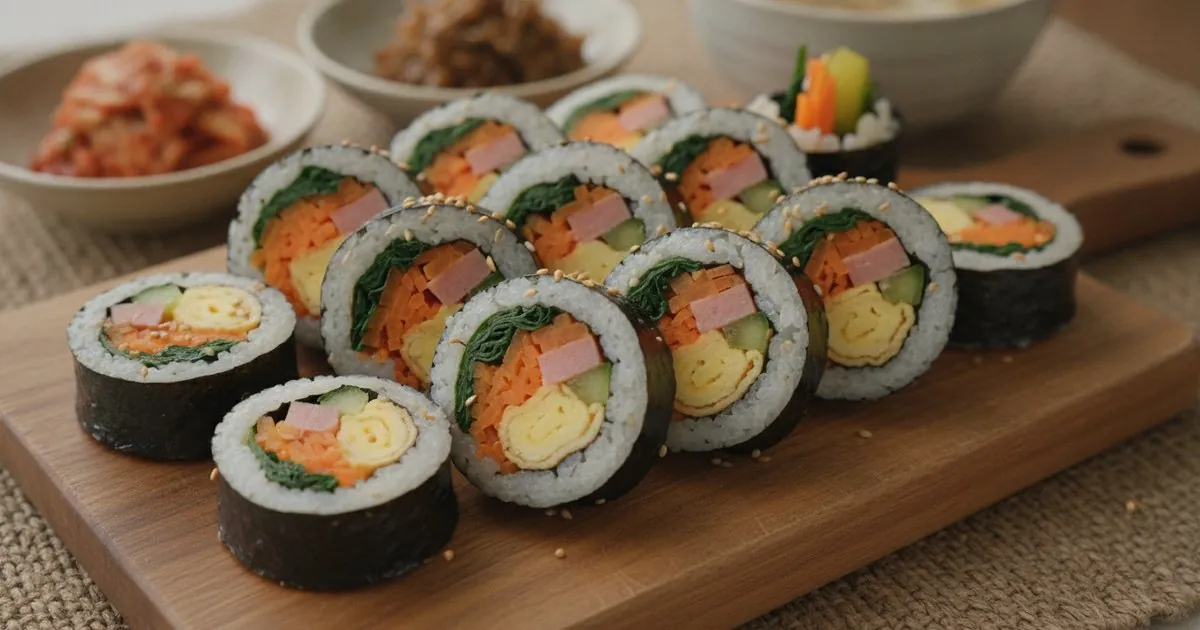
When the K-drama Extraordinary Attorney Woo premiered on Netflix in 2022, it quietly ignited one of the most charming food trends in recent memory. The show’s protagonist, Woo Young-woo, has a deep and sincere love of gimbap — she eats it nearly every day, in almost every episode, with obvious, unguarded joy. Within weeks of the show’s release, gimbap searches surged worldwide, Korean convenience stores reported spikes in sales, and home cooks across the globe began attempting to roll their own.
It was the perfect food for such a moment. Gimbap (김밥) is not flashy or complex. It doesn’t require hours of work or exotic techniques. It is, at its heart, simply rice and fillings rolled in roasted seaweed, sliced into bite-size rounds. And yet it is deeply, reliably delicious — the kind of food that makes you feel taken care of, whether you’re eating it from a convenience store on a Seoul street corner or unpacking it from a lunch box someone made for you at home.
What Is Gimbap?
Gimbap (also romanized as kimbap) takes its name from its two main components: gim (김, roasted seaweed sheets) and bap (밥, rice). Unlike Japanese maki sushi, gimbap uses rice seasoned with sesame oil and salt rather than vinegar. The fillings are fully cooked — there is no raw fish — and the flavor profile leans savory and nutty rather than bright and acidic.
The result is something quite distinct from sushi: heartier, more substantial, with a warm sesame fragrance that defines the eating experience. In Korea, gimbap is portable comfort food — a favorite for school lunches, hiking trips, picnics in Han River Park, and train journeys. Every Korean family has its own variation, passed down through generations, with small tweaks that each household considers essential.
A Brief History
The exact origin of gimbap is debated. Some historians trace it to bokssam — a traditional Korean dish where rice and other fillings were wrapped in various leaves or dried vegetables. The use of dried seaweed (gim) as a wrapper dates back at least to the Joseon period, when gim was a prized ingredient.
The modern rolled gimbap as we know it became widely popular in the 20th century. American military influence post-Korean War introduced Spam and processed cheese as fillings; Japanese colonial influence brought the technical similarity to maki rolls, though the Korean version developed its own distinct character. Today, gimbap ranges from the simplest home-version with egg and pickled radish to elaborate specialty rolls filled with tuna, kimchi, cheese, or even bulgogi.
The Rice: Getting It Right
The rice is the foundation of every great gimbap roll. Use short-grain white rice (Korean or Japanese sushi-style rice). Long-grain rice won’t stick together properly and your rolls will fall apart.
Season the rice while it’s still warm with sesame oil, salt, and sesame seeds. This is what distinguishes Korean gimbap rice from all other rice rolls — the sesame oil gives it a nutty fragrance that you’ll recognize in every gimbap you’ve ever eaten. Don’t use too much sesame oil (one tablespoon for three cups of rice is the right proportion) — you want it fragrant, not greasy.
The rice temperature matters. Warm rice is too sticky and will compress into a dense mass that’s unpleasant. Cold refrigerated rice won’t stick to the seaweed. Let the seasoned rice cool to just-above-room-temperature before rolling.
The Fillings: Classic and Creative
Traditional gimbap has a specific lineup of fillings that vary slightly by region and family, but commonly includes:
Danmuji (단무지): Yellow pickled daikon radish — non-negotiable in classic gimbap. It adds crunch, acidity, and a touch of sweetness that cuts through the richness of the egg and meat. Available in pre-cut strips at any Korean grocery store.
Gyeran (계란, egg): Cooked as a thin omelet (jidan) and cut into strips. This is different from the fried egg used in bibimbap — it’s a flat, pale yellow sheet rather than a whole egg.
Sigeumchi namul (시금치나물): Blanched, squeezed spinach seasoned with sesame oil. The same preparation used in bibimbap and japchae.
Carrot: Briefly sautéed julienned carrot. Just enough to take the raw edge off while preserving some crunch.
Bulgogi or plain sautéed beef: The protein. Some families use ground beef seasoned with soy sauce; others use tuna salad; still others use Spam.
Crab stick (surimi): A modern addition, extremely popular in Korean convenience store gimbap. It adds a sweet, mild seafood flavor that pairs beautifully with the sesame rice.
For more inspiration on combining Korean flavors, see our guide on what BTS eats, which covers the favorite foods of members who have publicly discussed their love of gimbap and other Korean classics.
The Seaweed: Choosing Your Gim
Not all dried seaweed is equal for gimbap. You need full-size roasted gim — the same kind used for making kimbap, sold in most Korean and Japanese grocery stores as large 8×7-inch (21×18cm) sheets. They’re labeled “gim for kimbap” or “nori for rolling.”
The best gim is a deep forest green-black color, uniformly thin, and crispy. It should have a subtle oceanic smell and a very faint sea salt flavor. Don’t buy the snack-sized seasoned gim sheets — they’re too small, too heavily seasoned, and too oily for rolling.
Store unused gim in an airtight container or resealable bag with a silica gel packet. Gim absorbs moisture quickly and will soften if left exposed to air.
Rolling Technique: The One Skill to Master
Rolling gimbap looks intimidating before you’ve done it. After the first two rolls, it becomes natural. Here’s what to remember:
Don’t overfill. This is the mistake everyone makes. A thin line of fillings rolls cleanly; a thick pile of fillings bursts through the seaweed. Each filling should be roughly the same diameter as your pinky finger. When in doubt, use less.
Leave a bare strip at the far edge of the gim. About one inch of bare seaweed at the far end acts as the “seal” for your roll. The moisture from the rice will make it stick.
Use the mat, not your hands. The bamboo mat (bambusoe or makisu) lets you apply even pressure across the entire width of the roll, creating a tighter, rounder shape than you could achieve by hand.
Press firmly as you roll. Gentle pressure creates loose, uneven rolls. Firm, steady pressure creates tight, beautiful rounds.
Wipe your knife between cuts. This single habit makes the difference between clean, pretty rounds and torn, squashed ones.
Variations
Chamchi gimbap (참치김밥): Made with canned tuna mixed with mayonnaise and a little sriracha. One of the most popular modern gimbap fillings, especially in convenience stores.
Kimchi gimbap: Finely chopped, squeezed kimchi added to the filling lineup. The sourness is incredible against the neutral sesame rice.
Cheese gimbap: A slice of processed cheese (Kraft single or similar) rolled inside — a kid-friendly variation that has become a beloved staple.
Mini gimbap (mini kimbap): Made with half-sheets of gim and rolled into narrow, one-bite rolls. These are adorable and perfect for parties or as banchan.
Nude gimbap (누드김밥): Also called “naked gimbap” — the rice is on the outside and the seaweed is inside, an inside-out technique borrowed from California rolls that’s grown popular in Korea.
Where to Buy Ingredients
Gim (roasted seaweed sheets): H Mart, Zion Market, any Korean grocery, or Amazon. CJ and Dongwon are reliable brands. Make sure you buy the large sheets, not mini snack packs.
Danmuji (yellow pickled radish): Available pre-cut into gimbap strips at Korean grocery stores. Look for packages labeled “gimbap danmuji.” Extremely affordable.
Bamboo rolling mat: Any Asian grocery or kitchen supply store. Also available on Amazon for under $5. Get a round mat rather than a square one for better control.
Short-grain rice: Koshihikari, Nishiki, or any brand labeled “sushi rice” at most grocery stores.
For more on stocking a Korean pantry for dishes like gimbap and others, see our Korean pantry essentials guide.
Storage and Packing for Picnics
Gimbap is genuinely best eaten within 1-2 hours of being made, when the seaweed is still crisp. After a few hours, the seaweed softens and the rolls become slightly soggy. This is a texture preference — the flavor is still good, but the ideal is fresh.
For picnics and packed lunches, wrap each roll tightly in plastic wrap (uncut) immediately after making. Cut and unwrap just before eating. This preserves the seaweed crispness longer.
Refrigerating gimbap makes the rice hard and unpleasant. If you must refrigerate, let the rolls come to room temperature for at least 20 minutes before eating.
Do not freeze gimbap.
Common Mistakes to Avoid
Using long-grain or freshly-cooked-hot rice. Long-grain rice (like jasmine or basmati) doesn’t have enough surface starch to hold together under pressure, so sliced rounds crumble apart on the cutting board. And rice that’s still steaming compresses into a gummy, dense log when you roll it. Use short-grain Korean or Japanese rice, and let it cool, uncovered, until it’s just slightly above room temperature — warm to the touch but no longer steaming. Twenty to thirty minutes on a wide tray speeds this up considerably.
Over-seasoning the rice with sesame oil. One tablespoon of sesame oil per three cups of cooked rice is the ceiling, not a starting point. Pouring in more doesn’t make the rice more flavorful — it makes it slick and greasy, which causes the seaweed to slide rather than seal. The rice won’t grip the gim, the roll will unravel when cut, and every slice will taste more like oil than sesame. Season conservatively; you can always brush a little extra oil on the outside of the finished roll.
Skipping the moisture squeeze on the spinach. Sigeumchi namul needs to be blanched, shocked in cold water, and then squeezed very firmly — with both hands, like you’re wringing out a wet cloth — before it’s seasoned. If excess water stays in the spinach, it migrates into the seaweed during rolling and turns it soft and rubbery before you’ve even finished slicing. Soggy gim loses its structural integrity and the roll tears instead of cutting cleanly.
Cutting with a dull or dry knife. Gimbap slices beautifully when the knife is sharp and lightly oiled or moistened between cuts. A dull blade drags and compresses the roll, smearing the rice and distorting the cross-section. Wipe the blade with a damp cloth or brush a thin film of sesame oil on it, then use a single confident forward stroke — not a sawing motion — per slice. Hesitant, back-and-forth cutting crushes the fillings.
Overfilling the roll. This is by far the most common reason a gimbap roll bursts open mid-roll or fails to seal. Each filling strip should be roughly as thick as a pencil, placed in a single tight line. When you pile fillings high, the bamboo mat can’t apply enough pressure to compress everything into a uniform cylinder — the seaweed cracks or gaps open at the seam. If you can’t close the mat around the roll without force, you’ve used too much filling. Remove some, re-roll, and start again.
Rolling with the seaweed shiny-side up. Roasted gim has a slightly rough matte side and a smoother, shinier side. Place the rice on the matte (rough) side — it grips the rice better and helps the roll hold its shape. Rolling rice-side down on the shiny surface means your rice layer shifts as you roll, resulting in an uneven interior and a roll that won’t seal properly at the seam.
Frequently Asked Questions
What’s the difference between gimbap and sushi? Though they look similar, gimbap and sushi are distinct. Sushi rice is seasoned with rice vinegar, sugar, and salt, giving it a bright, tangy flavor. Gimbap rice uses sesame oil and salt — nutty and savory. Gimbap uses only cooked fillings; sushi often uses raw fish. Gimbap is eaten as everyday portable food in Korea; sushi in Japan ranges from casual to high-end omakase.
Can I make gimbap without a bamboo mat? Yes, with some difficulty. You can use a clean kitchen towel covered in plastic wrap as a substitute. The rolling technique is the same. The result will be slightly less uniform, but perfectly edible. A bamboo mat is a worthwhile $4-5 investment if you plan to make gimbap regularly.
Why does my seaweed tear when I cut the rolls? Almost always a dull knife issue. Use the sharpest knife you own, keep it clean and slightly damp between cuts, and use a firm sawing motion rather than pressing straight down. Let the knife do the work. If your seaweed is particularly tough, let the roll rest for 5-10 minutes after rolling — the moisture from the rice will soften the seaweed slightly, making it easier to cut.
Can gimbap be made vegetarian? Easily. Simply omit the beef and crab stick. Add more vegetables — cucumber, avocado, sautéed mushrooms, sweet potato — or use firm tofu as a protein. The egg can be replaced with a plant-based egg product if you need fully vegan gimbap. Use sesame oil and rice only (sesame oil itself is vegan).
My rice keeps falling apart and not sticking. What went wrong? Most likely you’re using long-grain rice, or the rice is over-rinsed (removing too much starch) or improperly cooked. Use Japanese or Korean short-grain rice, cook it according to package directions, and season it while warm. Also make sure your rice isn’t too dry — if it’s not sticking at all, it’s been over-dried or overcooked.
How do Koreans eat gimbap for breakfast? Gimbap is all-day food in Korea, absolutely including breakfast. It’s a common convenience store breakfast — grab a roll from GS25 or CU, eat it standing at the counter with a cup of canned coffee. For homemade breakfast gimbap, simple versions with just egg and danmuji are traditional (called mayak gimbap, literally “drug gimbap” for how addictive the mini version is).