
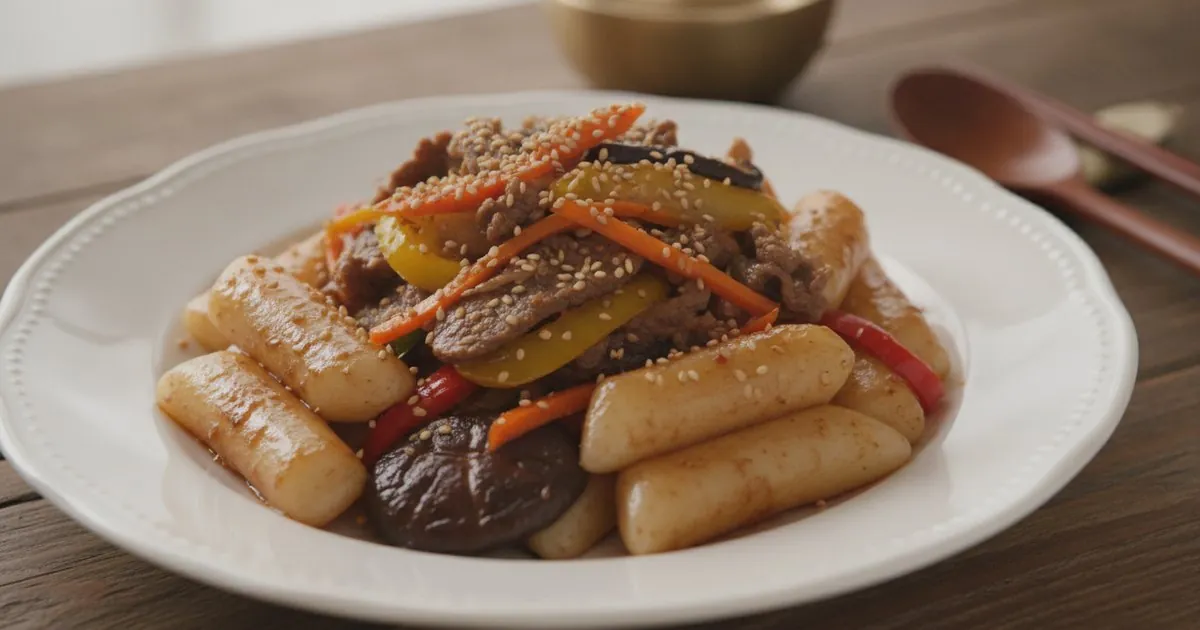
Before gochujang came into widespread use, before the street food carts of 1950s Seoul, before tteokbokki became the fiery, globally loved snack it is today — there was gungjung tteokbokki (궁중떡볶이). The name translates literally as “royal court rice cake stir-fry,” and the name tells you everything: this is the dish that was served in the kitchens of the Joseon Dynasty palace, prepared by professional royal court chefs for the king and his household.
It is, in almost every way, the opposite of the spicy street food version. There is no gochujang. There is no fire. Instead, there is soy sauce, sesame oil, tender beef, earthy mushrooms, and crisp colorful vegetables. The rice cakes are the same — chewy, cylindrical garaetteok — but the experience of eating them is entirely different: quiet, elegant, deeply savory, with a nutty richness from the sesame that lingers pleasantly long after the bowl is empty.
If the only tteokbokki you know is the red, spicy kind, gungjung tteokbokki will come as a revelation. And if you’ve been avoiding tteokbokki entirely because you can’t handle spice, this is your entry point.
A Dish With Eight Centuries of History
Korean royal court cuisine (gungjoong yori, 궁중요리) represents the pinnacle of the Korean culinary tradition. Developed across the Joseon Dynasty (1392–1897), it was characterized by meticulous technique, the highest quality ingredients sourced from across the country, elaborate presentation, and a philosophy of balance — in flavor, color, and nutrition.
Tteok (rice cakes) have been a central element of Korean food culture since at least the Three Kingdoms period (57 BC – 668 AD). Rice was precious; forming it into tteok was a way of honoring special occasions, ancestral rites, and the rhythm of the agricultural calendar. The first documented tteokbokki recipes, from royal court cookbooks of the Joseon era, describe a savory, non-spicy preparation: rice cakes sautéed with sliced beef, mushrooms, seasonal vegetables, and seasoned with soy sauce and sesame oil.
The spicy version we now think of as “normal” tteokbokki only appeared in the 1950s, after Madam Ma Bok-rim’s famous accident in Sindang-dong. From there, the fiery street food version rapidly overtook the royal court version in popularity. But gungjung tteokbokki never disappeared — it remained a staple of traditional Korean home cooking, featured in cookbooks, taught in Korean cooking schools, and eaten in homes where the preference is for savory elegance over chili-heat.
Today, many Korean restaurants offer both versions side by side, and the royal court style is frequently presented as the more refined, adult option. The two versions are complementary rather than competitive, and anyone who loves the pillar tteokbokki recipe should explore this one as a fascinating counterpoint.
What Makes This Dish Distinct
Several things set gungjung tteokbokki apart from both its spicy cousin and from Western stir-fry traditions:
No sauce pool. This is a dry stir-fry in the Korean tradition. The soy sauce, sugar, and sesame oil are absorbed into the rice cakes and vegetables, not left as a puddle in the pan. The dish is lightly glazed, not saucy.
The beef. Thin-sliced, quickly seared beef brings a richness and protein to the dish that the street food version lacks. Sirloin or ribeye are the traditional choices; the marbling in ribeye produces a slightly more unctuous result. The beef is marinated briefly before cooking, which seasons it and helps it caramelize quickly at high heat.
The vegetables. The classic combination is carrot, shiitake mushrooms, and bell pepper or zucchini — chosen as much for their color as their flavor. In traditional presentations, the dish should have five colors (obangsaek, 오방색): white (rice cakes), brown-red (beef), orange (carrot), green (scallion), and black (mushrooms). This isn’t just aesthetics; it reflects the Korean philosophical framework of yin-yang and the five elements.
Sesame oil as the finish. Where most Korean dishes use neutral oil for cooking, gungjung tteokbokki finishes with a drizzle of sesame oil just before serving. This preserves the oil’s delicate, nutty aroma — heat destroys it quickly. The fragrance you get when you drizzle it over a hot pan is one of the most appealing moments in Korean cooking.
Choosing and Preparing the Beef
The beef is the most technique-sensitive part of this recipe, and a few tips will make the difference between tender, flavored meat and chewy, overcooked strips:
Slice very thin. The thinner the beef, the more quickly it cooks and the more thoroughly it absorbs the marinade. Aim for slices no thicker than 2–3mm (about ⅛ inch). The trick that Korean home cooks use: freeze the beef for 20–30 minutes before slicing. Semi-frozen meat holds its shape and can be cut much thinner than fully thawed meat.
Slice against the grain. Look at the muscle fibers running through the meat and cut perpendicular to them. This shortens the fibers and results in more tender, less stringy pieces.
Don’t overcrowd the pan. Beef releases moisture as it cooks. If you add too much at once, the temperature drops and the beef steams rather than sears, losing the caramelized flavor you’re after. Cook in two batches if necessary.
Remove before it’s fully cooked. The beef goes back into the pan at the end. If you cook it fully the first time, it will overcook on the second pass. Remove it when it’s just cooked through — a light pink in the center is fine.
The Vegetables: Timing and Technique
In Korean stir-fry cooking, the order of vegetables added to the pan matters enormously. Harder, denser vegetables that take longer to cook go in first; delicate vegetables and aromatics go in last. For this recipe:
- Carrots first (densest, takes longest)
- Shiitake mushrooms (need a minute or two to release their moisture and develop flavor)
- Bell pepper (cooks quickly, should stay crisp-tender)
- Scallions last (add color and a mild onion flavor, shouldn’t be cooked long)
The goal is vegetables that are tender-crisp — cooked through but with a little texture remaining. Mushy vegetables are the enemy of a well-made gungjung tteokbokki.
Mushrooms: Dried shiitake reconstituted in warm water for 20 minutes produces an even more intense, woodsy flavor than fresh shiitake, and the soaking liquid can be used as stock. Either works here.
Gungjung Tteokbokki for Different Occasions
This dish is versatile in a way that’s easy to underestimate:
As a banchan (side dish): Serve small portions alongside rice and other Korean side dishes. A few pieces per person as part of a multi-dish Korean meal is traditional.
As a main dish: A larger portion — the full recipe for two people — served with a simple rice and soup is a complete weeknight dinner.
As a party dish or potluck contribution: Unlike the spicy version, gungjung tteokbokki is accessible to guests who don’t eat spicy food, making it a safer choice for a crowd. It also holds slightly better than the spicy version because there’s no thick gochujang sauce to continue thickening.
For children: Many Korean children’s diets include gungjung tteokbokki before they’ve built up a tolerance for spicy food. It’s a gentler introduction to tteok and to the savory flavors of Korean cooking.
Regional and Seasonal Variations
The basic formula of rice cakes + beef + soy sauce + sesame oil is universal, but what goes into the vegetable mix changes with the season and the cook:
- Spring: Blanched spinach, garlic scapes, fresh bamboo shoots
- Summer: Zucchini, thin green peppers, napa cabbage
- Autumn: Chestnut mushrooms, ginkgo nuts, thinly sliced daikon
- Winter: Dried jujubes, pine nuts, dried shiitake (the most traditional royal court version)
Pine nuts (jat, 잣) appear frequently in historical royal court tteokbokki recipes. They’re sprinkled on top as a garnish — their gentle richness and slight crunch are a lovely finishing touch if you can find them.
Pairing and Serving Suggestions
Gungjung tteokbokki is mild enough to pair with a wide range of drinks:
- Makgeolli (막걸리): The milky, slightly sweet, lightly fizzy Korean rice wine is a wonderful companion for savory tteok dishes.
- Soju: Works beautifully if you’re in the mood for something stronger.
- Green tea: The right choice if you’re eating this as part of a traditional Korean meal and want to cleanse the palate.
- Beer: A cold Korean lager (Kloud, Terra, Cass) alongside a plate of gungjung tteokbokki is deeply satisfying.
The dish itself goes well with miyeok guk (seaweed soup), dubu jorim (braised spicy tofu), or any mild Korean soup to complete the meal.
Storage and Reheating
Gungjung tteokbokki stores and reheats more gracefully than the spicy gochujang version:
- Refrigerate in an airtight container for up to 2 days.
- Reheat in a dry skillet over medium heat with a splash of water, stirring gently until warmed through. Add a fresh drizzle of sesame oil to restore the aroma.
- Do not freeze the finished dish — the rice cakes become grainy. Freeze raw, uncooked rice cakes instead.
One note: the vegetables will soften further as the dish sits, so if you’re planning to have leftovers, consider slightly undercooking the carrots and peppers during the initial preparation.
Common Mistakes to Avoid
Not soaking refrigerated rice cakes before cooking. Garaetteok stored in the fridge becomes hard and dense at its core. If you add cold, unsoaked tteok directly to the pan, the outside scorches while the inside stays stiff and gummy. Soak refrigerated rice cakes in room-temperature water for at least 20–30 minutes before stir-frying. Fresh or room-temperature tteok can go straight in, but when in doubt, soak — it’s cheap insurance.
Using too much soy sauce and creating a sauce pool. Gungjung tteokbokki is a dry stir-fry; the seasoning should coat and glaze, not puddle. Excess soy sauce makes the rice cakes waterlogged and salty, and the dish loses its characteristic lightly glazed finish. Measure carefully — typically 2–3 tablespoons for a standard two-serving portion — and add it in stages, tossing constantly so it absorbs rather than pools at the bottom.
Adding sesame oil too early. This is probably the most common mistake with Korean sesame-finished dishes. Sesame oil’s complex, nutty aroma is volatile — it dissipates rapidly over high heat, leaving behind only the fat without the fragrance. Add it off-heat or in the final 30 seconds of cooking, drizzling over the pan and tossing once. The fragrance you want is the one that hits you when you plate the dish, not when it went into the pan.
Overcrowding the pan and steaming the beef instead of searing it. If the pan is too full, the beef’s released moisture can’t evaporate fast enough and the temperature drops sharply — you end up with grey, steamed strips instead of lightly caramelized ones. Use a wide, heavy-bottomed skillet or wok preheated over high heat, and cook the beef in two batches if needed. Each batch should sizzle hard the moment it hits the pan.
Adding all the vegetables at once. Carrots, shiitake, and bell pepper have very different cooking times. Dump them in together and you’ll have mushy mushrooms alongside undercooked carrot, or overcooked pepper by the time the carrot is done. Stagger them — carrots first for two minutes, mushrooms next, bell pepper last — so everything finishes at the same moment with distinct texture.
Under-seasoning the marinade and over-correcting at the end. The brief beef marinade (soy sauce, sesame oil, garlic, a touch of sugar) is the foundation of the dish’s flavor. Skipping or rushing it means flat-tasting meat that no amount of pan-seasoning will rescue. Give the beef a full 10–15 minutes in the marinade, even if the rest of the prep runs faster than expected.
Frequently Asked Questions
Can I make this dish without beef, to keep it vegetarian? Absolutely. Replace the beef with firm tofu (pressed and sliced, then pan-fried), king oyster mushrooms (they have a meaty texture and umami similar to beef), or just increase the quantity of shiitake mushrooms. The savory soy-sesame flavor profile supports these substitutions beautifully.
What kind of soy sauce should I use? Regular Korean soy sauce (ganjang, 간장) is traditional. You can also use Japanese shoyu — the flavor is slightly sweeter and less sharp, which works well here. Avoid very dark, thick soy sauces (like dark Chinese soy sauce) as they will over-color and over-season the dish.
My rice cakes are sticking to the pan. What should I do? Make sure the pan is well-oiled and properly hot before adding the rice cakes. Adding 2–3 tablespoons of water to the pan during cooking helps loosen anything that sticks and creates a little steam that helps the rice cakes cook through. Don’t try to move them too early — they’ll release naturally once they’ve had a moment to sear slightly.
Is this the same as “Joseon-era tteokbokki”? Yes — gungjung tteokbokki is the direct descendant of the Joseon Dynasty palace recipe. Some recipes add a few tablespoons of water or dashima stock to create a very light sauce; others are completely dry-stir-fried. The recipe here is a home-cook adaptation of the palace version, using ingredients readily available outside Korea.
Can I add spice to this if I want a little heat? You can, and many modern Korean cooks do a hybrid version: mostly soy-sauce based with a small spoonful of gochujang stirred in. This gives you the savory complexity of gungjung tteokbokki with a mild background heat. Start with ½ tablespoon of gochujang and taste before adding more.
Where can I find the ingredients outside Korea? All the ingredients for this recipe are widely available. Korean rice cakes: Korean grocery stores (H Mart, Zion, Galleria) or online. Soy sauce and sesame oil: any grocery store. Shiitake mushrooms: increasingly common in mainstream grocery stores; also widely available at Asian markets. The beef can be any tender cut — the main requirement is that it can be sliced very thin.