
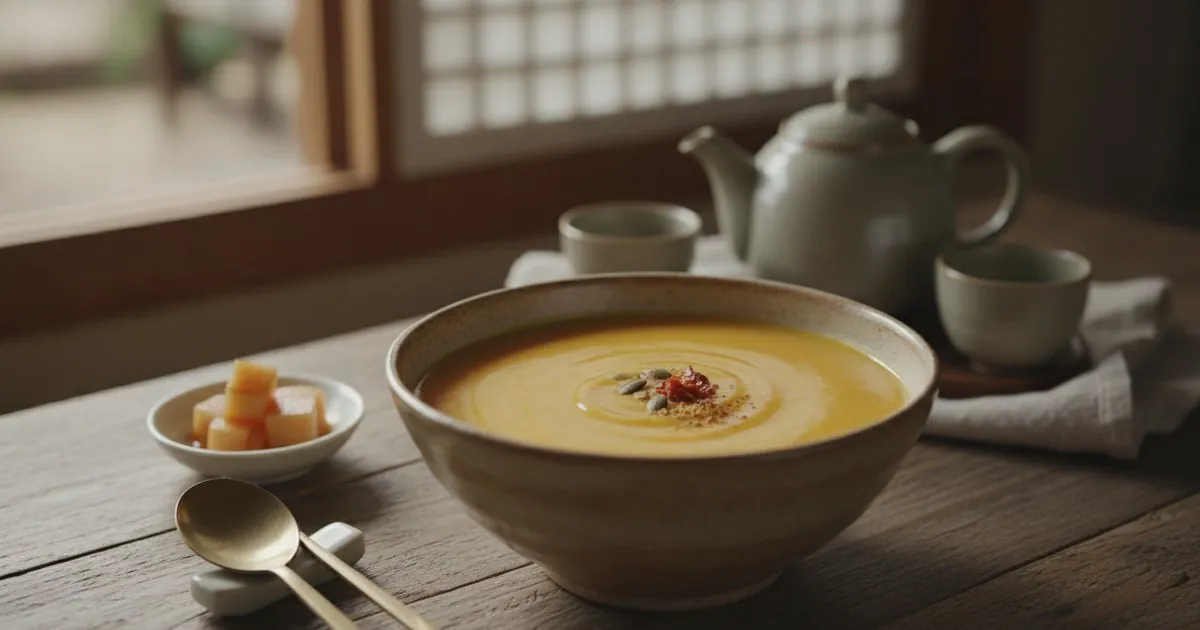
There is a particular kind of Korean comfort food that arrives quietly — no fiery chili, no punchy ferment — just warmth, sweetness, and an almost meditative simplicity. Hobak-juk (호박죽), Korean pumpkin porridge, is exactly that. It’s the bowl Koreans reach for when recovering from illness, on a cold autumn morning, or during the winter solstice festival of Dongji. It’s soft enough for children and the elderly, sweet enough to feel like a treat, and nourishing enough to be considered a genuine meal.
For Western cooks, hobak-juk offers something wonderfully accessible: it uses ingredients that are increasingly easy to find at mainstream grocery stores, the technique is forgiving, and the result — a smooth, velvety, golden-orange porridge studded with chewy rice cake balls — is genuinely unlike anything in the Western comfort food canon. Once you’ve made it, you’ll understand why Koreans have been eating it for centuries.
What Is Hobak-juk? A Quick Cultural Primer
Juk (죽) is the Korean word for porridge, a broad category of slow-cooked grain dishes that spans savory and sweet. Unlike Western oatmeal porridge or even Chinese congee (which is typically savory and rice-based), Korean juk covers an enormous range: from abalone porridge (jeonbok-juk) served as a luxurious restorative to the simple, sweet hobak-juk that appears in homes from Seoul to Busan whenever comfort is called for.
Hobak-juk holds a particularly special place in the Korean calendar. On Dongji (동지), the winter solstice — typically around December 21st — many Korean families eat red bean porridge (patjuk), but sweet pumpkin porridge appears in many regional traditions as well. Beyond seasonality, hobak-juk is considered a go-to boyangshik (보양식) — a restorative food for strengthening the body. Its natural sweetness, easy digestibility, and vivid orange color (rich in beta-carotene) have made it a staple of Korean convalescent cooking for generations.
Two Styles You Should Know: 단호박죽 vs. 늙은호박죽
It’s worth clarifying something that trips up many Western recipes: “hobak-juk” is not one monolithic dish. The word hobak simply means “pumpkin” or “squash” in Korean, and there are two distinct traditional styles:
- 단호박죽 (danhobak-juk): Made with danhobak (단호박), the Korean name for kabocha squash — the small, dark green, Japanese-style pumpkin with dense, intensely sweet orange flesh. This is what the vast majority of modern Korean recipes use, and it’s what this recipe is built around.
- 늙은호박죽 (neulgeun hobak-juk): Made with fully matured, old-harvest Korean pumpkin — a large, grey-green or tan squash with a milder, slightly starchier flavor. Less common in contemporary home cooking but deeply traditional, especially in rural and older household recipes.
If you see “hobak-juk” at a Korean restaurant or in a recipe, you’re almost always getting the kabocha version. That’s what we’re making today.
Ingredients and Where to Find Them
Kabocha Squash (단호박, Danhobak)
The star of the show. Kabocha is increasingly available at mainstream grocery stores — Whole Foods, Trader Joe’s, and most Asian-style supermarkets carry it from late summer through winter. H Mart and other Korean grocery stores sell it year-round. Look for a squash that feels heavy for its size, with dull (not shiny) dark green skin. A single kabocha weighing about 800g–1 kg (1¾–2¼ lb) will serve four generously.
Can you substitute butternut squash? Technically yes — but the result will be noticeably different. Butternut has higher water content and a milder, less sweet flavor, so you’ll end up with a thinner, paler porridge that needs more sugar. If kabocha is genuinely unavailable, butternut is the best alternative; just reduce the water slightly and expect to add more sweetener.
Sweet Rice Flour (찹쌀가루, Chapssal-garu)
This is the thickening agent that gives hobak-juk its characteristic glossy, clingy texture — very different from a cornstarch or regular flour slurry. Sweet rice flour (also sold as mochiko in Japanese grocery stores) is made from glutinous rice and creates a uniquely silky, slightly elastic consistency. You can find it in the baking or Asian foods aisle at most major supermarkets, or reliably at any Korean or East Asian grocery store. For more on building out your Korean pantry, including where to source ingredients like this, check out our Korean pantry essentials guide.
You’ll need about 3–4 tablespoons (25–35g) for roughly 800g of squash. Start with 3 tbsp for a lighter, soup-like porridge; use 4 tbsp if you prefer something thicker and more pudding-like.
Sugar and Salt
Kabocha is naturally sweet, so the added sugar is less about sweetness and more about balance and depth. Light brown sugar adds a subtle molasses note that works beautifully with the squash; plain granulated white sugar is also perfectly traditional. Start with 2 tablespoons (25g) and adjust after tasting — a very ripe, in-season kabocha can need almost none, while an off-season squash may need closer to 3 tablespoons. Salt (just ½ teaspoon / 2g) is essential — it’s what makes the sweetness pop rather than taste flat.
The Optional-but-Traditional Addition: Saealsim (새알심)
Saealsim — which translates roughly as “bird’s egg hearts” — are small, chewy rice cake balls made from sweet rice flour and dropped into the porridge to cook. They’re optional in the sense that the porridge is delicious without them, but they are deeply traditional and add a satisfying textural contrast to the smooth base. Every bite with a saealsim in it delivers that distinctive chew — the same glutinous, bouncy quality you find in hotteok or tteok rice cakes.
Making them is genuinely simple: mix sweet rice flour, a pinch of salt, and a little sugar, add boiling water gradually, knead briefly, and roll into small balls. The key diagnostic: the dough should feel like soft Play-Doh — pliable, smooth, not sticky. If it cracks when you roll a ball, it needs a few more drops of water. If it sticks to your palms, dust your hands with a little dry sweet rice flour.
How to Make Hobak-juk: Step by Step
The method follows a reliable sequence: cook → blend → thicken → season.
Cooking the squash is the longest step, and the method you choose doesn’t dramatically affect flavor — but it does affect effort. The stovetop steam-in-the-pot method (20–25 minutes) is the most traditional and requires the least equipment. The Instant Pot cuts it to 5 minutes of active pressure cooking plus ramp-up time. Microwave works in a pinch. Regardless of method, the squash is done when a chopstick or thin knife slides through the thickest part of the flesh with literally zero resistance — any firmness means it’s not done yet.
One important tip before you even touch your knife: microwave the whole, uncut kabocha for 5–6 minutes first. The raw skin of a kabocha squash is notoriously dense and unyielding, and cutting through it cold is a genuine knife-safety hazard. A brief microwave session doesn’t cook the flesh — it just softens the exterior enough to make cutting safe and controlled.
Blending should be thorough — 45 to 60 seconds on high speed, not a quick pulse. You’re looking for a purée that is completely smooth and a vivid, uniform amber-orange. Hold it up to the light; if you can see any lighter streaks or chunks, blend longer. Any lumpiness at this stage becomes gritty spots in the finished porridge.
Adding the slurry is a critical moment. Make sure the porridge is at a simmer before you add it — adding the slurry to cold liquid won’t thicken properly — and pour it in a thin, steady stream while stirring constantly. You’ll see the porridge transform from thin soup to a glossy, thick, coating consistency within about 90 seconds. This is your porridge finding its texture.
Serving and Garnish
Hobak-juk is served warm, not piping hot — temperatures that let the sweetness and squash flavor come forward rather than scorching your palate. The choice of garnish signals the cook’s intention:
- Pine nuts (잣): The most classic and elegant garnish, adding a slightly bitter, resinous crunch that contrasts the sweetness beautifully.
- Pumpkin seeds: A natural pairing, and easier to find at Western supermarkets.
- Sliced dried jujubes (대추): Papery, date-like sweetness; slice them thin and fan them across the surface.
- Cooked sweetened red beans (팥): For an earthier, more substantial bowl — the bittersweet beans play against the sweet squash the way cream cheese plays against carrot cake.
Common Mistakes to Avoid
1. Skipping the Microwave Pre-Softening Step (and Nearly Losing a Finger)
Raw kabocha skin is extraordinarily hard — harder than most Western squash. Trying to halve a cold, uncooked kabocha with a standard chef’s knife is genuinely dangerous because the squash will roll and the knife can skid. Microwaving the whole squash for 5–6 minutes before cutting doesn’t cook the flesh; it only yields the exterior enough to make the cut safe and clean. Do not skip this step.
2. Making a Lumpy Rice Flour Slurry
If you add the sweet rice flour directly to the porridge without first mixing it into a smooth slurry with cold water, you will get stubborn white lumps embedded in the finished porridge. They are nearly impossible to remove once the porridge thickens. Always mix the sweet rice flour with cold water (not warm, which starts cooking the starch prematurely) in a separate bowl, whisking until completely smooth before adding to the pot.
3. Not Stirring Constantly After Adding the Slurry
Pumpkin purée is dense and high in natural sugars. Once the rice flour slurry goes in and the porridge thickens, it scorches on the bottom of the pan with alarming speed. This isn’t a simmer-and-ignore dish — keep the spatula moving, scraping the bottom and sides of the pan continuously. If you smell a faint toasty, caramel note before it’s intentional, reduce the heat and scrape immediately. A mild scorch is recoverable; a heavy scorch will make the whole pot taste bitter.
4. Over-Sweetening Before Tasting the Kabocha
Kabocha sweetness varies more than you’d expect — an in-season, fully ripened kabocha in October can be intensely sweet on its own, needing barely a tablespoon of added sugar. An early-season or import squash might be noticeably bland. If you follow a recipe rigidly and add the full amount of sugar before tasting, you may end up with a cloying porridge. Always taste the cooked squash purée before adding any sugar, and add the sweetener gradually. The porridge is seasoned last.
5. Undercooking the Saealsim
The rice cake balls need more cooking time than intuition suggests. A common error is pulling them off heat as soon as they start to float — floating means they’re mostly cooked, but not necessarily done. Pinch a ball between two fingers: a correctly cooked saealsim will compress evenly and spring back with a bouncy, uniform texture. An undercooked ball will feel firm in the center and have a raw, powdery, gritty core when bitten. Give them the full 5–7 minutes at a steady gentle simmer.
6. Blending the Squash While It’s Still Steaming Hot
Pouring hot liquid into a sealed blender creates steam pressure that can blow the lid off suddenly and violently. Let the cooked squash cool for at least 5–10 minutes before blending. If you’re impatient, blend in batches with the lid loosely covered by a folded kitchen towel — never sealed tight. Alternatively, use an immersion blender directly in the pot once the squash is cool enough, though a countertop blender gives a noticeably smoother result.
Frequently Asked Questions
Is hobak-juk vegan and gluten-free? Yes to both, as written. The only ingredients are squash, water, sweet rice flour, sugar, and salt — no dairy, eggs, meat, or gluten. Sweet rice flour (glutinous rice flour) is entirely gluten-free despite its name; “glutinous” refers to the sticky texture of the cooked starch, not to wheat gluten. Always double-check your specific brand if you are celiac, as some facilities process multiple grains.
Can I use canned pumpkin purée instead of fresh kabocha? You can, but the result will be noticeably different. Canned pumpkin (typically made from Dickinson pumpkin, not kabocha) has a milder, earthier flavor and lacks the dense sweetness of kabocha. If using canned purée, skip the blending step — mix 425g (one 15 oz can) with enough water to reach a pourable consistency, then proceed from the “Cook the porridge” step. Expect to add a bit more sugar. The texture will be similar, but the flavor won’t quite match the fresh version.
How do I store and reheat leftovers? Hobak-juk stores well in an airtight container in the refrigerator for up to 3 days. It will thicken considerably as it cools — almost to a sliceable consistency when cold. To reheat, transfer to a saucepan over low heat and add water or a splash of unsweetened plant milk a few tablespoons at a time, stirring constantly until it loosens back to your preferred consistency. Do not microwave without adding water first; cold, undiluted juk reheated in a microwave can turn gluey and unpleasant.
What’s the difference between hobak-juk and Western pumpkin soup? The primary differences are texture, thickening agent, and intention. Western pumpkin soups are typically thickened with cream, coconut milk, or stock for a rich, savory result. Hobak-juk uses sweet rice flour as its thickener, which gives it a unique silky, slightly elastic body that is closer to a pudding than a soup. It is also served less hot, eaten more slowly with a spoon, and sits squarely in the sweet-savory intersection rather than firmly on the savory side.
Can I make hobak-juk ahead for a dinner party? Absolutely. Make the full porridge base up to a day in advance and refrigerate. Make the saealsim dough and roll the balls, storing them covered in the fridge (up to 8 hours; beyond that they may dry out). When ready to serve, reheat the porridge with a little water, bring to a simmer, drop in the fresh rice cake balls, and cook for the full 5–7 minutes fresh — they don’t reheat well once cooked, as they become firm and lose their bounce. Garnishes should always be added fresh at the table.