
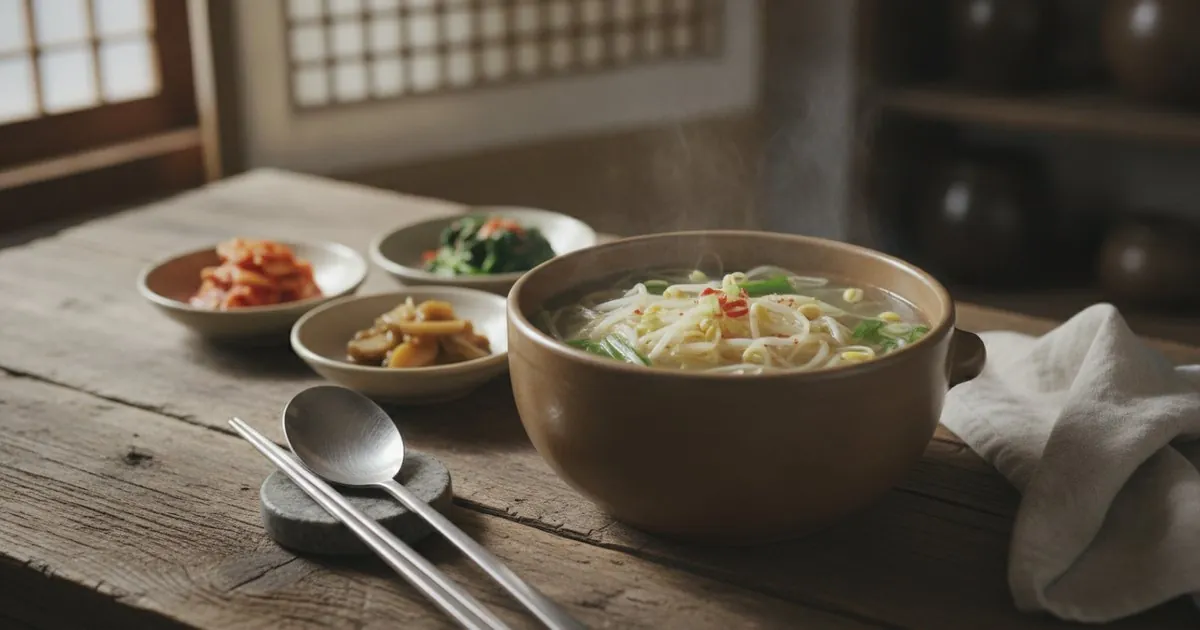
There’s a category of Korean soup that doesn’t ask anything of you. No long marinade, no complex spice paste, no multi-hour braise. Kongnamul guk — Korean soybean sprout soup — is exactly that kind of dish: humble, fast, and quietly brilliant. In about 35 minutes, using ingredients that cost very little, you get a bowl of pale golden broth that is startlingly clean, subtly savory, and deeply comforting. It’s the soup Korean home cooks reach for on the most ordinary of weeknights, on the morning after a long night out, and on the first day a cold starts to creep in. Once you understand how to make it properly, it becomes a permanent part of your rotation too.
What Is Kongnamul Guk?
Kongnamul guk (콩나물국) is a Korean soybean sprout soup with a long history in everyday home cooking. The name breaks down cleanly: kong (콩) means bean, namul (나물) means seasoned vegetables, and guk (국) means soup. Soybean sprouts have been cultivated in Korea for over a thousand years — they were documented in medical texts during the Goryeo Dynasty (918–1392 CE) as both food and medicine — and this soup is one of the most direct ways to appreciate them.
What sets kongnamul guk apart from countless other clear broths is the combination of its base ingredients: a quick anchovy-and-kelp stock (the workhorse broth of Korean cooking) and soybean sprouts, which release their own mild starch into the liquid as they cook, giving the finished broth a very gentle body and a pale, slightly cloudy appearance. The taste is not aggressive. It’s the soup that resets you.
The Critical Distinction: Soybean Sprouts vs. Mung Bean Sprouts
Before anything else, let’s address the ingredient issue that trips up most Western cooks making this for the first time. Soybean sprouts and mung bean sprouts are not the same thing, and they are not interchangeable in this recipe.
Soybean sprouts (콩나물, kongnamul) are longer, thicker-stemmed, and have a distinctly larger yellow seed head. Mung bean sprouts — the kind most commonly stocked in Western supermarkets — are shorter, thinner, and nearly translucent at the root end. When you boil mung bean sprouts for 8–10 minutes, they turn soft and mushy. When you boil soybean sprouts for the same time, they hold their structure and develop a pleasant, slightly chewy texture that anchors the soup.
Look for soybean sprouts in the refrigerated produce section at Korean grocery stores like H Mart — our H Mart shopping guide has a full breakdown of what to look for — or at most Asian supermarkets. They’re typically sold in plastic bags of 200–400g (7–14 oz). If a bag has a strong, unpleasant smell when you open it, skip it; fresh soybean sprouts should smell neutral and faintly green.
Ingredients Breakdown
The Broth: Anchovy-Kelp Dashi
Korean anchovy-kelp broth is the foundation of dozens of soups and stews — it’s the Korean equivalent of Japanese dashi, and the two are related historically. You need:
- Dried anchovies (gukmyeolchi, 국멸치): Look for the larger “soup anchovies” (국물용 멸치), not the smaller snack-size ones. They’re sold at H Mart and most Asian markets in cellophane bags. Remove the heads and pinch out the dark, bitter innards before using — it only takes a minute and makes a real difference to the broth’s cleanliness. If you genuinely cannot find dried anchovies, one dashi tea bag (the Japanese kind, widely available at Whole Foods or online) makes an acceptable substitute, though the flavor will be slightly different.
- Dried kelp (dashima, 다시마): One palm-sized piece, around 7×7 cm (3×3 in), is enough. Wipe it with a damp cloth rather than rinsing — the white powder on its surface is naturally occurring glutamate, which is exactly what you want in the broth.
The Sprouts and Aromatics
- Soybean sprouts (콩나물): 250g (9 oz) for four servings is the right quantity for a pot with 1.2L (5 cups) of broth. The sprouts will wilt slightly as they cook but maintain enough volume to feel present in every bowl.
- Garlic: Just one clove, minced fine. This is not a garlic-heavy soup — it’s a background note, not a feature. Add it toward the end of cooking so it doesn’t overpower the clean broth.
- Salt: Fine sea salt or Korean soup salt if you have it. Season at the end, not at the start — the broth will concentrate slightly as it cooks.
- Green onion: Sliced thin and added in the final minute. It should remain bright green in the finished bowl.
Optional Upgrades (All Authentic)
These additions move the soup from clean and simple toward something more complex:
- Gochugaru (Korean chili flakes): 1–2 tsp transforms this into the eolkeun (얼큰, spicy-hot) version. The color shifts from pale gold to a warm, ruddy orange, and the heat level goes from zero to a gentle, sustained warmth. For more on this ingredient, see our gochugaru guide.
- Salted shrimp (saeujeot, 새우젓): 1 tsp added instead of (or alongside a reduced quantity of) plain salt adds a subtle brininess and extra umami depth without making the soup taste noticeably “shrimpy.”
- Soup soy sauce (guk-ganjang, 국간장): Lighter in color and saltier than regular soy sauce. Half a teaspoon adds a faintly fermented depth and a pale amber tint to the broth. Do not substitute regular or dark soy sauce — it will turn the broth brown and the flavor will be too assertive.
Building the Broth
The anchovy-kelp broth takes 10–12 minutes of active simmering. Start with cold water — beginning cold and coming to temperature slowly draws more flavor from the anchovies than dropping them into already-boiling water. The smell as it simmers will seem more pungent than the finished broth tastes; as the steam carries off the volatile compounds, the broth mellows considerably.
When you taste the finished, strained broth before adding the sprouts, it should be a clean, light savory liquid — think of it as a very gentle, oceanic consommé. If it tastes bitter or sharp, the anchovies were likely over-simmered or the guts were not removed. Discard and start again; it’s only 10 minutes.
For a completely broth-free, plain-water version — which is genuinely common in Korean households, especially for very simple weeknight cooking — just substitute the same volume of plain water. The soup will be more delicate in flavor but still very pleasant, and it’s naturally vegan.
Variations Worth Trying
Spicy Kongnamul Guk (얼큰 콩나물국): Stir 1–2 tsp of gochugaru into the seasoned broth after the lid comes off. This version is especially popular as a hangover cure — the spice gets your circulation moving, and the electrolyte-rich broth does its restorative work.
Kongnamul Haejangguk (콩나물 해장국): The proper “hangover soup” variant. This version often includes a raw egg cracked in just before serving (the residual heat gently sets it), dried radish strips (mu cheong), and sometimes a spoonful of doenjang (fermented soybean paste) for extra umami richness. It’s a more substantial dish than the basic soup — closer to a full recovery meal.
Vegan Version: Skip the anchovies and dashima. Instead, make a broth from a 5×5 cm piece of dashima simmered in the same volume of cold water for 10 minutes. Kombu (the Japanese equivalent, widely available) works identically. Season with guk-ganjang instead of plain salt for additional depth. The result is a lighter, more subtle broth — still very good.
Serving Suggestions
Kongnamul guk is served as part of a standard Korean meal: alongside steamed white rice, kimchi, and a few small banchan (side dishes). Pour it into individual deep bowls — the ratio should feel soup-forward, with the sprouts distributed throughout rather than clumped at the bottom. It’s meant to be sipped between bites of rice, not drunk all at once at the end. This soup doesn’t hold well; the sprouts continue to cook in residual heat, so serve immediately and don’t plan on reheating leftovers more than once.
Common Mistakes to Avoid
1. Using Mung Bean Sprouts Instead of Soybean Sprouts
This is the single most common error. Mung bean sprouts disintegrate into soft, stringy pieces after 8–10 minutes of boiling. The result is watery and unappetizing. The visual difference is clear once you know it: soybean sprouts have a larger, yellower head and a thicker stem. If your store only stocks mung bean sprouts, a kongnamul guk with the right texture simply isn’t achievable — it’s worth the trip to an Asian grocery store.
2. Lifting the Lid Too Early
The beany, raw smell that can ruin this soup comes from lipoxygenase, an enzyme in soybeans that produces off-flavors when exposed to oxygen during cooking. The solution is to keep the pot covered at a vigorous boil for the first 5 minutes — the steam pressure and temperature together deactivate the enzyme and drive off the volatile compounds. Lifting the lid “just to check” before that point releases the steam and allows the smell to become fixed in the liquid. If your finished soup smells strongly beany, this is almost certainly why.
3. Overcooking the Sprouts
Ten minutes at a rolling boil is the ceiling. Beyond that, the bean heads at the top of the sprouts turn mealy and the stems become limp. The texture you’re after is tender throughout but with a perceptible snap in the thicker root sections — something that still has presence in the spoon. If you’re not sure, start tasting at the 8-minute mark. The color of the broth shifting from clear to a pale, slightly milky white is a visual cue that the starch in the sprouts is releasing properly — a good sign you’re in the right window.
4. Seasoning Too Early
Adding salt (or guk-ganjang or saeujeot) before the sprouts are cooked through is a reliable way to end up with an over-salted soup. The broth reduces slightly as the sprouts cook, concentrating whatever salt is already present. Always season after the lid comes off and the sprouts are done — start conservatively, taste carefully, and adjust in small increments.
5. Using Regular Soy Sauce for Color
If you want a slightly darker, more savory broth, the right call is guk-ganjang (soup soy sauce), which is lighter in color and saltier than regular Korean soy sauce or Japanese soy sauce. A half-teaspoon of guk-ganjang adds gentle depth without turning the broth murky brown. Regular soy sauce — even a small amount — makes the broth look dark and muddy, and the flavor becomes assertive in a way that competes with the delicate sprouts.
6. Skipping the Anchovy Prep
Leaving the heads and inner guts in the dried anchovies is a shortcut that costs you. The guts in particular contain bile, which releases a bitter, slightly metallic note into the broth during simmering. It won’t ruin the soup outright, but it introduces an unpleasant undertone that lingers. The prep takes less than two minutes: snap off the head and use a fingernail or toothpick to pull out the dark material inside the belly cavity. Rinsed anchovies ready to go should smell clean, not sharp.
Frequently Asked Questions
Why does my kongnamul guk taste or smell fishy? Two likely causes: (1) the dried anchovies were over-simmered (beyond 12–15 minutes the broth becomes bitter and sharpens), or the inner guts were not removed before cooking. Strain the broth and taste it before adding the sprouts — if it’s already unpleasant at that point, the anchovy step needs a reset. (2) The soybean sprouts were not fresh. Older sprouts have a stronger, more sulfurous smell that doesn’t fully cook out.
Can I make this soup vegan? Yes, and it’s genuinely delicious. Replace the anchovy-kelp broth with a pure dashima (kelp) broth: simmer one 7×7 cm piece of dashima in 1.2L (5 cups) cold water for 10 minutes, then remove and discard the kelp. Season with guk-ganjang instead of plain salt for added depth. The result is lighter than the anchovy version but clean and subtly savory.
How long does leftover kongnamul guk keep? Up to two days in the refrigerator in a sealed container. The sprouts continue to soften as they sit, so the texture on day two will be noticeably more tender (not unpleasantly so, but different). Reheat gently — do not boil again. The soup is not suitable for freezing; the sprouts become waterlogged and mushy after thawing.
Is kongnamul guk the same as kongnamul haejangguk? Related but distinct. Kongnamul guk (콩나물국) is the everyday, mild version described in this recipe. Kongnamul haejangguk (콩나물 해장국) is specifically a hangover recovery soup — typically spicier, often enriched with doenjang or a raw egg, and served as a more complete, restorative meal rather than a light side dish. The base technique is the same; the intention and add-ins differ.
Can I add other ingredients to the soup? Absolutely — kongnamul guk is a flexible base. Thin slices of firm tofu add protein and bulk. A few dried radish strips (무청, mu cheong) are traditional in the haejangguk style. Some home cooks add a small handful of dried small shrimp (건새우, geonsaewo) alongside the anchovies for a deeper, more complex broth. Keep additions minimal — the whole point of this soup is its lightness and clarity.