
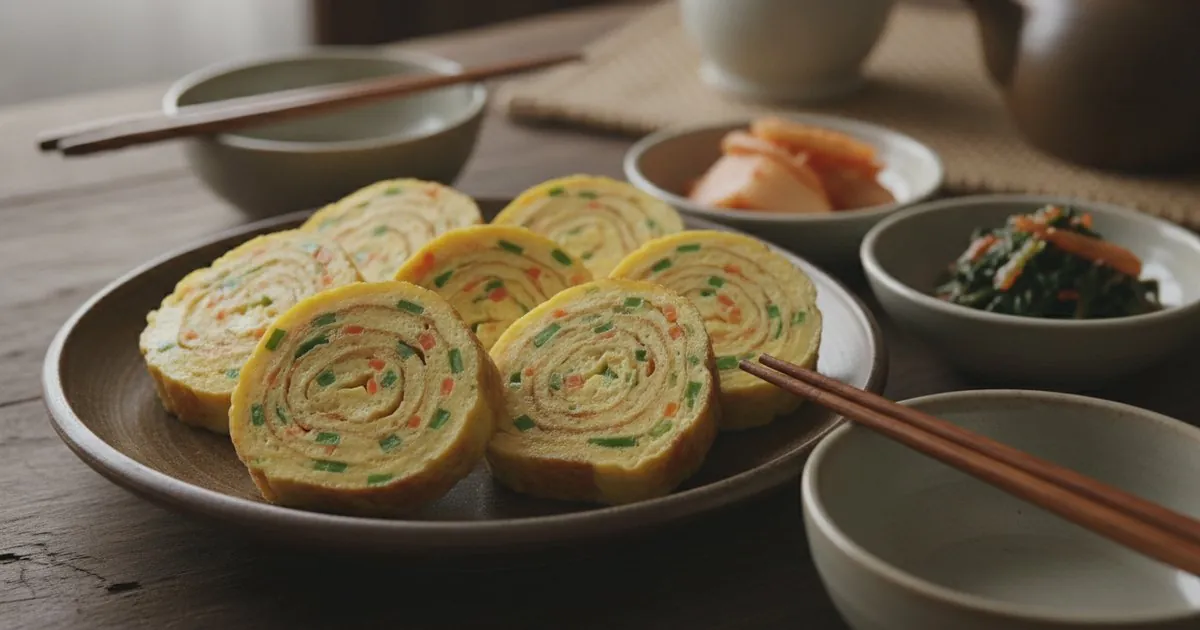
Gyeran mari (계란말이) is sometimes called “Korean egg roll” in English — and if you’re hearing that name for the first time, it’s worth clarifying right away that this has nothing to do with the Chinese-American deep-fried appetizer. Gyeran (계란) is the Korean word for egg, and mari (말이) means “roll” — the same syllable you’ll find in gimbap and other wrapped or rolled dishes. What you get is a multi-layered, silky, savory rolled omelette that slices into gorgeous golden rounds and lands on the table looking like something from a professional kitchen.
And yet it takes 20 minutes and requires nothing more exotic than eggs, scallions, a little carrot, and a non-stick pan.
Gyeran mari is a banchan — a Korean side dish — and it’s among the most beloved. It shows up in school lunchboxes (도시락, dosirak), on weeknight dinner tables, at weekend brunch spreads, and in the packed-lunch social media content that Korean home cooks post daily. Its staying power comes from what it does in the context of a meal: mild, gently savory, protein-rich, and visually striking, it acts as a counterweight to bolder, spicier dishes. It doesn’t compete; it completes.
This guide walks through the complete technique, all the ingredient choices, every common point of failure, and the variations worth knowing — so that the first time you make it, it works.
What Is Gyeran Mari (계란말이)?
The technique is closely related to Japanese tamagoyaki — both involve building a rolled omelette in successive poured layers — reflecting the centuries of culinary exchange between the two cultures. The Korean version is generally less sweet than its Japanese counterpart, more focused on clean savory flavor, and more open to a wider range of mix-ins. Where tamagoyaki often calls for dashi stock and a careful calibrated sweetness, gyeran mari says: scallion, carrot, whatever’s in the fridge.
Culturally, the dish is deeply associated with care and domestic comfort. A neatly sliced gyeran mari in a lunch box is one of the most iconic images of Korean food culture — visible in nostalgic dramas, in cookbook photographs, and in the social media dosirak reveals that consistently rack up millions of views. The cross-section, with its concentric layers of pale gold punctuated by green scallion and orange carrot, is part of the appeal.
If you’re building out your Korean side dish repertoire, gyeran mari pairs naturally with the rest of a banchan spread. Our complete banchan guide covers how to think about balance — flavor, texture, and color — when assembling Korean small plates for a full meal.
Ingredients You’ll Need
The Core Egg Mixture (5-egg / 4-serving version)
Eggs: 5 large eggs, 250g / 9 oz weighed without shells. Room temperature eggs beat more evenly and produce a smoother, more uniform mixture than cold eggs straight from the fridge. Pull them out 20 minutes before cooking if you can. This five-egg quantity makes a generous banchan portion for four people. If you’re cooking for one or two, three eggs work perfectly — scale everything proportionally and use an 8-inch pan.
Salt: ¼ tsp (1.25g) fine sea salt. Intentionally modest. Gyeran mari plays a supporting role in most meals, and you want its seasoning to stay in the background. If you’re serving it on its own as a snack, a touch more — ⅓ tsp — is reasonable. Taste your egg mixture before cooking and adjust if needed.
Rice wine (cheongju / 청주): 1 Tbsp (15ml), optional. Cheongju is a clear Korean rice wine used in cooking throughout Korean cuisine. It tenderizes proteins slightly and contributes a clean, subtly sweet aroma. Japanese cooking sake (mirin’s drier cousin) is a direct substitute. If you have neither, 2 Tbsp water works as an alternative and actually produces a slightly fluffier texture by keeping the egg mixture a little looser. Omitting liquid entirely is also fine — the recipe works either way.
Scallions: 2 Tbsp (10g), very finely minced, about 2 stalks. Use primarily the green parts, which carry more aromatic flavor than the white ends. Finely is the operative word — pieces should be no larger than 3mm. This isn’t a precision flex; it’s structural. Larger pieces tear the egg sheet during rolling.
Carrot: 2 Tbsp (15g), very finely minced, about ¼ of a medium carrot. In addition to providing a tiny, pleasant crunch contrast in an otherwise silky dish, the carrot creates those bright orange dots in the cross-section that make gyeran mari so visually distinctive. It’s technically optional, but worth including.
Black pepper: A pinch, optional. A small amount adds a subtle warmth; many traditional recipes omit it entirely. Taste preference.
Neutral oil: 1–2 tsp (5–10ml) total for the pan. Canola, grapeseed, or vegetable oil. Avoid olive oil — the flavor profile pulls in the wrong direction and the smoke point isn’t ideal for this technique.
Optional Add-ins: The Variations Worth Knowing
The classic version is egg, scallion, and carrot — full stop. These are the add-ins that appear across multiple reliable Korean cooking sources:
- Gim (roasted seaweed / nori): One sheet, trimmed to fit your pan width, laid over the first barely-set egg layer before rolling. The result is a striking black spiral in the cross-section and a distinctly umami, ocean-tinged flavor. Find gim at H Mart, Japanese grocery stores, or in the Asian foods aisle at most Whole Foods locations. If you’re curious about other uses for gim, our gimbap recipe puts the same ingredient to work in a very different context.
- Shredded mozzarella: ¼ cup (28g), scattered over the first layer before rolling. A popular modern variation, especially appealing to children. It melts into the roll and adds a mild, stretchy richness.
- Diced ham or Spam: 2 Tbsp (about 25g), very finely diced. A lunchbox staple. Stir directly into the egg mixture.
- Canned tuna or imitation crab: 1–2 Tbsp, well-drained. Adds protein and a mild seafood flavor; common in Korean coastal cooking.
- Garlic chives (buchu / 부추): A more assertive substitute for scallion. If you spot them at H Mart, they’re worth trying — they give the finished roll a pleasant garlicky bite.
Equipment: The Pan Matters More Than You Think
Ideal: A rectangular tamagoyaki pan (玉子焼き器 / makiyakinabe). Sold at H Mart, Japanese grocery stores, and on Amazon for $10–$25. The rectangular cooking surface means your roll naturally forms a tidy log with flat sides, requiring minimal shaping. Small (for 3 eggs) and medium (for 5 eggs) sizes are both widely available.
Perfectly acceptable substitute: An 8-inch round non-stick skillet for 3 eggs, or a 10-inch for 5 eggs. This is what most Korean home cooks use. The only difference is that the ends of your finished roll will be slightly rounded — once you slice into rounds, nobody can tell.
The paper towel trick: Keep a folded sheet of paper towel in a small bowl with a teaspoon of oil nearby. Between each layer pour, quickly wipe the exposed pan surface with the oiled towel. This technique gives you an ultra-thin, even oil coating without any pooling. Pooled oil causes the egg to set unevenly, introduces brown patches, and can make layers slip apart. The paper towel method is not optional — it’s genuinely the best approach here.
How to Make Gyeran Mari: Step by Step
Step 1: Mince the Vegetables
Take the time to mince your scallion and carrot finely — 2–3mm pieces, not a rough chop. At this size, the vegetables distribute evenly through each egg layer, stay embedded during rolling rather than pushing through the surface, and create the clean mosaic pattern in the cross-section. A sharp knife and one minute of focused cutting is all it takes.
Step 2: Beat the Eggs Correctly
Crack all 5 eggs into a medium bowl. Add the salt, optional pepper, and rice wine or water if using. Beat using long, deliberate strokes — 30 to 40 passes with chopsticks or a fork. Target: a completely uniform pale yellow with no visible white or yolk streaks. But be deliberate about not whipping: you want the mixture to come together, not to become foamy. Foam on the egg surface creates an uneven, bubble-pocked texture that looks wrong on the finished roll.
Stir in the minced scallion and carrot. For the cleanest layers, strain the entire mixture through a fine-mesh sieve into a pitcher or measuring cup with a pour spout. This removes the chalaza (the stringy white cord attached to the yolk) and any unbeaten bits, ensuring a perfectly smooth pour.
Step 3: Build the Roll in Three Pours
Heat your pan over medium-low heat — this is the single most critical variable in the whole recipe, and it runs lower than most people expect. Add ½ tsp oil and spread with your paper towel. Let the pan come fully up to temperature for about 90 seconds.
Test by dropping a few drops of egg mixture into the pan. They should set within 2–3 seconds without loud sizzling. When this is right, pour roughly one-third of the egg (about 80ml / ⅓ cup). Immediately tilt the pan to spread it into a thin, even sheet — the motion of crepe-making.
Watch the surface carefully. Here is the exact progression:
- Completely wet and shiny — wait.
- Edges becoming opaque and matte — getting close.
- Edges fully set, center still showing a thin glistening film — roll now.
If you wait until the center is fully dry, the layer has lost its plasticity and will crack when folded. That thin glistening film means the egg is still slightly pliable. This is your window.
Using a silicone spatula, fold from the far end toward you in 3–4 firm, even folds. Slide the roll to the far end. Oil the empty pan section. Pour the second third of egg and tilt so liquid flows under the existing roll — this is what bonds the layers. Cook to the same 90%-set point, roll again. Repeat for the third pour.
Shape by pressing gently on all four sides while warm. Rest on the cutting board for 1–2 minutes, then slice into rounds about 1.3cm (½ inch) thick.
Serving and Storage
Gyeran mari is one of the few egg dishes that is genuinely as good at room temperature as it is warm — which is part of why it became a lunchbox staple. Serve it as part of a banchan spread alongside rice and bolder, spicier dishes; its mild flavor is a textural and flavor contrast to anything fermented, spicy, or heavily seasoned.
For lunchboxes, pack it in a single layer in a well-sealed container. It holds well at room temperature for up to 4 hours.
Storage and reheating: Leftovers keep in the refrigerator in an airtight container for up to 2 days. To reheat, a quick 30-second pass in a dry non-stick pan over medium-low heat preserves the texture better than a microwave, which tends to make egg dishes rubbery. Cold gyeran mari eaten straight from the fridge is also a legitimate option — the flavor holds and the texture is firmer but still pleasant.
Common Mistakes to Avoid
1. Heat Too High — The Most Common Culprit
If your egg mixture hits the pan and immediately puffs, or the bottom browns and sets within 20–30 seconds, your heat is too high. High heat produces three problems: a tougher, less silky texture, visible browning on the outer surface that looks wrong when sliced, and a dramatically shortened rolling window that makes the technique nearly impossible for beginners. Fix: Reduce to medium-low and give the pan 45 seconds to adjust before testing again. On most home burners, you want roughly 30–35% of maximum heat. A properly heated pan will take 60–90 seconds to set each layer.
2. Rolling Too Late — Cracked Sheets
The egg sheet’s rolling window is narrow, and the most common timing mistake is waiting too long. Once the center surface goes fully matte and dry, the proteins have cross-linked past their plastic threshold — fold the spatula under them and you’ll get cracks and tears instead of a clean bend. The visual tell is that glistening, slightly-wet-looking central film: as long as it’s there, the sheet can fold. If you’ve already let it go too far, press cracked sections firmly back together during rolling — subsequent layers will help bind them — but the cross-section will show the damage. Prevention is easier than repair.
3. Vegetable Pieces Too Large
This isn’t an aesthetic preference; it’s structural. Scallion or carrot pieces larger than 4–5mm push against the egg sheet from the inside during rolling, creating localized weak points that tear. They also create an uneven cross-section — lumpy rather than a clean mosaic. Take the extra minute for a genuinely fine mince. Conversely, if you purée the vegetables rather than mince them, they release liquid into the egg mixture and cause weeping and a watery, loose texture. The target is a fine mince with visible pieces, not a paste.
4. The Layers Aren’t Bonding
When you slice the finished roll and the layers separate cleanly from each other rather than holding together, the issue is almost always that the egg poured for the second and third layers didn’t flow under the existing roll before setting. Each new pour needs to physically connect with the previous roll to form a unified structure. Fix: the moment you pour the second or third portion, tilt the pan toward the roll immediately and aggressively so that the liquid egg slides underneath it. The roll should visually appear to be sitting inside the new egg layer, not just touching its edge.
5. Too Much Oil Between Layers
Over-oiling causes two problems: visible greasy streaks in the cross-section, and layers that slide apart rather than adhering. Each inter-layer oil application should be a micro-film, barely visible — enough to prevent sticking, no more. If you accidentally add too much, blot with a clean paper towel before pouring the next egg portion. The paper towel application method (rather than pouring directly from the bottle) is your best protection against this.
6. Slicing Before Resting
Cutting into the roll immediately off the heat produces ragged, squashed rounds. The interior is still soft and the layers haven’t fully firmed up — the knife compresses them rather than cutting cleanly through. Even 90 seconds of resting off the heat makes a meaningful difference. The residual heat from the exterior layers continues cooking the interior slightly, and the proteins firm into a structure that holds its shape cleanly under the knife.
FAQ
Can I make gyeran mari without a tamagoyaki pan?
Yes, and the majority of Korean home cooks do exactly that. A standard round non-stick skillet — 8 inches for a 3-egg version, 10 inches for 5 eggs — works perfectly well. The only trade-off is that the ends of your roll will be slightly curved rather than flat-sided. Once sliced into rounds, this is invisible. A tamagoyaki pan is a worthwhile $15–$20 investment if you plan to make rolled egg dishes frequently, but it’s absolutely not a prerequisite.
What can I substitute for cheongju (Korean rice wine)?
Japanese cooking sake is the closest substitute and works identically. Dry sherry in a small quantity is a more Western-pantry option that works reasonably well. If you’d rather avoid alcohol entirely, 2 Tbsp of water produces a slightly fluffier egg texture and is a perfectly legitimate choice. You can also simply omit any liquid — the recipe functions fine without it, producing a slightly denser but still delicious roll.
Why is my gyeran mari coming out pale brown instead of golden yellow?
Pale brown coloring almost always means the cooking temperature was too high. When pan heat is excessive, the natural sugars in the egg begin to caramelize before the proteins finish setting, producing a brownish exterior. The target color is a solid, vibrant pale gold — think the inside of a properly cooked crêpe, not the outside of a pancake. Reduce your heat by roughly 30%, wait 45 seconds for the pan to adjust, and test again before pouring.
Can I prep gyeran mari ahead for meal prep or lunchboxes?
Yes, and it holds up better than most egg-based dishes. Cooked and sliced gyeran mari keeps in an airtight container in the refrigerator for up to 2 days without becoming rubbery or watery (a common problem with scrambled or fried eggs). For meal prep, cook the full 5-egg version and portion it across the week. It’s also genuinely pleasant eaten cold straight from the fridge — the texture firms up slightly but the flavor is intact.
How do I get more layers and a cleaner cross-section?
Three practical adjustments: First, pour each layer thinner — divide the egg mixture into 4 pours rather than 3 for more, thinner layers. More layers mean a more intricate visual spiral. Second, mince your vegetables more finely — 2mm rather than 3mm, as close to a fine dice as possible without going to a paste. Third, make sure your pan is the right size for your egg quantity. A 10-inch pan with only 3 eggs produces too thin a layer; a 10-inch pan with 5 eggs produces the right thickness per layer. Matching pan size to egg quantity is one of the most underrated variables in getting gyeran mari to look the way it does in Korean cooking videos.
Gyeran mari rewards repetition in a way that very few recipes do. The first time through, you’re managing the heat, watching the surface, and timing the roll all simultaneously. The second time, the pieces click into place. By the third or fourth time, it’s a 20-minute autopilot that consistently impresses — and those perfect, layered rounds on a white plate never stop looking satisfying. Make it once this week, and it will almost certainly find its permanent place in your regular rotation.