
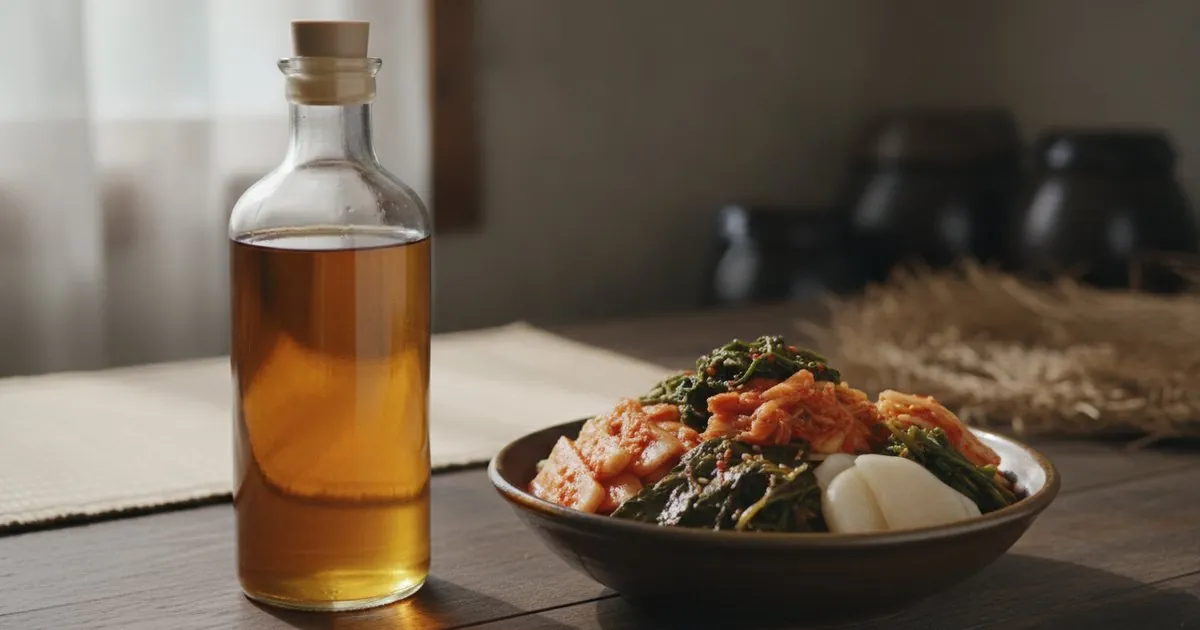
If you’ve ever tasted a Korean cucumber banchan that had a clean, cool brightness to it — or a cold noodle dressing that was sharp but never harsh — you’ve experienced Korean rice vinegar doing its quiet, essential work. It’s one of those pantry ingredients that doesn’t announce itself loudly, but the moment it’s missing, something feels flat and a little off.
Korean rice vinegar (쌀식초, ssal-sikcho) is the backbone of countless Korean dishes: the snap of quick-pickled daikon, the balanced tang of dipping sauces, the lift in a sesame namul dressing. Yet in Western kitchens, it’s frequently overlooked, swapped out without a second thought, or confused with the rice vinegar already sitting in the pantry from a Japanese cooking phase. This guide covers everything — what makes Korean rice vinegar distinct, how to use it, where to find it, and how to substitute it intelligently when you can’t.
What Is Korean Rice Vinegar? Terminology and Types
The Korean word for vinegar in general is 식초 (sikcho). When that vinegar is made from rice, it becomes 쌀식초 (ssal-sikcho) — literally “rice vinegar.” But that single label covers several distinct products worth knowing:
White Rice Vinegar (쌀식초, ssal-sikcho)
The workhorse of the Korean pantry. Mild, clear, and neutral in color, this is what most Korean recipes mean when they call for rice vinegar without further specification. If a recipe gives no other indication, this is your starting point.
Brown Rice Vinegar (현미식초, hyeonmi sikcho)
Made with whole brown rice, retaining the bran and germ through fermentation. The result has a noticeably deeper, slightly nutty flavor and a faint golden color. Korean cooking teachers and food writers consistently reach for this when they want complexity alongside the acid. If you see it at H Mart, it’s worth the upgrade.
Glutinous Rice Vinegar (찹쌀식초, chapssal sikcho)
Made from sweet/glutinous rice, producing a rounder, softer acidity with a hint of sweetness. Less common than the previous two, but exceptional in cold noodle dishes where you want acid that doesn’t cut too hard.
Makgeolli-Sikcho (막걸리식초)
Vinegar made from the lees of makgeolli, the milky Korean rice wine. This carries a faintly yeasty, bread-adjacent quality that’s genuinely interesting — a bridge between the ferment-forward world of Korean cuisine and the brightness of conventional vinegar. Look for it in specialty Korean grocery stores.
Micho (미초)
A mild, slightly sweet, fruity rice vinegar specifically formulated to be consumed diluted in water as a wellness drink. Think of it as Korea’s answer to drinking vinegar. It’s not a cooking ingredient in the traditional sense — it’s the product you buy when you want to sip rice vinegar, not cook with it.
For completeness: gam-sikcho (감식초), or persimmon vinegar, is technically not rice vinegar, but it’s the most beloved traditional rival — fruity, complex, faintly tannin-edged, and beautiful in dressings.
A History Steeped in Tradition
Korean vinegar culture is far older — and far richer — than most Westerners realize, and the historical record is surprisingly specific.
Fermented beverages (and therefore vinegar as a natural byproduct) appear in Korean records going back to the Three Kingdoms period (roughly 57 BCE–668 CE). But the golden age of documented Korean vinegar culture came during the Joseon Dynasty (1392–1897), when court scholars recorded culinary life with remarkable precision.
The 1459 text SanGaYoRok describes 14 different types of vinegar — rice, barley, and one made from iris flowers. By 1827, the comprehensive ImWonSipYukJi catalogued over 42 vinegar recipes, including varieties made with jujube, peach, honey, tangerine, persimmon, and named preparations like “Three Yellows” and “Thousand Miles.” The famous 1613 medical encyclopedia DongEuiBoGam (동의보감) — still referenced in Korean traditional medicine today — recommended vinegar both topically (for abscesses and insect bites) and orally (to treat dizziness and neutralize food toxins). This isn’t fringe history; this is a culinary tradition with a paper trail stretching across centuries.
One of the most charming details from the record: the Gyuhap Chongseo, an 18th-century domestic encyclopedia written by women, describes a household ritual of shaking the vinegar jar while chanting “Choya, choya, na wa salja” — “Vinegar, vinegar, come and live with me.” This turned out to be accidentally excellent fermentation science. Warmth and gentle agitation promote the activity of acetic acid bacteria. Ritual and microbiology, working in parallel.
The traditional Korean vinegar jar — the chodurumi — was itself a piece of functional design: narrow mouth, wide belly, tapered neck, naturally regulating temperature, airflow, and oxidation during slow ferment.
Today, two regional Korean rice vinegars — from North Gyeongsang Province and South Chungcheong Province — are listed in the Slow Food Ark of Taste, the international catalogue of heritage foods at risk of extinction. That designation matters. These aren’t just condiments; they’re living links to a fermentation tradition thousands of years deep.
Flavor Profile: What Makes Korean Rice Vinegar Unique?
Here’s the single most important thing to understand: Korean rice vinegar is milder than you expect.
Among the major East Asian rice vinegars, there’s a clear flavor hierarchy. Chinese rice vinegars have the strongest, most assertive character and highest acidity. Japanese rice vinegar is notably milder. Korean rice vinegar is milder still — one of the clearest descriptions out there comes from food specialists who note it’s “extremely mild tasting, even more so than Japanese vinegar.”
Commercial Korean rice vinegars typically fall in the 4–5% acidity range, similar to Japanese rice vinegar, though traditional slow-fermented Korean grain vinegars can span a wide range of 4.70–9.70% total acidity depending on production method. The key difference from Japanese rice vinegar isn’t the acidity percentage — it’s the flavor profile. Korean varieties tend toward a cleaner, less “fruity” quality. Brown rice (hyeonmi) versions introduce warmth and nuttiness, but even those stay more restrained than their Japanese counterparts.
What should it smell like? Open a bottle of good Korean rice vinegar and you should detect a clean, mildly sweet sourness — not sharp or pungent, not perfumed or wine-like, not cidery. It should smell like a clean ferment, full stop. If it smells chemical or stale or like it has a distinct secondary flavor, that’s a sign the bottle has aged poorly or you’ve picked up the wrong product.
On the palate, the finish is short and clean. The acid arrives, does its work, and exits. No lingering bitterness, no harsh chemical edge. That precise neutrality is its power: it brightens without flavor-bombing, acidulates without hijacking the dish.
How Korean Rice Vinegar Is Used in Cooking
Korean rice vinegar earns its keep across the entire spectrum of Korean cooking. Here’s where it shows up most essentially:
Quick Pickles and Banchan (반찬)
The crunch of ssam-mu (thin pickled radish wraps), the refreshing bite of oi-muchim (spicy cucumber salad), the cheery yellow of danmuji — Korean rice vinegar is the acid that makes quick pickles sing without overpowering the vegetable. A typical brine for ssam-mu: 60 ml (¼ cup) rice vinegar, 50 g (¼ cup) sugar, 5 g (1 tsp) salt, and 240 ml (1 cup) water. The acidity is present but clean, letting the radish’s natural sweetness come through.
For a deeper look at what makes Korean side dishes tick, the complete banchan guide is a great companion read.
Kimchi
This is where it gets nuanced. Traditional kimchi doesn’t typically use added vinegar — the lactic acid fermentation does the work over days and weeks. But quick kimchi (geotjeori) or summer kimchi designed to be eaten immediately often includes a small amount of rice vinegar to provide instant brightness, mimicking the tang of a fermented kimchi. Think 15–30 ml (1–2 tbsp) per medium head of cabbage — enough to lift, not enough to redirect.
For the full kimchi-making process, including when and why you might reach for vinegar, our guide on how to make kimchi walks through the complete method.
Cold Noodle Sauces and Namul Dressings
Bibim guksu (spicy mixed cold noodles), naengmyeon broth, and sesame-dressed spinach namul all use rice vinegar to cut through richness and provide lift. In a namul dressing, a typical ratio is 15 ml (1 tbsp) sesame oil, 10 ml (2 tsp) soy sauce, 10 ml (2 tsp) rice vinegar — the vinegar keeps the whole thing from tasting flat or heavy on the palate.
Dipping Sauces
The dipping sauce for haemul pajeon (seafood scallion pancake) almost always includes rice vinegar — typically 15 ml (1 tbsp) per serving. It brightens the soy base and balances the savory depth. The same applies to mandu (dumpling) dipping sauce. You want just enough acid to cut through the richness of the filling; rice vinegar provides it without pulling the flavor in a different direction.
Marinades
In galbi or bulgogi marinades, rice vinegar serves double duty: it begins to tenderize (acid starts breaking down muscle protein) and it lifts the overall flavor profile so the dish doesn’t taste flat after cooking. You rarely need more than 15–30 ml (1–2 tbsp) in a marinade for 500 g (about 1 lb) of meat.
Where to Buy Korean Rice Vinegar
H Mart and Korean grocery stores are your best bet. Look for brands like Ottogi (오뚜기), CJ Haechandle, and Chungjungone. Ottogi’s brown rice vinegar (hyeonmi sikcho) is particularly well-regarded and usually runs about $3–5 USD for a 500 ml bottle. If the label says 현미식초, that’s the brown rice variety — a worthwhile upgrade from plain white.
If you’re planning an H Mart run, the H Mart shopping guide has helpful tips on navigating the store and finding specialty ingredients efficiently.
Whole Foods typically carries Japanese rice vinegar (Marukan or Mizkan), which works as a close substitute. Some well-stocked Whole Foods locations in Korean-American communities stock Korean brands, but it’s inconsistent — call ahead.
Online: Search specifically for “hyeonmi sikcho” or “Korean brown rice vinegar” on Amazon or through Korean grocery delivery services like Weee! for the most authentic options.
The Best Substitutes for Korean Rice Vinegar
When Korean rice vinegar isn’t available, here are your options, ranked by fidelity:
1. Japanese Rice Vinegar — Best Substitute (Use 1:1)
Marukan or Mizkan are widely available. Japanese rice vinegar is slightly stronger and has a faintly fruitier aromatic edge, but it’s genuinely close. Use it 1:1 in any Korean recipe. The difference will be subtle in most applications.
2. Apple Cider Vinegar — Good with Slight Dilution
Apple cider vinegar has a more pronounced fruity note and slightly higher acidity. Use ¾ of the called-for amount, or dilute with a little water (about 10–15% by volume) to bring it closer to Korean rice vinegar’s gentler profile. Avoid it in pale, delicate applications where the apple character would distract.
3. White Wine Vinegar — Acceptable in Cooked Dishes
White wine vinegar has clean acidity but a wine-forward aroma that can feel slightly out of place in Korean cooking. Use ¾ of the amount and stick to cooked applications or strongly flavored sauces where it won’t stand out.
4. Distilled White Vinegar — Last Resort, Always Dilute
At 5% acidity and with a flat, sharp harshness, distilled white vinegar can work in a pinch — but it needs significant dilution. Mix 1 part white vinegar with 1 part water to approximate Korean rice vinegar’s gentler profile. Do not use it undiluted in namul or delicate pickles.
5. Fresh Lemon or Lime Juice — Situational
Citrus juice can stand in for rice vinegar in quick-use applications like dipping sauces or cold dressings where a citrus note is acceptable. Use the same volume. It changes the character of the dish, but can produce something delicious in its own right.
Common Mistakes to Avoid
1. Using Undiluted White Distilled Vinegar as a 1:1 Swap
This is the most damaging sourcing error. White distilled vinegar is harsh, flat, and about as far from the clean softness of Korean rice vinegar as a condiment can get. Use it at the same volume a Korean recipe calls for, and your banchan will taste industrial and metallic, with no sweetness or complexity to balance the acid. Fix: always dilute 1:1 with water before using it as a substitute, and taste carefully before adding more.
2. Confusing Korean Rice Vinegar with Chinese Black Vinegar (Chinkiang/Zhenjiang)
These are completely different products. Chinese black vinegar is dark, complex, slightly smoky, and deeply savory — a wonderful ingredient in its own right, but the wrong choice when a Korean recipe needs clean, pale brightness. If your ssam-mu brine comes out murky brown and tastes more like soy-adjacent umami than clean acid, this is likely what happened. There’s no recovery; start the brine again with the right ingredient.
3. Adding Vinegar Too Early When Cooking Over Heat
The volatile aromatic compounds in rice vinegar evaporate quickly with sustained heat. Add it at the start of cooking a sauce, and you’ll cook off the freshness, leaving nothing but flat, raw acidity. Add rice vinegar at the end of cooking — the final 1–2 minutes — or off the heat entirely. In dipping sauces, namul dressings, and quick pickles, it’s almost always added last or cold.
4. Over-Acidulating by Measuring a Stronger Substitute by Eye
When swapping in apple cider vinegar or white wine vinegar, eyeballing “about the same” instead of measuring tends to tip dishes into over-acidulated territory. The result is a metallic, mouth-drying sharpness that won’t balance no matter how much sugar or salt you add — acid damage is hard to reverse once it’s in a dish. Fix: measure precisely, use slightly less than the recipe calls for, and taste before adjusting.
5. Using Brown Rice Vinegar Where White Is Needed (and Vice Versa)
Hyeonmi sikcho is an excellent choice for marinades, bold dressings, and meat applications where its nuttiness adds character. But in a pale, visually clean radish pickle — where you want the white-and-pink daikon to look bright and fresh — the brownish tint and stronger flavor of brown rice vinegar muddy both the color and the taste. White ssal-sikcho is the right tool when neutrality is the goal.
6. Storing Vinegar Near the Stove “Because It’s Preserved”
Vinegar is indeed self-preserving and shelf-stable — it doesn’t spoil in the conventional sense. But heat and light degrade its flavor over time, and a bottle stored near the stove will gradually lose its clean brightness, developing off notes that register as flat or stale. The diagnostic: when you open it, the aroma should still be fresh, clean, and gently sour. If it smells muted or slightly musty, replace it. Store Korean rice vinegar in a cool, dark pantry; it will last 12–18 months after opening with no problems.
Frequently Asked Questions
Is Korean rice vinegar the same as Japanese rice vinegar?
They’re closely related but distinct. Korean rice vinegar is slightly milder and has a cleaner, more neutral character than Japanese rice vinegar, which often carries a faint fruity note. In most recipes, you can substitute one for the other at a 1:1 ratio with minimal perceptible difference — Korean rice vinegar will simply produce a slightly softer, cleaner result.
Can I use regular white vinegar instead of Korean rice vinegar?
You can, but it requires dilution. White distilled vinegar is harsher and more aggressive than Korean rice vinegar. Mix 1 part white vinegar with 1 part water before using it as a substitute, and taste as you go. It works best in cooked applications or strongly flavored dishes where the harshness has somewhere to hide. Avoid it in delicate quick pickles or cold dressings.
What’s the difference between ssal-sikcho and hyeonmi sikcho?
Ssal-sikcho (쌀식초) is white rice vinegar — mild, neutral, clear. Hyeonmi sikcho (현미식초) is brown rice vinegar — made from whole-grain brown rice, giving it a richer, slightly nutty flavor and a faint golden color. Both are genuinely useful; brown rice vinegar is the more complex choice and is often preferred by Korean cooks for everyday cooking when they want a bit more depth.
Does Korean rice vinegar need to be refrigerated after opening?
No. Korean rice vinegar is shelf-stable and does not require refrigeration. Store it in a cool, dark pantry cabinet away from the stove. The only exception might be if your kitchen runs extremely warm year-round — cool storage slows any gradual flavor degradation. Refrigeration won’t harm it, but it isn’t necessary.
Can I drink Korean rice vinegar like Micho?
Standard ssal-sikcho is too sharp to drink comfortably at full strength. Micho (미초) is a specific product category — formulated to be mildly sweet and pleasantly palatable when diluted in water, often with fruit flavors added. If you’re interested in the wellness drinking vinegar trend, look specifically for products labeled micho — they’re designed for drinking and taste quite different from cooking rice vinegar. If you want to experiment with your regular cooking vinegar, dilute it significantly: about 1 tablespoon in a large glass of water with a bit of honey is the starting point.