
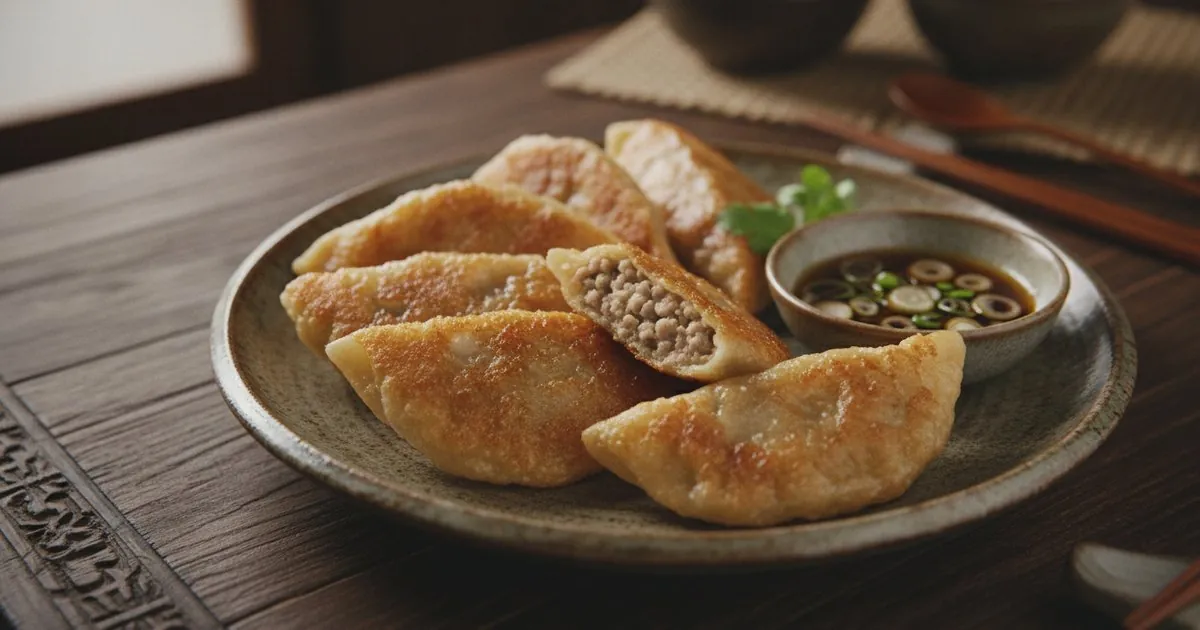
Mandu (만두) are Korean dumplings with a history as layered as their fillings. The word itself traces back through Chinese mantou and Central Asian traditions that traveled the Silk Road; archaeological evidence and historical texts place stuffed dumplings in Korean court cuisine by at least the Goryeo dynasty, and by the Joseon period mandu had become deeply embedded in the everyday food culture of the Korean peninsula — particularly in the northern regions where wheat was more readily available. Today mandu are eaten year-round, but they carry special weight at Seollal (Korean New Year), when families gather to make hundreds together and the dumplings go into mandu-guk, a clear broth soup that symbolizes a fresh start.
What sets Korean mandu apart from their Chinese or Japanese cousins isn’t any single ingredient — it’s the balance of textures and the care put into moisture management. The filling is lighter than Chinese jiaozi thanks to crumbled tofu and finely chopped vegetables, and the wrappers tend to be thin and delicate. Getting both right is the whole game.
This guide covers everything: the dough, the classic pork-and-vegetable filling, three cooking methods, and where to find the key ingredients if you’re cooking outside of Korea. Plan on about 75–90 minutes the first time, and consider doubling the batch — mandu freeze beautifully and taste even better cooked from frozen a week later.
Understanding the Two Components
Every mandu is two things: the mandu-pi (만두피), the wrapper, and the so (소), the filling. They need to work together. A beautifully seasoned filling inside a thick, gummy wrapper is still a disappointment, and a translucent, paper-thin wrapper stuffed with wet, underseasoned filling will burst on the way to your bowl. We’ll make each one right, then bring them together.
Part 1: Making the Mandu-pi (Wrapper Dough)
The Hot Water Rule
The base Korean wrapper dough is elegantly simple: all-purpose flour, salt, and hot water. The temperature of that water is not a minor detail — it’s the whole technique. Water at around 75°C / 165°F partially hydrates and softens the starches in the flour, resulting in a dough that’s pliable and easy to roll thin without fighting back. Cold water produces a stiffer, more elastic dough that shrinks the moment you put down the rolling pin. If you’ve ever wrestled with pasta dough that keeps retracting, you understand the problem.
Some cooks enrich the dough with a tablespoon of neutral oil for extra tenderness. A variation popular in some home kitchens also incorporates a small amount of sweet rice flour or cornstarch (a few tablespoons per 4 cups of flour) for a slightly chewier, more yielding bite. Both are legitimate approaches. Plain all-purpose flour with hot water is the traditional home method and produces excellent wrappers — don’t feel you need to complicate it.
Kneading and Resting
Knead for a full 8–10 minutes. The dough will start shaggy and rough and gradually transform — by the end it should be smooth, soft, and slightly elastic, with a surface that looks almost satin-like. Then the 30-minute rest is non-negotiable. During this time, the gluten fibers relax, which means the dough will stay where you roll it instead of springing back the moment you lift the pin.
Rolling to the Right Thickness
Roll to roughly 1.5–2mm thick — far thinner than most beginners expect. A reliable visual test: hold a rolled round up to a window. You should see the shadow of your fingers through it. If the dough is opaque, roll it thinner. Thick wrappers mean gummy, doughy seams that never quite cook through.
Cut into rounds of 11–12cm (4¼–4¾ inches) in diameter. A wide-mouthed jar, the lid of a spice jar, or a large cookie cutter all work. Stack finished rounds with a light flour dusting between each so they don’t stick together while you prepare the rest.
Part 2: The Classic Pork and Vegetable Filling
Moisture Is the Enemy
This point cannot be overstated: the single biggest cause of burst, soggy, or structurally disappointing mandu is wet filling. Napa cabbage, tofu, mung bean sprouts, and kimchi (if you’re making kimchi mandu) all carry substantial water. That moisture turns to steam inside the sealed wrapper during cooking, weakening the dough from the inside out and creating a greasy, collapsed result.
The solution: salt the cabbage and wring it out hard, press the tofu under a weight, blanch and squeeze the sprouts. The test: grip a fistful of the squeezed ingredient and squeeze again. Nothing should drip. If it does, keep going.
The Filling Breakdown
Ground pork is the protein backbone. An 80/20 fat ratio keeps the filling juicy and rich — leaner pork can turn chalky after steaming. Some recipes include a portion of ground beef alongside the pork, which adds a slightly different savory depth; either approach works.
Tofu is a distinctly Korean touch that lightens the filling and extends it. Use firm or extra-firm, pressed dry under a heavy pot for 10–15 minutes, then crumble by hand into pea-sized pieces.
Napa cabbage provides texture and mild sweetness. Salt it, wait 10–15 minutes, then wring it out in a kitchen towel until it’s as dry as you can get it.
Mung bean sprouts, blanched for one minute and squeezed dry, add a clean, fresh crunch and are a classic mandu ingredient.
Asian chives (buchu, 부추) have a mild garlic-chive character that’s more nuanced than regular chives. They’re available at H Mart and most Korean grocery stores. Scallions are the obvious substitute if you can’t find them — use the whole green onion, not just the green tops.
Dangmyeon (당면 — the chewy sweet potato glass noodles also used in japchae) is optional but worth including. Soaked and chopped into short pieces, they add a slightly springy, bouncy texture inside the dumpling that many Korean home cooks consider essential. Soak in cold water for 30 minutes until fully pliable, drain, and chop into pieces no longer than 1cm (½ inch).
Season, Then Test
Combine everything and mix with your hands for 2–3 minutes until the mixture coheres and feels slightly sticky — that’s the myosin in the pork binding things together, which is what you want. The filling should smell aromatic: garlic and ginger fragrant but not raw-sharp, sesame oil present and warm, the whole thing smelling like a well-seasoned meatball.
Then — and this is important — fry a teaspoon-sized patty of the raw filling in a dry skillet before you fold a single dumpling. Taste it. Adjust salt or soy sauce as needed. Skipping this step is how you end up with 40 bland dumplings.
Part 3: Assembly
Hold a wrapper flat in your palm. Spoon about 15g (1 generous teaspoon) of filling into the center — this is genuinely less filling than looks natural, but it’s the right amount. Overfilling is the second-most-common beginner mistake (wet filling is the first). The wrapper needs a clean, dry edge to seal.
Dip a fingertip in water and run it around the inside edge of the wrapper. Fold the wrapper over the filling, pressing out any trapped air pockets as you close it, and pinch the center of the curved top edge to anchor the fold. Then work along one side of the seam, creating 4–5 small pleats and pressing each against the unpleated back edge. Press the full length of the seam firmly between your thumb and forefinger. The mandu should feel snug and resist a gentle tug at the pleat tips.
If you have more filling than wrappers or vice versa, the filling scales well — you can form small patties of the leftover filling and pan-fry them as a cook’s snack while you work.
Freezing: Arrange finished mandu in a single layer on a parchment-lined baking sheet and freeze until solid, about 2–3 hours. Transfer to zip-lock freezer bags. They keep well for up to 2 months. Cook directly from frozen — add 2–3 minutes to steam or boil time.
Three Ways to Cook Mandu
Steam (Jjin Mandu / 찐만두): Line a steamer basket with parchment or a couple of napa cabbage leaves to prevent sticking. Arrange mandu about 2.5cm (1 inch) apart — they expand slightly during cooking. Steam over vigorously boiling water, covered tightly, for 12–15 minutes. Done mandu are translucent, springy when pressed, and smell rich and savory through the basket lid. This method shows off the wrapper most clearly.
Pan-fry (Gunmandu / 군만두): The crowd-pleaser. Heat oil in a flat-bottomed skillet over medium-high until it shimmers and moves — it needs to be properly hot before the mandu go in. Lay them flat-side down and listen: you want a strong, immediate sizzle, not a tentative hiss. If nothing happens, your pan isn’t hot enough. Cook 2–3 minutes until the bases are deep golden brown, then add water and cover at once. The steam will cook the filling through while the base remains crispy. Uncover for the final minute to let any residual moisture evaporate.
Boil (Mul Mandu / 물만두): Bring a large pot to a rolling boil. Slip in the mandu and stir once gently. They’ll float when nearly cooked — let them bob at the surface for a full 60 additional seconds before lifting them out. Floating alone doesn’t mean done; the filling needs that extra time. Boiled mandu are most commonly served in clear beef or anchovy broth for mandu-guk — a tradition particularly associated with Seollal, when a bowl of the soup is considered auspicious for the new year.
Finding the Ingredients
Most of the filling ingredients are available at any well-stocked supermarket — firm tofu, ground pork, napa cabbage, and mung bean sprouts are now mainstream. The items worth seeking out:
- Dangmyeon: H Mart, 99 Ranch, Mitsuwa, or online via Umamicart or Amazon. Chinese bean thread (mung bean) noodles behave similarly and are a workable substitute.
- Asian chives (buchu): H Mart reliably stocks them year-round, usually near the scallions.
- Gochugaru for the dipping sauce: Check our complete gochugaru guide for sourcing tips, quality markers to look for, and substitution notes. Whole Foods sometimes carries it in the international section; H Mart has it in multiple grades and bag sizes.
Once mandu becomes a household regular, you’ll likely want to try kimchi mandu (김치만두) — the same wrapper filled with squeezed ripe kimchi, ground pork, and tofu. It’s arguably the more flavorful version of the two. Our guide on how to make kimchi walks you through the base ingredient if you want to make that too, or you can use store-bought kimchi (squeeze it very well before adding it to any filling).
Common Mistakes to Avoid
1. Wet filling that makes wrappers burst The root cause: insufficient moisture removal from vegetables. Salting the cabbage is just step one — the real work is the wringing. Twist a kitchen towel packed with salted cabbage until your forearms ache, and then twist once more. The same applies to tofu, bean sprouts, zucchini (if substituting it for cabbage), and especially kimchi. If liquid pools at the bottom of your filling bowl after mixing, the vegetables weren’t squeezed nearly enough.
2. Wrappers left too thick A 3–4mm wrapper feels safe when you’re rolling, but it cooks into a gummy, doughy seal that overpowers the filling. Target 1.5–2mm — nearly translucent. The visual test: hold a round up to a window and check for the shadow of your fingers. There’s no shortcut here; roll with confidence.
3. Overfilling each dumpling More filling per dumpling feels intuitive but results in a seal that can’t close cleanly, wrappers that stretch and thin at the edges (making them prone to tearing), and dumplings that burst in boiling water. Keep to about 15g (1 generous teaspoon) per piece. The filling-to-wrapper ratio of a properly made mandu might surprise you — it’s more wrapper than you expect.
4. Skipping the filling taste test Raw pork filling is underseasoned cold and overseasoned warm because your palate reads them differently — and the only way to calibrate before committing to 40 dumplings is to fry a small patty and taste it. This is not optional. A two-minute investment prevents a batch of bland mandu that no dipping sauce can fully rescue.
5. Air trapped inside the fold If you feel a bubble when pressing the folded wrapper shut, that pocket of air will expand during steaming or boiling and split the seam. Before pleating, press gently around the filling to coax out any trapped air, then proceed with sealing. A properly closed mandu should feel snug and compact — no give, no puffiness at the seam.
6. Pan not hot enough for gunmandu Gunmandu placed into insufficiently hot oil stick, absorb excess grease, and turn flabby instead of crisping. The oil should be shimmering and slightly rippling when the mandu go in. You want an assertive, confident sizzle from the first second of contact. A cast iron skillet or heavy stainless pan maintains the heat spike better than a thin non-stick pan when the cold dumplings hit the surface.
FAQ
Can I use store-bought wrappers instead of making my own? Yes, and it cuts prep time considerably. Look for Korean mandu-pi at H Mart or Korean grocery stores. Japanese gyoza wrappers are slightly smaller and thinner but work very well. Chinese dumpling wrappers tend to be thicker and a bit more doughy but are perfectly usable. Whatever wrapper you buy, bring them to room temperature before filling — refrigerator-cold wrappers crack at the edges when you try to pleat them.
How do I store and cook mandu from frozen? Freeze in a single layer on a lined baking sheet until solid (2–3 hours), then transfer to zip-lock bags. To cook from frozen: steam for 15–17 minutes, pan-fry the same way as fresh but add an extra 2 minutes covered, or boil for 7–8 minutes. No thawing required. Frozen mandu keep for up to 2 months.
What’s the difference between mandu and Japanese gyoza? Related but distinct. Both fold a seasoned meat-and-vegetable filling into a thin wheat wrapper. Gyoza traditionally feature a finer pleating technique along one edge and a filling centered on pork, cabbage, garlic, and ginger with little else. Korean mandu incorporate tofu and often mung bean sprouts or dangmyeon glass noodles, producing a lighter, more complex texture. The folding style also varies — Korean pleating conventions are less rigidly uniform than gyoza’s characteristic crescent crimp.
How do I know when the mandu are cooked through? For steamed or pan-fried mandu: press one lightly with a finger. Cooked mandu feel firm and springy. Undercooked ones feel soft in the center, almost doughy. For boiled mandu, floating is a good sign but not the finish line — let them bob at the surface for a full 60 additional seconds. The wrapper cooks faster than the filling, so floating alone only tells you the dough is done.
Can I make a vegetarian or vegan filling? Absolutely. Replace the ground pork with double the amount of pressed, crumbled firm tofu plus 113g (4 oz) of shiitake mushrooms, finely diced and cooked in a dry skillet until most of their moisture has evaporated and they smell nutty and concentrated. Increase the soy sauce by about 1 teaspoon for umami depth. The moisture management rules apply exactly the same way — press and squeeze everything.