
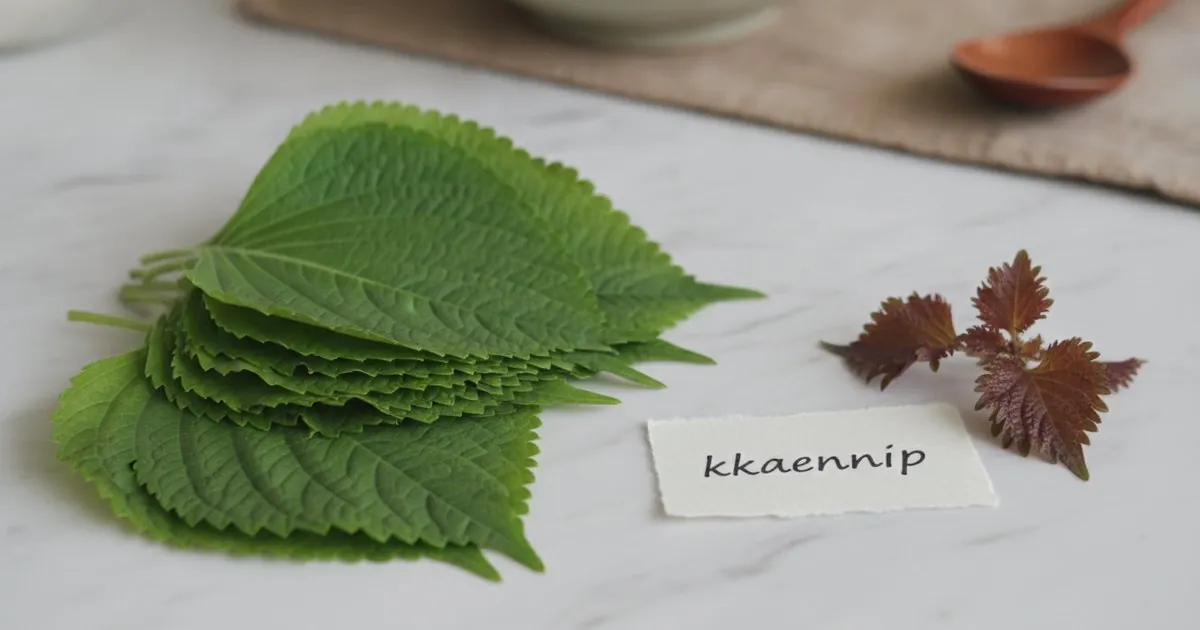
If you’ve ever sat down at a Korean BBQ table and reached for that pile of broad, deep-green leaves to wrap your grilled pork belly, you’ve already met kkaennip. And if you walked away thinking, what was that herb, and where do I get it? — this guide is for you.
Kkaennip (깻잎, pronounced roughly “kkenn-ip”) is one of those ingredients that quietly underpins enormous swaths of Korean cooking. It shows up as a fresh wrap, a fermented pickle, a soup garnish, a namul side dish, and even a cooking fat. Yet outside Korean and Korean-American communities, it remains oddly obscure — frequently mislabeled, confused with Japanese shiso, or skipped entirely because home cooks can’t figure out what to substitute.
This guide fixes all of that. We’ll cover what kkaennip actually is (botanically speaking), why the name “sesame leaf” on store packages is both technically correct and wildly misleading, how it differs from shiso, how Koreans cook with it, how to find it, how to keep it fresh, and what to reach for when you simply can’t track it down.
What Exactly Is Kkaennip?
Kkaennip is the leaf of the perilla plant, Perilla frutescens var. frutescens — a member of the mint family (Lamiaceae) native to the highland regions of South and Southeast Asia, stretching from the Indian subcontinent through Myanmar, southern China, and into Vietnam and Taiwan. Despite this dispersed origin, Korea developed such a deep, multifaceted culinary tradition around the plant that “Korean perilla” is now its dominant identity worldwide.
In Korean, the whole plant is called deulkkae (들깨), which translates literally as “wild sesame.” The leaf specifically is kkaennip. The seeds are pressed into perilla oil (들기름, deulgireum), a nutty, deeply aromatic oil used across Korean cooking — distinct from sesame oil, though they play in similar registers.
Why Your Package Says “Sesame Leaf”
Here’s where things get confusing for Western shoppers: at Korean grocery stores, kkaennip is almost always labeled in English as “sesame leaf” or “sesame perilla leaf.” This is a direct translation of deulkkae and is a perfectly legitimate Korean-language label — but it causes real confusion because perilla has absolutely zero botanical relationship to sesame (Sesamum indicum). Sesame is a completely different plant from a different family. Perilla is a mint relative; sesame is in the family Pedaliaceae.
So when you see “sesame leaf” at H Mart or any Korean grocery, you are looking at kkaennip. The names are used interchangeably in the Korean-American produce world. Just know that the plant in the bag is not related to the seeds in your sesame oil.
Kkaennip vs. Shiso: They Are Not the Same
This is perhaps the most important clarification in this entire guide. Japanese shiso and Korean kkaennip are both Perilla frutescens, but they are different varieties with meaningfully different flavor profiles and culinary applications.
| Kkaennip (Korean) | Shiso (Japanese) | |
|---|---|---|
| Botanical variety | P. frutescens var. frutescens | P. frutescens var. crispa |
| Leaf shape | Heart to oval, small teeth, neat edges | More pointed, deeply toothed, frilled |
| Leaf size | Large — 3 to 5 inches (7–13 cm) across | Smaller |
| Texture | Thick, slightly fuzzy, sturdy | Thinner, more delicate |
| Color | Deep green top; often purple-tinged underside | Green or deep red |
| Flavor | Earthy, peppery, anise-forward, nuttier | Mintier, lighter, more pronounced floral note |
| Key aroma compounds | Perilla ketone + egoma ketone | Perillaldehyde dominant |
In practical terms: kkaennip can handle being pickled in a robust soy-based brine for weeks without losing character. Shiso is more fragile and is typically used raw, as a sushi garnish or sliced into thin ribbons over cold noodles. Substituting one for the other won’t ruin a dish, but you’ll notice the difference — kkaennip has a more assertive, earthy punch where shiso reads as fresher and more delicate.
A (Surprisingly Ancient) History
While Korea is kkaennip’s cultural home, the plant itself is not originally Korean. Archaeobotanical evidence points to Southeast Asia and the Himalayan foothills as its native range. Evidence of perilla seeds at prehistoric Korean settlement sites dates to approximately 3500 BCE, with signs of active cultivation appearing around 1000 BCE — meaning Koreans have been growing this herb for roughly three millennia.
The plant also appears in Traditional Chinese Medicine texts among the fifty fundamental herbs, known in Chinese as zǐ sū (紫苏). Historical records suggest perilla reached the Korean peninsula before the Unified Silla era (prior to 935 CE), after which cultivation expanded rapidly.
What makes Korea’s relationship with kkaennip distinctive isn’t just its age — it’s the breadth of applications. Korean cooks developed preservation techniques (salted pickles, soy-marinated jangajji) that allowed them to capture the leaf’s flavor through autumn and winter, long before refrigeration. The plant was simultaneously a leafy vegetable, a cooking fat source (via seed oil), and a flavoring agent. That multipurpose utility is why it embedded so deeply into the cuisine while remaining, comparatively, a specialty item in Japanese and Chinese cooking traditions.
What Does Kkaennip Taste Like?
This is the question most Western cooks ask first, and it’s genuinely hard to answer simply because kkaennip doesn’t map cleanly onto any Western herb.
The closest comparison: imagine basil and mint had a more assertive, earthier sibling — one with a faint anise/licorice note, a subtle peppery bite, and a nuttiness that deepens slightly when the leaf is cooked. Fresh kkaennip is intensely aromatic the moment you tear it; the fragrance is immediately recognizable once you’ve encountered it. Rubbing a leaf between your fingers releases a dark green, slightly medicinal, herbal scent that reads very different from Italian basil.
When cooked — blanched briefly, stir-fried, or simmered in a stew — the intensity mellows, the anise note retreats, and a more savory, earthy quality comes forward. This is why kkaennip works both raw (as a wrap leaf) and cooked (in doenjang jjigae or as a namul).
How Kkaennip Is Used in Korean Cooking
1. Ssam (쌈) — The BBQ Wrap
The most iconic Western-facing application. At a Korean BBQ table, a leaf of kkaennip is laid flat, a piece of grilled meat placed in the center, a dab of ssamjang (seasoned fermented paste) added, maybe a sliver of garlic and a piece of green chili, and the whole thing is folded and eaten in one bite. The leaf is sturdy enough to hold the weight; its assertive flavor balances fatty pork belly or beef perfectly. For more on building the perfect Korean BBQ spread at home, see our Korean BBQ at Home guide.
2. Kkaennip Kimchi / Jangajji (깻잎장아찌) — Pickled Perilla
One of the great banchan. Whole leaves are stacked and marinated in a mixture of soy sauce, sesame oil, gochugaru, garlic, and sometimes sugar and sesame seeds. The leaves are typically left to marinate for at least 24 hours; the longer they sit, the more deeply the brine penetrates each silky, darkened leaf. Serve by peeling one leaf at a time from the stack over hot rice. For a broader look at Korean side dishes, our banchan guide has you covered.
3. Namul (나물) — Seasoned Vegetable Side
Blanched briefly in boiling water (about 30 seconds), squeezed dry, then seasoned with garlic, sesame oil, salt, and sometimes a touch of gochugaru. The cooked leaves turn silky and tender, with a milder, more savory flavor.
4. In Soups and Stews
Torn leaves are added to doenjang jjigae (fermented soybean paste stew) and other brothy dishes near the end of cooking. They function like an aromatic herb added to a western stew — brightening and adding depth.
5. Perilla Oil (들기름)
The seeds of the same plant yield a nutty, intense oil used in namul seasoning and as a finishing drizzle. It’s darker and more pungent than sesame oil — don’t substitute them interchangeably.
Where to Buy Kkaennip
Best source: Any Korean or East Asian grocery store. In North America, H Mart, Hanahreum, Super H Mart, and Zion Market reliably carry fresh kkaennip in the produce section, labeled as “sesame leaf,” “perilla leaf,” or occasionally “kkaennip.” They’re typically sold in plastic-wrapped bundles of 20–40 leaves.
Japanese grocery stores (Mitsuwa, Marukai) will often carry shiso, not kkaennip — check the variety before buying.
Mainstream grocers: Whole Foods occasionally carries perilla leaves in the specialty herb section, but availability is inconsistent and the variety may not be specified. Farmers markets in cities with significant Korean populations are a better bet in summer months.
Growing your own: Kkaennip is easy to grow from seed in containers or garden beds. Seeds are widely available online (search “Korean perilla seeds” or “egoma seeds”). The plant thrives in warm weather and produces prolifically — one or two plants will give you more leaves than you can use fresh, making summer the ideal time to make jangajji for the colder months.
How to Store It
Fresh kkaennip is perishable. The best method: treat it like fresh basil — wrap loosely in a slightly damp paper towel, place in a plastic bag or container, and refrigerate. It will keep for 5–7 days. Avoid washing until you’re ready to use it; excess moisture accelerates wilting.
For longer storage, the jangajji method (soy-marinated pickled leaves) extends shelf life to several weeks in the refrigerator.
Substitutes for Kkaennip
The honest answer: nothing replicates kkaennip exactly. But here are workable options when you’re in a pinch:
- Shiso (Japanese perilla): Closest botanical substitute. The flavor is lighter and more delicate, but the herbaceous, anise-adjacent character is there. Use 1:1 in fresh applications; accept that pickled shiso won’t have quite the same robustness.
- Fresh basil + fresh mint: A 3:1 blend of Thai basil (not Italian) and fresh mint approximates some of the earthy-anise-cool complexity. Not the same, but functional in a ssam wrap when you’re desperate.
- Large Swiss chard or butter lettuce leaves: For the structural role of wrapping BBQ meat, these work even if the flavor contribution is zero. Pair with a generous dab of ssamjang to compensate.
- Sesame oil as a flavor bridge: In cooked applications where kkaennip would have added nuttiness and aroma, a small drizzle of good sesame oil at the finish can approximate part of what you’ve lost.
What doesn’t work: Italian basil alone (too sweet, not earthy enough), regular mint alone (too medicinal), or cilantro (completely wrong flavor register for most Korean applications).
Common Mistakes to Avoid
1. Buying Shiso When You Need Kkaennip (or Vice Versa)
At Asian grocery stores that carry both varieties, the packages can look nearly identical. Check the leaf shape: kkaennip leaves are larger, oval-to-heart shaped with small regular teeth and a slightly fuzzy surface. Shiso has smaller, more dramatically frilled and pointed leaves. Using shiso in a kkaennip jangajji will produce a noticeably lighter, less robust pickle — edible, but noticeably off.
2. Over-Blanching Kkaennip for Namul
Kkaennip namul requires only about 20–30 seconds in vigorously boiling water. Leave it longer and the leaves turn army-drab, go slippery beyond recovery, and lose most of their aromatic character. The visual cue: as soon as the leaves turn uniformly bright green and go limp, pull them immediately and transfer to an ice bath. Squeeze firmly but gently — you want dry, not shredded.
3. Washing Leaves Too Far in Advance
Kkaennip leaves are prone to brown bruising along the edges once washed and left wet. Wash them in cold water just before using. If you’re making ssam wraps for a dinner party, dry them completely with a clean towel before plating — a wet leaf doesn’t wrap cleanly and dilutes the flavors of what’s inside.
4. Using Too Little Soy Sauce in Jangajji (and Expecting Quick Results)
Kkaennip jangajji is frequently under-seasoned by first-timers who worry about saltiness. The brine needs to be assertive — a 1:1 ratio of soy sauce to water is a reasonable starting point — because each leaf needs time to absorb it through its slightly waxy surface. Leaves that look deeply dark and silky after 24 hours are correctly marinated; pale, barely-tinted leaves after 24 hours mean your brine was too dilute or you didn’t use enough of it. Fix: pour the brine off, strengthen it (add more soy sauce, a touch of fish sauce, or reduce the brine briefly on the stove), let cool completely, and return to the leaves for another 12–24 hours.
5. Adding Kkaennip to Soups Too Early
In doenjang jjigae or other brothy dishes, kkaennip goes in during the final 1–2 minutes of simmering, not at the start. Added too early, the leaves disintegrate completely, turn brown, and contribute a faint bitterness rather than bright herbaceousness. Tear them roughly and drop them in just before you turn off the heat.
6. Storing Fresh Leaves in a Sealed Airtight Container
Kkaennip needs a little airflow. A fully sealed airtight container traps condensation against the leaves and accelerates decomposition faster than a loosely wrapped paper-towel bundle. The paper towel method — damp (not wet), replaced every couple of days if needed — consistently extends leaf life significantly longer than a sealed box.
Frequently Asked Questions
Is kkaennip the same as sesame leaf? Yes and no. “Sesame leaf” is the English translation used on Korean grocery store labels for kkaennip. The Korean word deulkkae means “wild sesame.” However, the plant is botanically unrelated to actual sesame (Sesamum indicum) — it’s a member of the mint family. So “sesame leaf” = kkaennip for shopping purposes, but don’t let the name mislead you into thinking these plants are related.
Can I substitute shiso for kkaennip? In a pinch, yes — shiso is the closest readily available substitute. Expect a lighter, mintier, more delicate flavor where kkaennip would give earthy pungency. For fresh applications like ssam wraps, the substitution is quite workable. For fermented pickles (jangajji), the difference in flavor and texture is more noticeable.
Where can I buy kkaennip in the US? Your best bets are Korean grocery chains like H Mart, where fresh kkaennip (labeled “sesame leaf” or “perilla leaf”) is a standard produce item. Japanese grocery stores typically carry shiso instead — verify the variety. In summer, some farmers market vendors in cities with Korean communities grow it. Growing your own from seed is surprisingly easy and produces a generous harvest.
How long does fresh kkaennip keep? Properly stored (wrapped loosely in a slightly damp paper towel in the refrigerator), fresh kkaennip will keep for 5–7 days. Wash only immediately before use. For longer storage, pickling the leaves as jangajji extends their life to several weeks in the fridge.
Can I use dried kkaennip? Dried kkaennip exists (sold in Korean grocery stores, occasionally in online Korean pantry shops) and is used primarily in soups and braised dishes. It does not work as a fresh wrap or as a namul substitute — the texture and much of the bright aromatics are lost in drying. Use dried kkaennip only in cooked applications where it will rehydrate in liquid, and use it sparingly, as the earthy notes can become slightly bitter and concentrated.