
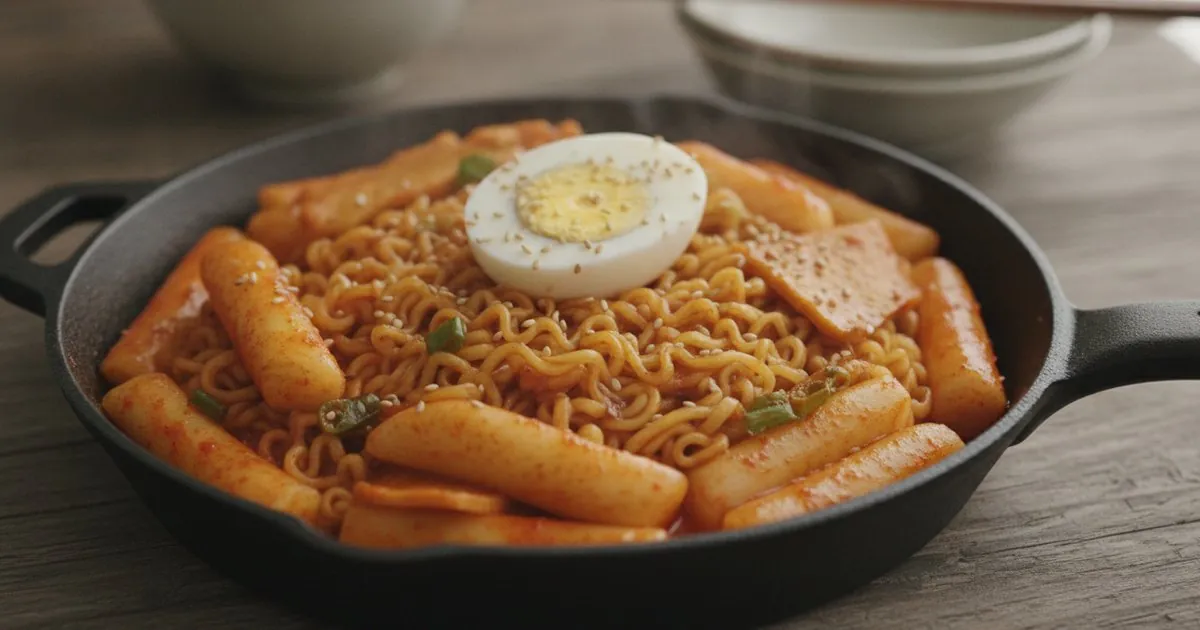
There’s a particular kind of Korean craving that only carbohydrates in multiples can satisfy. Tteokbokki alone is perfect. Ramen alone is perfect. But rabokki (라볶이) — the portmanteau mashup of ramyeon and tteokbokki — is something that transcends both of its parents. Chewy rice cakes and springy ramen noodles, tangled together in a thick, fiery, sweet-savory gochujang sauce: this is the dish that Korean convenience stores sell in cups, that street food vendors have in a perpetual, endlessly topped-up pot, and that home cooks make on rainy weekday evenings when nothing less than maximum comfort will do.
If you’ve already mastered the classic tteokbokki, rabokki is a natural next step — and frankly, a lot of people’s preferred version of the dish once they’ve tried it. The noodles do something the rice cakes alone can’t: they drink up the sauce with abandon, turning every strand into a delivery vehicle for the full complexity of gochujang, garlic, and sweetness. And then there are the rice cakes, bouncy and yielding, offering something entirely different in the same bite.
What Is Rabokki?
Rabokki is the combination of ramyeon (라면) — Korean instant noodles — and tteokbokki (떡볶이), Korea’s famous spicy rice cake dish. It occupies a beloved space in Korean food culture as both a street food staple and a home cooking shortcut: you’re already making tteokbokki, so you throw in a block of instant noodles to stretch the dish and change the texture.
The “ramen” in rabokki refers specifically to Korean instant ramyeon — the dry, curly, brick-style noodles that come in packages like Shin Ramyun, Samyang, or Neoguri. You discard the seasoning packets (or save them for another use) and cook only the noodles in the tteokbokki sauce itself. The noodles absorb the sauce as they cook, emerging deeply flavored and slightly saucy — very different from noodles that are cooked separately in water.
Why Rabokki Works So Well
The pairing of rice cakes and ramen noodles isn’t random. They have complementary textures: rice cakes are dense, chewy, and almost muscular in their resistance, while ramen noodles are lighter, springier, and more yielding. Together they offer textural variety in every mouthful that neither provides alone.
They also interact with the sauce differently. Rice cakes are starchy and thicken the sauce as they cook, giving it body and cling. Ramen noodles absorb the sauce into their coils, delivering flavor deep into the noodle itself rather than just coating the surface. The result is a dish where no two bites are quite the same.
And practically speaking, one block of instant ramen costs almost nothing, takes no additional prep time, and turns a two-person portion of tteokbokki into a satisfying meal for two hungry adults.
Choosing Your Ramen
Almost any Korean instant ramyeon works here, but there are some distinctions worth knowing:
Shin Ramyun (신라면): The most widely available Korean instant noodle globally. Its seasoning packet produces a very spicy broth, but since you’re discarding the packet for rabokki, you’re just using the noodle — and it’s excellent. Firm, chewy, holds its shape well.
Neoguri (너구리): Slightly thicker and chewier than Shin Ramyun, with a rounder texture. Many tteokbokki lovers prefer it for rabokki because the chew is closer to the rice cake’s texture, creating a more unified bowl.
Samyang 2x Spicy: A bold choice. If you’re already cranking up the gochujang, adding Samyang noodles creates a serious heat situation. Proceed with respect.
Any regular wavy instant noodle: If you can’t find Korean brands specifically, any wavy instant ramen noodle (not the flat Italian-style dried noodle) works. The curl and waviness is what traps the sauce.
Note: Do not use fresh ramen or Japanese-style straight ramen for this recipe. The instant noodle texture — specifically its ability to absorb liquid while staying bouncy — is what makes the dish work.
The Sauce: Calibrating Heat and Sweetness
The sauce for rabokki is essentially the same sauce as standard tteokbokki, just slightly loosened to account for the fact that the noodles will absorb a significant amount of liquid as they cook. If you make the sauce too thick from the start, you’ll end up with a dry, clumping mess by the time the noodles are cooked.
Gochujang quantity: 2 tablespoons is the starting point for a medium-spicy bowl. Scale up to 3 for a more assertive heat, or down to 1 for a gentler version.
Sugar: Essential. The sweetness is not optional — it’s what balances the fermented sharpness of the gochujang and makes the whole thing harmonious. Korean corn syrup (mulyeot) is traditional and gives a lovely glossiness; regular granulated sugar works perfectly well.
Soy sauce: Adds a darker savory note and deepens the overall flavor without making it salty. Don’t skip it.
Garlic: Fresh minced garlic is best. One teaspoon is the baseline; some recipes use a full tablespoon. Korean cooking generally is not shy about garlic.
Rabokki at Korean Convenience Stores
One of the great pleasures of visiting South Korea is the GS25 / CU / 7-Eleven convenience store culture, where a remarkable percentage of the food is genuinely excellent. Rabokki is a convenience store staple, available in two forms: a self-heating cup version (add hot water, wait, eat) and a premium fresh version assembled behind the counter to order.
The fresh counter version — often kept warm in a stainless tray under a heat lamp, or cooked fresh in a small pot — is particularly good and almost comically inexpensive. For roughly 3,000–4,000 Korean won (about $2–3 USD), you get a generous portion of rabokki, sometimes with a fried mandu (dumpling) or triangular kimbap on the side. It’s one of the most satisfying cheap meals in the world.
For more on the incredible range of Korean convenience store food culture, check out our guide to Korean convenience store food.
Variations and Customizations
Cheese rabokki: The single most popular variation. Pile shredded mozzarella on top in the final minute of cooking, put a lid on the pot, and let it melt. The cheese creates a dramatic stretch when you lift the lid and pull away a portion, and it genuinely tames the heat.
Budae jjigae–style rabokki: Add sliced spam, American cheese slices, canned baked beans, and cocktail sausages to the pot. This is more “army stew” than tteokbokki, but it’s a glorious maximalist version for a crowd.
Cream rabokki: Add 3 tablespoons of heavy cream in the last 2 minutes of cooking. The sauce turns a gorgeous blush pink and the heat becomes much more manageable. Popular with kids and heat-averse diners.
Vegan rabokki: Omit the fish cake. Use vegetable stock (kombu/shiitake dashi is ideal). Check your gochujang brand — most are naturally vegan, but some contain small amounts of fish sauce. Most major brands (CJ, Sempio) are vegan.
Add-in suggestions: Thinly sliced cabbage, oyster mushrooms, cubed tofu, sliced spam, or a handful of bean sprouts all work well added in the last 3–4 minutes of cooking.
How Much Noodle to Rice Cake?
This is a matter of preference and how you want the dish to lean:
- More rice cakes (300g tteok, ½ block ramen): The dish feels more like tteokbokki with some noodles added. Denser, chewier, more traditional.
- Even split (200g tteok, 1 block ramen): The classic rabokki balance. Roughly equal presence of both textures.
- More noodles (100g tteok, 1–1½ blocks ramen): The dish becomes more noodle-forward, closer to a heavily sauced ramen than to tteokbokki. Good for noodle lovers.
For two people as a main dish, the proportions in this recipe (300g tteok + 1 block ramen) land in the middle — satisfying without being overwhelming.
Storage and Leftovers
Rabokki does not store particularly well, and this is worth knowing before you scale the recipe up carelessly:
- The noodles absorb all remaining liquid as they sit. Leftover rabokki from even an hour ago will have significantly less sauce than when it was freshly made.
- Refrigerate promptly if you have leftovers. Store in an airtight container for up to 1 day (the noodles become very soft overnight).
- To reheat: Add ¼ cup water or stock to a pan over low heat. Add the leftover rabokki and stir gently until warmed through. The noodles will have softened but the dish will still be tasty. Do not reheat in a microwave — uneven heating makes the rice cakes tough.
For best results, make only as much as you intend to eat in one sitting. Halving the recipe for a single portion is completely practical.
Serving Rabokki
Rabokki is substantial enough to be a complete meal. But a few accompaniments make it even better:
- Fried mandu (pan-fried dumplings): The crispy exterior and meat filling are a classic partner.
- Kimbap: The neutral, seaweed-wrapped rice roll cuts through the spice and provides a contrast of texture and flavor.
- Iced corn tea (oksusu cha): The mild sweetness is calming next to a spicy bowl of rabokki. Banana milk also works wonderfully — the dairy genuinely helps with the heat.
Common Mistakes to Avoid
Starting with too little liquid in the sauce. The biggest structural mistake in rabokki is treating the sauce exactly like standard tteokbokki sauce. The instant noodles will absorb a significant amount of liquid as they cook — far more than rice cakes do. If you don’t add extra water (or anchovy broth) upfront, the noodles will drink the pan dry before they’ve finished cooking, leaving you with a clumping, sticky mass rather than a saucy, tangle-able bowl. When making rabokki, start with roughly 50–75ml more liquid than you would for a plain tteokbokki batch of the same size, and keep a small cup of hot water nearby to splash in if things tighten up mid-cook.
Adding the ramen noodles at the wrong moment. Add them too early and the noodles will be overcooked and blown out before the rice cakes finish. Add them too late and you’ll have rubbery tteok sitting in sauce that the noodles haven’t had time to absorb. The window: add noodles once the rice cakes have been cooking for 4–5 minutes and have softened to almost-done — the noodles need about 3–4 more minutes to fully cook and marry with the sauce, and they’ll finish together.
Using rice cakes straight from the fridge without soaking. Cold refrigerated tteok (or frozen tteok that’s only partially thawed) will cook unevenly — soft on the outside, stubbornly chalky and hard at the center. Soak refrigerated rice cakes in room-temperature water for at least 20 minutes before cooking. For frozen tteok, thaw fully first. This step is not optional; no amount of extra cooking time in the sauce will fix a rice cake that went in cold.
Skimping on the sugar. Gochujang has a fermented sharpness that needs sweetness to resolve into something harmonious. Without enough sugar (or mulyeot), the sauce tastes raw and one-dimensional, all heat and no depth. If your rabokki tastes aggressively spicy but flat, add sugar before reaching for water — it’s usually the missing element, not over-seasoning.
Not stirring frequently enough. Starch from the rice cakes accumulates quickly on the bottom of the pan, and the thick sauce creates ideal scorching conditions over medium-high heat. Stir every 30–45 seconds, especially once the noodles go in — neglecting this for even two minutes can leave you with a burnt layer that flavors the whole pot bitterly.
Pulling it off the heat too early and eating immediately. Rabokki needs 1–2 minutes of resting time after the heat goes off. The sauce continues to thicken and the noodles continue to absorb — serve it the moment it comes off the burner and the sauce will look thin; wait two minutes and everything will have pulled together into the cohesive, glossy, clingy consistency the dish is known for.
Frequently Asked Questions
Do I have to use the anchovy stock, or can I use water? Water works fine and many people use it. Anchovy-kelp stock adds a round, savory depth that elevates the dish, but the gochujang, soy sauce, and garlic provide so much flavor on their own that rabokki made with plain water is still excellent. If you want to split the difference, use half stock and half water.
Can I use leftover tteokbokki to make rabokki? Yes, and this is a great rescue move for leftover tteokbokki. Add a splash of water to the pan to loosen the sauce, bring it back to a simmer, and add your noodles. The rice cakes will be softer than if you’d started fresh, but the overall dish is completely good.
My noodles got too soft and mushy. What happened? Ramen noodles overcook quickly, especially in a hot, starchy sauce. Make sure you’re adding the noodles when there’s still plenty of sauce liquid (before the sauce has reduced significantly), and pull the dish off the heat the moment the noodles are cooked through. Cooking time from adding the dry noodles to done is typically 4–5 minutes — don’t walk away.
How spicy is this dish? With 2 tablespoons of gochujang and 1 tablespoon of gochugaru, this recipe lands at a medium-spicy level by Korean standards — noticeable heat but manageable for most people. For reference, it’s spicier than most generic “Asian” dishes at Western restaurants but significantly less spicy than a level-1 Korean fire noodle challenge. Adjust the amounts to your tolerance.
Can I make rabokki in advance for a party? You can prep all the ingredients in advance (soak the rice cakes, make the sauce base, cut the fish cake and scallions), but cook it fresh when guests arrive. Rabokki takes 15 minutes from start to finish and is genuinely better made to order.
Is there a non-spicy version of rabokki? Yes — substitute the gochujang with a mixture of soy sauce, sesame oil, and a touch of oyster sauce, and omit the gochugaru. You’ll get a savory, umami-rich sauce that’s very similar to the royal court tteokbokki style but with ramen noodles added.