
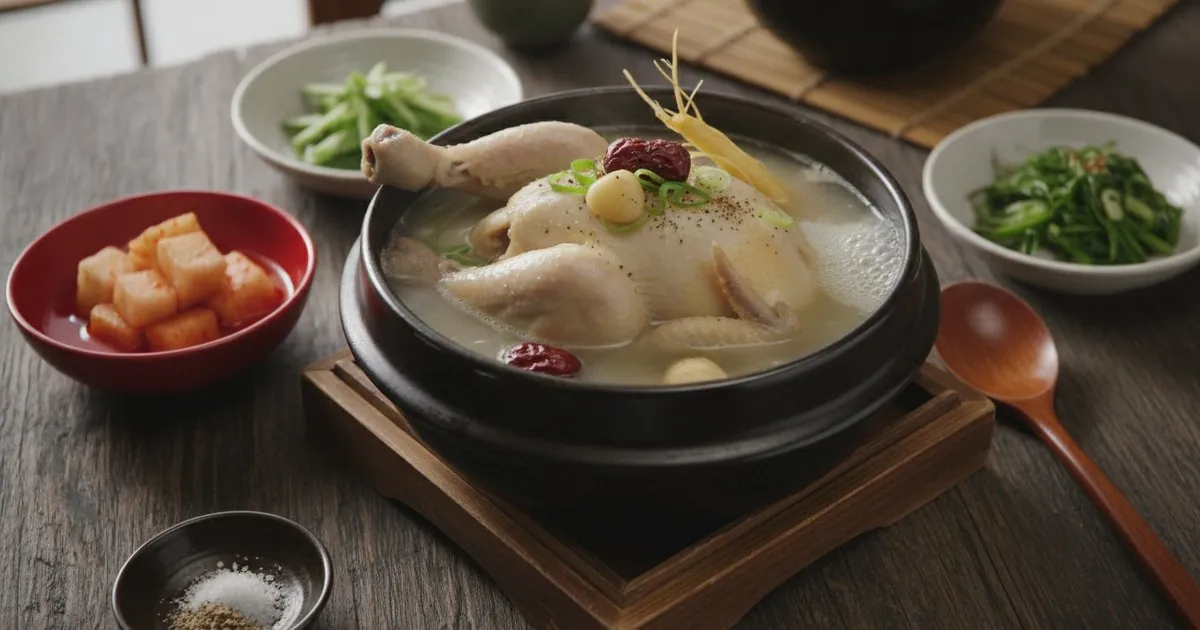
If you’ve ever wanted a bowl of soup that feels like it was designed specifically to restore you — after a punishing week, a stubborn cold, or a summer day that wrung out every reserve of energy — samgyetang is that bowl. This is Korea’s most iconic nourishing dish: a whole young chicken stuffed with glutinous rice, ginseng root, plump dried jujubes, and garlic, then simmered slowly until the broth turns silky, golden, and deeply savory and the chicken practically melts at the touch of chopsticks.
It looks deceptively simple. One pot, one bird, a handful of dried herbs. But samgyetang rewards precision and patience. Get the bird size right, resist the urge to over-fill the cavity, skim the broth faithfully in that early window — and you’ll end up with something that tastes genuinely restorative in a way that’s hard to describe but easy to feel from the first spoonful.
This guide covers everything: what samgyetang actually is, why Koreans eat it ritually on the hottest days of summer, where to find every ingredient in a Western kitchen, and — critically — how to sidestep the handful of specific mistakes that separate a restaurant-quality bowl from a disappointing one.
What Is Samgyetang (삼계탕)?
The name unpacks neatly: sam (삼) means ginseng, gye (계) means chicken, tang (탕) means soup or broth. Ginseng chicken soup. But the dish is more than the sum of those three words.
The defining technique is whole-bird stuffing. A young chicken — in Korea, this is called 영계 (yeong-gye), a spring chicken weighing roughly 500–600g — is stuffed with soaked glutinous rice, a ginseng root, dried jujubes, and garlic cloves, then placed whole into a pot and simmered until the broth is rich and the stuffing has absorbed all the inner juices of the bird. The result is a dish where the soup, the meat, and the rice filling all taste completely of each other — unified, concentrated, and impossible to replicate by any other technique.
Crucially, each diner gets their own whole bird in their own vessel. This is not a communal stew; it’s a deeply personal, individual bowl. In Korean restaurants, samgyetang arrives in a stone pot (돌솥, dolsot), still bubbling, set directly in front of you and no one else.
The Boknal Tradition: Why Koreans Eat Hot Soup on the Hottest Days
Samgyetang is famously a summer food — more specifically, a boknal (복날) food. The three hottest days of the Korean lunar calendar are called 초복 (chobok), 중복 (jungbok), and 말복 (malbok), and they typically fall between mid-July and mid-August. On these three days, samgyetang consumption surges to a national scale: restaurant queues extend down the block hours before opening, and Korean families gather around bowls of this specific dish with a kind of ritualistic intentionality.
The logic might seem counterintuitive to Western cooks, who tend to associate soup with winter. The Korean concept here is 이열치열 (i-yeol-chi-yeol): “fight heat with heat.” Traditional Korean medicine holds that excessive summer heat and sweating depletes the body’s vital energy (기, gi), and that eating warming, fortifying foods — particularly those containing stimulating herbs like ginseng and garlic — replenishes what the heat has taken. You sweat more from the soup, yes, but you emerge from the meal feeling restored rather than drained.
Whether or not you subscribe to that framing, the practical experience is real. A well-made bowl of samgyetang, finished with a pinch of flaky salt and eaten slowly, does feel genuinely fortifying. It’s also very much a year-round dish in Korea — winter samgyetang is equally traditional — but if you want the most culturally resonant experience, make it on the year’s hottest evening.
The Ingredients, Explained
The Bird: Cornish Hens Are Your Best Friend
The traditional Korean yeong-gye is a young chicken in the 500–600g (1.1–1.3 lb) range. In Western supermarkets, the closest and most widely available equivalent is a Cornish game hen (also sold as poussin in some regions). Look for birds in the 450–600g (1–1.3 lb) range — the smaller end of what you typically find at Whole Foods or Trader Joe’s is ideal. At H Mart or a Korean grocery, you may find small whole chickens labeled specifically for samgyetang.
A note on sizing: Cornish hens labeled around 700–800g (1.5–1.7 lb) are workable but will need an extra 10–15 minutes of simmering, and the individual-pot intimacy starts to feel a bit less elegant. If you want a family-style version, a 1.2 kg (2.6 lb) whole chicken can work, but the stuffing ratio changes and the cook time extends considerably. For the authentic experience, one small bird per person is the way.
Glutinous Rice (찹쌀, Chapssal)
This is not regular white rice. You need sweet glutinous rice (also called sticky rice or sweet rice) — the variety that becomes creamy, cohesive, and almost pudding-like when cooked, rather than fluffy and separate. Use 3–4 tablespoons (45–60g) per bird, soaked in cold water for at least 1 hour (2 hours is better for a creamier texture). The soaking allows the grains to cook through fully inside the cavity in the time available.
Find it at any H Mart, Korean or Asian grocery, or in the Asian foods aisle of larger Whole Foods stores. Bob’s Red Mill sells it under the name “sweet white rice” if that’s your most accessible option.
Ginseng (인삼, Insam)
This is the soul of the dish, and there’s no real substitute that produces the same result. Korean ginseng (Panax ginseng) has an earthy, slightly bitter, unmistakably medicinal quality that gives the broth its characteristic depth. Use 1 root per bird.
You’ll encounter it in several forms at Korean markets:
- Fresh ginseng: The gold standard — looks like a pale, tentacled root. Rinse well under cold water and use as-is.
- White dried ginseng: Air-dried and slightly processed. Whole roots benefit from a 30-minute soak in cold water before use; use that soaking water in your pot. Thin slices and small pieces (common in pre-packaged herb kits) can go in dry.
- Samgyetang herb kits: Many H Mart locations stock pre-packaged kits containing ginseng pieces, jujubes, astragalus root (황기, hwanggi), and sometimes angelica root. These are genuinely convenient and produce excellent results.
American ginseng (Panax quinquefolius) is available at health food stores and can be used in a pinch, but its flavor is milder, less bitter, and less complex than Korean ginseng. It’s a substitute, not an equivalent — worth knowing the difference before you commit to it.
Jujubes (대추, Daechu)
These wrinkled, dark-red dried fruits — also known as Chinese dates or red dates — bring a soft, honeyed sweetness to the broth that rounds out the ginseng’s bitterness beautifully. Use 2–3 per bird: 1–2 go inside the cavity, and any remaining ones go directly into the pot. They’re visually striking in the finished bowl and entirely edible, though most people push them to the side.
Find them at H Mart, any Korean or Chinese supermarket, or easily online — they keep for months in a sealed container.
Garlic
Korean cooking doesn’t apologize for garlic, and samgyetang is no exception. Use 4–6 cloves per bird — 2 go inside the cavity with the rice and herbs, and the rest go directly into the simmering pot to infuse the broth. After 45–55 minutes of gentle simmering, these broth garlic cloves turn sweet, mellow, and almost jammy. They’re delicious eaten alongside the chicken.
The Seasoning: Salt and White Pepper at the Table
Samgyetang is served intentionally under-seasoned from the pot. Small dishes of flaky sea salt and white pepper are set out on the table, and each person seasons their own bowl. This isn’t an oversight — it’s tradition, and it matters. The broth has natural depth from the herbs, bones, and aromatics; layering salt on top individually allows for precise, personal control. Do not pre-season heavily before serving.
Where to Source These Ingredients in the West
- H Mart (US and Canada) and T&T Supermarket (Canada): Your single best destination. Cornish hens, glutinous rice, fresh or dried ginseng, jujubes, and pre-packaged samgyetang herb kits are reliably in stock.
- Whole Foods / Sprouts / Trader Joe’s: Cornish hens, yes. Glutinous rice, sometimes. Ginseng and jujubes — usually only in stores with a well-stocked Asian section.
- Online (Amazon, Weee!, Umami Insider): Dried ginseng, jujubes, glutinous rice, and pre-made samgyetang herb kits are all easily ordered and ship well. Fresh ginseng is available seasonally through Korean specialty sellers.
If stocking your pantry for more Korean cooking adventures beyond samgyetang, our guide to Korean pantry essentials covers the building blocks you’ll reach for again and again — from doenjang and gochujang to the right rice vinegar and anchovy stock packets.
How to Make Samgyetang: Step by Step
1. Soak the rice. Cover your glutinous rice with cold water and soak for 1–2 hours. Drain thoroughly — waterlogged rice will dilute the broth inside the cavity.
2. Prep the birds. Rinse each Cornish hen inside and out under cold running water. Remove any giblets from the cavity. Pat the outside dry with paper towels — dry skin holds together better during the long simmer.
3. Stuff the cavities. For each bird, add 3 tablespoons (45g) drained rice, 1 ginseng root, 2–3 jujubes, and 2 peeled garlic cloves. Fill to roughly 70% capacity. The rice will swell to fill the remaining space; overfilling causes it to burst out into the broth.
4. Truss the legs. Cross the drumsticks and tie with kitchen twine, or tuck the ankle joints under the skin flap near the cavity opening. This keeps the stuffing contained throughout the simmering process.
5. Build the pot. Place the hens snugly in a heavy pot — a 4–5 liter Dutch oven works well for two birds. Add the remaining 6 garlic cloves, any leftover jujubes, and the white parts of the green onions. Pour in cold water until the hens are covered by 2–3 cm (about 1 inch). If you soaked dried ginseng, add that soaking water now.
6. Boil and skim. Bring to a rolling boil over high heat. Within a few minutes, gray-brown foam will begin rising to the surface — this is coagulated protein from the chicken. Skim it off steadily with a ladle or fine-mesh skimmer for 3–5 minutes, until foam production slows significantly. This step produces a clear, clean-tasting broth.
7. Simmer gently. Reduce the heat to medium-low, cover, and simmer for 45–55 minutes. You should hear and see a steady, gentle bubble beneath the lid — not a churning boil. Check doneness by piercing the thigh with a skewer: juices should run clear with no resistance. The glutinous rice inside will be puffed, creamy, and fragrant.
8. Season and serve. Season the broth with salt (start with 1 teaspoon, taste, add from there). Serve each hen in a deep bowl or stone pot with plenty of broth ladled over. Top with sliced green onion tops and set out small salt and white pepper dishes on the side.
Tips for the Best Bowl
- Choose a pot that fits snugly. A too-large pot means the hens float freely, the water-to-chicken ratio skews too high, and the broth ends up thin and flat. Two Cornish hens want a pot they can nestle in together without swimming around.
- Always start in cold water. Submerging the hens in cold water and bringing everything up to temperature together draws more flavor and collagen from the bones and herbs than starting in boiling water.
- Don’t keep lifting the lid. A covered pot holds steady heat and simmers more evenly. Opening it frequently drops the temperature, extends cooking time, and stresses the meat. After skimming, cover and leave it mostly alone.
- Rest before serving. Turn off the heat and let the pot sit covered for 5 minutes before serving. The meat relaxes, juices redistribute, and the broth temperature settles from scalding to pleasantly steaming.
Samgyetang is a complete meal on its own, but it’s classically served with kimchi alongside — the bright, fermented sharpness cuts through the clean richness of the broth in exactly the right way. If you want to round out the table with a few more small plates, our guide to banchan — Korean side dishes has everything you need to put together a spread without overwhelming yourself.
Common Mistakes to Avoid
1. Overfilling the Cavity With Rice
This is the single most common failure mode, and it’s irreversible once the bird is in the pot. Dry glutinous rice roughly doubles in size as it absorbs moisture and heat — if you pack the cavity more than 70% full, the rice has nowhere to go but out. The result is a burst cavity, loose grains floating throughout the broth, and stuffing that cooked in the soup rather than inside the bird, losing the entire point of the technique. Measure the rice precisely (3 Tbsp / 45g per bird), and if the cavity looks barely filled, trust the measurement rather than your eyes.
2. Skipping or Rushing the Foam-Skimming Stage
The gray-brown foam that rises in the first few minutes of boiling is coagulated blood and protein from the chicken. If you put the lid on before this foam has been fully skimmed, it cooks back into the broth, turning it cloudy and lending it a slightly bitter, off-flavored quality — the kind of broth that tastes vaguely murky no matter how much salt you add. The skimming window is only 3–5 minutes at the start of cooking. Stay at the stove with a ladle and don’t walk away during this phase.
3. Boiling Too Vigorously After Skimming
Once the foam is cleared and the lid goes on, the temptation is to keep the heat higher than needed to feel like things are moving along. Resist this. A hard rolling boil does three damaging things to samgyetang: it toughens the chicken breast into dry, stringy meat; it emulsifies fat into the broth, turning it cloudy and heavy; and it risks breaking the bird apart prematurely, scattering the stuffing before the dish is ready. What the broth should look like under the lid: a slow, steady, contented bubble. If you lift the lid and see turbulence, reduce the heat immediately.
4. Using Too Large a Bird
A Cornish hen over ~700g (1.5 lb), or a standard supermarket whole chicken, won’t cook through evenly in the 45–55 minute window. The breast meat — which has less insulation from the bone — overcooks and dries out before heat fully penetrates the stuffed cavity and the inner thigh. The tell-tale sign: the breast pulls apart easily with chopsticks but the thigh resists, or the stuffing is still partly underdone in the center. Keep birds in the 500–600g range. If yours runs closer to 750–800g, add 10–15 minutes and verify with a thermometer (74°C / 165°F at the thickest part of the thigh).
5. Skipping the Rice Soak
Dry glutinous rice packed directly into the cavity does not cook through reliably in the 45–55 minute simmering window. You’ll end up with rice that’s hard or chalky in the center, without the creamy, cohesive texture that makes samgyetang stuffing so satisfying. The rice should emerge puffed, soft throughout, and having absorbed the interior juices of the chicken. Soaking for 1 hour — 2 hours for an even creamier texture — is non-negotiable. Set a timer when you start the soak; it’s the step most easily forgotten.
6. Seasoning the Broth Heavily Before Serving
Because samgyetang simmers uncovered or partially covered for almost an hour, the broth concentrates. Salt added at the beginning or even midway can render the finished broth uncomfortably salty by the time the dish is done. Add salt only at the very end, start conservatively (1 teaspoon in the pot), taste, and adjust slightly — then rely on the table-side salt and white pepper dishes to allow each person to finish their own bowl. The broth from the pot should taste clean, savory, and slightly restrained. Over-salted samgyetang broth cannot be fixed without diluting everything you just built.
FAQ
Can I make samgyetang without ginseng?
Technically possible, but the dish becomes something else. Ginseng is the defining ingredient — its earthy, slightly bitter complexity is what distinguishes samgyetang from other chicken soups and gives it that characteristic depth. Without it, you have a nicely stuffed chicken broth, not samgyetang. If Korean ginseng is genuinely unavailable, American ginseng (Panax quinquefolius) from health food stores is a real (if milder) substitute. Dried astragalus root (황기, hwanggi), often included in pre-made samgyetang herb kits, adds its own gentle sweetness and is a useful supplement alongside ginseng rather than a replacement for it.
What’s the difference between fresh and dried ginseng in this recipe?
Fresh ginseng produces a broth with a slightly milder, cleaner ginseng flavor. Dried ginseng (white-dried, the most common form) is more concentrated and slightly more assertive — neither is categorically better, just different in intensity. Whole dried roots benefit from a 30-minute pre-soak (use the soaking liquid in your broth — it carries flavor). Thin dried slices and small pieces from samgyetang herb kits can go in dry without any special preparation. Either form produces an excellent finished dish.
Can I use a regular whole chicken instead of Cornish hens?
Yes, with adjustments. A 1.2 kg (2.6 lb) whole chicken makes a family-style version that serves 3–4. Scale the stuffing proportionally, increase the water to cover, and simmer for 75–90 minutes rather than 45–55. The dish loses some of its individual-pot intimacy, but the flavor is similar. Just note that the individual-serving tradition — one whole bird, one person, one pot — is a meaningful part of the samgyetang experience, not only a culinary choice.
Can I cook samgyetang in an Instant Pot or pressure cooker?
Yes — pressure cook on high for 22–25 minutes, followed by a 10-minute natural pressure release before manually venting the rest. The broth will be rich and the chicken very tender. The main trade-off: because the lid is sealed from the beginning, you can’t skim foam during the cooking process. To compensate, briefly bring the water and chicken to a boil on the stovetop, skim the foam for 3–4 minutes, then transfer to the pressure cooker and seal. Also note that the chicken skin softens completely under pressure — the visual presentation will be different from the stovetop version.
What should I serve alongside samgyetang?
Kimchi is the classic companion — its sharp, fermented punch provides exactly the contrast the clean, mild broth needs. Kkakdugi (깍두기, cubed radish kimchi) is a particularly traditional pairing for samgyetang specifically. Beyond that, a small bowl of barley tea (보리차, boricha) and perhaps one or two simple banchan — a seasoned spinach, a small pile of bean sprouts — round out the table without competing with the soup. Samgyetang is a complete meal in itself; the accompaniments should support it, not crowd it.