
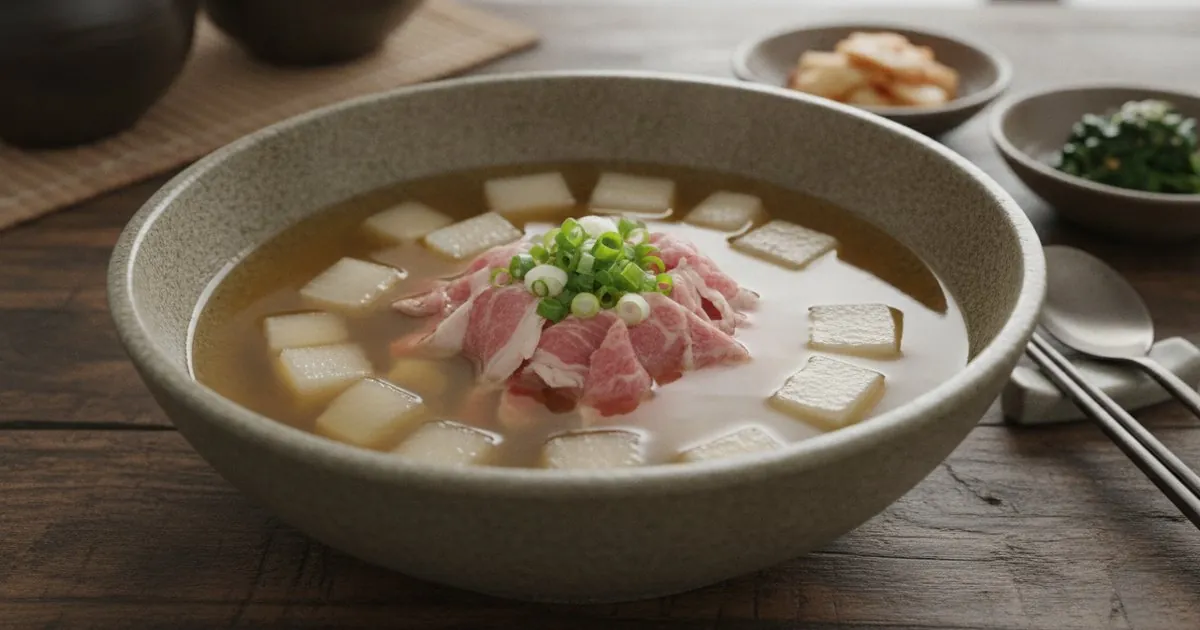
There are weeknights when only something warm, clear, and restorative will do — something that takes the edge off the evening without demanding too much of you in return. Sogogi muguk (소고기 무국, Korean beef and radish soup) is exactly that dish. A pale, golden-tinged broth carries the quiet depth of beef and garlic; thick squares of Korean radish turn almost translucent as they absorb everything around them; slices of brisket become just tender enough to pull apart at the edges without going mushy. The whole thing comes together in about 45 minutes and tastes like it’s been going all afternoon.
This is everyday Korean cooking at its most essential. Guk (국) — the broad category of Korean soups — appear at virtually every Korean meal, and sogogi muguk is among the most universally beloved of them all. It’s a soup people eat for breakfast before work, for lunch on cold days, for dinner when nothing else sounds right. Light enough to feel nourishing rather than heavy, and seasoned with the quiet umami of soup soy sauce and sesame oil rather than a paste-heavy punch, it’s a completely different experience from doenjang jjigae or kimchi stew — and one that consistently surprises Western cooks with how much flavor emerges from such a short ingredient list.
What Is Sogogi Muguk?
The name breaks down simply: sogogi (소고기) means beef, mu (무) is Korean radish, and guk (국) is the word for the broth-forward soups that anchor Korean meals. Unlike jjigae (찌개) — those thicker, more intensely seasoned stews meant to be shared communally from a hot pot — guk are served in individual bowls alongside rice and function almost like a seasoned beverage: you sip the broth between bites of rice, alternating with banchan side dishes to build each mouthful.
Korean radish, or mu, resembles Japanese daikon but tends to be shorter, rounder, and denser, with a slightly sweeter, crisper bite and a less peppery edge. When it simmers in a seasoned broth, the transformation is remarkable: the edges soften, the flesh goes silky, and the color shifts from chalky white to a luminous near-translucency that signals full absorption of the surrounding flavors. A properly cooked piece of muguk radish has a texture like firm tofu — yielding but not falling apart — and tastes of everything it’s been sitting in.
The seasoning backbone of the soup is guk ganjang (국간장), often translated as soup soy sauce or joseon soy sauce. It’s saltier, lighter in color, and with a more complex fermented depth than all-purpose soy sauce — designed specifically for seasoning Korean soups and vegetable dishes without darkening the broth. This is the single ingredient that makes sogogi muguk taste unmistakably Korean rather than generically “beef soup.”
The Ingredients: What You Need and Why
Beef: The Cut Determines the Character
The cut you choose shapes the final soup meaningfully. Brisket is the most traditional option — its intramuscular fat and connective collagen contribute richness to the broth as they break down, and the slightly chewier texture plays beautifully against silky radish. Chuck roast behaves similarly and is often easier to find pre-sliced. Boneless short rib yields the most luxurious result if you’re willing to spend slightly more. Sirloin works for a leaner, milder soup — just don’t overcook it, or it turns dry and stringy faster than fattier cuts will.
For four servings, plan on 225–280g (8–10 oz) of beef. The soup isn’t a stew; the radish shares equal billing, and you want the balance to stay intact.
For slicing: cut across the grain into pieces about 6mm (¼ inch) thick and 4cm (1½ inches) long. Brisket can be slippery to cut precisely — 20 minutes in the freezer firms it up and gives you much cleaner slices without tearing.
Korean Radish (Mu)
You’ll need about 340g (12 oz), peeled. Cut it into rectangles roughly 3–4cm (1¼–1½ inches) wide and 6mm (¼ inch) thick — thick domino-tile shapes. This specific thickness matters: too thin and the radish disintegrates by the time the beef is ready; too thick and you get raw centers even after 25 minutes of simmering. If you’re eyeballing it, err toward thinner rather than thicker.
Japanese daikon is an acceptable substitute if Korean radish isn’t available. The soup will be slightly more peppery and the texture marginally more watery, but it works well enough for a weeknight.
Guk Ganjang: Don’t Skip It
This is the ingredient most likely to be unfamiliar to Western cooks, and it’s worth seeking out specifically before you improvise. Guk ganjang is pale golden-amber, considerably saltier than standard soy sauce, and has a distinct savory-funky complexity from a longer fermentation process. Using regular dark soy sauce will turn your broth dark brown and shift the flavor toward a generic “Asian beef soup” profile rather than something specifically Korean. Light (thin) soy sauce is the better emergency substitute — the soup will be slightly different in character but still recognizable.
Guk ganjang is stocked prominently at H Mart and most Korean grocery stores. Look for Sempio (샘표) or Chung Jung One (청정원) brands. It ships well and is available through Amazon and Korean food specialty sites if you want to order ahead.
The Rest of the Cast
Garlic goes in twice — once in the marinade, where it mellows and melds into the beef, and again in the final minutes of cooking, where it adds a brighter, more present note. Sesame oil appears in the marinade and optionally as a finishing drizzle; use a 100% pure sesame oil, not a blend, because you’re relying on the aroma more than the fat itself. Green onions are added in the final minutes to stay fresh and bright rather than going limp and flavorless. Dried kelp (dashima, or kombu) is optional but genuinely useful — a single piece added with the water and removed after boiling contributes quiet oceanic umami that deepens the broth without making it taste remotely “fishy.”
How to Make Sogogi Muguk: Step by Step
Step 1: Marinate the Beef (10–15 minutes)
Combine sliced beef with 1 tablespoon of guk ganjang, 1 teaspoon of minced garlic, 1 teaspoon of sesame oil, and a few grinds of black pepper. Toss well — every piece should be lightly coated. The beef will darken slightly and smell savory-nutty. This marinade does two things: it seasons the meat internally and gives it a head start on flavor before it hits the pot.
Step 2: Sauté the Beef (2–3 minutes)
Heat a medium pot (at least 3L / 3-quart) over medium-high heat. Add the neutral cooking oil and wait until it shimmers. Add the marinated beef in a single layer as best you can. The pot should sizzle actively the moment the beef goes in — if it’s quiet, the heat is too low and you’ll steam rather than sear. Sauté for 2–3 minutes, stirring occasionally, until the pink is gone and you see a light golden-brown on the surface of some pieces. You’re not building a deep crust here; you’re just establishing flavor.
Step 3: Add Radish and Stir (1–2 minutes)
Add the radish pieces and stir everything together. The radish will pick up a slight glossiness as it absorbs the pan drippings. This 1–2 minutes of contact before the water goes in gives the radish its own base flavor rather than just poaching in broth from scratch.
Step 4: Add Water and Bring to a Boil — Skim the Foam
Pour in all 1.9L (8 cups) of cold water. Add the dashima if using. Raise the heat to high. As the liquid heats toward a boil — somewhere between 5 and 8 minutes — watch for gray-brown foam rising to the surface. This is coagulated protein and impurities from the beef. Skim it off steadily and continuously with a spoon or flat ladle. At peak foaming, you may be scooping every 30 seconds. Keep at it until the surface is mostly clear. The color of the foam shifts from dark gray to pale tan to nothing — that’s your signal to back off.
Step 5: Simmer Until Radish Is Translucent (20–25 minutes)
Remove and discard the kelp. Reduce the heat to medium-low so the broth simmers gently — you want a soft, steady bubble where a few lazy wisps of steam rise and the surface barely trembles. This gentle simmer keeps the broth clear and golden rather than murky.
After 20–25 minutes, the radish will have transformed. It should be completely translucent — you can see through the edges — and a chopstick or thin knife should slide through a piece with no resistance whatsoever. If there’s any springback or the center looks whitish, keep simmering in 3-minute increments and test again.
Step 6: Season and Finish
Add the remaining 1 tablespoon of guk ganjang and the remaining 1 teaspoon of fresh minced garlic. Stir, then taste the broth directly. It should taste savory and complete — clean and light, not flat and watery, but not salty either. Adjust with pinches of salt as needed. Add the green onion pieces and simmer for 2 more minutes. Turn off the heat, add a few drops of sesame oil if you like, and serve immediately.
Serving Sogogi Muguk
Sogogi muguk is always served alongside hot steamed short-grain white rice — in separate bowls, not poured over. The traditional way to eat it is to sip the broth between bites of rice and side dishes, letting the soup soften and warm each mouthful. Round out the meal with a well-chosen spread of banchan (Korean side dishes) — kimchi, spinach namul, and pickled radish are classic companions that add contrast without competing with the soup’s delicate flavor.
For a more substantial dinner, the soup pairs naturally with something that has a bit of char or richness. Bulgogi alongside a bowl of muguk is a particularly satisfying combination — the sweetness and sear of the beef next to the clean, savory soup create the kind of balance Korean table-setting is built around.
Leftovers keep refrigerated for up to 3 days. The broth actually deepens overnight and the soup often tastes marginally better on day two. Reheat gently over medium-low to avoid toughening the beef.
Common Mistakes to Avoid
1. Skipping or rushing the foam skimming — and ending up with murky, slightly bitter broth
The gray-brown foam that rises during the first few minutes of boiling is the most consequential thing happening in the pot during that window. It’s coagulated blood and proteins from the beef; if you let it subside back into the broth instead of removing it, the liquid will taste slightly bitter and look gray rather than golden-clear, and there’s no fixing it later. Set up your skimming spoon before the water even goes on the stove. When the foam appears — and it appears fast — work steadily for 3–5 minutes, scooping and discarding continuously. The broth is ready to simmer when the surface looks clean between bubbles.
2. Using regular soy sauce instead of guk ganjang
Standard dark soy sauce contains significantly more color pigment and has a different fermentation profile than guk ganjang. Add two tablespoons to this soup and the broth turns dark brown, the flavor shifts toward a sweet-salty “Asian fusion” baseline that reads nothing like traditional Korean muguk, and the subtle complexity is lost entirely. Light (thin) soy sauce is a closer emergency substitute, but the flavor still differs. If you’re serious about making this properly even once, track down guk ganjang first. It’s available at H Mart, Korean grocery stores, and through online retailers — it keeps for a long time refrigerated after opening.
3. Cutting the radish too thick and getting raw centers
Radish cut thicker than about 8mm (⅓ inch) will take noticeably longer to cook through than the beef, and you’ll face a choice between undercooked radish (crunchy, starchy, raw-tasting at the center) or beef that’s been simmering too long and has dried out. The 6mm (¼-inch) target is the tested sweet spot for this cooking time. If you’ve already cut it thicker, don’t panic — just extend the simmer by 5–10 minutes and test with a chopstick before adding your final seasonings.
4. Keeping the heat too high throughout — and clouding the broth permanently
After the initial foaming boil and the skimming phase, the heat must come down. A sustained hard boil agitates suspended particles back into the liquid and permanently clouds the broth — you can’t unclouded it once it’s happened. The difference between a properly simmered muguk (golden, clear, almost lacquered-looking in a well-lit bowl) and an aggressively boiled one (gray, opaque, unappealing) is almost entirely a question of heat management after that initial boil. Once foam is skimmed and kelp removed, the surface should just barely tremble.
5. Not tasting and adjusting at the end — because guk ganjang varies by brand
The saltiness of guk ganjang varies considerably between brands. The recipe amounts here are starting points, not final targets. The soup is properly seasoned when the broth tastes savory, complete, and gently complex — not flat or watery, but also not salty enough to make you reach for water. Always taste after adding the final tablespoon of guk ganjang. If it’s still flat, add plain salt in small pinches and taste again rather than adding more soy sauce (which adds color along with seasoning).
6. Adding all the garlic at the marinade stage and skipping the fresh addition at the end
Garlic that marinates with the beef and cooks through the entire simmering time becomes mellow, rounded, and almost sweet — pleasant but one-note. The second addition of fresh minced garlic in the final 3–5 minutes of cooking contributes a brighter, more forward garlic presence that cooked-through garlic simply cannot provide. The two stages work together and produce a more nuanced result than either would alone. If you forget the second addition, the soup is still good — just noticeably less complex in its garlic character.
Frequently Asked Questions
Can I use a different cut of beef, like pre-sliced bulgogi meat?
Yes — pre-sliced beef from Korean grocery stores (often labeled for bulgogi or shabu-shabu) works very well and saves the slicing step entirely. The cut will typically be sirloin or rib eye, both of which produce a slightly leaner, milder soup than brisket. Adjust your simmering time slightly downward if the slices are very thin, as lean beef can get stringy if overcooked.
What’s the difference between muguk and miyeok guk?
Both are guk-style Korean soups with a clear, lightly seasoned broth, but they’re quite distinct in character. Miyeok guk (미역국) uses rehydrated dried seaweed (miyeok, related to wakame) as its primary solid ingredient, giving the soup a distinctly oceanic, silky texture. Sogogi muguk uses radish, which creates a heartier, earthier profile. Miyeok guk is famously associated with birthdays and postpartum recovery in Korean culture; muguk is more of an everyday, all-occasions soup.
Can I make sogogi muguk in an Instant Pot?
Yes. Use the Sauté function to cook the marinated beef for 2–3 minutes, add radish and stir briefly, then add the water. Pressure cook on High for 8 minutes and quick-release. The broth will be somewhat cloudier than stovetop (you can’t skim foam under pressure), but the flavor is solid. After opening, add the final guk ganjang, fresh garlic, and green onions, and simmer on Sauté for another 2–3 minutes before serving.
Why does my broth taste flat even after I’ve added guk ganjang?
Flat-tasting broth usually traces back to one of three things: the beef didn’t sauté long enough to build a flavor base before the water went in; the beef-to-water ratio is off (too much water for the amount of beef); or the soup simply needs more salt or guk ganjang. Start by adding salt in small pinches and tasting between each addition. If it’s still flat after seasoning, simmer a small piece of dashima in the broth for 5 minutes and then remove — it lifts the savory baseline noticeably without adding any “seafood” flavor.
How long does sogogi muguk keep, and can I freeze it?
Refrigerated in an airtight container, it keeps 3 days and often tastes slightly better on day two as the flavors meld. Freezing works for the broth and beef, but previously cooked radish turns soft, waterlogged, and unpleasant after freezing and thawing. The best approach: freeze the broth with the beef only, and add freshly cut, uncooked radish when you reheat from frozen. Simmer until the new radish is tender, re-season, and serve.
Sogogi muguk earns its place in the weekly rotation not because it’s dramatic or technically impressive, but because it genuinely delivers: a bowl of something clear, savory, and restorative that takes 45 minutes from a cold pot to the table and tastes like it took longer. That’s the quiet magic of Korean guk cooking — restraint, patience, and respect for a short ingredient list. Get the guk ganjang, keep the heat gentle after the foam is gone, and this soup will reward you every time.