
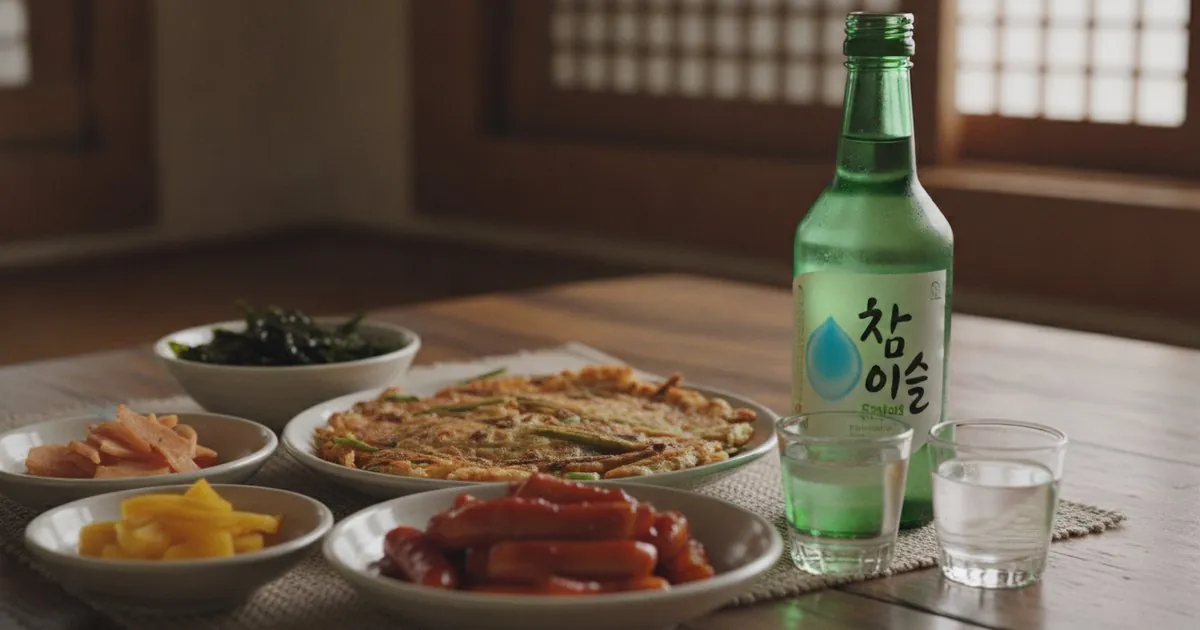
If you’ve ever sat down at a Korean BBQ restaurant and watched a green bottle materialize on the table before the meat even hit the grill, you’ve already had your first soju moment. That slim, emerald-tinted bottle is one of the most recognizable objects in Korean dining culture — and the clear, slightly sweet spirit inside is the world’s best-selling liquor by volume, year after year. Yet for many Western home cooks who love Korean food, soju remains a bit of a mystery. What exactly is it? Why does it taste so different from Japanese sake or Chinese baijiu? And what do you actually do with it beyond shooting it at a barbecue joint?
This guide covers everything: the surprisingly dramatic history, the science of how it’s made, the full landscape of styles and flavors available today, and how to drink it the way Koreans actually do — including all the unwritten rules of table etiquette that nobody puts on the menu.
What Is Soju? The Short Answer
Soju (소주) is a clear, distilled Korean spirit, traditionally made from grain and typically served neat and cold in small ceramic or glass cups. The name itself is instructive: so (燒) means “burned” or “distilled by heat,” and ju (酒) means “liquor.” Burned liquor. It’s a direct nod to the distillation process that defines it.
Modern mass-market soju sits between 16–25% ABV — gentler than vodka, stronger than wine — with a mild, slightly sweet flavor and almost no burn when chilled. Traditional craft varieties, however, can reach 40–53% ABV and carry the complexity of aged grain spirits. These are not the same drink in any meaningful way, which is exactly why it pays to understand the landscape before you buy.
A History Forged by Mongols, Famines, and Green Bottles
The 13th-Century Persian Connection
Soju is not actually an indigenous Korean invention. It arrived on the peninsula during the Goryeo Dynasty in the 13th century, carried by Mongol forces of the Yuan Dynasty who had themselves inherited the art of distillation from Persian and Arab traditions — the same lineage that produced arak. The Mongols used the Korean city of Andong as a military staging ground for their campaigns against Japan, and distilleries took root near Gaegyeong (present-day Kaesong), the Goryeo capital.
Andong’s connection to the Mongols is precisely why Andong Soju still exists today as one of Korea’s most prestigious regional spirits — it’s a living relic of a 13th-century military occupation. King Chungnyeol of Goryeo is even credited with personally learning the distillation craft from Yuan commanders stationed there.
Before this distillation knowledge arrived, Koreans fermented grain into lower-alcohol beverages using a saliva-based enzymatic process called mi-inju — grain was chewed and spat to trigger fermentation, a technique with parallels in Peru’s chicha and Japan’s ancient kuchikamizake. The Mongol introduction of true distillation was, in that sense, a genuine technological revolution for Korean drinking culture.
The 1965 Grain Law That Changed Everything
For centuries, soju was distilled from rice and other grains. By the 1920s, the Korean peninsula had over 3,200 soju breweries. Then, in 1965, everything changed.
South Korea’s Grain Management Law — combined with a severe rice famine in 1966 — banned the use of rice and other grains in alcohol production. The government needed the grain for food, not liquor. Distillers were forced to pivot almost overnight, switching to sweet potatoes, tapioca, and wheat, distilling these to a very high-proof ethanol (around 95%), then diluting with water and adding sweeteners and flavorings.
This is where the modern, mild, mass-market soju was born — not from tradition, but from crisis. Saccharin was the original sweetener, used until the late 1980s before being replaced by stevioside. And here’s a detail that surprises most people: virtually all South Korean mass-market diluted soju today draws its base spirit from a single supplier, the Korea Ethanol Supplies Company. That means Jinro, Chum Churum, Good Day — the brands you see lining convenience store shelves in Seoul — all start from the same ethanol pool. What differentiates them is their water source, their filtration process, and their proprietary blend of additives.
The ABV Slide and the Rise of Flavored Soju
Since the 1960s, Korean producers have steadily dialed down the alcohol content as tastes shifted:
| Era | Typical ABV |
|---|---|
| Pre-1965 traditional | ~35% |
| Post-1965 (diluted era begins) | ~30% |
| 1973 | ~25% |
| 1998 | ~23% |
| 2007–present | Under 20%, dominant |
The sub-20% era was driven by health-conscious consumers and a deliberate industry strategy to broaden appeal, particularly among women and younger drinkers. Then, in 2015, Lotte Chilsung launched “Sunhari” — a fruit-flavored soju — and sold over 1.2 million bottles in its opening week. The entire industry followed. Today, you’ll find peach, grapefruit, strawberry, watermelon, and green grape varieties in practically every Korean convenience store.
The iconic green 360ml bottle, by the way, was standardized in 1994 by Doosan Beverage, and by 2009 seven major producers had agreed on a shared bottle design specifically for reusability. South Korea achieved a 97.2% soju bottle recovery rate by 2018 — one of the highest in the world.
The Main Types of Soju You’ll Encounter
Mass-Market Diluted Soju (희석식 소주)
This is what most people mean when they say “soju.” Clear, neutral, lightly sweet, 16–25% ABV.
- Jinro Chamisul — The undisputed market leader, holding roughly 50% of the national market through HiteJinro. Quadruple-filtered through activated carbon for a clean, round finish. The gold-label Classic runs at 20.1% ABV; the Fresh variety comes in at 17.2%.
- Chum Churum (Lotte Chilsung) — Slightly softer mouthfeel, marketed on its “pH-neutral” alkaline water base. A tangible difference when sipped cold.
- Good Day (Muhak) — Dominant in the Busan/South Gyeongsang region; slightly sweeter profile.
- Regional bottles: Hallasan from Jeju Island, Shiwon from Busan, Yipseju from South Jeolla Province. Picking up a regional bottle is one of the quiet pleasures of traveling in Korea.
Traditional Distilled Soju (증류식 소주)
Made the old way — grain fermented into a mash (makgeolli or grain wine base), then pot-distilled, usually once or twice, resulting in a spirit that carries the flavor of the source grain.
- Andong Soju (35–45% ABV) — The reference standard. Made from rice, it has a dry, slightly oily body with a clean heat and faint floral notes. Recognized as a Korean intangible cultural property.
- Hwayo (25–53% ABV) — A premium brand that has made traditional distilled soju fashionable again; the 41% and 53% expressions are sought after for gifting.
- These are sipping spirits. Treat them like a fine whisky: small pour, room temperature or slightly chilled, no rushing.
Flavored Soju
These are diluted soju bases infused with fruit flavors — 12–14% ABV, noticeably sweet, and extremely approachable. Peach and grapefruit are the Western crowd favorites. They function essentially as light fruit liqueurs and work well mixed with soda water (1:1) over ice if you want to stretch them. Don’t judge them as “lesser” soju — they represent a genuinely different drinking occasion.
Korean Drinking Culture: The Unwritten Rules
Soju is fundamentally a social drink, and there’s a whole set of customs that Koreans follow instinctively. You don’t have to memorize all of them, but knowing the key ones transforms the experience.
Pour for others, not yourself. This is the most important rule. Keep an eye on others’ cups and refill them when they’re low. Pouring your own is considered a little sad — it implies no one is looking out for you.
Use two hands. When offering or receiving a pour, hold your glass or bottle with both hands, or support your pouring arm at the elbow with your other hand. It’s a sign of respect. Especially important when an older person is involved.
Drink when others drink. Soju is not a solo activity. When someone proposes a toast (“Geonbae!” — cheers), everyone drinks together.
The first shot is downed. The opening round is typically a quick shot for everyone at the table. After that, the pace is yours.
The bomb shot: Somaek. Mix soju and beer — drop a shot glass of soju into a glass of lager. This is called somaek (소맥), and it’s everywhere. The ratio matters to Koreans: a 3:7 soju-to-beer ratio is considered the sweet spot by many.
Pairing Soju With Food
Soju is designed to be eaten with food, not drunk in isolation. The mild sweetness and low-to-moderate alcohol make it a forgiving match for bold Korean flavors.
The classic pairings aren’t accidental. Rich, fatty, grilled meats — like what you’d find at a Korean BBQ night at home — are soju’s natural habitat. The spirit’s clean neutrality cuts through fat without competing with smoke and char. The same logic applies to samgyeopsal (pork belly) and galbi.
Spicy dishes are another natural match. The slight sweetness of modern soju tempers the heat of a dish like tteokbokki without extinguishing it. And soju alongside kimchi jjigae — the deeply fermented, fatty, spicy stew — is a combination that simply makes sense.
For flavored soju, pair with lighter foods: seafood pancakes, fresh tofu, cold noodles. The fruit notes would be overwhelmed next to heavy BBQ smoke.
Where to Buy Soju in the West
Soju’s international footprint has expanded dramatically in the last decade.
- H Mart and Korean grocery stores: Your best bet for the widest selection, including regional brands, flavored varieties, and some traditional distilled options. You’ll typically find Jinro Chamisul, Chum Churum, and a rack of flavored bottles.
- Total Wine, BevMo, large liquor chains: Jinro Chamisul is now reliably stocked in most major US metropolitan areas. Peach-flavored soju has also crossed over into mainstream liquor stores.
- Whole Foods and specialty retailers: Less common, but Jinro and occasionally Hwayo appear in markets with a strong Asian-American customer base.
- Online: Drizly, ReserveBar, and Minibar carry Jinro and a few premium labels for delivery in most US states.
If you want to start somewhere specific: buy a bottle of Jinro Chamisul Classic (the green label, $10–12/bottle) for traditional diluted soju, and a peach or grapefruit flavored variety to understand the lighter end of the spectrum. If you want to try traditional distilled soju, look for Hwayo 41 ($30–40) — it’s the most accessible premium expression in Western markets.
Common Mistakes to Avoid
Serving It Too Warm
Mass-market soju is engineered to be drunk cold — ideally straight from the refrigerator at around 4–6°C (39–43°F). At room temperature, the artificial sweeteners and added flavoring compounds become noticeably more prominent, and any harshness in the ethanol is amplified. If your soju tastes sharp or chemically sweet, check the temperature first. Traditional distilled soju is different — 41%+ expressions benefit from being slightly cooler than room temperature (around 15°C / 59°F), not refrigerator-cold, so their grain aromatics can open up.
Mistaking Flavored Soju for Traditional Soju
Fruit-flavored soju (peach, grapefruit, etc.) is a different product — essentially a sweet fruit liqueur at 12–14% ABV. Serving it as the “representative” Korean spirit at a dinner is like serving Baileys as a stand-in for Irish whiskey. It’s not wrong per se, but it misrepresents the category. For food pairing or introducing guests to authentic Korean drinking culture, start with a standard unflavored Chamisul or Chum Churum.
Skipping the Two-Handed Pour
At a Korean table, pouring someone’s drink with one hand — especially for an older guest — reads as dismissive or careless, even if unintentionally. It takes no extra effort to use both hands or support your forearm, and it signals that you’re paying attention to the people around you. This is the single fastest way to make a Korean dining companion feel respected.
Shooting Premium Soju as a Cheap Shot
If you’ve invested in a bottle of Andong Soju or Hwayo 41, do not treat it like a round of shots at a bar. Traditional distilled soju at 35–45% has genuine flavor — grain character, texture, subtle heat — that disappears instantly if you slam it cold. Sip it slowly. Use a small ceramic cup (jagi) if you have one, which slightly warms the spirit in your palm. The nose alone on a quality distilled soju, when you bring the cup close, has a faint floury sweetness followed by a dry, almost herbal finish. That’s worth paying attention to.
Mixing Soju With Strongly Flavored Mixers
Soju’s mild profile gets completely buried under cola, tonic water, or citrus juice. It turns into a vaguely alcoholic sweet drink with no identity. The traditional Korean approach — straight, or as somaek (soju + Korean lager) — works because lager has a similarly neutral base that amplifies without overpowering. If you want a mixed drink, soda water with a wedge of yuzu or a thin slice of cucumber is far more successful at letting the soju speak.
Confusing Soju With Sake or Baijiu
These are three entirely different drinks. Sake is a brewed Japanese rice wine (15–20% ABV, unfiltered grain flavor, best served slightly warm or chilled). Baijiu is a Chinese spirit fermented with a complex grain-and-mold starter (qu), typically 40–60% ABV with intensely funky, almost nail-polish-adjacent aromas. Soju — diluted style — is a neutral distilled spirit, closer to a mild vodka than either of these. The confusion leads to wrong pairings, wrong serving temperatures, and deeply confused dinner guests.
Frequently Asked Questions
Is soju gluten-free? Most mass-market diluted soju is made from sweet potato or tapioca-based ethanol and is generally considered gluten-free, though formulations vary by brand. Traditional grain-distilled soju made from wheat or barley would not be gluten-free. If you have celiac disease, check directly with the manufacturer for the specific batch.
Can you cook with soju? Yes, and it’s underused as a cooking ingredient in Western kitchens. Soju works well as a marinade component for pork or chicken — its mild sweetness and alcohol help tenderize and carry aromatics. It can also deglaze a pan in place of rice wine (mirin or sake), though it’s slightly drier. Use about 2 tablespoons (30ml) as a direct substitute for rice wine in marinades for Korean BBQ at home.
What is the difference between Jinro Chamisul Classic and Jinro Chamisul Fresh? The Classic runs at 20.1% ABV and has a slightly rounder, fuller mouthfeel. The Fresh is lighter at 17.2% ABV with a crisper, cleaner finish. Both are quadruple-filtered. Fresh is generally recommended for newcomers; Classic is preferred by those who want something closer to the traditional diluted soju profile.
Does soju go bad? Unopened soju has a very long shelf life — years — stored in a cool, dark place. Once opened, it’s best consumed within a few months; the alcohol will begin to slowly oxidize and the subtle flavor compounds will fade. Flavored soju loses its brightness faster than unflavored; drink flavored varieties within weeks of opening.
How does soju compare to vodka? Mass-market soju is often described as a milder, slightly sweeter vodka — but that undersells both. Vodka is typically 40% ABV and filtered for maximum neutrality. Diluted soju at 16–20% has a genuinely softer texture and a faint sweetness that vodka lacks. Traditional distilled soju at 35–45% is closer to vodka in strength but retains grain character that vodka is specifically engineered to strip out. They’re adjacent categories, not the same thing.