
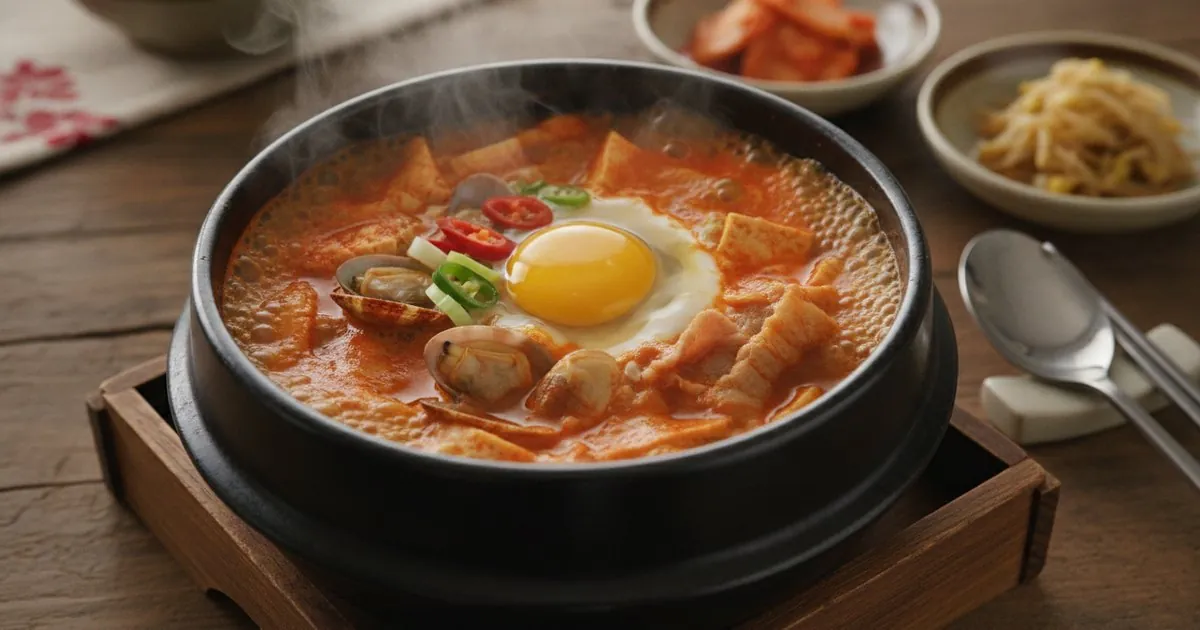
There is a specific kind of cold that only a bowl of sundubu jjigae (순두부찌개) can cure. Not the damp gray cold of autumn, not the brisk cold of a winter morning — the bone-deep cold of a day that has gone wrong in every direction at once. Sundubu jjigae, Korea’s fiery soft tofu stew, is medicine for that cold. It arrives at the table still violently bubbling in its earthenware pot, crayon-red and fragrant with gochugaru, with a raw egg cracked in at the last second that begins to cook gently in the residual heat. You break the yolk into the broth, spoon up the silky tofu, and everything, for a moment, is right with the world.
This is one of Korea’s most beloved everyday stews — served in dedicated sundubu restaurants from Busan to Seoul, and in the homes of Korean families who have their own version, slightly different from every other family’s version. It’s also become one of the most accessible Korean dishes for Western home cooks: the ingredient list is short, the technique is simple, and it comes together in about 30 minutes. If you’ve been looking for an entry point into Korean cooking beyond kimchi fried rice, this might be your best starting place.
What Is Sundubu Jjigae?
Sundubu (순두부) literally means “pure/soft tofu” — a specific variety of Korean tofu that has been coagulated but not pressed, leaving it extraordinarily delicate, silky, and custard-soft. It’s sold in tube-shaped packaging (you squeeze it directly into the pot) and is much softer than any Western-style silken tofu you may have encountered.
Jjigae (찌개) is the Korean word for a class of thick, intensely flavored stews. They’re cooked and served in individual earthenware pots called ttukbaegi (뚝배기) that retain heat intensely, keeping the stew bubbling long after it leaves the stove. The ttukbaegi is what gives the dish its theatrical quality — the stew arrives at the table still boiling, the egg cooking in the heat of the pot, everything alive and sizzling.
Sundubu jjigae’s flavor base is gochugaru (Korean red pepper flakes) and gochujang bloomed in pork fat or sesame oil, dissolved into a rich anchovy-kelp broth. The result is a deeply savory, bright-red broth that’s spicy without being one-dimensional — there’s sweetness from the seafood, richness from the tofu and egg, and a funky depth from the anchovy broth that you can’t quite put your finger on but can’t imagine living without.
The Two-Pepper System: Gochugaru and Gochujang
If you’ve read our gochujang guide, you know that gochujang and gochugaru are related but distinct ingredients. In sundubu jjigae, they work in tandem:
Gochugaru (고춧가루, Korean red pepper flakes) is the primary heat source and color agent. When bloomed in hot fat, it turns the oil a vivid red-orange and provides a clean, bright, slightly fruity heat. Use a coarse grind for sundubu jjigae — the texture of the flakes is part of the broth’s character.
Gochujang (고추장, fermented red pepper paste) adds body, umami depth, and a fermented complexity that gochugaru alone can’t provide. It’s used in smaller quantities here — mostly as a flavor amplifier rather than a primary seasoning.
The blooming step — cooking both peppers in hot fat before adding liquid — is non-negotiable. Raw gochugaru added directly to liquid gives you a muddy, flat spice. Bloomed gochugaru gives you that distinctive Korean stew flavor: roasted, complex, gloriously red.
The Broth: Why Anchovy Matters
The broth in sundubu jjigae is traditionally made from dried anchovies and kelp (dashima), simmered briefly to extract a clean, oceanic umami. This broth — called myeolchi-dasima yuksu — is one of the foundational stocks of Korean cooking, used in tteokbokki, various jjigae, and countless other dishes.
If you’ve never made it, don’t be intimidated. It’s simpler than any Western stock: 5-6 dried anchovies, one small piece of dried kelp, 3 cups of water, 10 minutes of simmering. Strain and it’s done. The resulting broth is not fishy in the way you might fear — it’s savory and subtly oceanic, providing the umami backbone that makes the entire stew taste more complex.
For convenience, Korean grocery stores sell pre-packed anchovy broth packets — small tea-bag style sachets you drop into water. These are excellent and save significant time. Available at H Mart and online.
Can you substitute chicken broth? Yes, though the flavor will be different — more familiar but less Korean. For an entirely plant-based version, mushroom-kelp broth is the closest approximation.
Sundubu: What to Buy and Why It Matters
Standard Western silken tofu — the kind in a carton at any grocery store — can be used in a pinch, but it won’t give you the true sundubu jjigae experience. Genuine sundubu is softer, more custard-like, and comes in a distinctive tube-shaped package (often with red and white packaging). When you squeeze it into the pot, it breaks into beautiful, irregular chunks that are tender enough to melt on the tongue.
Look for sundubu at Korean grocery stores (H Mart, Zion Market, Hanahreum) in the refrigerated tofu section. Common brands include Pulmuone and Bibigo. Online it’s available through Asian grocery delivery services like Weee! or Hmart.com.
If sundubu genuinely isn’t available, drain a carton of silken tofu thoroughly and spoon it in gently. The texture will be softer and it will break up more, but the flavor will still be there.
For more essential Korean pantry items including the gochugaru and doenjang that make this dish possible, our Korean pantry essentials guide covers everything you need to build your Korean pantry from scratch.
The Protein: Pork, Seafood, or Both
Classic sundubu jjigae typically contains either pork, seafood, or a combination of both. Pork belly or pork shoulder (thinly sliced) provides richness and fat that blooms the spices beautifully. Seafood — shrimp, clams, mussels, squid, oysters — provides sweetness and ocean depth.
The haemul (seafood) version is particularly popular in coastal Korean restaurants and is many people’s preference: the clam juices and shrimp flavor enhance the broth in ways pork alone can’t.
For a lighter, more delicate stew, use only seafood. For a richer, meatier version, use only pork. For the most complex and satisfying bowl, use both.
Clam note: Fresh littleneck clams or Manila clams are ideal. Give them a 20-minute soak in salted water to purge any sand. Discard any that don’t open after cooking. Frozen clam meat works as a practical substitute.
The Egg: Raw, Barely Cooked
The egg in sundubu jjigae is not beaten and stirred in (that’s a different technique, used in some soups). It’s cracked whole into the bubbling stew at the very end, left undisturbed, and served almost immediately. The white cooks through from the heat of the broth; the yolk remains runny and golden.
When you eat, you break the yolk with your spoon, and it mingles with the red broth, creating something silky, rich, and perfect. If you prefer a fully cooked yolk, cover the pot for an additional 2-3 minutes. But I’d encourage you to try it runny first — it’s one of the best things about the dish.
The Earthenware Pot: Ttukbaegi
If you plan to make sundubu jjigae regularly (and you will), a ttukbaegi is worth owning. These small, individual-serving Korean earthenware pots are inexpensive ($8-15 at Korean grocery stores), retain heat extraordinarily well, and create the theatrical bubbling presentation that is half the pleasure of the dish.
New ttukbaegi must be seasoned before first use: fill with water, bring to a boil on the stovetop, let cool, discard the water. Some sources recommend doing this 3-4 times.
A heavy-bottomed saucepan works fine as a substitute and produces equally good stew — you just lose the aesthetic element.
Variations
Pure pork sundubu (daeji sundubu): Omit seafood entirely, double the pork. Rich, hearty, deeply satisfying. The most common restaurant version.
Pure seafood sundubu (haemul sundubu): Omit pork, use a mix of clams, mussels, shrimp, and squid. Lighter, brighter, ocean-forward. Excellent if you want to avoid pork.
Mushroom sundubu (beoseot sundubu): Vegetarian/vegan option using a variety of mushrooms (shiitake, enoki, oyster, king oyster) instead of meat and seafood. Use mushroom-kelp broth. Replace the pork fat bloom step by using sesame oil or a neutral oil.
Kimchi sundubu (kimchi sundubu jjigae): Add a half cup of aged kimchi to the pot along with the pork. The kimchi fermented sourness adds another flavor dimension entirely, and the soup turns an even deeper red.
Mild sundubu for spice-sensitive eaters: Use only 1 teaspoon of gochugaru (or sweet paprika instead), omit the gochujang, and add a small spoonful of doenjang (Korean fermented soybean paste) for umami without heat. The broth will be pale orange rather than red, but still delicious.
Where to Buy the Specialty Ingredients
Sundubu (soft tofu in tube): H Mart, Zion Market, Korean grocery stores. Online at Hmart.com or Weee!. Brands: Pulmuone, Bibigo, Hansang.
Gochugaru (Korean red pepper flakes): Now available at many mainstream grocery stores, Whole Foods, Target. Korean grocery stores have a wider range. Look for bright red, not brownish — brighter red means fresher. Store in the freezer for longest shelf life.
Dried anchovies (myeolchi) and dashima (dried kelp): Korean grocery stores, H Mart, or online. Both are inexpensive and have a very long shelf life. Alternatively, use the convenient pre-packed anchovy broth sachets (labeled “anchovy stock bag” or “dasima myeolchi bag”).
Ttukbaegi (earthenware pot): Korean grocery stores, Amazon, Korean kitchen supply shops. Absolutely worth the small investment.
Storage
Sundubu jjigae is best eaten immediately, straight from the pot. The tofu continues to cook in the hot broth even off the stove, and a second reheating can make it chalky.
If you have leftovers, let cool and refrigerate in an airtight container for up to 2 days. Reheat gently over medium heat — do not boil aggressively or the tofu will toughen and break apart too much. The stew’s flavors actually deepen overnight.
Do not freeze. Tofu’s texture deteriorates badly through freezing and thawing.
Common Mistakes to Avoid
Rushing the gochugaru bloom. The article is emphatic about this for good reason: if you add gochugaru to liquid before it’s had 60–90 seconds in hot fat, the starch in the pepper flakes never fully toasts and you lose the roasted, vibrant depth that defines the broth. The tell is color — properly bloomed gochugaru turns the oil a saturated brick-red almost immediately. If your oil looks pale orange or the pepper smells raw rather than toasty, give it another 30 seconds before adding anything liquid.
Stirring the tofu after adding it. Sundubu is fragile by design, and once it’s in the pot, aggressive stirring shreds it into a grainy mush rather than those soft, irregular chunks that make the stew luxurious. Add the tofu by squeezing the tube directly into the pot in sections, then use a wide spoon to gently push it under the broth once — and leave it alone. Let the simmering liquid do the work.
Cracking the egg too early (or too late). The egg is supposed to be barely set — the white just opaque, the yolk still runny and rich when you break it. If you crack it in while the stew is still on high heat, it will overcook in under a minute. If you forget it until you’re halfway through the bowl, you’ve lost the whole effect. Crack the egg in the moment the pot comes off the heat or right as it hits the table, then give it 60–90 seconds in the residual heat of the ttukbaegi before eating.
Under-seasoning the broth. Anchovy-kelp broth is clean and subtle — which means it needs assertive seasoning to become a proper jjigae base. Most recipes rely on a combination of soup soy sauce (guk ganjang, which seasons without darkening the broth), fish sauce, and salt. Taste the broth before adding the tofu; it should taste slightly saltier than you want in the finished bowl, because the tofu and egg will mellow it out. If it tastes flat, add a small splash of fish sauce first — it closes the gap quickly.
Adding seafood at the start. Shrimp turns rubbery in about four minutes of hard simmer; clams and mussels tighten just as fast. Add shellfish only after the broth is fully seasoned and the tofu is in, then simmer just until the shells open or the shrimp turn pink — roughly two to three minutes. Anything longer and the seafood’s texture works against the silky tofu rather than complementing it.
Substituting firm tofu without draining silken tofu. If you’re using carton silken tofu instead of genuine sundubu, it holds significantly more water. Spoon it out gently and let excess liquid drain briefly before adding it, or your broth will be diluted and the heat recovery time in the pot will be longer — you’ll end up with lukewarm stew before the egg has a chance to set.
Frequently Asked Questions
What’s the difference between sundubu jjigae and doenjang jjigae? Both are fundamental Korean jjigae (stews), but they’re built on entirely different flavor foundations. Doenjang jjigae uses fermented soybean paste (doenjang) as its primary seasoning and typically contains zucchini, potatoes, and mushrooms — it’s deeply savory, earthy, and less spicy. Sundubu jjigae uses gochugaru/gochujang as the primary seasoning and has tofu as the main ingredient. They’re both essential Korean stews, but they taste completely different.
Is sundubu jjigae very spicy? Traditional sundubu jjigae is moderately to very spicy by Western standards. Most Korean restaurants offer heat level options (mild/medium/spicy). At home, you have full control: use 1 teaspoon of gochugaru for mild, 1 tablespoon for medium, 2 tablespoons for traditional spicy, and 3 tablespoons if you genuinely love heat. The egg yolk and tofu provide natural cooling against the spice.
Can I make sundubu jjigae ahead for a dinner party? Make the broth and pork base (steps 1-4) up to 2 days ahead and refrigerate. When ready to serve, bring back to a boil, add seafood, then tofu, then eggs — everything from that point takes about 5 minutes. This is actually ideal party cooking.
Why does my broth look pale/watery instead of vivid red? The most likely cause is skipping or rushing the gochugaru blooming step. The spices must sizzle in hot fat for a full minute before you add liquid. If you add water too quickly, the pigments don’t fully extract into the fat and your broth will be pale. Also, use fresh gochugaru — older flakes that have lost their color will give pale results regardless.
Can I add vegetables to sundubu jjigae? Absolutely, and this is common practice. Zucchini (cut into half-moons), enoki mushrooms, and sliced shiitake are the most typical additions. Kimchi, as mentioned in variations, is also excellent. Add vegetables along with the seafood so they cook through in the simmering broth.
What’s the right way to eat sundubu jjigae? Always with a bowl of steamed white rice on the side. Korean stews are not eaten as a soup you sip; they’re consumed alongside rice, alternating between bites of stew and rice. Use a soup spoon (Korean metal spoons are ideal, but any large spoon works) rather than chopsticks — though chopsticks are good for picking up the tofu. Be careful of the hot earthenware pot. The ttukbaegi retains heat for a very long time.