
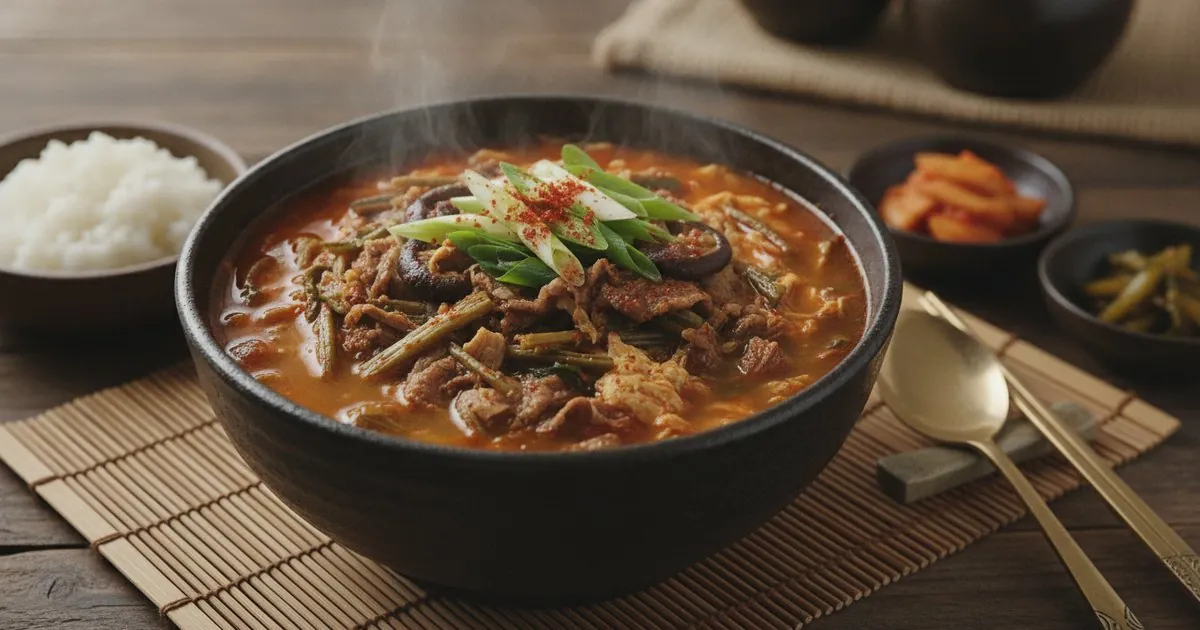
Few soups announce themselves the way yukgaejang does. The moment the lid comes off the pot, a wave of deep rust-red broth rises toward you — spicy, savory, carrying the fragrance of slow-cooked beef and toasted sesame. It’s the kind of soup that commands attention, the kind Koreans have been reaching for on scorching summer days and bone-cold winter nights alike for centuries. If there is a Korean dish that demonstrates just how much flavor patience and a handful of well-chosen ingredients can build, it’s this one.
Yukgaejang takes some planning — the gosari (dried bracken fern) needs an overnight soak, the beef broth needs a proper two-hour simmer — but none of it is technically difficult. The steps are straightforward and forgiving, and the result is a soup that tastes deeper and more complex than the sum of its parts. Here’s everything you need to know to make it right at home.
A Soup With Centuries of History
The name “yukgaejang” (육개장) is a linguistic artifact worth unpacking. “Gaejang” (개장) referred to a traditional broth-based spiced soup; “yuk” (육, 肉) simply means meat — in this case, beef. The name marks yukgaejang as a beef adaptation of that older tradition. Its lineage is documented: the dish appears in the Gyugon Yoram (규곤요람), a Hangul-language cookbook from the early 1800s during the Joseon dynasty, which means it was already well-established in Korean culinary culture by the time that text was written. Some culinary historians draw connections between yukgaejang and the gomguk (곰국) tradition — the slow-cooked, deeply nourishing bone and meat broths associated with Korean court-adjacent cuisine — though it’s perhaps better understood as a dish that crossed social strata and fed ordinary Koreans as readily as anyone else.
The cultural moment where yukgaejang is most at home is Sambok (삼복): the three hottest days of the Korean lunar calendar — Chobok (초복), Jungbok (중복), and Malbok (말복), falling across the peak of summer. On these days, it’s traditional to eat hot, spicy food as an expression of 이열치열 (以熱治熱), “fight heat with heat.” The logic is both philosophical and practical: a bowl of fiery soup makes you sweat, and the evaporation cools your body. Whether or not you’re observing a centuries-old Korean calendar tradition, there is something genuinely satisfying about sweating your way through a proper bowl of yukgaejang in August.
The same soup is just as beloved in the depths of winter — its richness and sustained heat make it one of Korea’s definitive cold-weather comfort foods. Daegu, a major city in the southeast, is particularly associated with a robust regional style of yukgaejang that gained national recognition as the Gyeongbu rail line connected the city to Seoul and the dish’s reputation spread.
Key Ingredients: What You Need and Where to Find It
Beef Brisket — The Right Cut Matters
Brisket (양지머리, yangji meori) is the near-universal choice for yukgaejang, and the reason is practical: it’s a well-worked muscle with enough collagen to add subtle body to the broth, and it shreds beautifully into long, silky strands after a proper slow simmer. Lean cuts like eye of round shred too dryly and produce thinner, less satisfying broth. Beef shank (사태, sate) is the other traditional option, producing an even richer, more gelatinous broth — worth trying if you can find it.
Western kitchen tip: Flat-cut or point-cut brisket is widely available at most American supermarkets. Trader Joe’s and Whole Foods carry it regularly; H Mart will have it labeled in Korean. Look for visible marbling — that intramuscular fat renders into the broth and adds depth. For a full guide to navigating the meat and produce sections, our H Mart shopping guide covers everything you need.
Gosari: The Ingredient That Makes It Traditional
Dried bracken fernbrake — gosari (고사리) — is the ingredient that elevates yukgaejang from “spicy beef soup” to something genuinely its own. Once rehydrated and cooked, it develops a pleasantly chewy, earthy texture and absorbs the spicy broth into every fiber. The flavor is subtle but distinctive: faintly woodland, slightly mineral, impossible to replace with anything else.
Find dried gosari at H Mart or any Korean grocery store, in the dried goods section — it comes in cellophane packages and keeps indefinitely. Some larger Asian supermarkets carry it as well. If you truly cannot source it, additional mung bean sprouts are the most sensible substitute, but the soup will taste generic compared to the real thing. Gosari is worth the effort to find.
Prep note: Dried gosari requires an overnight soak plus 30–40 minutes of simmering before it’s ready. Factor this into your planning — it’s a “night before” task, not a “same day” one.
Gochugaru: Don’t Substitute This
The deep red color and layered heat of yukgaejang come from gochugaru (고추가루) — Korean red pepper flakes. This is emphatically not interchangeable with cayenne, paprika, or generic chili flakes. Gochugaru has a specific character: fruity, moderately hot, with a slight smokiness and a sweetness that softens through the long simmer. The coarse-ground variety is what you want here — it gives the soup its characteristic texture and that gorgeous, matte-red pigmentation.
Three tablespoons for four servings lands in the “noticeable and warming but not weaponized” range. Scale back to 2 tablespoons for a milder bowl; go up to 4 for something properly fiery. For everything you need to know about sourcing and using this essential ingredient, our complete gochugaru guide is a good starting point.
Guk Ganjang: The Seasoning You Need
Yukgaejang is seasoned with guk ganjang (국간장), soup soy sauce, rather than regular or dark soy sauce. Guk ganjang is lighter in color but saltier and more pungent than the soy sauce you’d use for stir-fries — it seasons the broth without muddying its color. Find it at H Mart labeled “soup soy sauce” or “guk ganjang.” If you substitute regular soy sauce, reduce the quantity by about 20% and taste carefully, as the salt levels differ.
The Vegetables
Two vegetable components complete the classic version:
- Mung bean sprouts (숙주나물, sukju namul): Their light crunch and freshness contrast the tender, deeply seasoned beef. Soybean sprouts (kongnamul) are used in some versions and work equally well — they’re just slightly more robust in flavor.
- Scallions / Korean leek (대파, daepa): Cut into generous pieces, these sweeten and soften into the broth over the simmer. Standard supermarket scallions are perfectly fine; the thicker daepa is traditional but optional.
Serving Yukgaejang
Ladle into deep, wide bowls — this soup needs room. In Korea, it’s served with steamed short-grain white rice either alongside or added directly to the bowl (gukbap style, where you eat the rice and soup together from one vessel). A spread of simple banchan — kimchi, seasoned spinach, a softly steamed egg — completes the table without competing with the soup’s intensity.
Storage and leftovers: Yukgaejang is one of those dishes that genuinely improves overnight. The flavors knit together and deepen. Refrigerate in an airtight container for up to 4 days, or freeze for up to 3 months. Reheat gently on the stovetop; if it thickens too much in the fridge, add a splash of water or broth when warming.
Common Mistakes to Avoid
1. Skipping or rushing the foam-skimming step. The gray-brown foam that rises in the first 10 minutes of simmering is coagulated proteins and impurities from the meat. If you don’t remove it diligently — or if you let the water boil hard before skimming — it re-incorporates into the broth and produces a muddy, faintly gamey flavor that no amount of seasoning will fully fix. Set a ladle and small bowl beside the pot before you start, and skim continuously until the foam stops appearing. The broth should look visually clean and clear before you reduce the heat.
2. Under-soaking or under-cooking the gosari. If gosari goes into the soup still wiry and resistant, it will stay that way — no amount of final simmering will rescue it. After soaking, the gosari should feel pliable and fully soft throughout; after its initial cooking, press a strand between your fingers and it should give without any hard center. If it still feels tough at 40 minutes of simmering, keep cooking — an extra 10–15 minutes is fine. Stringy, under-hydrated gosari is one of the most common texture complaints about this dish, and it’s entirely preventable with time.
3. Using the wrong type of chili or too little of it. Generic chili flakes or cayenne won’t replicate gochugaru’s fruity, slightly smoky warmth — they produce a harsher, sharper heat that dominates rather than supports the beef. Beyond the type, don’t be timid with the quantity. Three tablespoons sounds like a lot until you consider that it’s dispersed through nearly 2 liters of broth and simmered for 25 minutes. The long cook time mellows the raw chili punch considerably. A finished soup made with the right gochugaru at the right quantity should be vibrant, warming, and complex — not aggressive.
4. Shredding the beef immediately out of the broth. Hot beef shreds unevenly and loses too much moisture as you work. Rest the brisket for at least 10–15 minutes before pulling it apart. Also, resist the urge to use two forks or a stand mixer — machine-shredded beef turns the meat into a fine paste that disappears into the soup. Hand-shredding along the grain produces the long, satisfying strands that are visually and texturally essential to the dish.
5. Not simmering the finished soup long enough. Combining the seasoned beef with the broth and serving within five minutes is a common shortcut that produces a soup that smells and tastes raw and sharp — you can genuinely detect the uncooked edge of the gochugaru. A fully simmered yukgaejang smells deeply rounded, slightly smoky, and savory in a way that’s difficult to describe until you’ve experienced the contrast. Give the final stage its full 20–25 minutes. If it still smells bright and acidic, keep going.
6. Over-seasoning with the wrong soy sauce. Using dark soy sauce at a 1:1 substitution for guk ganjang will over-salt the broth and turn it a murky brown-red rather than the characteristic deep brick-red of a proper yukgaejang. If guk ganjang isn’t available and you’re using regular soy sauce, start at 60–70% of the stated quantity and taste as you go. The broth should taste boldly savory but never one-dimensionally salty.
Frequently Asked Questions
Can I make yukgaejang without gosari? You can, but the soup will taste noticeably different — more like a generic spicy beef broth than the genuine article. Gosari contributes a specific earthy chewiness that nothing else replicates. If you absolutely cannot source it, increase the mung bean sprouts and add a small amount of thinly sliced zucchini for texture. But dried gosari keeps indefinitely, so it’s worth having on hand once you find it.
How spicy is it? With 3 tablespoons of gochugaru for 4 servings, yukgaejang sits in the “assertively warming” range — the kind of heat that builds steadily and makes you sweat pleasantly. It should not be incapacitating. If you have a lower heat tolerance, start with 1.5 tablespoons; you can always add more gochugaru stirred into your individual bowl at the table. If you want it properly fiery, go to 4 tablespoons.
Can I make yukgaejang in an Instant Pot? Yes, and it works well. Pressure-cook the brisket with the aromatics and water for 45 minutes on high pressure, then natural release for 15 minutes. Strain the broth, shred the beef, prepare the seasoning paste, and combine everything back in the pot. Use the sauté function to simmer the finished soup for 15 minutes. The broth is slightly less nuanced than a long stovetop simmer but still excellent.
Is there a chicken version? Yes — it’s called dakgaejang (닭개장) and it’s popular enough to be considered its own dish. It follows essentially the same method: simmer a whole chicken or bone-in thighs, shred the meat, and season with the same paste. The broth is lighter and the flavor somewhat different, but the technique is identical and the result is equally satisfying.
How long does yukgaejang keep? Refrigerated in an airtight container, it keeps well for up to 4 days — and it genuinely tastes better on day two than it does fresh. For longer storage, freeze in individual portions for up to 3 months. Thaw overnight in the refrigerator and reheat gently on the stovetop.
Yukgaejang rewards patience in a way that few dishes do. The overnight soak, the careful skimming, the long broth, the final simmer — each step compounds on the last, building toward a bowl that’s far greater than any of its individual parts. Once you’ve made a proper pot, you’ll understand why this soup has stayed in Korea’s culinary repertoire across centuries of hot summers and cold winters. Make a big batch. It only gets better tomorrow.