
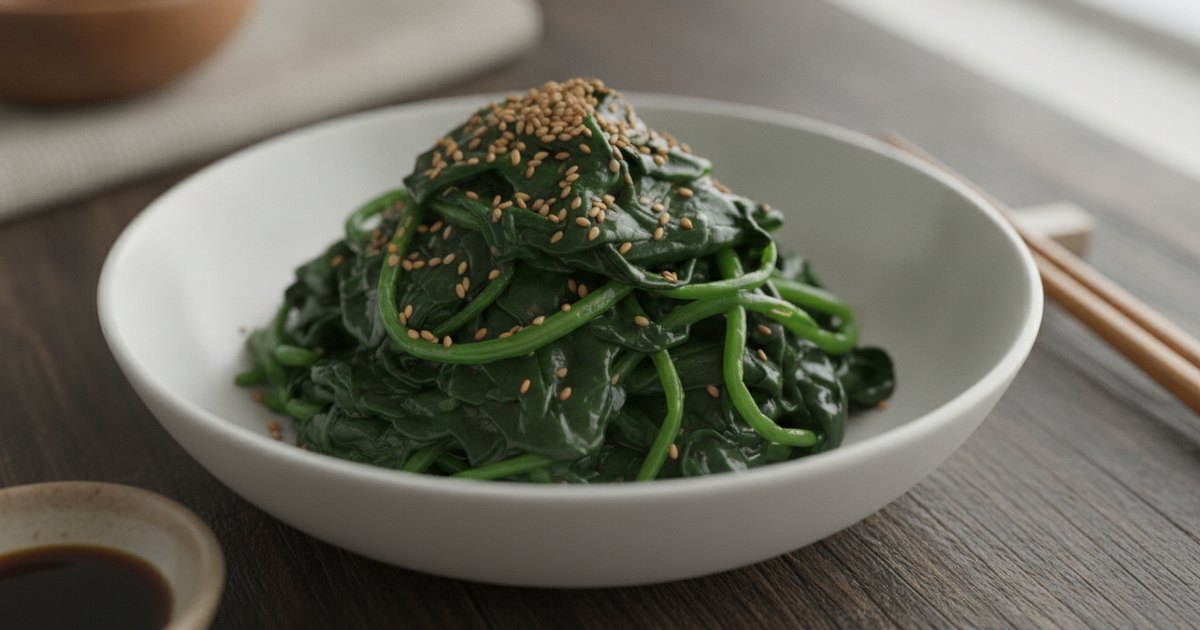
There's something quietly powerful about a small dish of sigeumchi namul sitting at the corner of a Korean table. Bright jade-green, glistening with sesame oil, carrying that faint whisper of garlic — it doesn't demand attention the way a bubbling jjigae or a sizzling galbi does. But if you've eaten at a Korean home or restaurant and found yourself reaching for the same little bowl again and again before the main dishes even arrived, there's a good chance this was the one.
Sigeumchi namul (시금치나물) — Korean sesame-seasoned spinach — is the kind of dish that defines the banchan philosophy: simple, fast, vegetable-forward, and made with restraint. Ten minutes. One bunch of spinach. A small handful of pantry seasonings. The technique is almost meditative in its straightforwardness, and yet the result punches well above its weight in flavor and elegance.
If you're just getting into building a Korean table at home, this is the banchan to start with. It's approachable, it's weeknight-fast, and once you understand the core method — blanch briefly, shock in ice water, squeeze bone-dry, season by hand — you'll have unlocked the foundational technique behind dozens of Korean vegetable side dishes. For a fuller picture of how sigeumchi namul fits into the broader world of Korean sides, our banchan guide is the place to start.
What Is Sigeumchi Namul?
Namul (나물) is a category, not a single recipe. It refers to any seasoned, cooked or raw vegetable preparation in Korean cuisine — one of the oldest and most fundamental pillars of the Korean culinary tradition, with roots in Joseon-era cooking practices documented in historical Korean cookbooks.
Sigeumchi (시금치) simply means spinach. Put them together and you have the most ubiquitous namul in Korean home cooking — the one that appears on almost every Korean table, every day, across the peninsula and in Korean households around the world.
What distinguishes sigeumchi namul from a Western spinach salad isn't just the dressing. It's the entire philosophy. The spinach is blanched (never raw, not heavily wilted by steam), shocked in ice water to lock in both color and nutrients, then hand-squeezed until nearly dry before any seasoning touches it. The result is silky rather than soggy, vibrant rather than dull, and the seasoning clings to every strand instead of pooling at the bottom of the bowl.
You'll also encounter sigeumchi namul as one of the essential components inside bibimbap — the iconic mixed rice bowl where colorful namul of various kinds are arranged in separate sections before being combined at the table. Learning to make sigeumchi namul well means you're already most of the way to an authentic, from-scratch bibimbap.
The Ingredients, Explained
Guk Ganjang (국간장) — Korean Soup Soy Sauce
This is where Western cooks most often get tripped up. Traditional sigeumchi namul is seasoned with guk ganjang, also called joseon ganjang or Korean soup soy sauce. It looks nothing like the Kikkoman on your shelf — it's darker in the bottle, noticeably thinner, and significantly saltier per teaspoon. More importantly for this dish: it's lighter in color in the finished food, which means it seasons the spinach without turning it a murky brown.
Where to find it: H Mart, 99 Ranch, any Korean or Asian grocery store, and Amazon. Sempio and Chung Jung One both make widely available versions. Look for "국간장" on the label, or the English words "soup soy sauce."
If you don't have it, here are your two best substitutes:
- Regular soy sauce (Kikkoman, San-J tamari, La Choy): Use about 1 Tbsp for every 2 tsp of guk ganjang called for. Add gradually and taste — it's darker and will shift the color of the spinach slightly more than guk ganjang does.
- Fine sea salt alone: This is not a compromise — it's a fully traditional and arguably older preparation. The all-salt version produces the cleanest spinach flavor and the most vivid green color. Many Korean home cooks prefer it precisely for these reasons.
The Other Seasonings
Garlic: Fresh-minced only, please. Jarred minced garlic (even good-quality jarred garlic) produces a noticeably sharper, more aggressive bite than fresh garlic. In namul, garlic should be a supporting note, not the lead — and fresh garlic mellows gently into the dish in a way that jarred doesn't.
Toasted sesame oil: This is non-negotiable, and the word toasted matters. Toasted sesame oil — the kind used in Korean and Japanese cooking as a finishing oil — is dark amber, deeply fragrant, and smells almost smoky straight from the bottle. Light (untoasted) sesame oil is pale yellow and mild; it's a cooking fat, not a finishing oil. These are not interchangeable. Find toasted sesame oil at H Mart, Whole Foods (Spectrum or Kadoya brands), or any Asian grocery. Start with 1 tsp and add more after tasting — 1–2 tsp is the right range for 250 g of spinach.
Toasted sesame seeds: Buy pre-toasted from a Korean grocery (Ottogi or Beksul are reliable brands), or toast raw seeds yourself: dry pan, medium heat, constant shaking, 2–3 minutes until they're golden and fragrant. Pull them the moment they start popping and jumping in the pan. They burn fast.
Green onion (scallion): One thinly sliced scallion adds fresh sharpness that balances the sesame oil's richness. Don't skip it.
Sugar and black pepper: Both optional, and both contested. Sugar (¼–½ tsp) rounds out the flavors slightly; it appears in some recipes and is omitted in others. Black pepper is a more modern addition that certain cooks favor. If you want the most classic, home-style result, leave both out.
The Recipe: Step by Step
The Visual Target
Before you start cooking, hold this image in mind: a compact, tightly-bound mound of emerald-green spinach strands, evenly coated in a light, glossy, sesame-fragrant sauce. When you pull a few strands apart with chopsticks, they should separate easily — silky and tender, not mushy, not squeaky. The aroma when you toss the seasoned spinach should be: toasted sesame, garlic, and something clean and green underneath.
The Blanching Window Is Narrow
Bring a large pot of water to a full rolling boil. Salt it generously (1 Tbsp fine sea salt). Set a bowl of ice water right next to the stove before the spinach goes in — you'll need to move fast.
Add all the spinach at once. The water will lose its boil for a few seconds; that's fine. Start watching immediately. The window is 30 to 45 seconds from the moment the water returns to a boil. The visual cue is more reliable than the clock: watch the thickest stems. When they flex from stiff to pliable, and the entire mass turns a luminous, almost unnatural jewel-green, pull the spinach out immediately. Not a second later.
Transfer it directly to the ice bath with a spider strainer or tongs. Press it under the surface and leave it there for at least 1 full minute.
The Squeeze: The Most Important Step
Drain the cooled spinach, then gather it into a ball and squeeze. Hard. Really hard. Imagine you're wringing out a soaking wet kitchen towel. A properly squeezed bundle of one bunch of spinach will be surprisingly small — a tight cylinder that holds its shape when you set it down and doesn't weep when you press it. If water is still running out, squeeze again. This step is not optional: water left in the spinach dilutes the seasoning and turns the texture from silky to limp and watery.
Chop the compressed bundle into 5–7 cm (2–3 inch) sections.
Seasoning by Hand
Put the chopped spinach into a bowl. Add the guk ganjang (or soy sauce / salt), minced garlic, sesame oil, sesame seeds, and sliced scallion. Use your hands — spread your fingers and work the seasonings into the spinach, separating the strands as you go. Chopsticks also work well. A spoon compresses the spinach into clumps and doesn't distribute the seasoning evenly.
Taste. Adjust carefully. Different bunches of spinach absorb different amounts of salt from the blanching water, and sesame oil intensity varies by brand. Seasoning namul is always calibrated by taste, not formula.
Variation: Spicy Gyeongsang-do Style
The regional home cooking of Korea's southeastern Gyeongsang provinces often adds gochugaru (Korean red pepper flakes) to sigeumchi namul — about ½ to 1 tsp mixed in with the other seasonings. This turns the classic dish into something with a rustic heat and a striking crimson-flecked appearance. Some versions of this style also add 1 tsp of rice vinegar for brightness. Start with the base recipe until you've mastered the technique, then explore this variation.
Serving and Storage
Sigeumchi namul is served at room temperature as part of a spread of banchan alongside steamed rice and a soup — it pairs especially well alongside heartier, richer dishes where its lightness provides balance.
It keeps beautifully. Covered in the refrigerator, it's good for 3 days, and the flavor genuinely improves overnight as the garlic mellows and the sesame oil fully penetrates the spinach. Many Korean households make a batch at the start of the week and serve it across several meals.
Do not freeze — freezing destroys the spinach's cell structure and produces a watery, mushy result after thawing.
Common Mistakes to Avoid
1. Over-Blanching the Spinach
What goes wrong: You step away for 90 seconds. The spinach comes out olive-drab and smells faintly sulfurous — that overcooked school cafeteria quality. The texture is soft and sliding toward slimy.
The fix: Stay at the pot and use your eyes, not just the timer. The color transition from dark green to vivid emerald is the signal. It happens fast — often before 45 seconds — and once you've missed it, no amount of ice water brings back a truly bright color. If you catch it just slightly over, the ice bath will limit further damage, but prevention is everything here.
2. Under-Squeezing the Spinach
What goes wrong: The finished namul is wet and pools at the bottom of the serving dish. The seasoning tastes thin and washed out because it's diluted by residual moisture. The texture is limp rather than silky.
The fix: Squeeze the blanched, cooled spinach until you think you're done, then squeeze again. The correct amount of force is more than feels comfortable — you're genuinely trying to remove as much water as possible. A correctly squeezed 250 g bunch of spinach will fit in a closed fist and feel almost solid.
3. Using the Wrong Soy Sauce Without Adjusting the Quantity
What goes wrong: The recipe says 2 tsp; you use 2 tsp of Kikkoman instead of guk ganjang (which is saltier) and the dish comes out flat. Or, overcompensating, you use 2 Tbsp of regular soy sauce and the spinach turns brownish and tastes one-dimensional.
The fix: When substituting regular soy sauce for guk ganjang, use approximately 1 Tbsp for every 2 tsp of guk ganjang. Add half of it first, toss, taste, then add the rest if needed. The substitution works — it just requires active tasting rather than automatic measurement.
4. Using Pre-Minced Jarred Garlic
What goes wrong: The dish has an assertive, slightly acrid garlic note that doesn't mellow and overpowers the delicate spinach and sesame flavors.
The fix: Mince fresh garlic just before using. You need very little — ½ to 1 tsp is correct for a full bunch of spinach. If jarred garlic is your only option, use half the quantity and expect a sharper result.
5. Using Light (Untoasted) Sesame Oil
What goes wrong: The dish smells flat and lacks the toasty, nutty depth that defines sigeumchi namul. It tastes seasoned but not aromatic.
The fix: Smell the sesame oil before you use it. Toasted sesame oil is dark amber and intensely fragrant — almost smoky, deeply nutty. If the bottle in your pantry is pale yellow or smells faintly neutral, it's light sesame oil, and it cannot replicate the flavor contribution of the toasted variety in this dish.
6. Skipping the Taste-and-Adjust Step
What goes wrong: The namul hits the table under-seasoned or imbalanced because the cook assumed the measurements were exact for their particular bunch of spinach.
The fix: Spinach varies. A small, tightly packed bunch absorbs blanching salt differently than a large loose one. Sesame oil varies in intensity by brand. Always taste the finished namul before serving and make small corrections — a pinch more salt, a few drops more sesame oil. The difference between a good namul and a great one is almost always in this final adjustment.
FAQ
Can I use baby spinach instead of bunched spinach?
Yes, with some adjustments. Baby spinach is more tender and will blanch in about 20–30 seconds — watch it carefully. The result is more delicate in texture, which many people prefer. The main difference is that traditional sigeumchi namul benefits from the slight chew of the stems that bunched spinach provides; baby spinach produces a more uniformly silky, softer result. Both are good; bunched spinach is more traditional.
My spinach turned out yellowish or brownish. What happened?
Almost certainly one of two things: over-blanching, or not getting the spinach into ice water quickly enough after blanching. Carry-over heat continues cooking the spinach for several seconds after it leaves the boiling water, which is why the ice bath needs to be ready before the spinach goes in, not assembled after. If the color is seriously compromised, it's worth starting over — this dish is fast enough that it's not a major loss.
Is sigeumchi namul the same thing as "Korean spinach salad"?
That's a common English label for it, and it's not wrong — it's served cold, it's dressed. But calling it a salad undersells both the technique and the cultural context. Namul is its own deep category in Korean cuisine with a specific blanch-shock-squeeze-season method that's quite different from Western salad-making. "Banchan" or "namul" is the more accurate framing for how it functions at the table.
Can I make sigeumchi namul ahead of time?
Not only can you — it's often better the next day. The garlic mellows, the sesame oil fully penetrates the spinach, and the flavors integrate in a way that takes time. Make it up to 3 days ahead and store it covered in the refrigerator. Bring to room temperature before serving, or serve it lightly chilled — both are traditional and both work.
How much spinach do I need for a larger batch?
Scale linearly. For 2 bunches (500–560 g / about 18–20 oz), double everything. Note that you may need a larger pot of water to keep the blanching time consistent — the water should return to a boil within a few seconds of the spinach going in. If your pot is small, blanch in two batches rather than crowding. ```