Beoseot Bokkeum: Korean Spicy Mushroom Stir-Fry That Beats Any Banchan
Beoseot bokkeum (버섯볶음) is the spicy Korean mushroom stir-fry banchan ready in 20 min — earthy, savory, and endlessly versatile for any home cook.
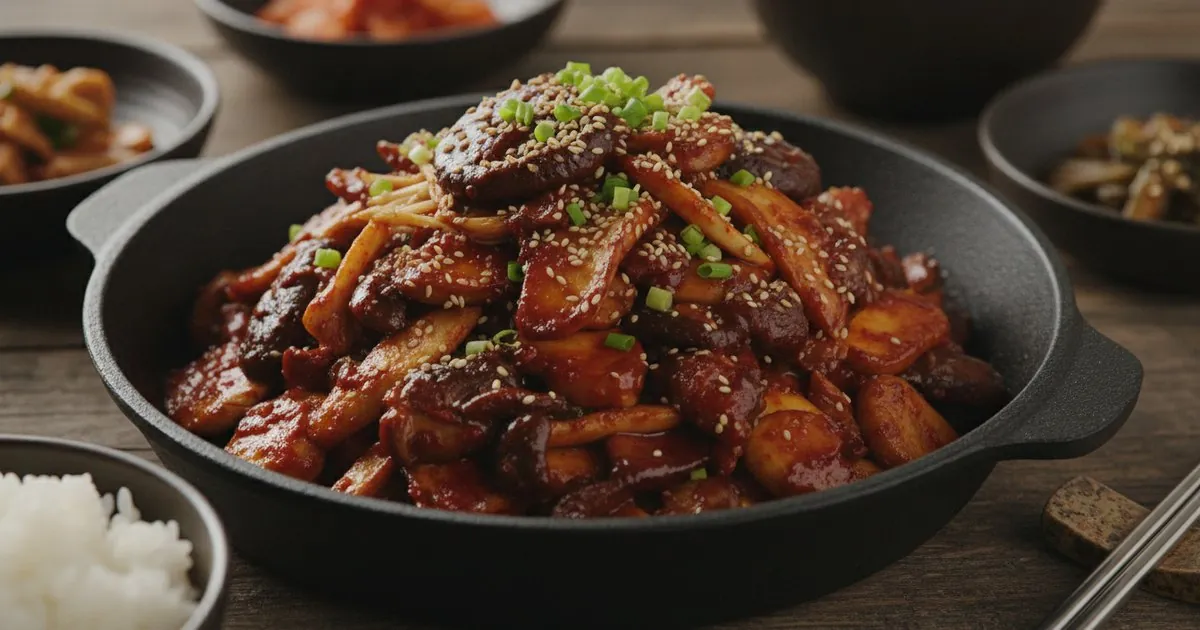
Beoseot bokkeum (버섯볶음) might be the most underestimated dish in the Korean banchan lineup. While tteokbokki and dakgalbi command the spotlight, this spicy mushroom stir-fry quietly earns its place at every Korean table — and once you nail the technique, you'll understand exactly why. It's a dish that delivers deep, complex flavor in about 20 minutes, costs very little, and works as a side dish, a rice bowl topper, or a gimbap filling. On a table of otherwise bold, fermented, and braised things, it holds its own.
The name is literal and honest: beoseot (버섯) means mushroom, bokkeum (볶음) means stir-fry. Simple enough. But that simplicity conceals a real technique challenge — one the recipe card alone doesn't fully capture, which is why this guide exists.
What Is Beoseot Bokkeum (버섯볶음)?
In Korean cuisine, banchan are the small side dishes that accompany rice and soup at every meal. They run the full spectrum from fermented kimchi to braised short ribs to barely-cooked seasoned greens. Beoseot bokkeum belongs to the bokkeum (stir-fry) category of banchan — quick-cooked, lightly sauced, and designed to add savory contrast to a spread.
Mushrooms occupy a particular place of honor in Korean culinary history. In Buddhist temple cuisine (사찰음식, sachal eumsik), where meat and strong aromatics like garlic and green onion were traditionally excluded, mushrooms became the primary source of umami and meaty texture. Temple cooks developed sophisticated techniques for layering mushroom flavors — drying, rehydrating, sautéing, and seasoning — that influenced the broader Korean kitchen. What modern food science now recognizes as glutamate-driven savory depth, Korean cooks have been coaxing out of mushrooms for centuries.
The version we're making here represents what you could call the spicy weeknight tier of beoseot bokkeum: soy sauce for depth, gochugaru for heat, garlic and onion for body, sesame oil for a nutty finish. This is the style you'll encounter in Korean home kitchens and in small-dish bapsang (meal table) spreads across the country. If you're building your banchan vocabulary, our complete banchan guide lays out the full landscape of side dishes this recipe fits into — including how to balance a spread and how to store multiple dishes efficiently.
Why Mushroom Choice Makes or Breaks This Dish
This is where most Western adaptations go sideways. The mushroom variety you choose determines moisture content, texture, surface area for browning, and how effectively the sauce clings. Getting this right costs nothing extra; it just takes knowing which mushrooms behave well under high heat.
The Best Mushrooms for Beoseot Bokkeum
Oyster mushrooms (느타리버섯, neutari beoseot) are the workhorse of Korean mushroom stir-fries. Their ruffled, layered surface creates enormous contact area with the hot pan, producing plenty of golden-brown edges. The key technique: tear them by hand along the natural grain rather than cutting. The irregular, feathery edges produced by tearing catch sauce far better than the smooth faces left by a knife.
Shiitake mushrooms (표고버섯, pyogo beoseot) deliver the most concentrated umami hit of any common cultivated mushroom. Remove the tough stems (save them for stock), and slice the caps into ¼-inch strips that cook evenly and develop beautiful color. If you find dried shiitake, they're worth rehydrating — soak in cold water for at least 30 minutes, squeeze out thoroughly, then slice. Cold water preserves more of the flavor compounds than hot water does.
King oyster mushrooms (새송이버섯, saessongi beoseot) have gained real traction at Asian grocery stores and are worth the hunt. Sliced into thick rounds or matchstick planks, they hold their shape perfectly and develop gorgeous seared surfaces — they look almost like scallops after a proper sear in a hot pan.
Enoki mushrooms (팽이버섯, paengi beoseot) are delicate and cook in under 2 minutes. In a mixed batch, add them last, after the other mushrooms are nearly done, or they'll turn soft and tangled.
Shimeji and beech mushrooms work well for mixed preparations, adding visual variety and holding up nicely to high heat.
What to Avoid
White button or cremini mushrooms are the enemy of a proper stir-fry beoseot bokkeum. They release a disproportionate volume of water when they hit a hot pan — enough to drop the pan temperature and turn your sear into a braise. They're fine in soups and slow-cooked dishes, but in a fast, high-heat preparation they actively undermine the texture you're working toward.
Sourcing in Western markets: H Mart and 99 Ranch carry all the varieties above, usually at much lower prices than mainstream grocery stores. Whole Foods reliably stocks fresh oyster and shiitake. King oyster mushrooms are trickier — Asian grocery stores are your best bet, though some well-stocked natural food stores carry them. If you can only find shiitake + oyster, that combination alone produces an excellent dish.
The Spicy Sauce Breakdown
It's worth knowing that beoseot bokkeum isn't a single fixed recipe — there's a spectrum, and understanding where this version sits helps you adjust to your own palate.
Salt and garlic only is the most traditional minimal treatment. No soy, no gochugaru — just mushrooms, garlic, oil, salt, and black pepper. Clean, pure mushroom flavor with nothing competing.
Soy-sesame is the most common version in Korean home cooking: soy sauce adds fermented depth, sesame oil adds nuttiness, garlic rounds it out. No heat. This is what most Korean grandmothers make, and it's excellent.
Spicy with gochugaru is what we're making here. The soy-sesame base plus gochugaru (Korean red pepper flakes) transforms the dish into something with real energy — fruity heat, deeper color, and a sauce that looks as appetizing as it tastes.
For the gochugaru specifically: use the coarse-ground variety labeled "for kimchi," not the fine powder. Coarse gochugaru has a better texture in stir-fries and doesn't turn as dense when it blooms in oil. Find it at H Mart in 1 lb bags or increasingly at Whole Foods in smaller jars. If you're curious about the difference between gochugaru and gochujang, and when to use each, our gochujang guide has the full breakdown — for this recipe, you want the flakes, not the paste.
Technique: What the Recipe Card Doesn't Tell You
The recipe steps are in the card above, but here are the sensory cues that tell you whether things are going right — the kind of information that makes the difference between a competent cook and a confident one.
When the pan is ready: You should see faint wisps of smoke rising from the dry surface before the oil goes in. When you add the oil, it should shimmer immediately — not pool and sit. When the mushrooms hit the oil, the sound should be an immediate, loud, aggressive sizzle. If it's a quiet, wet hiss, the pan is too cold.
During the mushroom sear: After about 60 seconds of no-stir cooking, peek under a few pieces of oyster mushroom. If you see a golden-brown crust beginning to form at the contact surface, you're on track. That's the Maillard reaction happening — actual flavor development that cannot be replicated by any other method.
When blooming the gochugaru paste: The paste should bubble actively when it hits the bare pan surface, and it should shift color within 15–20 seconds from a bright raw red to a deeper, more muted brick-red. If you smell anything approaching burnt, immediately toss the mushrooms back in — the paste is done. The aroma at this stage should be fragrant and slightly nutty, not sharp or acrid.
How to Serve Beoseot Bokkeum
Beoseot bokkeum is most at home as part of a Korean meal spread — a bowl of short-grain rice, a broth-based soup, and two or three banchan. It pairs well with something cooling and mild: sliced cucumber doused in rice vinegar, a soft egg soup, or a bowl of white congee. The spice level here is moderate (about as hot as a mild salsa), so it doesn't need much to offset it.
Temperature: Unlike cold banchan served straight from the fridge, beoseot bokkeum is best warm or at room temperature. Sesame oil congeals slightly when cold and the mushroom texture firms up. If serving from refrigerator leftovers, let it sit out for 20 minutes or give it a 30-second microwave warm-up first.
Storage: Keeps in an airtight container in the refrigerator for up to 4 days. The flavors deepen noticeably by day two as the sauce permeates the mushroom fibers more completely — this is one of those dishes that legitimately improves with time.
Beyond banchan: A generous serving over hot rice with a jammy fried egg on top is a complete weeknight meal. It also works beautifully folded into bibimbap as the mushroom component, or tucked into gimbap rolls alongside pickled vegetables.
Common Mistakes to Avoid
1. A Pan That Isn't Hot Enough Before the Mushrooms Go In
This is the most frequent and most consequential error. Mushrooms are between 80–92% water by weight. In a properly hot pan, that water evaporates almost as fast as it's released, keeping the mushroom surface dry enough to brown. In a lukewarm pan, the water pools, drops the temperature further, and you end up braising your mushrooms in their own liquid — pale, rubbery, and without any of the caramelized flavor you're after. Fix: Preheat your empty pan over high heat for a full 2 minutes before adding oil, and 3–4 minutes for cast iron. You should see faint smoke before you add the oil. Don't be tempted to start earlier.
2. Crowding the Pan
Even with a screaming-hot pan, piling too many mushrooms in at once overwhelms the pan's thermal capacity. The released moisture can't evaporate fast enough, the temperature plummets, and steaming takes over. For 450g (1 lb) of mushrooms, you need at minimum a 30cm (12-inch) skillet or a wok. If your pan is smaller, split the mushrooms into two batches: cook the first until nearly done, remove to a plate, cook the second, then combine and add the sauce. The extra 4 minutes is absolutely worth it.
3. Rinsing Mushrooms Under Running Water
Mushrooms are porous and absorb water quickly. Wet mushrooms will steam rather than sear, regardless of how hot your pan is. Clean them with a damp paper towel or a soft pastry brush to remove any growing medium or debris. The only exception is dried mushrooms, which you intentionally rehydrate — and then you must squeeze them thoroughly dry before they touch the pan.
4. Adding Sesame Oil During Cooking
Toasted sesame oil has a relatively low smoke point, and more importantly, its characteristic aromatic compounds — the ones responsible for that warm, toasted-nut fragrance — are volatile and dissipate rapidly under heat. Adding sesame oil at the stir-fry stage means those aromatics burn off before the food even reaches the table. Fix: Always add sesame oil as the very last step, with the heat off, tossing once to distribute. A single teaspoon added this way contributes far more fragrance than double the amount added early.
5. Skipping the Gochugaru Bloom
Stirring gochugaru paste directly into a pan full of mushrooms and liquid results in a dish that tastes like raw chile flakes tossed with mushrooms — sharp, slightly bitter, one-dimensional. The bloom step — pushing mushrooms aside and letting the paste sizzle in bare, hot oil for 15–20 seconds — releases fat-soluble flavor compounds, deepens and mellows the heat, and creates the rich, brick-red color that signals a properly developed sauce. You'll know it's ready when the paste smells fragrant and nutty rather than raw and pungent, and its color has shifted to a deeper, more saturated red.
6. Seasoning Too Aggressively at the Start
Raw mushrooms cook down to roughly one-third of their original volume. A sauce that tastes balanced when you're looking at a mountain of fresh mushrooms will taste significantly saltier once everything has reduced. Season the sauce conservatively when you mix it, then taste the final dish and adjust with a small pinch of salt only after the mushrooms are fully cooked and the liquid has evaporated. This is especially important if you're using a soy sauce with higher sodium content.
Frequently Asked Questions
Can I make this without gochugaru? I don't handle much heat.
Absolutely — just omit the gochugaru and increase the soy sauce by half a tablespoon to compensate for the lost volume and depth. A few extra drops of sesame oil and an additional clove of garlic fill out the flavor profile. What you get is ganjang beoseot bokkeum — the soy-based version — which is arguably the more traditional preparation and equally delicious. Some cooks add a teaspoon of oyster sauce (or vegan mushroom sauce) at this point for extra body.
Is beoseot bokkeum vegan?
This recipe is fully vegan as written — no fish sauce, no oyster sauce, no animal-derived ingredients. Mushrooms provide enough natural glutamates that nothing feels missing. If you want to push the umami even further, a teaspoon of doenjang (Korean fermented soybean paste) stirred into the sauce before cooking adds an extra layer of depth without adding heat.
My mushrooms released a ton of water and it won't evaporate. What do I do?
This happens when the pan wasn't hot enough, the batch was too large, or both. Don't panic — crank the heat to maximum, spread the mushrooms as thin as you can, and keep tossing. The liquid will eventually evaporate, though you've passed the optimal sear window. For next time: hotter pan, bigger pan, or smaller batch. If the liquid volume is truly excessive and showing no signs of reducing, you can carefully tilt the pan and use a spoon to remove some of the pooled liquid before adding the sauce.
Can I use dried shiitake mushrooms instead of fresh?
Yes — and many experienced cooks prefer them. The texture of properly rehydrated shiitake is denser and chewier than fresh, and the flavor is more concentrated. Rehydrate in cold water (not hot — cold water extracts more flavor compounds) for 30–60 minutes, squeeze the mushrooms firmly to remove excess liquid, then slice. The soaking liquid is intensely flavorful and excellent in soups and braises, but don't use it in this stir-fry — you'll add too much moisture to the pan.
How many mushroom varieties should I use?
Two is the sweet spot for most home cooks: shiitake for depth and firm texture, oyster for surface area and delicacy. A three-mushroom combination (add king oyster or enoki) creates a more interesting texture contrast and makes the dish visually appealing. Beyond three varieties, the incremental complexity gain doesn't justify the prep time or cost. More important than variety count is making sure all pieces are cut to a similar size so they finish cooking simultaneously. ```
Rezept
4.8 / 5 (147)
- Vorbereitungszeit
- 10 min
- Kochzeit
- 10 min
- Gesamtzeit
- 20 min
- Portionen
- 4
- Schwierigkeit
- Einfach
Zutaten
Zubereitung
- Prep the mushrooms: Wipe shiitake caps clean with a damp paper towel — do not rinse under running water. Remove the tough woody stems and slice caps into ¼-inch (6mm) strips. Tear oyster mushrooms by hand along their natural grain into similarly-sized pieces (the irregular edges are better at gripping sauce than knife-cut edges). For king oyster, slice into ¼-inch rounds or thin planks. For enoki, trim the base and separate into small clusters. All pieces should be roughly uniform in size so they finish cooking at the same time.
- Make the sauce paste: In a small bowl, combine gochugaru, soy sauce, and sugar if using. Stir into a loose paste and set aside. Pre-mixing ensures the paste distributes instantly and evenly the moment it hits the hot pan.
- Heat the pan: Set a large (30cm / 12-inch) skillet or wok over high heat for a full 2 minutes — until you see the first faint wisps of smoke rising from the surface. Add the neutral oil and swirl to coat. This step is non-negotiable. A properly preheated pan is the single biggest variable between mushrooms that sear and mushrooms that steam.
- Cook the aromatics: Add the minced garlic and sliced onion. Stir-fry for 60–90 seconds until the garlic is pale golden at the edges and smells sweet and fragrant — not raw, not browned.
- Sear the mushrooms: Add all the mushrooms at once and spread them into as close to a single layer as the pan allows. Resist the urge to stir immediately — let them sit undisturbed for 60 seconds to develop a proper sear. You should hear an aggressive sizzle throughout. Then toss and stir-fry on high heat for another 2–3 minutes. If liquid pools in the pan, keep the heat on maximum and keep moving — the goal is to evaporate all that moisture before the sauce goes in.
- Bloom the sauce: Push the mushrooms to the outer edges of the pan, exposing the bare center. Add the gochugaru paste directly to that center and let it sizzle in the residual oil for 15–20 seconds. It should bubble actively and shift from bright red to a deeper brick-red. This blooming step releases fat-soluble flavor compounds from the chile and is where the dish's depth comes from. Then fold the mushrooms back in and toss to coat evenly.
- Add green onion: Toss in the green onion pieces and stir-fry for 30 more seconds, just until they wilt slightly but are still bright green.
- Finish and plate: Pull the pan off the heat. Drizzle sesame oil over the top and toss once. Taste — add a pinch of salt if it needs it. Transfer to a small banchan dish, scatter sesame seeds over the top, and serve warm or at room temperature alongside steamed rice.
Die Nährwertangaben sind Schätzungen. Befolge stets sichere Praktiken bei der Handhabung und Zubereitung von Lebensmitteln.