
When Extraordinary Attorney Woo landed on Netflix in July 2022, something unexpected happened alongside the emotional courtroom drama: a global craving for gimbap. Viewers in the United States, Brazil, France, and across Southeast Asia started Googling "kimbap recipe" in record numbers — not because the food was flashy or exotic, but because of one unforgettable character and the very specific, very honest way she ate it.
This is the story of how a K-drama phenomenon reignited the world's love for one of Korea's most quietly perfect foods — and everything you need to recreate it in your own kitchen.
The Netflix Numbers Tell the Story
Before we get to the rice and seaweed, it's worth appreciating just how massive 이상한 변호사 우영우 (Extraordinary Attorney Woo) became. The show premiered on Korean cable network ENA on June 29, 2022, then arrived on Netflix on July 13. By the finale, it had pulled a 17.5% nationwide domestic rating — a stunning figure for a cable drama in the streaming era.
Globally, the numbers were even more striking. The show claimed #1 on Netflix's non-English TV chart for seven consecutive weeks, with viewership climbing from 24 million hours in week one to a jaw-dropping 77.43 million hours in its peak week. Its cumulative total: 348.15 million viewing hours, placing it at #6 among the most popular non-English series of all time on the platform. Rotten Tomatoes critics gave it a perfect 100%, specifically praising its "humane portrayal of the range of people on the autism spectrum."
Writer Moon Ji-won and director Yoo In-shik created something genuinely unusual: a legal procedural that was simultaneously a quiet, empathetic portrait of neurodivergence. Lead actress Park Eun-bin — who is neurotypical and built the role through meticulous research and expert consultation — plays Woo Young-woo, a rookie attorney with an IQ of 164 and autism spectrum disorder, navigating life at the prestigious Seoul law firm Hanbada.
And she eats gimbap. Every single day.
Why Gimbap? The Real Reason Behind Young-woo's One Food
In the very first episode, before viewers ever see Woo Young-woo in a courtroom, they learn about her relationship with food. In her precise, unhurried voice-over, she explains exactly why gimbap is the only meal she eats:
"Kimbap is reliable. I can see all the ingredients, so I will not be alarmed by unexpected texture or flavor."
This isn't a quirk inserted for easy characterization. It's one of the most clinically grounded food depictions in mainstream television.
Screenwriter Moon Ji-won spent over a year consulting with Prof. Kim Byung-gun of Korea Nazarene University on autism symptoms and lived experience before a single script page was written. The gimbap detail reflects a well-documented reality: food selectivity tied to sensory hypersensitivity is highly prevalent in autism spectrum disorder. For many autistic people, "safe foods" provide exactly what Young-woo articulates — complete visual information, zero surprise textures, and a repeatable, predictable experience where nothing is concealed inside an opaque sauce.
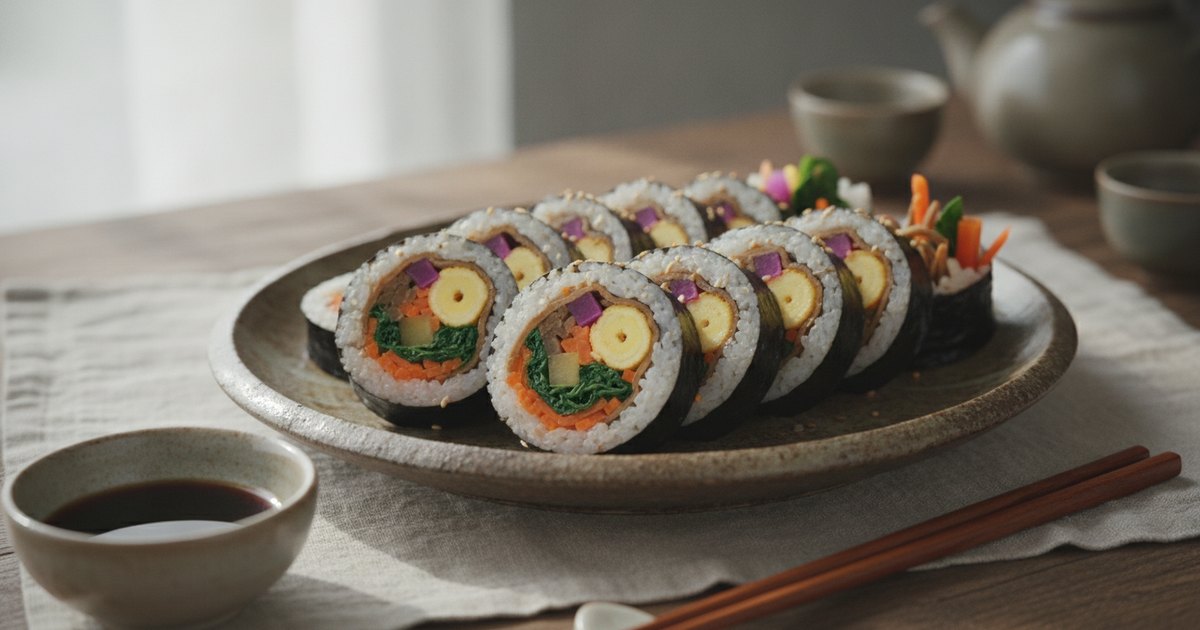
Gimbap is, structurally, a roll you can see through. Slice it and every layer becomes immediately visible — white rice, orange carrot, yellow danmuji (pickled radish), dark green spinach, a strip of egg or meat at the center. The composition is transparent. The experience is identical from the first piece to the last. For someone whose nervous system finds unpredictability genuinely distressing, this isn't a preference — it's a solution.
The Autism Society of Korea noted that the show sparked unprecedented national conversation about autism and its day-to-day realities. Internationally, autistic viewers and their families described feeling genuinely seen for the first time by a mainstream drama.
Meanwhile, a recurring visual motif quietly devastated audiences worldwide: Young-woo's father, Woo Gwang-ho, who owns and runs "Woo Young Woo Gimbap" restaurant in Suwon, hand-packs her lunch box every single morning. That scene — a father carefully rolling and slicing gimbap for his daughter, day after day — transforms an everyday Korean food into a symbol of patient love and unconditional understanding. By episode three, half the fandom wanted gimbap for lunch. By episode seven, the other half had already attempted to make it.
Gimbap's Cultural and Historical Roots
Gim (김) means dried seaweed; bap (밥) means cooked rice. Together: rice in seaweed. But the dish carries considerably more history than its name suggests.
The origins of gimbap are genuinely contested, and it's worth understanding both sides honestly. The dominant academic consensus holds that gimbap derived from Japanese makizushi — seaweed-rolled rice — introduced during Japan's occupation of Korea from 1910 to 1945. The technique of rolling rice and fillings in seaweed on a bamboo mat, then slicing into rounds, is widely agreed to have entered Korean food culture through that period.
The counterargument points to bokssam — Korea's pre-existing tradition of wrapping rice and side dishes in seaweed — and to an 1819 Joseon manuscript that explicitly references cooked rice and filling rolled with gim. Seaweed cultivation in Korea is documented from at least the 15th century.
What's clear is what happened after 1945: as Korea rebuilt its cultural identity following colonial rule, the Japanese loanword norimaki was replaced with the native Korean term gimbap, and the dish evolved into something distinctly its own. The critical difference: gimbap uses sesame oil to season the rice, never vinegar. Its fillings are emphatically Korean — canned tuna, bulgogi, kimchi, fish cake, pickled vegetables. Visually similar to a maki roll; in terms of flavor, completely different.
Today gimbap is the quintessential Korean picnic and lunchbox food — sold in convenience stores (CU, GS25) for under 2,000 won, hand-packed by parents every morning, and now — thanks to Woo Young-woo — recognized and craved by food lovers on every continent.
For a broader look at Korean table culture, our banchan guide covers the side dishes that often accompany a gimbap lunch and explains the logic behind how Koreans build a meal.
Making Gimbap in a Western Kitchen
The complete step-by-step recipe is on our dedicated gimbap recipe page, but here's what you need to know about making this dish work with a non-Korean pantry.
The Non-Negotiable Ingredients
Gim sheets: Standard toasted seaweed sheets — identical to those used in Japanese nori rolls, so they're widely available. Find them at H Mart, any Korean grocery store, or the international aisle at Whole Foods (Annie Chun's, gimMe, and Trader Joe's own-brand sheets all work). One pack of 10 sheets is enough for 10 rolls.
Short-grain white rice: Long-grain rice will not hold the roll structure. Calrose rice — widely available at Costco and most Asian grocery stores — is a reliable stand-in for Korean short-grain. Cook it slightly firmer than usual: 1 cup (200g) dry rice to 1¼ cups (300ml) water. The rice needs structural integrity, not fluffiness.
Seasoning the rice: Once cooked and cooled to around 40–45°C (104–113°F) — warm but not steaming — toss with 1 tablespoon (15ml) toasted sesame oil, ½ teaspoon (3g) fine salt, and optionally 1 teaspoon (5ml) rice vinegar. This is the flavor backbone of the entire roll.
Classic Filling Components
- Danmuji (yellow pickled radish): Sold pre-cut in tubes at Korean grocers. It provides the essential sweet crunch. If unavailable, quick-pickle daikon slices in rice vinegar, sugar, and a pinch of turmeric for color.
- Spinach: Blanch briefly — 30 seconds in boiling salted water — then squeeze aggressively dry. Season with a few drops of sesame oil and a pinch of salt. It should taste actively good on its own before it goes into the roll.
- Carrot: Julienned into fine matchsticks (about 5cm / 2 inches long), then sautéed for 2–3 minutes in a neutral oil until just softened but still holding a little snap.
- Egg: Beat 2 large eggs with a pinch of salt, pour into a lightly oiled pan over low heat, and cook into a thin sheet. Roll the sheet and slice into strips roughly 1cm (½ inch) wide.
- Protein: Imitation crab (surimi) is classic and inexpensive. Canned tuna mixed with a small spoonful of Japanese mayo is equally traditional. Cooked and seasoned bulgogi works beautifully for a heartier roll.
The Roll
Place a bamboo rolling mat flat on your work surface, with a gim sheet laid on it shiny-side down. Spread approximately ¾ cup (115g) of seasoned rice in an even layer, leaving a bare 3cm (1¼ inch) strip at the top edge — this is your sealing flap. Lay fillings in a tidy horizontal line across the center of the rice. Using the mat, roll firmly from the bottom edge upward, applying consistent even pressure without crushing. Seal the bare top edge with a tiny dab of water on your fingertip.
Brush the outside of the finished roll generously with sesame oil. This step keeps the seaweed pliable and gives the roll its characteristic dark sheen.
Slice with a single clean downward stroke per piece using a sharp, lightly dampened knife. Each roll yields 8–10 pieces.
Common Mistakes to Avoid
1. Rice That's Too Hot Splits the Seaweed
Rice fresh from the pot is still steaming, and steam trapped inside a sealed roll turns the seaweed soggy and causes it to crack when you cut. The rice should feel warm — around 40°C (104°F) — not hot. A reliable test: hold your palm above the bowl; if you have to flinch, wait another five minutes.
2. Wet Fillings Destroy the Structure
Spinach that isn't squeezed thoroughly dry will slowly soak through the rice layer, turning the seaweed limp within 20 minutes. After blanching, squeeze the spinach in your fist as hard as you comfortably can — then squeeze again. It should feel nearly crumbly in texture, not damp. Danmuji from a tube should be patted dry on paper towels before use.
3. Overfilling Causes a Blowout
The most common beginner error: the fillings look like they fit, so you add a little more. When rolling starts, the excess pushes the rice apart and the front seam bursts open. One modest, single layer of each component — a strip of carrot, a strip of egg, a strip of crab, a tablespoon of spinach — is exactly enough. Gimbap rewards restraint.
4. Uneven Rolling Pressure
A roll that's too loose falls apart the moment you start slicing — pieces look ragged and fillings slide out. A roll compressed too tightly becomes dense, gummy, and unpleasant to eat. The correct pressure feels like a firm, steady handshake: deliberate and even, not a squeeze. The finished cylinder should feel solid but yield very slightly when pressed with a finger.
5. Sawing Through the Roll
A dull knife or sawing motion will compress the roll and smear the cut face, turning each piece into a squashed disc. Use the sharpest knife in your kitchen, wet the blade between every single cut (a damp kitchen towel on the board works perfectly), and slice with one confident downward motion per piece. Don't second-guess the stroke.
6. Skipping the Sesame Oil Exterior
An uncoated roll will see its seaweed dry out and become brittle in less than 30 minutes at room temperature — it loses the glossy finish and starts to crack. The light brush of sesame oil on the outside isn't decorative; it's what keeps the roll intact and edible for hours, exactly as Woo Gwang-ho would need his daughter's lunchbox to stay fresh through a long court day.
If you're interested in more K-drama and K-pop food crossover stories, our piece on what BTS eats covers more of the viral food moments that have introduced Korean cuisine to new audiences around the world.
Frequently Asked Questions
Is gimbap the same as sushi? They're visually similar but taste completely different. Sushi uses rice seasoned with rice vinegar and typically features raw fish. Gimbap uses rice seasoned with sesame oil and salt, and is almost always made with cooked fillings. The seaweed wrapper and cylindrical shape are the main points of resemblance — the flavor profiles and cultural histories are distinct.
Why does Woo Young-woo eat only gimbap? The show grounds this in a real autism-related phenomenon called "safe foods" — foods that are predictable in texture, appearance, and flavor, providing no sensory surprises. Young-woo explains it directly in episode one: "Kimbap is reliable. I can see all the ingredients, so I will not be alarmed by unexpected texture or flavor." Screenwriter Moon Ji-won developed this detail during a year of research and consultation with autism specialists, making it one of the show's most clinically informed character choices.
Is gimbap difficult to make for the first time? Each individual component is simple. The learning curve is entirely in the rolling: specifically the pressure control and getting the fillings centered. Most people's first roll is imperfect — usually overfilled or lopsided. By the third roll, it's markedly better. By the fifth, the technique clicks. Setting up all fillings before you begin rolling (mise en place) is more important than any single skill.
Where can I buy gim (seaweed sheets) if I don't have a Korean grocery store nearby? Most Whole Foods locations carry toasted seaweed sheets in the international or snack aisle (gimMe and Annie Chun's are the most common brands). Trader Joe's carries its own-label version. Any Asian grocery store will have larger, better-value sheets. For online ordering, Weee! and H Mart's online shop ship nationwide.
Was "Woo Young Woo Gimbap" a real restaurant? The restaurant in the drama is fictional — created specifically as part of Woo Gwang-ho's character backstory. However, it became a real-world cultural touchstone. After the show aired, numerous gimbap restaurants across Korea adopted similar names or displayed attorney Woo signage, and "attorney woo gimbap" became a popular search term among international tourists planning food-focused visits to Seoul and Suwon.
What Extraordinary Attorney Woo understood — without ever being preachy about it — is that food can be a language of safety, love, and identity. Gimbap's global moment, sparked by a fictional autistic attorney who found the world more navigable one transparent, sesame-scented roll at a time, is a reminder of what food storytelling at its best can do. It doesn't just make you hungry. It makes you understand something. ```