
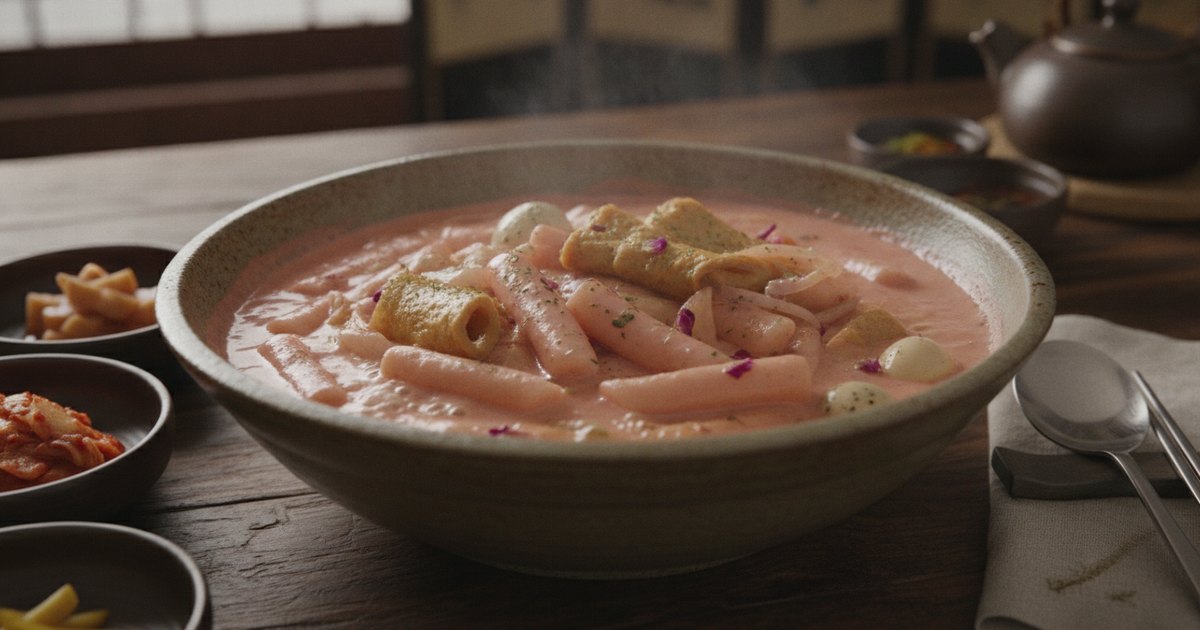
If there's one dish that captures where Korean food culture has been heading over the past several years, it's rose tteokbokki. Part comfort food, part visual spectacle, this blush-pink bowl of chewy rice cakes has swept through Korean street food stalls, home kitchens, and social media feeds with the kind of momentum that only happens when a dish is genuinely, unmistakably delicious — not just photogenic.
The name alone tells the story. "Rose" (로제, rosé) refers to the sauce's colour: that dreamy coral-pink you get when Korea's most iconic street food condiment, gochujang, meets European-style cream. The result is a sauce that is simultaneously spicy and soothing, deeply savoury and silky — and nothing like a compromise between two culinary traditions. It tastes entirely like its own thing.
This guide covers everything you need to know to pull it off at home, from sourcing the right ingredients at H Mart or your local supermarket, to building the sauce correctly, to diagnosing the specific ways this dish can go sideways.
What Is Tteokbokki, and Why Is the Rose Version Different?
A quick grounding before we get into the rose variation. Tteokbokki (떡볶이) is arguably Korea's most beloved street food: cylindrical rice cakes called garaetteok braised in a spicy-sweet sauce built around gochujang and gochugaru. The dish as we know it today solidified in the 1950s and has been a staple of Korean pojangmacha (street food stalls) and school canteens ever since. It's fiery, chewy, intensely satisfying, and carries a specific nostalgia for Koreans that runs very deep.
The original palace-style tteokbokki (gungjung tteokbokki) was made with soy sauce and was mild — the gochujang-heavy version came later, after Korean cuisine fully absorbed chilli peppers. Today's creative variations — cheese tteokbokki, rabokki (tteokbokki with ramen noodles), black bean sauce tteokbokki — are all products of that same restless innovation.
Rose tteokbokki stands out among these variations because the dairy doesn't just soften the dish aesthetically. It changes the fundamental chemistry of how the heat is delivered. Capsaicin, the compound responsible for chilli heat, is fat-soluble. When you add heavy cream to gochujang, the capsaicin binds to the fat molecules and is released more slowly and evenly in the mouth — the heat builds gradually and lingers warmly rather than hitting sharp and fast. The fermented, slightly funky depth of the gochujang also mellows and rounds out in the cream, producing something almost reminiscent of a mild miso or light cheese sauce. It doesn't taste mild, exactly. It tastes balanced.
The "Rose" Sauce: Understanding What You're Building
The concept borrowed from Italian-American cooking is straightforward: combine a red sauce (here, gochujang) with cream (white), and you land in blush-pink territory. But the execution matters enormously.
Rose tteokbokki isn't just gochujang stirred into cream. The depth comes from the layering — from rendering bacon first and cooking aromatics in that fat, from toasting the gochujang briefly in the pan before adding liquid, from allowing the rice cake starch to slowly thicken the sauce rather than adding flour or cornstarch. Each step is doing specific work on the flavour.
The proteins — bacon, cocktail sausages, and fish cake — aren't just toppings. Rendered bacon fat is the flavour foundation that everything else is built on. The smokiness integrates into the cream and creates a background richness that plain oil simply can't replicate. Cocktail sausages add a familiar, crowd-pleasing meatiness. And Korean fish cake (eomuk) provides a subtle, oceanic umami that plain rice cakes lack — it's the ingredient that makes the dish taste fully Korean rather than a fusion experiment.
Ingredients and Where to Find Them in the West
What You'll Need (Serves 2–3)
Rice cakes and proteins:
- 320g (¾ lb) Korean rice cakes (garaetteok / tteokbokki-tteok)
- 100g (3.5 oz) Korean fish cake (eomuk), cut into triangles
- 90g (3 oz) cocktail sausages or Vienna sausages (8–10 pieces), scored
- 3 strips smoked bacon, cut into 2.5cm (1-inch) pieces
Sauce:
- 1½ tbsp gochujang
- 1 tsp gochugaru
- 1 tbsp soy sauce
- 1½ tbsp sugar (white, raw, or brown)
- 180ml (¾ cup) heavy cream
- 60ml (¼ cup) whole milk
Aromatics and fat:
- 1 tbsp neutral oil
- ½ medium onion (about 50g / 1.75 oz), thinly sliced
- 3 cloves garlic, minced
- 2–3 green onions (scallions), white and green parts separated
Optional garnish: sesame seeds, sesame oil
Sourcing Tips
Rice cakes are the trickiest ingredient to track down if you don't live near a Korean grocery store. H Mart stocks them fresh and vacuum-packed in the refrigerated section. Some larger Whole Foods locations carry brands like Chung Jung One or Wang in the Asian foods aisle. Online retailers — Weee!, H Mart's own online shop, and Amazon — carry multiple options including frozen. Frozen rice cakes work perfectly; just extend the soaking time to 30 minutes. Look specifically for the cylinder-shaped tteokbokki-tteok — not the flat or oval-shaped sweet rice cakes used in desserts.
Gochujang is now widely stocked. Bibigo, CJ Haechandle, and O'Food are the brands you'll most commonly see at Whole Foods, Target, and larger supermarkets. For a full breakdown of brands and heat levels, the kfoodlab gochujang guide is worth a read before you shop — gochujang quality varies quite a bit across brands.
Gochugaru (Korean red pepper flakes) has a specific coarse texture, moderate heat level, and slightly fruity, smoky character that Italian red pepper flakes or cayenne simply don't replicate. Don't substitute — the flavour of the finished sauce will be noticeably different. H Mart and most Asian grocery stores carry it reliably; it's also easy to find online.
Fish cake (eomuk) is typically sold frozen in flat sheets or round pieces. Look in the frozen Korean foods section. If it's completely unavailable, you can skip it — the dish works without it — but add a small splash of fish sauce (about ½ tsp) to the cream sauce to compensate for some of that lost umami.
Heavy cream: Any whipping cream or heavy cream (30–36% fat) from any supermarket works. Higher fat content means a more stable, richer sauce, so full-fat is preferable over light cream.
Step-by-Step: Making Rose Tteokbokki
Before You Cook
Soak refrigerated or frozen rice cakes in cold water for at least 20 minutes. This is not optional. Cold, stiff rice cakes added directly to a hot pan crack on the outside while the centre stays hard and chalky. The soak hydrates them evenly so they cook uniformly. Drain well before adding to the pan.
Score the cocktail sausages with three or four shallow diagonal cuts on each side. This isn't decorative — it helps the sauce penetrate the surface and prevents the sausages from curling into an unwieldy shape.
Take the cream and milk out of the refrigerator and let them come toward room temperature while you prep. Cold dairy hitting a hot pan drops the temperature abruptly and can cause the sauce to seize or form uneven lumps.
Building the Base
Start with a cold pan — no preheating. Add the bacon pieces and place over medium heat. Starting in a cold pan gives the fat time to render slowly and completely, producing a cleaner, more flavourful base. Cook for 3–4 minutes until the edges of the bacon are just starting to crisp. The pan should smell smoky and sweet. Remove the bacon with a slotted spoon and set it aside, leaving the rendered fat in the pan — that fat is your flavour foundation.
Add the neutral oil to the rendered bacon fat and raise the heat slightly if needed to keep it at medium. Add the sliced onion and the white parts of the green onion. Cook, stirring occasionally, until the onion is completely translucent and just beginning to take on the faintest colour at the edges — about 2–3 minutes. Add the garlic and stir constantly for 30 seconds. It should smell fragrant and toasty; the moment you see it beginning to turn golden, move on. Add the scored cocktail sausages and cook for 2 minutes, turning once or twice until slightly coloured.
Toasting the Gochujang — Don't Skip This
Push everything to the sides of the pan, creating a clear space in the centre. Add the gochujang directly to that centre space and let it sit on the heat for about 30 seconds without touching it. Watch and smell: the paste will start to sizzle slightly, and the aroma will shift from raw, pungent fermented chilli to something deeper and slightly caramelised — almost like a concentrated, sweetened chilli jam. That transformation is what you're after. Now stir it into the aromatics and sausages. Add the soy sauce and sugar and mix everything together until the rice cakes and sausages are coated in a thick, mahogany-red paste.
Building the Rose Sauce
Pour in the heavy cream and whole milk. The colour change is immediate and dramatic: the deep red paste turns soft coral-pink within seconds of the cream making contact. Stir thoroughly to emulsify the sauce. Bring it to a gentle, steady simmer over medium heat — small, frequent bubbles are what you want to see breaking at the surface. A rolling boil is your enemy here; the cream will break and the sauce will look greasy and separated.
Cooking the Rice Cakes
Add the drained rice cakes and fish cake triangles and stir to coat everything in the sauce. Maintain medium to medium-high heat, stirring every 1–2 minutes to prevent sticking and to ensure the rice cakes cook evenly. As the rice cakes heat through, they release starch into the sauce, which is what gives rose tteokbokki its characteristic glossy, clingy consistency. Watch the sauce as you stir: at around the 5-minute mark, it should start visibly thickening. At the 8-minute mark, drag a spatula through the sauce — it should hold a clear trail for 2–3 seconds before closing.
Test a rice cake at 8 minutes. Slice one in half with a spoon or chopstick: the cross-section should show a uniform, translucent texture with no white, starchy core remaining. Bite through it — the exterior should yield immediately and the interior should have a gentle, springy resistance that Koreans describe as 쫄깃쫄깃 (jjolgit-jjolgit). If there's any chalky resistance in the centre, cook for 2 more minutes and re-test.
Finishing
Return the reserved bacon to the pan and stir through. Add the gochugaru and stir. Now taste critically. The sauce should hit four notes in sequence: creamy richness first, then savouriness, then a building warmth from the gochujang, finishing with a light sweetness. If it tastes flat, add soy sauce in ½ tsp increments. If the heat is too sharp, stir in a small splash of cream. If it tastes one-dimensional, a pinch more sugar often rounds everything out. Season with white pepper if desired.
Divide immediately between bowls. Garnish with the green parts of the scallion, a pinch of sesame seeds, and a very light drizzle of sesame oil. Serve straight from the pan — this dish does not wait well.
Variations Worth Trying
Tomato-rose variant: Replace half the gochujang with 1 tbsp of tomato paste. The result is slightly sweeter, less fermented, and leans more explicitly toward the Italian rosé sauce concept. Popular in Korean cafés as a slightly more approachable version.
Rabokki (with ramen): Add one block of instant ramen noodles during the final 3–4 minutes of cooking. The noodles soak up the creamy sauce and stretch the dish into a more substantial meal. This is a classic Korean home-cook shortcut that works beautifully.
Cheese finish: Scatter torn mozzarella over the top just before serving and let it melt into the sauce. Stretchy, salty cheese and creamy gochujang sauce are a natural combination — see our guide to cheese tteokbokki for more on how cheese integrates into tteokbokki dishes.
Make it milder: Reduce gochujang to 1 tbsp and skip the gochugaru entirely for a dish that's warming but quite gentle — good for spice-cautious guests or kids.
Common Mistakes to Avoid
1. Skipping the Rice Cake Soak
This produces a specific, diagnosable failure: the outside of the rice cake will be soft and saturated with sauce while the centre remains hard, white, and chalky. Once this happens mid-cook, there's no easy fix — you'd have to keep cooking long past the point where the exterior has turned mushy. Soak for at least 20 minutes in cold water. If your rice cakes came straight from the freezer, extend that to 30 minutes and make sure the soaking water is truly cold so they rehydrate evenly rather than beginning to cook on the outside.
2. Boiling the Cream Sauce Too Hard
This is the most visually obvious failure mode: the sauce breaks and turns oily, with a pool of butter-yellow fat separating from the liquid. Once you see fat beading on the surface, the sauce has gone wrong. The fix: immediately lower the heat, add 2–3 tbsp of cold milk, and stir vigorously in small, tight circles to re-emulsify. Prevention is much easier — keep the heat at a steady medium throughout, aiming for gentle, active bubbling rather than a rolling boil. If you hear a hard, sputtering sound from the pan, that's your signal to turn the heat down immediately.
3. Not Toasting the Gochujang Before Adding Cream
Adding the gochujang paste directly to the liquid without that 30-second toast in the centre of the pan produces a sauce with a noticeably raw, sharp edge. You can taste the uncooked fermented paste sitting underneath the cream rather than integrated into it. The toasted version smells distinctly different — rounder, slightly sweet, more complex. Those 30 seconds make a disproportionate difference. If you're ever in doubt about whether you've toasted it enough, trust your nose: the aroma shift from raw to toasted is unmistakable.
4. Adding Cold Cream Straight from the Refrigerator
Cold cream hitting a hot pan drops the temperature of the sauce abruptly. The fats in cold cream can also clump before they fully emulsify, resulting in a slightly grainy or lumpy sauce. Leave your cream and milk out for 10–15 minutes before cooking, or warm them briefly in the microwave (30–40 seconds) until they're at room temperature. It's a small step that consistently produces a smoother final sauce.
5. Under-Seasoning After the Cream Goes In
Cream is mildly flavoured and relatively neutral, and a substantial quantity of it can mask the seasoning you built into the base. The finished rose tteokbokki sauce should taste assertively savoury and have a clear warmth from the gochujang — if it tastes bland, creamy, or one-dimensional, the sauce needs more work. Taste after you add the cream and again after the rice cakes have cooked. Add soy sauce for depth, sugar for balance, and gochugaru for heat. A properly seasoned rose sauce should make you want to drink it from the spoon — not taste like cream with a faint suggestion of chilli.
6. Letting the Dish Sit Before Serving
Rose tteokbokki's sauce thickens aggressively as the rice cakes continue to absorb liquid off the heat. A dish that looks perfectly saucy in the pan will, within 3–5 minutes, become thick and sticky — still edible, but noticeably less appealing. If you need to reheat leftovers, add 2–3 tbsp of milk to the pan, stir over low heat until the sauce loosens back to the right consistency, and taste to re-season. Don't add water — it thins without restoring flavour.
FAQ
Can I make rose tteokbokki without fish cake (eomuk)?
Yes. The dish will still work, but you'll notice a slightly less rounded, one-dimensional savoury quality in the sauce. Fish cake adds a subtle oceanic umami that doesn't taste distinctly "fishy" — it operates as a background depth note. If you can't source it, add ½ tsp of fish sauce to the cream sauce to approximate that layer. For a vegetarian version, a small pinch of MSG dissolved into the sauce or a piece of dried kombu steeped in the warm cream for a few minutes before adding can substitute for that savoury depth.
How spicy is this compared to regular tteokbokki?
Meaningfully milder. With 1½ tbsp of gochujang and 1 tsp of gochugaru, the heat is real and warming — but it's delivered slowly and gently through the fat in the cream, without the sharp, immediate intensity of classic tteokbokki. If you've found standard tteokbokki uncomfortably spicy in the past, rose tteokbokki is an excellent starting point. If you want it very mild, reduce the gochujang to 1 tbsp and omit the gochugaru entirely. If you want it closer to standard tteokbokki heat, increase the gochugaru to 1 tablespoon.
Can I make this dairy-free?
You can, with caveats. Full-fat coconut cream is the most structurally similar substitution — it has comparable fat content and will keep the sauce from breaking — but it adds a distinct coconut flavour that isn't traditional. Unsweetened full-fat oat milk or cashew cream are more neutral in flavour and produce a lighter, slightly less rich sauce. Any of these will still yield a pink, creamy-looking sauce; just expect the flavour profile to differ from the dairy version.
My sauce turned out too thick and gluey. How do I fix it?
This typically happens if the rice cakes cooked for a little too long, releasing excess starch, or if the dish sat for a few minutes before you served it. The fix is straightforward: add whole milk in 2-tablespoon increments, stirring over low heat between each addition, until the sauce loosens to your preferred consistency. Avoid plain water — it dilutes the sauce without compensating for the lost flavour. If you're reheating leftovers that have set almost solid in the refrigerator, this same technique restores them reliably.
Do I have to use bacon, or can I substitute something else?
The bacon serves two functions: flavour and cooking fat. You can substitute pancetta for a slightly more refined smokiness, or thick-cut smoked turkey bacon if you don't eat pork. If you want to skip cured meat entirely, use 1½ tbsp of butter as your cooking fat instead — it won't have the smoky depth, but it produces a rich, clean base. Caramelising the onion a little more deeply when using butter will help compensate for the lost complexity.
Looking to master the classic before you take on the rose version? Our complete tteokbokki guide covers the foundational gochujang-based recipe, the full history of the dish, and practical tips for sourcing rice cakes and adjusting heat levels to your preference. ```