
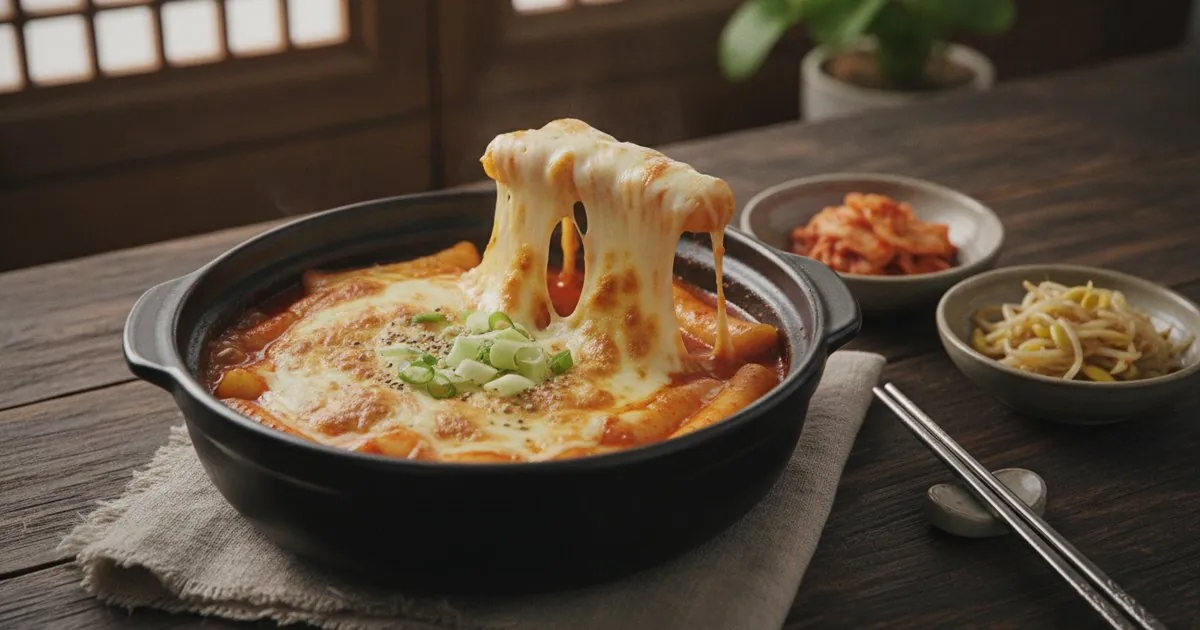
Something magnetic happens when you pull apart a spoonful of cheese tteokbokki and a long ribbon of molten mozzarella stretches between the pan and your bowl. The chewy, fire-red rice cakes beneath are unapologetically bold — deep with gochujang, funky from anchovy broth, sweetened just enough to balance the heat — and the cheese doesn’t tame that intensity so much as throw it into sharp, addictive relief. This is Korean comfort food at its most audacious. Once you make it at home, you’ll understand exactly why it has taken over K-drama cafeteria scenes and social media feeds from Seoul to São Paulo.
Why Cheese and Tteokbokki Work So Well Together
At first glance, pairing stretchy mozzarella with Korea’s most iconic spicy street food might sound like a gimmick. It isn’t. The fat in melted cheese coats the palate and slows the delivery of capsaicin, giving you a brief, creamy respite between each fiery bite. The mild, milky sweetness of mozzarella contrasts with gochujang’s fermented, umami-rich depth without canceling it. Texturally, the satisfying spring of a properly cooked rice cake against silky, molten cheese creates a contrast that keeps you going back for one more bite.
Korean food culture has long been comfortable with dairy-meets-spice combinations. If you’ve ever had cheese dakgalbi — the spicy stir-fried chicken crowned with molten mozzarella at Chuncheon restaurant chains — this flavour marriage will feel instantly familiar. Cheese tteokbokki follows the same logic, applied to Korea’s most beloved street snack.
New to the tteokbokki world entirely? Our classic tteokbokki guide breaks down the base recipe from scratch — a useful read before layering on the cheese variation.
A Brief History: From Sindang-dong to Your Skillet
Tteokbokki in its modern, gochujang-sauced form was popularized by a street food vendor named Ma Bok-rim in Seoul’s Sindang-dong neighborhood during the 1950s. The dish that preceded it — gungjung tteokbokki, the royal-court ancestor — was soy sauce-based, entirely non-spicy, and far more delicate in character. Ma Bok-rim’s adaptation swapped soy sauce for gochujang and created the dish that would define Korean pojangmacha (street stall) culture for decades.
Cheese arrived as a topping much later, surfacing first at Korean tteokbokki specialty restaurants and convenience stores during the mid-2000s, then gaining serious international momentum through the 2010s as Korean pop culture spread globally. Today it’s fully canonical: cheese tteokbokki appears on Korean convenience store menus, in K-drama food scenes, and across mukbang culture. It isn’t an experiment any more — it’s a pillar of the modern tteokbokki canon.
Ingredients: What You Need and Where to Find It
The Rice Cakes (Tteok / 떡)
For tteokbokki, you want garaetteok — long, cylindrical rice cakes pre-cut into roughly 2-inch (5 cm) pieces, sometimes labeled “tteokbokki tteok” (떡볶이 떡) on the package. These are not the same as the flat, oval rice cake slices used in tteokguk (rice cake soup) — shape matters here, because cylindrical cakes hold their chew better in a saucy, high-heat braise.
Find them at any H Mart or Korean supermarket, refrigerated or frozen. Vacuum-sealed packages are also widely available online with fast shipping. What about Whole Foods? Some locations carry tteok in the refrigerated international section, but availability is inconsistent. For sourcing peace of mind, an Asian grocery store is the right call.
- Refrigerated or vacuum-packed tteok: Soak in cold water for 20–30 minutes. This re-hydrates the surface starch, softens the texture, and prevents the skins from splitting in the hot sauce.
- Frozen tteok: Thaw completely in cold water first — about 30–45 minutes — then proceed as above.
- Fresh tteok (made that day): No soaking needed; they go straight in.
The Broth
The classic base is myeolchi-dasima (anchovy-kelp) broth: dried anchovies (멸치, myeolchi) and dried kelp (다시마, dasima) simmered in water for 10 minutes, then strained. This builds a savory, subtly briny depth that amplifies gochujang’s fermented character beautifully. Pre-made stock bags (찌개용 멸치다시마 티백) sold at any Korean market make this effortless — steep two bags in hot water for 7–10 minutes.
Western shortcuts that actually work well:
- Japanese dashi (liquid carton, powder, or granules): very similar savory profile, widely available
- Low-sodium chicken broth: lighter and less funky, but the gochujang carries it
- Plain water: least complex, but perfectly functional — the sauce still tastes like tteokbokki
The Sauce: Gochujang vs. Gochugaru — Know the Difference
This two-chili structure confuses many first-timers, so let’s be clear:
- Gochujang (고추장) is the fermented red pepper paste — thick, deeply umami, moderately spicy, with a sweetness from fermented rice. It’s the foundational flavor and color of the sauce. Our gochujang guide covers every brand and heat level worth knowing for your pantry.
- Gochugaru (고추가루) is pure Korean red pepper flakes — clean, bright heat with a subtle fruitiness. It layers on top of the gochujang’s depth to give the sauce its edge.
Using 2–2½ tablespoons of gochujang plus 1 tablespoon of gochugaru for 400g of rice cakes will produce a dish that’s genuinely spicy but balanced by the cheese and sugar. Reduce the gochugaru to 1 teaspoon if you’re cooking for heat-sensitive guests; look for mild gochujang (순한, labeled 1-bar heat on the packaging) if you need to scale the base spice down further.
The Cheese
Whole-milk shredded mozzarella is the universal choice — and for good reason. It melts into wide, silky pools rather than breaking into grease or separating into stringy clumps. Its mild, milky flavor doesn’t compete with the sauce; it softens it. Use 75g (¾ cup) for moderate cheese coverage, or up to 100g (1 cup) if you want dramatic pull.
A small handful of freshly grated parmesan (about 1 tablespoon) mixed into the mozzarella adds a savory, nutty depth without changing the melt behavior — a trick borrowed from rosé tteokbokki recipes that rounds the overall flavor beautifully. A single slice of American cheese or mild cheddar layered on top appears in many Korean home recipes for extra richness and a slightly saltier finish.
Avoid: pre-sliced low-moisture mozzarella (doesn’t melt smoothly), any aged cheese that isn’t finely shredded, or anything labeled “cheese food product” — the melt will be uneven and often greasy.
Optional But Traditional Add-ins
- Fish cake (eomuk / 어묵, ~100g / 3½ oz): Pre-cooked fish cake sheets, cut into triangles or strips. A classic tteokbokki companion that absorbs sauce and adds a savory, pleasantly chewy contrast. Refrigerated at Korean and most Asian grocery stores.
- Hard-boiled eggs (계란): A street-food staple. The rich yolk is excellent dragged through the spicy sauce.
- Ramen noodles (라면 사리): Add one portion, cooked separately or dropped in raw with an extra splash of broth, during the last 3 minutes. Instantly makes this a more filling meal.
- Sliced cabbage or onion: Both add bulk and a gentle sweetness that rounds the sauce.
How to Make Cheese Tteokbokki: What to Look and Listen For
(The complete step-by-step recipe is in the card above. Here’s the narrative version, with the sensory cues that tell you when each step is going right.)
Use a wide, shallow pan — a 30cm (12-inch) skillet or shallow braising pot gives you the surface area to reduce the sauce properly and lay the cheese in an even layer at the end.
Get your broth simmering before anything else, then build the sauce directly in the liquid. Whisk the gochujang in while the broth is at a gentle simmer, not a rolling boil — high heat makes the paste seize rather than dissolve. The fully mixed sauce should look like a glossy, deep brick-red liquid with no visible lumps. Taste it: the raw sauce will read aggressively salty, spicy, and sweet all at once. That’s correct. The rice cakes are starchy and will absorb a significant amount of that seasoning as they cook, so the sauce needs to start over-seasoned.
Add the drained tteok and you’ll hear a gentle sizzle as they hit the sauce. Stir immediately. Over the next 8–10 minutes, watch the surface of the sauce: it will go from thin and brothy to progressively thicker and more viscous as starch migrates out of the rice cakes into the liquid. The moment you’re cooking toward is when a spoon dragged through the pan leaves a clear trail that holds for 2–3 seconds before closing back in, and every rice cake is visibly coated in a clingy, glossy glaze.
For the cheese melt: turn the heat as low as it goes, scatter the mozzarella, cover, and step back. Peek at 90 seconds — the cheese should be fully melted, shimmering, and starting to bubble gently at the very edges. That’s perfect. White, soft, and gleaming is the target. If you see any browning or a pool of separated oil forming, you’ve let it go too far and the heat was too high.
Variations Worth Exploring
Rosé Tteokbokki (로제 떡볶이)
Reduce the gochujang to 1 tablespoon, skip the gochugaru, and stir in 3–4 tablespoons of heavy cream (or 2 tablespoons of milk plus 1 tablespoon of unsalted butter) in the last 2 minutes of cooking. The sauce turns a dusty rose color, the heat drops to gentle warmth, and the richness climbs considerably. Add a tablespoon of parmesan to your mozzarella blend. This variation has become enormously popular in Korean home cooking and is the ideal gateway version for anyone who finds classic tteokbokki too intense.
Seafood Cheese Tteokbokki
Replace the fish cake with a mix of small peeled shrimp, squid rings, and/or mussels (total about 150g / 5 oz). Add them in the last 4 minutes so they don’t overcook. Reduce gochujang slightly to 1½ tablespoons to let the seafood’s natural sweetness breathe. The result — briny seafood, spicy red sauce, melted mozzarella — reads almost like a Korean take on seafood fra diavolo.
Common Mistakes to Avoid
1. Skipping the Rice Cake Soak
Refrigerated or vacuum-packed tteok that go straight into a hot pan without soaking cook unevenly: the outer layer softens and absorbs sauce while the interior stays hard and chalky. You’ll bite through what looks like a done rice cake and find a stiff, grainy core. The 20–30 minute cold-water soak is not optional for anything that isn’t freshly made. How to confirm they’re ready: they should bend without snapping and feel slightly slippery between your fingers. If you hear a crack when you bend one, soak for another 10 minutes.
2. Failing to Fully Dissolve the Gochujang
Gochujang is dense and doesn’t disperse easily in hot liquid without active whisking. If you add it to aggressively boiling broth and just stir once or twice, you’ll end up with concentrated paste pockets in the sauce — some bites will be scorchingly spicy, others bland. Always add gochujang to a gently simmering (not boiling) broth and whisk continuously until the liquid is uniformly red with zero visible lumps before anything else goes in.
3. Overcooking the Rice Cakes Until Gluey
The window between perfectly chewy and sadly mushy is narrower than you’d expect — roughly 2–3 minutes at the vigorous simmer stage. Overcooked tteok lose their defining chew and turn paste-like, clumping together in the pan. Start tasting at 8 minutes. The correct texture: soft and yielding all the way through, with a distinct but gentle springiness when you bite down. If it dissolves like overcooked pasta, it’s too far gone. When in doubt, pull it off the heat while it still has some chew — residual heat in the sauce will carry it slightly further.
4. Adding Cheese Over Heat That’s Too High
Mozzarella scattered over a pan still bubbling at medium or medium-high heat will bubble aggressively, then the fat separates from the protein and you’re left with a greasy, rubbery layer instead of a smooth melt. Always reduce to the lowest possible burner setting before adding cheese. The residual heat from the sauce and the hot pan is more than enough; the lid traps steam to finish the melt from above. If you see orange oil pooling around the cheese edges, the heat is too high — pull the pan off the burner entirely and let residual heat finish the job with the lid on.
5. Under-seasoning and Forgetting to Adjust at the End
Gochujang brands vary enormously in salt content and intensity — what’s 2½ tablespoons in one brand might taste like 1½ tablespoons of another. Always taste the sauce just before adding the cheese and make micro-adjustments: a few extra drops of soy sauce for savory depth; a pinch more sugar if it tastes flat; a tiny splash of fish sauce if the whole thing needs a backbone. The cheese adds a small amount of salt and fat to the final dish, so you want the sauce to taste fractionally more intense than your ideal before the cheese goes on.
6. Letting the Dish Sit Before Serving
Cheese tteokbokki punishes delay. Within 5 minutes of coming off the heat, the sauce continues to thicken as it cools, the rice cakes start to clump together, and the mozzarella firms from silky to stringy to rubbery. This is a dish to serve the instant the lid comes off — straight from the pan to the table. If you’re eating with someone who isn’t seated yet, wait until they are before adding the cheese. The cheese melt is the finale; treat it that way.
Frequently Asked Questions
Can I make cheese tteokbokki without a Korean grocery store?
Mostly yes. Gochujang is now stocked at many mainstream US grocery stores — Trader Joe’s carries a well-regarded version, and Whole Foods usually has one or two brands in the international aisle. Gochugaru is harder to find outside Korean or Asian grocery stores; in a pinch, use 2 teaspoons of sweet smoked paprika plus ½ teaspoon of cayenne as a rough approximation. The trickiest ingredient to substitute is the rice cakes themselves — check the freezer section of any Chinese, Japanese, or pan-Asian grocery store, or order online (several brands ship with 2-day delivery). Gnocchi can mimic the chewiness in a rough way, but the flavor and texture of real tteok is genuinely irreplaceable.
How do I store and reheat leftovers?
Store in an airtight container in the refrigerator for up to 2 days. The rice cakes will harden as they cool — this is normal. To reheat: add a splash of water or broth (2–3 tablespoons) to a pan over medium-low heat, add the tteokbokki, and stir gently until warmed through and the sauce has loosened to a glossy consistency again. Scatter a fresh small handful of mozzarella over the top, cover for 60–90 seconds, and serve. Microwave reheating is faster but makes the rice cakes rubbery and the cheese uneven; stovetop is strongly preferred.
What’s the difference between cheese tteokbokki and rosé tteokbokki?
Both have melted cheese on top, but the sauces are different. Cheese tteokbokki uses the full spicy gochujang-gochugaru red sauce as its base — the cheese is the topping. Rosé tteokbokki incorporates cream or milk directly into the sauce, which mellows the spice, lightens the color to a pale rose, and creates a much richer, creamier result throughout. Rosé is the version to make if you want the cheese-tteokbokki experience at a lower heat level.
Can I make this vegetarian?
Yes. Omit the fish cake, use kelp-only broth (skip the dried anchovies) or dashi, and confirm your gochujang doesn’t contain anchovy paste — most brands don’t, but check the label. With those adjustments, the dish is fully vegetarian. For a vegan version, substitute a plant-based mozzarella that melts well (Miyoko’s Creamery and Violife are frequently recommended); note that melt behavior and stretch will vary by brand.
My sauce turned out too spicy — how do I fix it?
Add sugar in small increments (½ teaspoon at a time) — sweetness directly counteracts capsaicin heat. More cheese also helps; the fat coats the tongue and reduces the perception of burn. A tablespoon or two of heavy cream stirred in at the end will mellow the sauce significantly and push it toward rosé territory. For future batches: start with 1 tablespoon of gochujang and 1 teaspoon of gochugaru, taste the raw sauce before adding the rice cakes, and build upward gradually. It’s much easier to add spice than to remove it.