
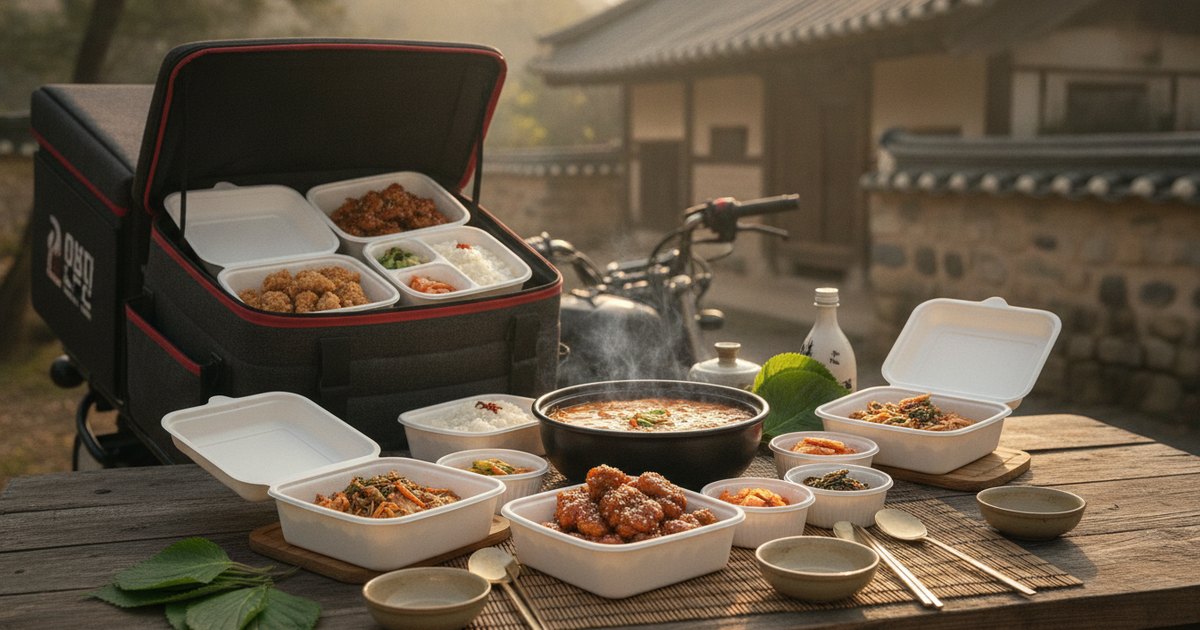
If you have ever ordered food delivery in South Korea — or watched a Korean drama where a character cracks open a plastic container of glossy black-sauce noodles while rain hammers the window — you have witnessed something that goes far deeper than convenience. Korean food delivery is a cultural institution, refined over more than 250 years, turbocharged by infrastructure investment, and now powered by some of the most sophisticated logistics apps on the planet. The rest of the world is still catching up.
This piece walks through the full arc: from a royal court scholar ordering noodles in 1768 to the 40,000 fried chicken restaurants dotting the Korean peninsula today. Along the way, you will find practical guidance on how Western home cooks can capture that same delivery-night energy in their own kitchens — even without a motorbike courier at the door.
The World's First Documented Food Delivery (Yes, Really)
Most food historians trace modern delivery culture to the 20th century. Korea complicates that narrative considerably.
In July 1768, a scholar named Hwang Yunseok recorded in his diary that he had ordered naengmyeon — cold buckwheat noodles in icy broth — delivered to his quarters so he and colleagues could eat after civil service examinations. Naengmyeon was, at the time, a delicacy associated with the royal court: slippery, chewy noodles in a tart, icy dongchimi (radish kimchi) broth, topped with thin-sliced pear, cucumber, and a hard-boiled egg. The fact that a private citizen was having it delivered to his desk in the middle of summer speaks to how early the infrastructure of "food-to-you" was already operating in Korean cities.
Even earlier, hyojonggaeng — literally "dawn bell soup," a thick beef-bone soup — was slow-cooked outside Seoul's city walls, sealed into insulated clay jars wrapped in cotton to retain heat, and delivered to officials before the 4 a.m. curfew bell rang. The Korean instinct for hot food, served precisely when and where you want it, is genuinely ancient.
How Jjajangmyeon Became the Delivery Dish
If naengmyeon established that Korean food delivery could exist, jjajangmyeon proved it could become a mass phenomenon.
In the late 19th and early 20th centuries, Chinese laborers from Shandong province arrived in Incheon to help build the port. They brought zhájiàngmiàn — wheat noodles tossed in fermented black bean paste. Korean cooks transformed it: the sauce became sweeter and glossier, the noodles softer and thicker, the vegetable content richer with diced onion, zucchini, and pork. The landmark restaurant Gonghwachun (공화춘), founded around 1905 in Incheon's Chinatown, is widely credited with cementing the Korean adaptation of the dish. A bowl of jjajangmyeon today looks and tastes nothing like its Chinese ancestor — it is entirely its own thing.
By the 1930s, Chinese-Korean restaurants across every major city were delivering jjajangmyeon by bicycle and motorbike, packed in the cheolgabang (철가방) — a rectangular insulated metal box slung over the shoulder or strapped to the back of a bike. The thick, clingy black bean sauce had a structural advantage: it stayed hot, didn't splash, and maintained its texture through the journey. The cheolgabang became so iconic that it's now a symbol of Korean delivery nostalgia.
The system that developed around jjajangmyeon delivery is still remarkable: food arrived in reusable metal bowls, and after eating, customers simply set the empty dishes outside the apartment door. The delivery worker — often the restaurant owner himself — would loop back later to collect them. No disposable packaging. No waste. This bowl-return system persisted well into the 2000s, and a version of it still operates in some neighborhoods today.
Fried Chicken, Financial Crisis, and 40,000 Restaurants
The other pillar of Korean delivery culture is, of course, Korean fried chicken — and its rise is inseparable from a national economic trauma.
Fried chicken delivery in Korea has roots in 1968, when Myeongdong's Yeongyang Center posted the first known fried chicken delivery advertisement. The 1970s and 1980s saw the franchise system take shape: Lims Chicken (1977), then KyoChon (1991), BBQ Chicken (1995), Ne Ne Chicken (1999). The distinctive yangnyeom style — a lacquered, sweet-spicy glaze applied to double-fried chicken — was invented in Daegu in 1982, and it remains the most-ordered style today.
But the explosion happened in 1997, when the Asian Financial Crisis devastated Korean corporations and produced massive layoffs almost overnight. Tens of thousands of newly unemployed workers looked for low-capital business opportunities. Fried chicken restaurants — requiring minimal equipment, a small space, and a delivery motorbike — were the answer. The number of chicken shops in Korea went from manageable to almost incomprehensible: today there are approximately 40,000 fried chicken restaurants in South Korea, a country of 51 million people. For context, that's more chicken restaurants than McDonald's locations in the entire world.
The pairing of fried chicken with cold beer (chimaek, from chicken + maekju) evolved into its own cultural ritual, one that K-dramas broadcast globally and that you can now find replicated in Korean restaurants from London to Los Angeles.
The App Era: When Delivery Became an Ecosystem
Physical infrastructure — the motorbikes, the insulated bags, the reusable bowls — gave Korean delivery its foundation. But the smartphone era turned it into something genuinely unprecedented.
Baemin (배달의민족), launched in 2010, became the dominant delivery app in Korea with a name that translates, with charming bluntness, to "People of Delivery." Its interface is famously playful: pixel art graphics, cheeky copy, limited-edition merchandise. Rival Yogiyo (2011) pushed the market toward price competition. Coupang Eats (2019), backed by the logistics giant Coupang, introduced guaranteed delivery times and real-time GPS tracking, training Korean consumers to expect not just fast delivery but predictably fast delivery — often under 25 minutes.
The result is a delivery density that makes Western apps look primitive. In Seoul, it is entirely normal to order a single bowl of hot soup at midnight and have it arrive before an episode of anything finishes loading. Delivery coverage extends to parks, river banks, and hiking trail entrances. Restaurants that would never be economically viable as dine-in operations exist purely as "ghost kitchens" optimized for the app ecosystem.
What Actually Makes Korean Delivery Different
Beyond speed, a few design choices distinguish Korean delivery in ways that matter if you are trying to understand — or recreate — the experience.
Temperature engineering. Korean delivery packaging is engineered around the specific thermal properties of individual dishes. Soups arrive in sealed styrofoam containers that retain heat; fried chicken comes in double-walled boxes with vented lids specifically designed to prevent steam from softening the crust. This is not accidental — it reflects decades of iteration by restaurants whose entire business model depends on food arriving in edible condition.
Side dishes (banchan) as standard. When you order a main dish in Korea, you almost always receive small complimentary banchan — kimchi, pickled radish, seasoned vegetables. This isn't generosity; it's the expectation. If you have never explored banchan, our banchan guide is the best place to start.
The sauce architecture. Korean delivery dishes are built for transport separation. Sauces for certain dishes (like tteokbokki or dipping sauces for fried chicken) frequently arrive in separate containers, with the customer combining them at the table. This prevents soggy textures and lets diners control the final sauciness level — a design choice that also works beautifully in home cooking.
Recreating Korean Delivery Night at Home
You do not need a Baemin account or a Seoul apartment to have a proper Korean delivery night. Here is how to set the scene with Western pantry reality.
For jjajangmyeon, the key ingredient is chunjang (춘장) — fermented black bean paste. This is available at H Mart, most Korean grocery stores, and online (search "Korean black bean paste," not Chinese). It needs to be stir-fried in oil before adding liquid; skipping this step produces a raw, bitter sauce rather than the deep, rounded flavor you want. Combine 3–4 tablespoons (45–60g) of stir-fried chunjang with diced pork belly (150g / 5 oz), diced onion, and zucchini, finish with a cornstarch slurry for that characteristic glossy texture, and serve over thick wheat noodles. The sauce should coat a spoon thickly and have the color of dark chocolate.
For delivery-style fried chicken, the double-fry method is non-negotiable. First fry at 160°C (320°F) to cook through, rest for 5 minutes, then fry again at 190°C (375°F) until the crust blisters and crackles. You should hear the crust crackling audibly when you pick up a piece — that sound is the moisture escaping through a properly dry exterior. The yangnyeom sauce (gochujang, honey, soy, garlic, gochugaru) goes on after the second fry, not before, and should be applied in a thin, even coat that clings without pooling.
Common Mistakes to Avoid
Whether you are making jjajangmyeon, fried chicken, or any other Korean delivery staple at home, these are the failure modes that produce disappointing results.
1. Using raw chunjang paste without blooming it. Straight from the jar, chunjang is sharp, astringent, and almost unpleasant. It must be stir-fried in a generous amount of neutral oil (2–3 tablespoons / 30–45ml) over medium-high heat for 2–3 minutes until it darkens slightly and loses its raw edge. The smell should shift from pungent and fermented to nutty and savory. Skip this step and your sauce will taste one-dimensional and bitter no matter how long you simmer it afterward.
2. Frying chicken only once. Single-fried Korean chicken will have a pale, soft crust that turns soggy within minutes. If you bite into a piece and the crust compresses easily between your teeth without any audible crack, it has not been double-fried. The second fry — brief, at higher heat — is what drives moisture out of the crust and produces the glass-like exterior that Korean fried chicken is known for.
3. Applying yangnyeom sauce too early. Sauce on hot chicken is fine. Sauce on chicken before it finishes frying is catastrophic — the sugars in the gochujang and honey will burn black and bitter in the oil. Always sauce post-fry, and work quickly so the glaze sets on a still-hot surface, giving you that lacquered appearance rather than a dull, sticky coating.
4. Wrong noodle texture for jjajangmyeon. Jjajangmyeon noodles should be thick (about 4–5mm / 0.2 inches in diameter), chewy, and mildly alkaline — similar to udon but firmer. Standard spaghetti or thin ramen will not give you the right mouthfeel; the sauce will overwhelm thin noodles and pool at the bottom rather than clinging evenly. Look for fresh jjajangmyeon noodles at Korean grocers, or use thick fresh udon as the closest Western substitute.
5. Oversaucing tteokbokki for delivery style. Classic street-style tteokbokki is very saucy. Delivery-style tteokbokki — the kind engineered to travel well — uses a slightly thicker, more reduced sauce that clings to the rice cakes rather than pooling. If your tteokbokki arrives at the table (or at a dining companion's plate) swimming in liquid, the sauce has not been reduced enough. Cook it until it just barely coats the back of a spoon and the rice cakes have a glossy, lacquered appearance.
6. Ignoring the resting step after frying. This applies to both chicken and other fried items. Pulling fried food straight from oil to plate traps steam under the crust, softening it within two minutes. Rest fried items on a wire rack (not paper towels — paper traps steam) for at least 3–4 minutes. The crust will continue crisping slightly as residual moisture escapes.
Frequently Asked Questions
Why is Korea so obsessed with food delivery compared to other countries?
The combination of factors is fairly unique: high-density apartment living (where cooking space is limited), a cultural emphasis on hot, freshly prepared food at mealtimes, and the early development of reliable motorbike delivery infrastructure created demand that the tech industry then optimized. The app platforms didn't create Korean delivery culture — they accelerated a habit that was already 250 years old.
What is chimaek and why is it so popular?
Chimaek combines chicken (치킨) and maekju (맥주, beer) — the cultural ritual of eating fried chicken with cold beer. The pairing works because the carbonation and mild bitterness of lager cuts through the oil and sweet-spicy yangnyeom glaze perfectly. It became a nationwide phenomenon in the 1990s and exploded internationally after Korean dramas popularized the image of friends sharing a delivery box of fried chicken with cans of beer.
Can I make jjajangmyeon at home without Korean ingredients?
Partially. The chunjang (Korean black bean paste) is genuinely irreplaceable — Chinese tianmianjiang is not the same flavor profile, and substitutions like hoisin sauce will give you something tasty but distinctly not jjajangmyeon. Chunjang is increasingly available at Asian grocery stores and online, and it is worth sourcing properly. For the noodles, thick fresh udon is an acceptable substitute; for everything else in the dish (pork, onion, zucchini, potato), standard supermarket ingredients work fine.
How does the Korean bowl-return system work?
Historically, delivery food arrived in reusable metal containers. After eating, customers would set the empty dishes outside the front door. The delivery worker — often on their next run through the neighborhood — would collect them. This system reduced packaging waste dramatically and was standard practice until disposable plastic became dominant in the 2000s. Some traditional restaurants still offer a version of this, and it has experienced a modest cultural revival as awareness around packaging waste has grown.
What are the best Korean delivery dishes to try recreating at home?
Start with dishes that travel structurally well: jjajangmyeon (glossy black bean sauce clings and stays warm), yangnyeom fried chicken (the glaze sets hard and doesn't go soggy quickly), and tteokbokki (thick rice cakes hold heat and texture). If you want to explore the wider range, japchae (glass noodles) and gimbap also hold up exceptionally well and are deeply satisfying as a "delivery night at home" spread. ```