
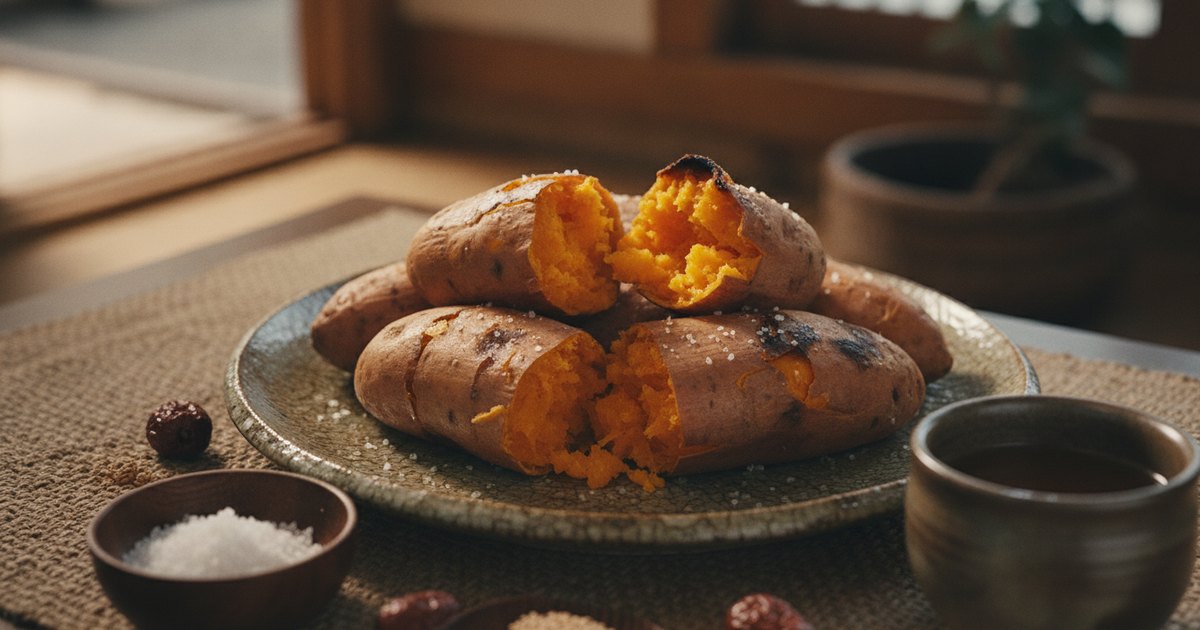
On a bitter winter evening in Seoul, few sensory experiences are as immediately comforting as the sweet, faintly smoky scent drifting from a street vendor's charcoal drum. Gun-goguma (군고구마) — literally "roasted sweet potato" — is one of Korea's most beloved cold-weather street foods, sold from battered tin roasters on busy corners from late autumn well into February. A vendor scoops a hot potato into a brown paper bag, you clutch it like a hand warmer, and then you eat it standing on the pavement. No sauce, no butter, no garnish. Nothing else is needed.
What makes a properly roasted Korean sweet potato so remarkable is how deeply, almost impossibly sweet it becomes with zero added sugar — a concentrated, caramelized sweetness that pools in amber droplets from the cracks in the skin and transforms the interior into something resembling warm custard. That transformation is entirely natural and entirely reproducible in a home kitchen, once you understand two things: which variety of goguma to buy, and why a slow start always beats a fast blast of heat.
This guide covers all of it — the variety question, the enzyme science, three tested home methods with precise temperatures, and the sensory cues to tell you exactly when you've landed it correctly.
A Brief History in a Brown Paper Bag
The sweet potato (고구마, goguma) arrived in Korea during the Joseon era, likely in the 18th century, through trade routes passing via Japan. While the precise date of introduction is debated among food historians, what is documented is how quickly and decisively it embedded itself in Korean food culture — first as a famine-relief crop capable of thriving in poor soils where rice couldn't, then over time as a staple snack food and, eventually, an icon of street food culture.
The evolution from subsistence food to beloved street snack is a common Korean food story: resourceful home cooking scaled up and sold from a cart, refined through repetition into something people would seek out even when they didn't need it. Today, the gun-goguma vendor's drum — often a repurposed oil barrel mounted on a small cart, heated with coal or wood — is as much a part of Seoul's winter scenery as the Han River fog rolling in from the south. The smell hits you from half a block away: not the sharp sweetness of candy, but something richer and earthier, like caramelized starch and autumn bonfires folded together.
The Goguma Varieties: Why Your Choice of Potato Changes Everything
This is the most important variable in gun-goguma, and the one most Western recipes skip right past. Korean sweet potatoes are not the same as the orange-fleshed sweet potatoes standard in North American supermarkets. They are a different variety category with different flesh textures, starch compositions, and flavor profiles — and the variety you choose will determine whether you get a dry, nutty result or a moist, syrupy one.
The Main Types You'll Encounter
Hobak-goguma (호박고구마, "pumpkin sweet potato"): Light brown skin, deep golden-yellow flesh that shades toward orange when raw. When slow-roasted, the interior becomes exceptionally moist and almost custard-like, with caramel syrup visibly pooling at the stem end. The name "pumpkin" refers to the flesh color rather than the flavor. For the weeping-caramel, street-vendor-style result, this is commonly the preferred variety.
Bam-goguma (밤고구마, "chestnut sweet potato"): Reddish-purple skin, golden-yellow flesh. Denser, firmer, and drier than hobak-goguma after roasting, with a distinctly nutty flavor that earns the chestnut comparison. This is typically the variety found at Western retailers like Whole Foods, and it makes a genuinely delicious gun-goguma — just expect a different texture profile: more like roasted chestnuts than warm custard. It doesn't usually produce dramatic amber caramel drips the way hobak-goguma does.
Mul-goguma (물고구마, "water sweet potato"): Higher natural moisture content, milder flavor, typically longer and thinner in shape. A good middle-ground option when available.
A note on "kkul-goguma (꿀고구마, honey sweet potato)": You'll see this label at Korean markets. It isn't always a distinct, standardized cultivar — it more often refers to a particularly well-cured, high-brix example of another type, most frequently hobak-goguma or a close hybrid. If a vendor labels something kkul-goguma, expect it to be very sweet and moist.
What about Japanese sweet potatoes? They're closely related to bam-goguma — purple skin, yellow flesh, dry and nutty when roasted — and a perfectly valid substitute wherever dedicated Korean varieties aren't available.
Shopping tip: For hobak-goguma specifically, an H Mart or Korean grocery store is your best bet — they're usually labeled "Korean sweet potato" or written in hangul on the bin. Outside Korean stores, Japanese sweet potatoes from Whole Foods or Trader Joe's are the closest widely-available substitute and will give you a solid result.
The Science Behind the Sweetness
This is the part that changes how you'll cook gun-goguma from now on. Sweet potatoes naturally contain an enzyme called β-amylase, which cleaves starch molecules into maltose, a naturally occurring sugar. Under optimal conditions, this enzymatic conversion can account for a substantial portion of the potato's final sugar content — which explains why a slow-roasted goguma tastes so much sweeter than a raw one or a quickly boiled one.
The critical detail: β-amylase is most active in a temperature window of roughly 130–150°F (54–65°C), and it completely denatures — stops working permanently — above approximately 158°F (70°C), which is also around the starch gelatinization point.
In practical terms: if you roast sweet potatoes at high heat from the start, you kill the enzyme before it has meaningful time to work. The starch gelatinizes, the enzyme is denatured, and the result is a cooked potato that never developed its full potential sweetness. Start low and slow — hold the potato in that enzyme-active temperature zone long enough for the conversion to run — and you end up with dramatically more maltose, a more caramelized interior, and an altogether sweeter result.
This is why the traditional charcoal drum produces such extraordinary sweetness: coal heat is gradual by nature, and the thick walls of a drum roaster moderate the temperature rise in a way a preheated oven at full blast cannot. The graduated-temperature oven method below recreates this effect at home.
Three Methods for Home Cooking
Method 1: Graduated-Temperature Oven (Best Results, ~80 min)
This is the most science-aligned approach and the method that most closely reproduces the deep sweetness of a street vendor's drum. It takes longer than a straightforward high-heat bake, but the payoff is significant. Full instructions are in the recipe card above. A few key technique notes:
- The first 40 minutes at 250°F (120°C) is the enzyme phase. The kitchen will barely smell like anything and the potato will look essentially unchanged. This is correct — work is happening at the molecular level, not the sensory one.
- When you raise to 400°F (200°C), the maltose that β-amylase has been building now has the heat it needs to caramelize. This is when the kitchen starts to smell extraordinary.
- Do not pierce the skin at any point. Keeping the potato sealed traps interior steam that helps the flesh cook evenly from the inside out, producing that characteristic uniform-custard interior rather than a dry outer ring and wet core.
Method 2: Stovetop / Heavy Pot (No Oven Required, ~50–60 min)
This method mimics the closed drum roaster and is ideal when your oven isn't available or you're only cooking one or two potatoes.
Heat a heavy-bottomed pot or Dutch oven over medium-low. Add the whole, dry, unpeeled potatoes in a single layer and cover with the lid. Roast over medium-low, turning every 10–15 minutes, for 50–60 minutes total depending on size. The potatoes need dry, indirect heat — not steam. If you see moisture condensing on the lid and dripping back down, reduce the heat and crack the lid a centimeter. The skin should gradually tighten and darken, and you'll begin to smell caramel in the final 15 minutes. Test doneness with a chopstick through the thickest point.
Method 3: Air Fryer (Quickest, ~40–45 min)
Place whole, dry, unpeeled potatoes in the air fryer basket without crowding. Cook at 375°F (190°C) for 40–45 minutes, turning once at the halfway point. The air fryer's high convective heat moves through the enzyme-active temperature window quickly, so the result is slightly less maximally sweet than the graduated oven method — still very good, just a somewhat different point on the sweetness curve. This is the right choice when you want gun-goguma in under an hour with minimal fuss.
How to Tell When It's Done
Regardless of which method you use, these are the diagnostic cues to watch for:
- The resistance test: A chopstick, thin skewer, or paring knife slides through the thickest part of the potato with zero resistance — like pushing through soft butter. Any perceptible firmness at the core means more time is needed.
- Skin appearance: Tightened and wrinkled, darkened to deep reddish-brown or even near-black in spots. A potato that still looks smooth and plump isn't done.
- Syrup weep: Amber to dark brown droplets of caramelized sugar visible at the stem end or through small cracks in the skin. For hobak-goguma especially, this is your most reliable visual confirmation that sugars have fully concentrated.
- Smell: The kitchen smells of caramelized sugar and warm starch — rich, sweet, slightly nutty. If the potato still smells neutral or faintly raw, give it more time.
Serving Gun-Goguma the Korean Way
Eat it plain — this is always the correct first move. The flavor needs nothing else. Split the potato lengthwise, let the steam escape for a moment, and eat straight from the skin with a spoon or directly with your hands.
The one traditional accompaniment worth knowing about is kimchi. The fermented acidity and chile heat cut right through the potato's richness, and this pairing has been a fixture of Korean food culture for generations. It's not garnish — it functions as the contrasting element that keeps the meal from being one-note. If you've been meaning to make your own kimchi but haven't started yet, our step-by-step kimchi guide walks you through the whole process.
Non-traditional additions you'll encounter at modern Korean cafes include a pat of salted butter pressed into the split interior, a drizzle of honey, or even a swipe of nut butter. These are enjoyable, but they move you away from the traditional experience. At minimum, try it plain first.
If you want to build out a proper Korean winter street food spread at home, hotteok (sweet stuffed pancakes) are the natural companion to gun-goguma — both are sold from the same types of street carts and eaten in the same casual, standing-up way.
Common Mistakes to Avoid
1. Starting at High Heat
Jumping straight to 400°F (200°C) skips the β-amylase phase almost entirely. You'll produce a cooked sweet potato, but the interior will be noticeably starchier and less sweet than one started low. This is the most common error in Western adaptations of the recipe. Fix: Always begin at 250°F (120°C) for the first 40 minutes, even though it feels slow. The flavor difference is not subtle.
2. Piercing the Skin Before Roasting
Gun-goguma is not a baked potato. Piercing lets steam escape, dries out the interior, and disrupts the even, slow-cook effect that produces the custard texture. Fix: Leave the skin completely intact from start to finish.
3. Putting a Wet Potato in the Oven
Skipping the drying step after washing means residual surface moisture turns to steam around the potato, slowing the skin from tightening and caramelizing properly. The skin ends up soft and pale rather than wrinkled and dark. Fix: After washing, pat each potato thoroughly dry on all sides before it goes into any cooking vessel.
4. Using the Wrong Sweet Potato
Trying to make gun-goguma with standard orange-fleshed American varieties (Beauregard, Jewel, Garnet) produces a wetter, softer, less structured result with a different sweetness profile. It's not unpleasant, but it isn't gun-goguma in the meaningful sense. Fix: Seek out Korean or Japanese sweet potatoes — bam-goguma and hobak-goguma are both correct for this dish, just different in texture outcome.
5. Skipping the Rest Period After Cooking
Cutting into the potato immediately off the heat releases internal steam rapidly, and the interior can collapse into a wet, gummy mash rather than holding the silky custard structure it should. Fix: Rest for a full 5 minutes after removing from the oven or pot. The sugar sets slightly and the interior firms up into the right texture.
6. Crowding the Pan
Sweet potatoes need dry, circulating heat on all sides to develop the characteristic wrinkled, caramelized skin. Pack them too close together and they effectively steam each other, producing soft, pale skin with none of the Maillard caramelization that signals a proper gun-goguma. Fix: Single layer, space between each potato, always.
Frequently Asked Questions
Can I use regular orange sweet potatoes if I can't find Korean varieties? You can, and the result will still be edible — but expect a noticeably different dish. Orange-fleshed American sweet potatoes have higher initial moisture content and a different starch structure, producing a softer, wetter result with less of the firm-exterior, creamy-interior contrast that defines gun-goguma. Korean or Japanese sweet potatoes are worth the extra trip to an Asian grocery store for the authentic experience.
How do I store and reheat leftovers? Cool completely, then refrigerate in an airtight container for up to 3 days. To reheat: wrap in foil and warm in a 350°F (175°C) oven for 15–20 minutes, or use an air fryer at 350°F (175°C) for 8–10 minutes. Avoid the microwave — it turns the texture waterlogged and uneven. Cold gun-goguma eaten straight from the refrigerator is actually worth trying once; the sugars concentrate and the flesh firms up pleasantly.
Do I need to season the potato during cooking? No. The authentic preparation uses nothing but the potato itself — no oil, no salt, no sugar. The sweetness that develops through the enzymatic process is sufficient and the primary reason to make the dish. A small pinch of flaky salt on the cut interior at serving is the maximum you'd add if you want to heighten sweetness perception, but it's entirely optional and non-traditional.
Why does my gun-goguma come out starchy rather than sweet? This is almost always a heat issue. Either the oven started too hot (killing the enzyme before conversion could happen), the potato was too large for the heat to hold it in the enzyme-active temperature window long enough, or the low-temperature phase was cut short. Fix: Use smaller-to-medium potatoes for more even heat penetration, use the graduated-temperature method without skipping or abbreviating the low-heat phase, and accept that this dish rewards patience over speed.
Is gun-goguma actually healthy? Korean sweet potatoes are genuinely nutritious — good sources of dietary fiber, vitamin A precursors, vitamin C, and potassium. Because gun-goguma is cooked without any added fat or sugar, the nutritional profile of the potato is essentially intact. The slow roasting does increase the glycemic impact compared to boiling (by converting starch to rapidly-digested sugars), but the fiber content moderates the overall blood sugar response. As a snack, a medium potato is both satisfying and nutrient-dense in a way that most convenience foods are not. ```