
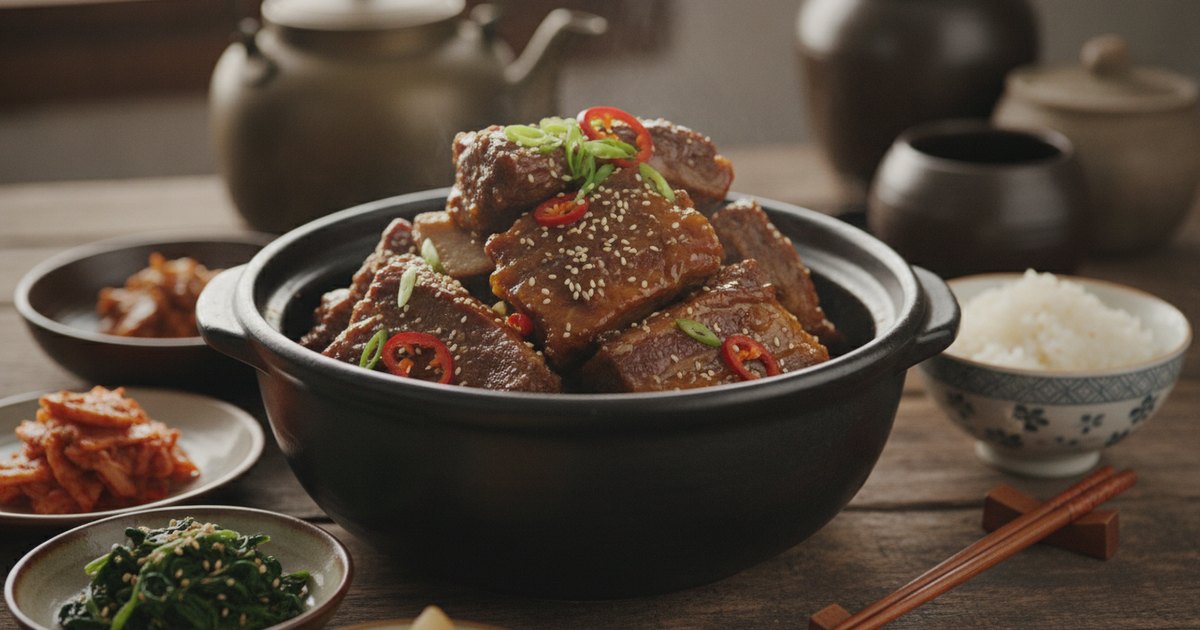
The smell alone announces it before the pot even reaches the table — soy, garlic, a deep caramelized sweetness, something intensely meaty drifting through the kitchen after hours of quiet, low-heat work. Galbi jjim (갈비찜) is Korea's definitive braised short rib dish: bone-in beef gone fall-apart tender in a lacquer-dark sauce, root vegetables stained mahogany and glossy, the whole thing tasting like a Sunday roast and a slow-cooked BBQ feast somehow had a very good idea together.
For Korean cooks, this is ceremonial food. Galbi jjim appears at Chuseok (추석, the harvest festival), Seollal (설날, Lunar New Year), milestone birthdays, and celebratory family dinners that justify the three-hour commitment it requires. The chestnuts, jujubes, and egg garnishes in traditional recipes aren't decoration — they carry meaning: symbols of abundance, prosperity, and care. When a Korean family puts galbi jjim on the table, they're saying this meal matters.
The good news for home cooks in Western kitchens: galbi jjim rewards patience far more than technical skill. The method is forgiving. The flavor payoff is extraordinary. And if you know which specific pitfalls to avoid — the wrong cut of rib, a mistimed sauce, an under-reduced glaze — this dish is entirely within reach on a weekend afternoon. Here is everything you need to know.
What Is Galbi Jjim? A Dish With Royal Roots
Galbi (갈비) means "ribs" in Korean — most commonly beef, though pork galbi exists too — and jjim (찜) is a broad Korean culinary term covering dishes that are braised or steamed until deeply tender. The combination appears in Korean culinary history as far back as the Joseon Dynasty (1392–1897), where royal court (gungjung) cuisine elevated it into an elaborate, multi-garnished centerpiece dish.
Traditional royal versions featured precisely cut rib pieces arranged with strips of separately cooked egg white and yolk (jidan), chestnuts, pine nuts, and deep-red jujubes — as much visual theater as it was sustenance. Home versions today are less formal but the intention is identical: galbi jjim is effort food, made with awareness of the occasion it's serving.
If you've explored Korean BBQ at home, you already know galbi in its grilled form — the thin, crosscut LA-style ribs marinated in sweet soy sauce, cooked fast over high heat. Galbi jjim is the low-and-slow counterpart: the same flavor language (soy, garlic, sweetness, sesame), a completely different cut, and cooking logic that runs in the opposite direction.
Choosing the Right Short Ribs
This is where galbi jjim goes wrong most often, before a single drop of sauce hits the pot.
You need thick, bone-in beef short ribs cut into chunks — not the thin flanken-style strips. The reason is fundamental to how braising works: galbi jjim requires long, moist cooking time for the collagen in the connective tissue to convert to gelatin, which gives the sauce its clingy, glossy, almost syrupy body. Thin flanken strips (the kind sold for Korean BBQ grilling) are designed for fast, high-heat cooking. After two hours of braising, they become dry, stringy, and chewy — exactly the opposite of what you want.
What to look for:
- English-cut short ribs: Each piece has one bone running along the short edge, with a generous block of beef above it. You want pieces roughly 7–8 cm (3 inches) tall. In Korean butchery, these are typically cut specifically for braising and sold labeled as such.
- Weight: 1.4–1.8 kg (3–4 lbs) for 4–6 generous servings.
- Marbling: Look for visible intramuscular fat and a good fat cap. Very lean short ribs will be drier and less flavorful after the long braise. The fat renders into the sauce and is a significant source of its richness and body.
Where to find them in Western markets:
- H Mart or any Korean grocery store: Best option. Often pre-cut specifically for galbi jjim, usually labeled clearly.
- Whole Foods, Butcher Box, or local butcher: Ask for English-cut bone-in short ribs, cut into 7–8 cm (3-inch) pieces. Most good butchers will do this on request.
- Costco: Carries bone-in short ribs in larger packs — good value for a big batch or freezing.
The Braising Sauce: What Goes In and Why
The galbi jjim sauce balances five distinct dimensions: salty depth from soy sauce, sweet roundness from sugar and honey, aromatic warmth from garlic and ginger, mild acidity from rice wine, and a finishing richness from sesame oil. Here are the consensus proportions from the most widely respected Korean recipe sources, scaled for 1.6 kg (3½ lbs) of ribs:
Core sauce — combine before cooking:
| Ingredient | Amount |
|---|---|
| Korean soy sauce (ganjang) | 80–120 ml (⅓–½ cup) |
| Granulated or brown sugar | 2–3 tablespoons (25–38 g) |
| Honey | 2 tablespoons (40 g) |
| Mirin or Korean rice wine (cheongju) | 60 ml (¼ cup) |
| Garlic, minced | 6–8 cloves (~2 tablespoons) |
| Fresh ginger, grated | 1 teaspoon |
| Ground black pepper | ½ teaspoon |
Added only at the very end, off the heat:
- Sesame oil: 1–2 tablespoons
An important note about seasoning the raw sauce: it should taste noticeably intense at this stage — saltier and sweeter than finished food. That's correct. It will be diluted by water, tempered by the rendered fat from the ribs, and enriched by moisture from the vegetables over two-plus hours. A sauce that tastes perfectly balanced before the braise begins will be bland by the end.
The Asian Pear Question
Three of the five major Korean recipe sources include grated Asian pear or apple in the marinade; two do not. Both approaches are legitimate — this is a genuine regional preference, not a case of one being right.
Why pear works: Asian pear contains natural enzymes that begin breaking down muscle fibers, functioning as both a tenderizer and a natural sweetener that integrates into the sauce. Grate about 100–170 g (roughly ¾ cup) of peeled pear directly into the sauce.
Workable substitutes: A Bosc or D'Anjou pear performs nearly identically. Fuji or Gala apple is a common variation. Some cooks add a small piece of kiwi (high in tenderizing actinidin enzyme) alongside the pear.
If you skip it entirely: The dish is still excellent. The long braise does the heavy tenderizing work. The fruit tenderizer is most helpful with particularly thick ribs or older, tougher beef — consider it a useful option rather than a requirement.
The Vegetables and Traditional Garnishes
Galbi jjim is not a solo-rib dish. The vegetables added midway through the braise absorb the sauce as it concentrates and become almost as compelling as the meat itself.
The core vegetable trio:
- Korean radish (무, mu): 280–340 g (10–12 oz), peeled and cut into 4 cm (1½-inch) cubes. The radish turns translucent and silky during braising, soaking up the sauce like a sponge. If it's your first time eating galbi jjim radish, it's a revelation — deeply savory and tender with a slight sweetness. Substitute: daikon radish, which is nearly identical and sold at most Asian markets.
- Carrots: 2 medium, cut into 3 cm (1-inch) chunks or oblique cuts. They add color, mild sweetness, and textural variety.
- Dried shiitake mushrooms: 4–6 mushrooms, soaked in cold water for at least 30 minutes until fully rehydrated, stems removed. Cut larger caps in half. Save the soaking liquid — it's concentrated with umami and can replace some of the braising water for additional depth.
Traditional festive garnishes (optional, but they communicate occasion):
- Chestnuts (밤, bam): 8–10 peeled chestnuts. Fresh are ideal in season; vacuum-packed or frozen work beautifully year-round and are sold at most Korean grocery stores.
- Dried jujubes (대추, daechu): 8–10 red dates, soaked briefly if very dry. They contribute subtle sweetness and the deep red color is considered auspicious at Korean celebrations.
- Pine nuts (잣): Scattered over the finished dish.
- Egg garnish (지단, jidan): Thin strips of separately cooked egg white and yolk — a royal court tradition still practiced for formal presentations.
Step-by-Step Method
Step 1: Soak the Ribs
Place the short ribs in a large bowl and cover with cold water. Soak for at least 30 minutes — ideally one full hour — changing the water once midway. The water will cloud and turn pinkish-red as blood draws out. This step significantly reduces any gamey odor and produces a cleaner-tasting braising liquid. Drain and rinse.
Step 2: Blanch and Clean the Ribs
Place the soaked ribs in a large pot and cover with cold water. Bring to a boil over high heat. The water will foam aggressively and turn gray-brown within the first minute — that's exactly what you want drawn out. Boil for 6–8 minutes, then drain. Rinse each rib individually under cold running water, rubbing off any gray bits or coagulated protein from the surface. Pat completely dry with paper towels.
At this point, the ribs should smell clean and meaty. Any lingering off-odor means they need more rinsing, or the soaking step needed more time.
Step 3: Make the Sauce and Marinate
Combine all sauce ingredients in a large Dutch oven or heavy-bottomed pot. Add the blanched ribs and toss to coat. Marinate for at least 30 minutes at room temperature, or refrigerate overnight. The overnight marinade genuinely makes a difference — you can taste the depth of penetration in the finished dish.
Step 4: First Braise
Add 480 ml (2 cups) water to the pot. Bring to a boil over high heat, skim any foam, then reduce heat to medium-low. Cover tightly and simmer for 1 hour 15 minutes, turning the ribs once at the halfway mark.
The liquid should maintain a steady, quiet simmer throughout — you should see small, consistent bubbles but not an aggressive rolling boil. If the lid is rattling and steam is blasting out, the heat is too high. After about an hour, the braising liquid will have turned a deep mahogany color and smell intensely savory and slightly sweet. Skim any pools of rendered fat from the surface.
Step 5: Add the Vegetables
Stir in the radish, carrots, shiitake mushrooms, chestnuts, and jujubes. The liquid should come roughly halfway up the ribs — add more water or mushroom soaking liquid if needed. Cover and simmer for another 30–45 minutes.
Timing signals to watch for: The radish is ready when it's fully translucent and a chopstick slides through with almost no resistance. The carrots should be completely tender. If either vegetable still has any crunch, give it more time — the braising liquid is only getting better.
Step 6: Reduce the Sauce
This step transforms the dish from "braised ribs" to galbi jjim. Remove the lid and increase heat to medium-high. Cook for 10–15 minutes, occasionally tilting the pot and basting the ribs with the liquid. You're watching for the braising liquid to reduce to a sticky, glossy glaze — it should visibly coat the ribs and cling to the back of a spoon with a syrupy consistency. The color deepens noticeably during this stage.
The meat will now be completely fall-off-the-bone tender. If you can slide the bone cleanly out of the rib with almost no resistance, the texture is right.
Step 7: Finish and Serve
Turn off the heat. Drizzle sesame oil over the pot and fold it in gently — sesame oil's aromatic compounds dissipate at high heat, so adding it off the flame is intentional. Taste and adjust seasoning.
Transfer to a serving bowl and garnish with sliced scallions and toasted sesame seeds. Galbi jjim is traditionally served family-style from a communal dish. The sauce pooled at the bottom is meant for spooning generously over steamed short-grain rice — it's not a side note, it's the point.
For serving ideas, the banchan guide has excellent pairing suggestions: spinach namul, bean sprout salad (kongnamul), and steamed egg (gyeran jjim) are classic companions.
Sourcing Guide for Western Kitchens
| Ingredient | Best Source | Acceptable Substitute |
|---|---|---|
| Korean soy sauce (ganjang) | H Mart, Korean grocery | Kikkoman regular (not low-sodium) |
| Mirin / cheongju (rice wine) | H Mart, Whole Foods Asian aisle | Dry sherry or sake (similar function) |
| Asian pear | H Mart, some Whole Foods | Bosc pear; Fuji or Gala apple |
| Korean radish (mu) | H Mart, any Asian market | Daikon (nearly identical) |
| Dried shiitake mushrooms | Any Asian grocery, Amazon | Dried porcini (flavor varies slightly) |
| Dried jujubes / red dates | Korean or Chinese grocery, Amazon | Skip, or use a few pitted Medjool dates |
| Chestnuts | H Mart (vacuum-packed, peeled) | Canned chestnuts, well-rinsed |
| Rice syrup (물엿) | H Mart | Corn syrup (for gloss); or omit |
Mirin or cheongju is genuinely worth the trip to a specialty store. The mild acidity and subtle sweetness it contributes to the braise are functionally different from adding more sugar — particularly in how the sauce's body develops during reduction.
Common Mistakes to Avoid
1. Skipping the Blanching (or the Soak Before It)
Blanching is not optional aesthetic housekeeping — it's a structural step that directly determines whether your braising liquid tastes clean and deep or muddy and slightly sour. The foam you see during blanching is blood, coagulated protein, and off-flavor compounds that would otherwise spend two hours leaching into your sauce. If you blanch and see very little foam, it usually means the soaking step was too short. Both steps work in sequence: the soak draws blood out of the tissue; the blanch captures and discards what's left on the surface. The blanching water should be gray and aggressively foamy. That foam belongs in the drain.
2. Using the Wrong Cut of Rib
Thin LA-style flanken ribs — the kind cut across multiple bones for Korean BBQ grilling — will disintegrate and dry out after two hours of braising. They have neither the collagen content nor the meat mass to survive long, moist cooking. Before you start, physically check your ribs: each piece should have one bone, a thick block of beef sitting above it, and feel substantial in your hand. If the rib looks like a short, thin strip with multiple bones visible along the cut edge, it's flanken. Return it.
3. Tasting the Raw Sauce and Deciding It's Too Strong
This mistake leads to a thin, underseasoned braise. The raw sauce — before water and vegetables go in — is supposed to taste intense. It will dilute significantly during two-plus hours of cooking with water, rendered fat, and vegetable moisture. Cooks who find the pre-braise sauce "too salty" and add more water typically end up with a watery, flat finished dish that no amount of reduction can fully rescue. Trust the ratios; calibrate by tasting in the final reduction phase, not the beginning.
4. Braising at Too High a Heat or Rushing the Timeline
A lid rattling on a boiling pot is the wrong image for galbi jjim. The collagen-to-gelatin transformation that makes short ribs meltingly tender is a slow enzymatic process — it happens efficiently at a gentle simmer (around 85–93°C / 185–200°F) and stalls out or causes the meat to seize and toughen at a rolling boil. If your pot is boiling hard, the meat on the outside of the rib is overcooking while the collagen inside hasn't had time to break down. Reduce the heat until you see small, lazy bubbles. Plan for the full time — 1 hour 45 minutes to 2 hours 15 minutes of liquid cooking time is not excessive.
5. Adding the Vegetables Too Early (or Too Late)
Radish and carrots added at the start of the braise will dissolve into the sauce by the time the meat is tender — you'll have richly flavored liquid and no vegetable pieces to serve. Mushrooms added in the final 10 minutes won't have had time to absorb the sauce's flavor. The correct timing — vegetables in with about 30–45 minutes of liquid cooking time remaining — gives them enough time to become silky and sauce-saturated without disintegrating. Use the fork test on your radish to confirm doneness before the sauce reduction begins.
6. Not Reducing the Sauce at the End — or Walking Away During Reduction
The reduction stage is what converts galbi jjim from "braised beef in brown liquid" to the lacquered, glossy centerpiece dish it's supposed to be. Without it, the sauce is too thin and won't cling to the ribs. With it, the texture becomes syrupy and the flavors concentrate dramatically. But this is also the most temperamental five minutes of the whole recipe: the sugar content means the sauce can go from perfectly glossy to scorched and bitter fast. Stay at the stove during reduction. Tilt the pot and baste constantly. Pull it the moment the sauce coats a spoon with a visible, sticky sheen — better to slightly under-reduce than to scorch.
Frequently Asked Questions
Can I make galbi jjim in an Instant Pot or slow cooker?
Yes, with adjustments. For the Instant Pot: after blanching and marinating, pressure cook with 240 ml (1 cup) water on HIGH for 45 minutes, then natural release for 15 minutes. Add the vegetables and pressure cook on HIGH for another 8 minutes, quick release. Finish by reducing the sauce using the sauté function with the lid off, watching closely. For the slow cooker: cook marinated ribs on LOW for 7–8 hours or HIGH for 4–5 hours; add vegetables for the last 2 hours on LOW. You'll need to finish by reducing the sauce in a separate saucepan. Results from both methods are good, though the stove-braised version develops more layered flavor from the gradual, open reduction.
Can galbi jjim be made ahead of time?
It's actually better the next day. The flavors deepen overnight, and the rendered fat solidifies on the surface in the refrigerator, making it easy to skim before reheating. Reheat gently over medium-low heat, adding a small splash of water if the sauce has thickened too much. Galbi jjim keeps for 3 days refrigerated and freezes well for up to 2 months — freeze in portion-sized containers with plenty of sauce.
My finished sauce is too salty. How do I fix it?
Start with balance: a small addition of honey or a teaspoon of sugar can pull excess saltiness back into proportion. If it's significantly over-salted, add a few cubes of raw potato to the pot and simmer for 15–20 minutes — potato absorbs salt effectively — then discard before serving. For future batches, start at the lower end of the soy sauce range (80 ml / ⅓ cup) and taste before adding more.
What's the difference between galbi jjim and the galbi you grill at Korean BBQ?
The key difference is the cut and cooking method. Grilled galbi — often called "LA galbi" or flanken-cut — are thin slices cut across the rib bones, marinated in a similar sweet soy sauce and cooked quickly over high heat. Galbi jjim uses thick, bone-in English-cut pieces braised slowly for hours. The flavor profile is related, but the textures and cooking logic are opposites: one is fast and charred, the other is slow and silky. If you want to explore both styles, the Korean BBQ at home guide covers galbi grilling in full.
What should I serve alongside galbi jjim for a full Korean holiday meal?
Steamed short-grain rice is non-negotiable — the sauce-saturated rice at the bottom of your bowl is one of the best bites in Korean food. Classic banchan pairings include kimchi, spinach namul (시금치나물), bean sprout salad (콩나물무침), and steamed egg (계란찜). At Korean holiday tables — Chuseok, Seollal — galbi jjim traditionally appears alongside japchae, the glass noodle stir-fry, which complements the rich braise with something lighter and vegetable-forward. Together, the two dishes form the ceremonial core of a Korean feast. ```