
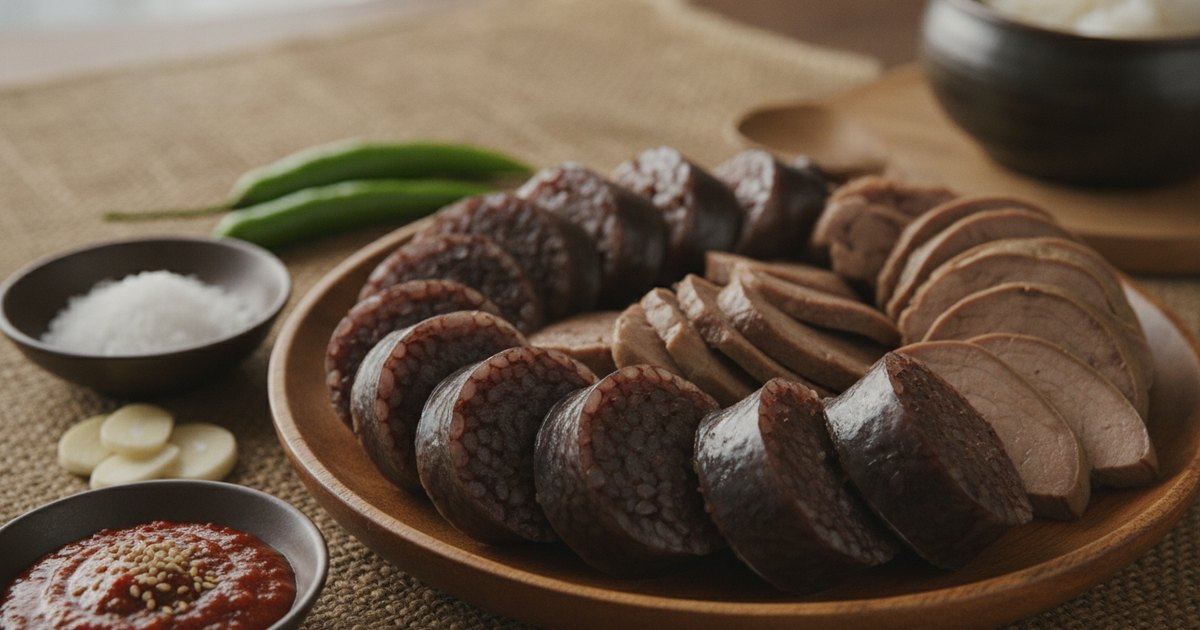
Korea's street food scene has a hall of fame. There's tteokbokki with its brick-red sauce, hotteok crisping on winter griddles, and skewers of everything imaginable lined up under tent awnings. But tucked into the pojangmacha (street food cart) stalls of Gwangjang Market and the covered gastronomic corridors of bus terminal food courts across the country sits a dish that separates the curious from the truly committed: soondae (순대), Korea's iconic blood sausage.
Dark, chewy, subtly earthy, and deeply satisfying, soondae has a devoted following that stretches across generations of Korean eaters. To the uninitiated, it can look intimidating — that near-black cross-section is not exactly inviting if you've never seen it before. But one bite of a properly made soondae, fresh from the steamer with just a pinch of salt, and the logic becomes immediately clear. This is humble, resourceful, extraordinary food. And it's worth making at home.
What Is Soondae (순대)?
Soondae is a Korean sausage made by stuffing cleaned pork intestine with a filling built around three core elements: fresh pork blood, cooked glutinous (sweet) rice, and dangmyeon — the chewy, translucent sweet potato starch glass noodles you may know from japchae. These are bound together with aromatics — scallions, garlic, ginger, sesame oil — and often deepened with a spoonful of doenjang (fermented soybean paste) before the whole thing is steamed until firm and sliceable.
The name is sometimes romanized as sundae, which causes perpetual confusion with the frozen dessert. They are emphatically unrelated.
Soondae's roots in Korean food culture stretch back centuries. Blood sausage preparations appear in Joseon-era (1392–1897) culinary records, and the dish's broader popularity accelerated in the mid-20th century as resourceful cooks and street vendors stretched every part of the animal as far as it would go. What emerged was something that managed to be both frugal and deeply delicious — a combination that tends to produce the most enduring foods in any culture. Today, soondae is one of the most reliably available snack foods at traditional Korean markets and pojangmacha from Seoul to Busan.
A note on terminology: the Korean word seonji (선지) specifically refers to congealed blood used as an ingredient — in soondae, the blood is typically used in its liquid form and mixed directly into the filling. It's a related but distinct preparation worth keeping straight when you're navigating a Korean recipe or grocery store.
Regional Variations: Soondae Across Korea
Part of what makes soondae so interesting to explore is how dramatically it varies from one region to the next. The pojangmacha version most Westerners first encounter is really just one expression of a much wider category.
Seoul / pojangmacha style is the reference point for most people: glass noodles and glutinous rice dominate the filling, the texture is bouncy and firm, and it arrives dipped in or alongside tteokbokki sauce and eomuk (fish cake) broth. It's a deeply communal eating experience.
North Korean-influenced versions (sometimes called abeoji soondae) lean on cooked barley rather than glutinous rice, or a mix of the two. The result is earthier, slightly coarser in texture, and arguably more filling.
Jeju-do soondae is perhaps the most distinctive regional form — so distinctive that the Slow Food Foundation's Ark of Taste has recognized it as a heritage food worth conserving. Jeju soondae is made using meat from the island's native black pigs and often incorporates local herbs like minari (water parsley). The filling ratios and flavor profile differ significantly from mainland versions.
Ojingeo (squid) soondae is a coastal specialty associated with the Sokcho area on Korea's east coast, where the same filling is stuffed into a cleaned whole squid body instead of pork intestine. The casing gives the finished sausage a sweeter, marine character entirely its own. This variant is a useful reminder that "soondae" describes a method and a filling philosophy as much as a specific casing — it's a remarkably adaptable format.
Modern commercial soondae is also commonly made with artificial casings rather than natural intestine. Packaged soondae from Korean grocery stores nearly always uses this method, which produces a very uniform texture and requires no intestine-cleaning prep work whatsoever.
Finding Ingredients in Western Kitchens
Making soondae from scratch in a Western kitchen requires planning, but the ingredient access situation has improved enormously in recent years.
Pork blood is your first sourcing challenge. H Mart, 99 Ranch Market, Lotte Plaza, and most Korean or Chinese supermarkets carry it — typically frozen in 1-liter containers near other pork products. In cities with a halal butcher community, those shops often carry pork blood when asked. If you're in a more rural area, call ahead to specialty butchers; heritage pork farms that do whole-animal processing will often sell it if you ask.
Pork small intestines are available at Korean and Chinese grocers (sometimes already partially cleaned and packed with salt), and in parts of the American South under the name "chitlins." The scrubbing process is unavoidable regardless of source — plan for it.
Dangmyeon (sweet potato starch glass noodles) are widely stocked at Asian grocers and increasingly available in the international aisle of mainstream stores. They're the exact same noodles used in japchae.
Glutinous rice (sweet rice, sticky rice — the labels vary) is available at virtually every Asian grocery and in most natural food stores. Do not substitute regular short-grain or jasmine rice; the high amylopectin content of glutinous rice is what gives the interior its characteristically dense, slightly springy texture.
Doenjang (Korean fermented soybean paste) is a flavor multiplier in this filling. H Mart carries it reliably. In a pinch, Japanese red miso (aka miso) is a workable substitute — it contributes the same deep, savory fermented quality without identical flavor, but it won't ruin the dish.
How to Make Soondae at Home: Technique Breakdown
The full recipe with precise quantities appears in the recipe card above. What follows is a closer look at the technique and sensory checkpoints that make the difference between a soondae you're proud of and one that goes sideways.
Cleaning the Casings — Don't Skip a Step
This is where most first attempts go wrong. A single rinse with plain water is not sufficient to remove the inherent odor of pork intestines. The correct method — repeated scrubbing with a mixture of coarse salt and all-purpose flour — works because the salt draws moisture and bacteria while the flour acts as a mild abrasive that physically lifts residue. Rinse between scrubs. By the second or third pass, the water should run completely clear. The smell test is equally important: a properly cleaned casing should smell faintly neutral, like clean meat. Any sharpness or ammonia-like quality means another round of scrubbing.
Building the Filling
Before stuffing, your filling should look like a thick, dark reddish-brown porridge — the blood gives it this deep color, and the pale grains of rice and the slightly translucent noodle pieces should be clearly visible against it. If the filling looks uniformly purple-black and you can't distinguish the rice, the ratio is off or the rice was over-moistened.
The smell at this stage: primarily sesame and scallion, with a faint background iron note from the blood. That iron note will mellow significantly during steaming.
Stuffing and Steaming
Go slow with the stuffing. A sausage funnel makes this far easier than improvising; a wide-mouth funnel or even the neck of a clean plastic bottle cut down works as a substitute. The critical rule: leave room. That 3cm (1 inch) of slack at the tied end is insurance against bursting as the rice swells.
Steam over actively boiling water — not simmering, actively boiling — so the heat penetrates quickly and evenly. The casing tightening around the filling and the sausage becoming firm to a light press are your two visual and tactile checkpoints. Don't rely on color alone; the exterior casing doesn't change dramatically in appearance during cooking.
Slicing
Patience here pays off visually. Straight from the steamer, the soondae interior is too soft and cohesive to yield clean slices — you'll compress and smear the filling. Five minutes of resting lets the structure firm. Then slice on a diagonal for the most attractive presentation; diagonal cuts show a larger cross-section of that stunning dark interior with its speckling of rice and glass noodle.
How to Serve Soondae
The classic pojangmacha presentation is deliberately minimal: sliced soondae on a plate or in a paper cup, with a small mound of fine salt on the side for dipping. This is the format that lets the clean, savory flavor of the sausage speak for itself.
Gochujang or ssamjang are both common accompaniments — the fermented heat and funk of either paste cuts through the richness of the filling perfectly. In most street food contexts, soondae arrives alongside tteokbokki and eomuk in the same tray, and the spicy-sweet tteokbokki sauce doubles as a natural dip.
For a more substantial meal, soondae is served in soondaeguk — a pale, milky-looking pork bone broth soup with sliced soondae, scallions, and perilla seeds. It's one of the great hangover remedies in Korean culinary tradition.
Soondae Bokkeum: The Weeknight Fast Track
If making from scratch feels like too much on a Tuesday, soondae bokkeum (순대볶음) — stir-fried soondae — is the pojangmacha dish that makes the best possible use of store-bought soondae. Slice it into rounds, then stir-fry in a very hot pan with gochujang, gochugaru, soy sauce, garlic, thinly sliced cabbage, and fish cake if you have it. The sauce should hit the hot pan and sizzle loudly; what you're after is those slightly caramelized, sticky-crisp spots on the cut faces of the soondae rounds. That textural contrast — crispy edges against the dense, chewy interior — is deeply satisfying and far easier to achieve than the from-scratch version. The same heat-management principles we discuss in our guide to Korean BBQ at home apply here: high heat, minimal stirring at the beginning to let the fond build.
Common Mistakes to Avoid
1. Insufficient casing cleaning
One or two rinses with plain water won't neutralize the natural smell of pork intestines. The result is a finished soondae with a persistent gamey, ammonia-tinged odor that no seasoning will mask. Fix: Use the coarse salt and flour scrub method described above, repeated a minimum of two to three times, until the rinse water is clear and the casing smells neutral. This step takes 20–25 minutes and cannot be shortened.
2. Overfilling the casings
The glutinous rice absorbs additional moisture and swells significantly during steaming. A tightly packed casing has nowhere to expand and will burst, releasing the filling into the steamer water. Fix: Fill to about 80% capacity and leave at least 3cm (1 inch) of empty casing at the tied end. A small, careful poke with a thin skewer at the first sign of extreme puffing can also release excess steam pressure before a blowout.
3. Over-soaking the dangmyeon
Glass noodles soaked until fully soft will completely disintegrate into the filling during the steaming process, contributing no texture and making the interior dense and gummy. Fix: Soak for 30 minutes in warm (not boiling) water until the noodles are pliable and bendable but still retain some firmness at the center — like al dente pasta. They will finish cooking inside the casing.
4. Cooking the glutinous rice with a standard water ratio
Standard rice cooking ratios produce glutinous rice that is too wet for this filling. The excess moisture makes the interior gummy and over-dense, and it dilutes the blood-to-filling ratio. Fix: Use approximately 20% less water than usual and spread the cooked rice on a wide tray to steam-dry and cool before incorporating it into the filling. The rice should clump but not be wet to the touch.
5. Skipping the pre-stuffing taste check
Once the filling is inside the casing and steaming, seasoning correction is impossible. Soondae is served with minimal accompaniments, so an under-seasoned interior has nowhere to hide. Fix: Place a tablespoon of filling on a small plate and microwave for 30 seconds to cook it through, then taste. It should be clearly savory with forward sesame notes. Adjust salt before stuffing.
6. Slicing too soon after steaming
The filling directly out of the steamer is too soft and cohesive to hold a clean slice — a knife drags and compresses the interior rather than cutting through it. The cross-section looks smeared rather than showing distinct rice and noodle pieces. Fix: Rest the soondae for a minimum of 5 minutes on a cutting board before slicing. The interior firms as it cools slightly and will yield clean, attractive diagonal rounds.
Frequently Asked Questions
Is soondae safe to eat? What does it actually taste like? Soondae is fully cooked during steaming — the internal temperature reaches well above the food-safe threshold of 75°C (165°F). The flavor is far milder than its appearance suggests. The dominant notes are sesame, scallion, and a gentle savory depth from the doenjang and garlic. The blood contributes an earthy background that experienced eaters liken to a well-seasoned pork filling; there is no pronounced metallic or "iron" flavor in a properly made, well-seasoned soondae. If that metallic note is present, the filling was under-seasoned or the blood wasn't fresh.
Where can I buy pre-made soondae without making it from scratch? Most H Mart locations carry pre-made soondae in the refrigerated or frozen section — typically vacuum-packed in whole logs near the deli case or alongside tteokbokki ingredients. Lotte Plaza, 99 Ranch Market, and independent Korean grocery stores are reliable sources. Alternatively, Korean restaurants that serve pojangmacha-style dishes or have a to-go section often sell it by the portion.
Can I make soondae without blood? A blood-free adaptation is possible — increase the dangmyeon proportion, add an extra tablespoon of doenjang for umami depth, and consider adding finely chopped kimchi for color and flavor complexity. What you get is a glass noodle and rice stuffed sausage that is genuinely tasty. It is, however, a fundamentally different dish; calling it soondae would be a stretch. If blood is the obstacle, starting with store-bought soondae for soondae bokkeum is a lower-commitment way to try the flavors before committing to a full scratch batch.
Can I freeze soondae? Yes, and it freezes well. Freeze cooked soondae in individual portions in a sealed container or zip-lock bag; it keeps for up to 2 months. Reheat from frozen by steaming for 5–8 minutes, which preserves the texture of the casing. Pan-frying sliced frozen soondae directly in a lightly oiled hot pan is another excellent option — the cut faces caramelize while the center heats through. Avoid microwaving whole pieces, which tends to make the casing rubbery and uneven.
How does soondae compare to Western blood sausages like black pudding or boudin noir? The key difference is structural. Western blood sausages typically bind blood with pork fat, oats, grain, or breadcrumbs — the result is dense, fatty, and relatively uniform in texture. Soondae uses glutinous rice and glass noodles as its body, making it chewier, lighter in fat, and more texturally varied (you can feel the distinct noodle pieces in every bite). The flavor profile is also distinctly Korean: sesame, garlic, and fermented soybean paste rather than the thyme, marjoram, and onion of a classic black pudding. If you enjoy any European blood sausage, soondae is a fascinating and worthwhile comparison. ```