
If Kim Seokjin — known worldwide as Jin — ever launches a second career, there’s a strong argument it should be in food. Among BTS’s seven members, Jin has consistently been the most deeply and demonstrably invested in Korean food culture: not just eating, but shopping for ingredients, cooking on-camera with real technique, and passing knowledge to the people around him. When Bon Voyage, Run BTS, and In The Soop put the group in kitchens and cabin retreats, Jin was the member who showed up with a personal filleting knife and a plan. That’s not a bit — that’s a person who genuinely cooks.
This is your deep dive into what Jin actually eats, what he’s cooked on-screen, and how to bring those dishes into your own kitchen.
The Man Behind the Meal: Jin as BTS’s In-House Chef
Jin’s reputation as BTS’s cook is built on years of documented, on-screen evidence. On In The Soop Season 1, he prepared mulhoe (물회 — spicy cold raw fish soup) from scratch, attempted to fillet a live flatfish for the group’s sashimi dinner (he found it harder than expected but persisted), and cooked doenjang-guk (soybean paste soup) and gamasot cauldron fried rice for everyone. On Run BTS, he taught both V and Jimin how to make janchi guksu — a deceptively simple Korean banquet noodle dish that rewards attention to detail — a segment Billboard noted specifically for its warmth.
His long-running YouTube series Eat Jin — a mukbang format before “mukbang” was a global word — is part of why Western audiences first connected food enthusiasm with BTS. The combination of genuine knowledge and on-screen cooking chops makes him an unusual celebrity food figure: the food clearly came before the camera.
On JTBC’s Please Take Care of My Refrigerator, his fridge has been opened twice, and both times it revealed the kitchen of someone who genuinely cooks: assorted sashimi portions (modum hoe), frozen dongchimi brine, homemade beef bone broth, and seafood stacked in deliberate order. In the July 2025 return episode, he showed up talking about mulhoe again. Some people never change — and with Jin, that’s a genuine compliment.
Jin’s All-Time Favourite Dish: Mulhoe (물회)
If you had to summarise Jin’s food identity in a single bowl, it would be mulhoe — Korea’s intensely refreshing spicy cold raw fish soup. On Please Take Care of My Refrigerator’s July 20, 2025 return episode (JTBC), Jin confirmed he eats mulhoe at least three times per week and self-declared the title of “President of the Mulhoe Promotion Association” (Korea Times, July 2025). He’d already made it on-screen during In The Soop, and in May 2025 — when Tom Cruise visited Korea to promote Mission: Impossible – The Final Reckoning and appeared on Run Jin — Jin recommended mulhoe specifically as the Korean food Cruise had to try. That’s not casual enthusiasm; that’s a person on a mission.
What Mulhoe Actually Is
Mulhoe is the antithesis of a heavy, warming soup. Think of it as ice-cold, lightly sweetened gochujang broth poured over sliced raw fish and crisp, julienned vegetables. In Korean summers, it is genuinely transformative — the kind of dish that resets your body temperature and appetite simultaneously.
The broth combines gochujang, doenjang (fermented soybean paste), rice wine vinegar, a small amount of sugar or honey, and crushed garlic — diluted with very cold water or slushed ice. The colour should be a vivid coral-red before you add the ice; if it’s going brown, the gochujang ratio is too low relative to the doenjang. Standard toppings include:
- Thinly sliced white fish — flounder, sea bream, or halibut
- Julienned cucumber, perilla leaves, and green onions
- Cooked somyeon noodles added at the end to soak up the broth
Western kitchen tip: Sashimi-grade halibut or red snapper from a reputable fishmonger works well. For gochujang and doenjang, H Mart stocks the right brands in the right quantities — our H Mart shopping guide has exactly what to reach for. The single non-negotiable: sashimi-grade fish. This is a food-safety matter, not a flavour preference.
Season the broth so it tastes bold and a touch over-acidic before adding ice — the ice will dilute it, and you want the finished bowl to hit a clean, spicy-sour note.
The Cold Noodle Obsession: Naengmyeon (냉면)
At the 2020 BTS Festa Q&A, Jin stated naengmyeon was the food he could eat every single day of the week (sportskeeda.com, blondekimchi.com). He specifically prefers mul-naengmyeon — the pale, clear beef-broth version — over the bibim (spicy, mixed) variant. The broth is clean and deeply savoury, served ice-cold with thin buckwheat noodles that have an elastic, slightly resistant chew unlike any other noodle type.
More telling than the preference itself: his Please Take Care of My Refrigerator appearance revealed he keeps frozen dongchimi brine and frozen beef bone broth at home so he can assemble naengmyeon broth on demand. That’s not something you do unless you’ve thought carefully about what you eat.
For a wider look at what BTS members reach for, our full guide to what BTS eats covers the group’s collective food tastes in detail.
The Rest of Jin’s Confirmed Hit List
Golbaengi Muchim (골뱅이무침) — Seasoned Sea Snail Salad
Golbaengi muchim is a childhood favourite of Jin’s — food writers have specifically noted it aligns with his documented preference for firm, chewy textures (blondekimchi.com). Canned sea snails (whelk) are dressed with gochujang, rice wine vinegar, sesame oil, sugar, garlic, and julienned vegetables, then classically tossed with cooked instant noodles. The result is bracing, spicy, and deeply satisfying. Bon Voyage Season 4, Episode 7 featured the group eating it together — an episode that demonstrably sent Western search traffic for the dish spiking.
Canned golbaengi (whelk) are available at H Mart in the canned seafood aisle, and this is one of the more achievable Korean dishes for a first attempt: open the can, drain, dress, toss.
King Crab and Fresh Seafood
Jin orders king crab approximately every two weeks, describing it as a personal indulgence that became affordable once BTS found its footing (blondekimchi.com). On Eat Jin, he once reportedly ate six lobsters in a single sitting. Beyond the spectacle, his everyday seafood habits are genuinely sophisticated: he keeps assorted sashimi (modum hoe — flatfish, salmon, red sea bream, tuna) fresh in his refrigerator and makes homemade nigiri (chobap) using fresh fish on seasoned rice. He reportedly ate sashimi every day during the COVID lockdown. He brought his own filleting knife to In The Soop — the kind of detail that speaks for itself.
Korean Fried Chicken (치킨)
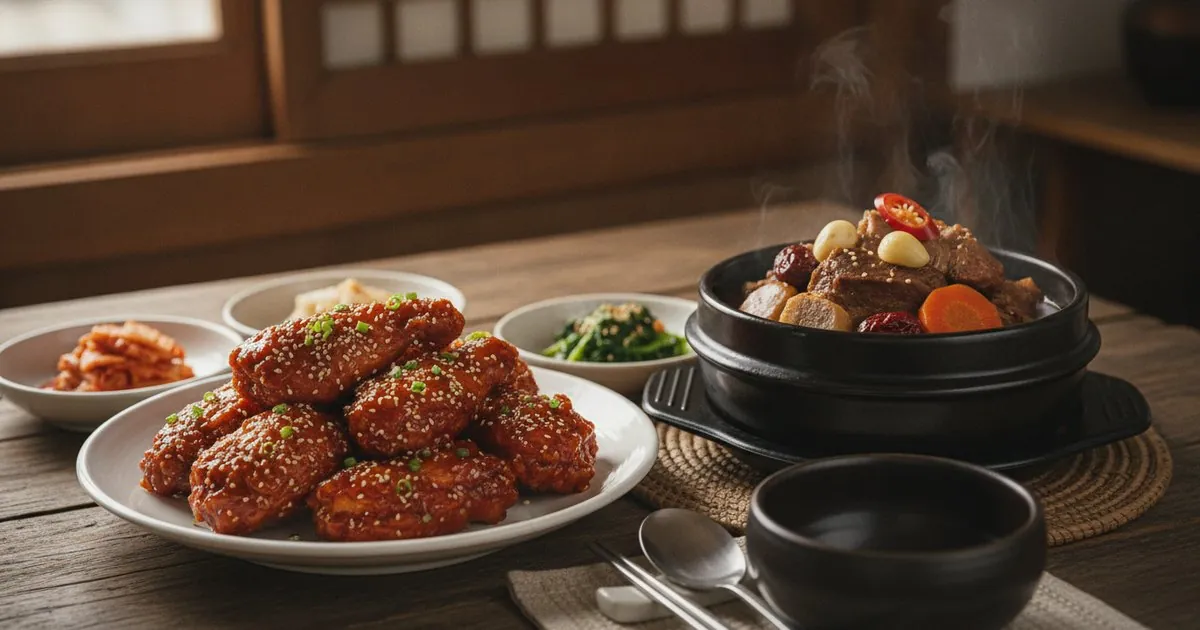
Jin’s mother bought fried chicken instead of snacks when he was a child, and the affection has never left him. He’s described eating chicken as “life’s third greatest moment” (blondekimchi.com). Korean fried chicken’s double-fry method produces skin that is shatteringly crisp and glossy with sauce — a different experience from Western styles. If you haven’t tried making it at home yet, our guide to Korean fried chicken covers the full double-fry method and sauce variations.
Jin’s Signature On-Screen Dish: Janchi Guksu (잔치국수)
Janchi guksu — banquet noodles — is the dish most consistently linked to Jin’s on-screen cooking. It’s traditionally served at Korean celebrations: weddings, birthdays, first-birthday feasts. It’s also the dish he taught V and Jimin to make on Run BTS, which feels apt: simple enough to teach in a short segment, but precise enough that it actually matters how you teach it.
The heart of janchi guksu is the broth. You’re building a clean, pale anchovy-kelp stock (myeolchi-dashima-guk) and finishing the bowl with uniformly cut, carefully cooked garnishes. Nothing is hidden under sauce.
Ingredients (Serves 2)
For the broth:
- 1 litre / 4 cups cold water
- 20g / ¾ oz dried anchovies (myeolchi), heads removed and gutted
- 10g / ⅓ oz dried kelp (dashima / kombu), roughly a 10cm / 4-inch square
- 1 tbsp / 15ml light soy sauce
- Fine salt to taste
For the garnishes:
- 1 medium zucchini / courgette, about 150g / 5 oz, julienned
- 1 medium carrot, about 100g / 3.5 oz, julienned
- 2 eggs, separated (for jidan egg garnish)
- 2–3 tbsp kimchi, finely sliced, to serve alongside
- ½ tsp / 2.5ml toasted sesame oil, sesame seeds to finish
Noodles:
- 200g / 7 oz dried somyeon (thin Korean wheat vermicelli)
The Method
Step 1 — Build the broth. Cold-start the anchovies and kelp in the water. Bring slowly to a simmer over medium heat, about 10 minutes. Remove the kelp just before a full boil — kelp releases pleasant savoury compounds up to about 80°C / 176°F, then turns bitter and muddies the broth. Keep the anchovies at a gentle simmer for another 5–8 minutes, then strain. Season with soy sauce and salt. The finished broth should be pale gold, clean, and deeply savoury. If it smells aggressively fishy rather than clean-savourily oceanic, the anchovies were in too long.
Step 2 — Prep the garnishes. Salt the julienned zucchini lightly (¼ tsp / 1.25ml per 100g), let it sit 10 minutes, then squeeze out the moisture. Sauté in a dry pan over medium-high heat until just tender — 2 minutes. It should stay a bright green, not brown or translucent. Do the same for the carrot, which needs 3–4 minutes. For jidan: separate the eggs, cook each thinly in a barely-oiled pan over low heat, cool, and slice into fine ribbons.
Step 3 — Cook the somyeon. Bring a large pot of unsalted water to a rolling boil. Add the noodles and cook for 2–3 minutes — taste at 2 minutes; they overcook quickly. Drain immediately and rinse thoroughly under cold running water, working the noodles gently with your hands. They should feel smooth and completely separate between your fingers, not starchy or clumped.
Step 4 — Assemble. Nest the rinsed noodles in a warm bowl. Ladle hot broth over them. Arrange the garnishes on top in clean sections: zucchini, carrot, egg ribbons. Add a small mound of sliced kimchi alongside. Finish with a drizzle of sesame oil and sesame seeds. The visual is as important as the flavour — the pale broth, vibrantly coloured garnishes, and fine noodles together make the dish look like a celebration, which is the point.
Common Mistakes to Avoid
1. Boiling the Kelp
This is the most common janchi guksu broth error. Kelp (dashima) releases glutamates and pleasant, clean sea-savour up to around 80–90°C / 176–194°F. Beyond that — at a rolling boil — it turns slimy, releases bitter compounds, and clouds the broth irreversibly. Watch for the first small bubbles forming at the bottom of the pot and pull the kelp out before they break the surface. The texture change is subtle but the flavour change is significant.
2. Leaving Anchovy Heads and Guts Intact
The digestive tracts of dried anchovies contribute a harsh bitterness and aggressively fishy smell to stock. Spend three minutes before cooking: snap off the heads, split each anchovy lengthwise with your thumbnail, and pull out the dark gut line. The resulting broth is noticeably cleaner and more delicate.
3. Seasoning the Broth to “Just Right” Before Adding Noodles
Noodles draw salt from broth as they sit. If the broth tastes balanced before the noodles arrive, it will taste flat and thin-flavoured after 30 seconds of contact. Season the stock so it’s very slightly saltier than your target finish. Taste again after the noodles have been in the bowl briefly and adjust at the table if needed.
4. Skipping the Salt-and-Squeeze Step for Zucchini
Zucchini is roughly 95% water. Sautéing unsqueezed zucchini means it steams itself in the pan, turns limp and translucent, and releases a puddle of liquid that will cloud your broth. The salt-rest-squeeze step takes 10 minutes and changes the outcome entirely: the zucchini holds its shape, keeps a slight bite, and stays vivid green in the bowl.
5. Overcooking the Somyeon
Somyeon cooks faster than almost any noodle you’ve worked with before — 2 to 3 minutes at a full boil is the window. At 4 minutes, they’re soft, clumping, and losing their characteristic silky-firm chew. Start tasting at the 2-minute mark and drain while there’s still just a faint resistance at the centre. Carryover cooking in the hot broth will finish the job.
6. Not Rinsing Thoroughly After Boiling
Skipping or rushing the cold-water rinse leaves a floury starch coating on the noodles that makes them clump, turns the broth cloudy, and adds an unpleasant powdery texture. Rinse under cold running water for at least 30 seconds, working the noodles with your hands until they feel individually separate and clean — almost silky. This step also stops the cooking instantly, which is the other reason it matters.
FAQ
What is Jin’s single favourite food? Based on his own statements across multiple TV appearances, mulhoe (spicy cold raw fish soup) is his answer — he confirmed he eats it at least three times per week on JTBC’s Please Take Care of My Refrigerator in July 2025, and he’s given himself the self-appointed title of “President of the Mulhoe Promotion Association.” Naengmyeon (Korean cold noodles) is a close and well-documented second.
Is mulhoe something I can realistically make at home? Yes, with one firm prerequisite: the fish must be sashimi-grade from a reputable source. Because mulhoe uses raw fish, this isn’t a flavour preference — it’s a food-safety requirement. Once you have the right fish, the broth assembly (gochujang, doenjang, vinegar, garlic, cold water) takes about 10 minutes.
Where do I find somyeon noodles outside Korea? H Mart, 99 Ranch Market, and most Korean or broader Asian grocery stores carry somyeon — look for labels reading “thin wheat vermicelli” or “Korean angel hair noodles.” Ottogi and Sempio are reliable widely-stocked brands. Online, Hmart.com ships nationwide in the US.
What does janchi guksu taste like? Clean, delicate, and comforting. The anchovy-kelp broth is savoury without being heavy; the somyeon noodles have a light, silky chew. Crucially, janchi guksu is not spicy — the heat comes from optional kimchi on the side. It tastes deliberately celebratory, which reflects its origins as a dish for weddings and birthdays.
Where should I start if I’m new to Korean cooking? Janchi guksu is genuinely one of the best entry points — short ingredient list, forgiving technique once you learn the anchovy broth fundamentals, and a rewarding result. For the broader pantry knowledge that underpins many of Jin’s favourite dishes, our doenjang guide covers the fermented soybean paste you’ll encounter repeatedly, from the mulhoe broth base to the soybean paste soup Jin cooked on In The Soop.
Jin’s food story is, at its core, about someone who loves to eat and has put genuine time into cooking well. The dishes on his list — mulhoe, naengmyeon, janchi guksu, golbaengi muchim — aren’t particularly glamorous or trend-chasing. They’re the food of a person who grew up eating Korean food, kept eating it, and wanted to cook it for the people he cares about. That’s the most compelling kind of food enthusiasm there is, and it’s a good reason to make one of them for dinner tonight.