
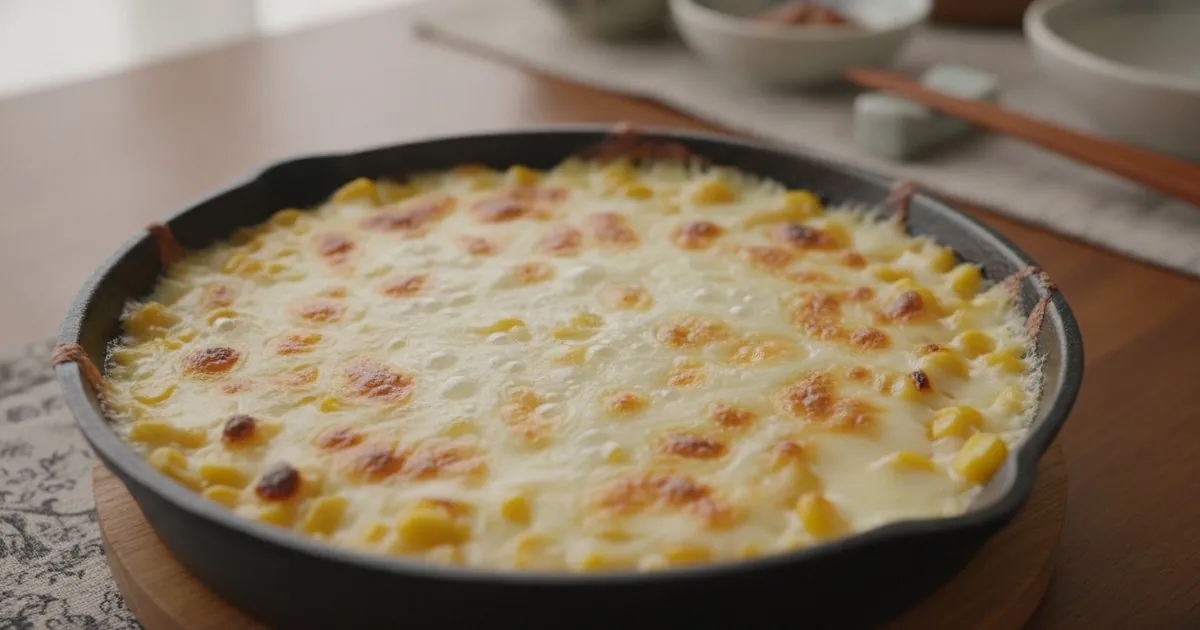
At a Korean BBQ restaurant, corn cheese tends to arrive without fanfare. A small cast-iron skillet lands on the table, its edges still bubbling furiously, the surface mottled with irregular blisters of golden-brown mozzarella. Someone at the table scoops a spoonful over a piece of just-grilled pork belly. The cheese stretches in a long, satisfying pull. Whatever conversation was happening stops.
This is 콘치즈 — Korean Corn Cheese. Its ingredient list is genuinely short: canned corn, butter, Japanese mayo, a whisper of sugar, and good mozzarella. The technique is simple enough that you can have it on the table in 25 minutes. Yet the result punches well above its weight — sweet, creamy, savory, and deeply satisfying in a way that keeps people coming back for the last spoonfuls long after everything else on the table is gone.
If you’re building out a full Korean BBQ spread at home, our Korean BBQ at Home guide covers everything from the grill setup to the banchan lineup — and corn cheese belongs on that table without question. And if you want to round out your Korean sides in general, our banchan guide covers the full range of small dishes that make a Korean meal complete.
What Is 콘치즈 (Korean Corn Cheese)?
Corn cheese — 콘치즈, pronounced “kon-chee-jeu” — is a Korean dish of sweet corn kernels bound in a creamy, mayo-seasoned mixture and blanketed under a thick layer of broiled mozzarella. It is served sizzling in a small skillet or ceramic bowl and eaten by scooping directly from the vessel.
The dish is a product of Korea’s creative post-war absorption of Western pantry staples. Canned corn, mayonnaise, and processed cheese entered Korea in significant volume during the American military presence beginning in the 1950s, and over the following decades they were woven into everyday Korean cooking. Corn cheese as a distinct preparation became especially popular through the 호프집 (hof) culture of the 1980s and ’90s — the Korean-style beer pubs that became neighborhood institutions. There, it took its place as a classic 안주 (anju): the food eaten alongside alcohol, designed to balance, enhance, and sustain a long evening of drinking.
Today, corn cheese appears at Korean BBQ restaurants as a standard table side, at 포장마차 (pojangmacha, covered street food tents), in convenience store food courts, and frozen in supermarket aisles across Korea. It has also crossed over into Korean-American restaurant menus and home kitchens internationally — not because it is traditionally complex or culturally weighty, but because it is simply and immediately delicious.
The Ingredients: What You Need and Where to Find It
The beautiful thing about corn cheese is that every single component is available at mainstream Western grocery stores. Nothing requires a special trip to H Mart — though a few ingredient upgrades are worth making if you have access.
Sweet Corn (Canned)
Canned whole kernel sweet corn is the traditional base for this dish, and it has been since the beginning. It delivers reliably sweet, tender kernels regardless of season, which is exactly what the recipe needs. One standard 15 oz / 425g can yields approximately 1½ cups (about 270g) of drained kernels — enough for a generous serving of three to four.
The most important thing you will do with that can is drain it properly. Empty it into a colander and shake well, then transfer the kernels to a clean kitchen towel or thick layer of paper towels and press firmly. The kernels should feel dry to the touch before they go into the pan. Skipping this step is the most common reason a batch of corn cheese turns out watery and diluted.
Fresh corn works beautifully in peak summer season — strip two ears of corn and briefly blanch or char the kernels in a dry pan before proceeding. Frozen corn (thawed completely and pressed dry) is a solid year-round alternative. Both options produce a slightly firmer-textured kernel than canned, which can be a nice variation.
Kewpie Japanese Mayonnaise
If there is one ingredient upgrade worth making for this recipe, it is switching from standard American mayo to Kewpie. Japanese Kewpie mayo is made with egg yolks only (rather than whole eggs), rice vinegar, and MSG, which makes it richer, tangier, and more savory than Hellmann’s or Best Foods. That extra depth translates directly into a more complex, restaurant-quality corn cheese.
Find Kewpie at H Mart, Mitsuwa, 99 Ranch, most Asian grocery stores, and increasingly at Whole Foods, Trader Joe’s, and Target. If Kewpie is not available, regular full-fat mayonnaise works fine — the flavor will be slightly milder but the dish will still be excellent.
Mozzarella
Every reliable source on this dish agrees on one thing: low-moisture, whole-milk mozzarella in block form, shredded yourself just before use. This is not a minor preference — it is the difference between the golden, stretchy, blistered cheese top that defines the dish and a flat, watery, or gummy result.
Low-moisture block mozzarella (the kind sold in plastic-wrapped rectangles, not fresh balls packed in water) has the low moisture content needed to melt into those dramatic pulls and brown blisters under the broiler. Whole-milk varieties brown and stretch better than part-skim. And shredding from a block yourself matters because pre-shredded bagged mozzarella is coated in anti-caking agents (usually cellulose or potato starch) that interfere with smooth melting. Two minutes with a box grater is all it takes.
The right amount for a standard batch is ¾ to 1 cup (85–100g), though some recipes go as high as 140–170g for an extra-blanketed result. Start at the lower end and go up if you want a more dramatically cheesy top.
Sugar
There is always a small amount of sugar in a traditional corn cheese, and it pulls more weight than it appears to. A teaspoon or so amplifies the natural sweetness of the corn in a way that creates the specific sweet-savory balance the dish is known for. Taste your corn before adding it: very sweet canned varieties (Green Giant, for example, tends to run sweet) may only need 1 tsp (4g), while starchier or milder corn benefits from 1½ tsp (6g). The 2026 research consensus puts the right range at 1 to 1½ tsp (4–6g) for a standard can.
Butter and Aromatics
One tablespoon (14g) of unsalted butter forms the sautéing base. Traditional versions from Maangchi and others include a small amount of finely diced onion and red and green bell pepper — just a couple of tablespoons of each. These aromatics are mild enough not to dominate, but they add savory depth, a whisper of sweetness, and color to what would otherwise be a monochrome mixture. Many simplified recipes omit them entirely. We recommend keeping at least the onion; it makes the overall flavor rounder and more complex.
Equipment
A 6–8 inch cast-iron skillet is the classic vessel for corn cheese, and it earns its reputation: it holds heat brilliantly, goes from stovetop to broiler seamlessly, and keeps the dish hot at the table for longer than anything else. If you do not have one, any oven-safe skillet, small gratin dish, or oven-safe sauté pan will work. The only firm requirement is that the vessel must be rated safe for broiler use.
How to Make Korean Corn Cheese (Step by Step)
Prep time: 10 minutes | Cook time: 15 minutes | Total: 25 minutes | Serves: 3–4
Step 1: Drain and Dry the Corn Thoroughly
Drain the canned corn in a colander, shaking to remove loose liquid. Transfer to a clean kitchen towel or paper towels and press firmly — do not rush this. The kernels should feel genuinely dry on their surface before they touch the pan.
Step 2: Soften the Aromatics
Melt 1 tbsp (14g) of butter in your skillet over medium heat. Add the diced onion and bell peppers. Cook for 3–4 minutes, stirring occasionally, until soft and translucent. You are looking for a steady, gentle sizzle — a constant low hiss rather than a popping or spattering sound. If the butter is browning quickly or the onion edges are darkening, reduce the heat slightly.
Step 3: Add and Cook the Corn
Add the dried corn to the aromatics. Stir to coat in the butter and cook for about 2 minutes until heated through and any remaining surface moisture has cooked off. Listen: as the moisture evaporates, the sound of the pan transitions from a slightly wet, burbling sizzle to a crisper, drier sound. That shift is your signal that the corn is ready.
Step 4: Build the Sauce
Remove the pan from heat. Add 2½–3 tbsp (37–45ml) of Kewpie mayo, 1–1½ tsp (4–6g) of sugar, ¼ tsp black pepper, and a pinch of salt. Stir until every kernel is coated in a glossy, creamy mixture with no pockets of dry corn. Taste the mixture right now — this is the only window you have to adjust the seasoning before the cheese seals everything in. The flavor should be balanced: sweet, savory, creamy, with a mild tang from the mayo. If it tastes flat, add a small pinch more salt; if it tastes too sweet, a few drops of rice vinegar or another pinch of salt will balance it.
Step 5: Add the Cheese and Broil
Set your oven rack 5–6 inches from the broiler element and preheat on HIGH. Spread ¾–1 cup (85–100g) of freshly shredded mozzarella evenly over the corn mixture, covering the surface all the way to the edges — the cheese should form a complete blanket, not islands.
Broil for 3–5 minutes. Do not walk away. The transformation happens quickly: the cheese will first become glossy and soft, then begin to bubble at the edges, then develop golden-brown blisters across the surface as the Maillard reaction sets in. Those brown blisters are the target. The edges of the skillet should be visibly and audibly bubbling when you pull it.
Step 6: Serve Immediately
Scatter sliced scallions over the top and set the skillet directly on the table — on a trivet or folded towel to protect the surface. Provide a large spoon for scooping. Corn cheese is at its peak for about the first 3 minutes after it leaves the oven, while the cheese is still molten and the pull is still long and dramatic.
Flavor Variations Worth Trying
Surimi (Imitation Crab) Version: Shred 2–3 sticks of surimi into coarse strands and fold them into the corn mixture before adding the mayo. The surimi adds a mild sweetness and slightly chewy texture that pairs naturally with the corn.
Spicy Version: Stir ½ tsp cayenne pepper or 1 tsp gochugaru (Korean red pepper flakes) into the corn mixture before topping. The heat cuts through the richness of the cheese in a deeply satisfying way. For an even deeper spice backbone, a small dollop of gochujang stirred into the mayo before mixing is excellent — our gochujang guide covers everything you need to know about working with this paste.
Extra-Savory Version: Add 1 tsp of soy sauce to the mayo mixture and finish the broiled dish with crumbled crispy bacon and a drizzle of toasted sesame oil.
Mixed Cheese: Replace a quarter to a third of the mozzarella with freshly grated Parmesan. The Parmesan contributes a savory, nutty quality that deepens the overall profile, and it also accelerates browning under the broiler.
How to Serve Korean Corn Cheese
Corn cheese is most naturally at home at a Korean BBQ table, where it functions as both a palate cleanser and a rich counterpoint to grilled meats. A spoonful draped over samgyeopsal (grilled pork belly) or wrapped inside a ssam lettuce cup with rice is a combination that earns its reputation.
Beyond the BBQ table, it works as:
- A party appetizer with tortilla chips, sturdy crackers, or sliced baguette for scooping
- A bar snack alongside Korean lager, soju, or makgeolli
- A rich side dish next to fried chicken or spicy rice cakes
- A potluck contribution that travels in its skillet and reheats reasonably well under a broiler
Common Mistakes to Avoid
1. Skipping the Corn-Drying Step
This is the most common reason a batch of corn cheese disappoints. Canned corn kernels hold significant surface moisture even after draining, and that moisture releases into the pan during cooking. Instead of sautéing with a sharp sizzle and developing light flavor in the butter, the corn steams in its own liquid. The result is a loose, watery corn mixture that dilutes both the mayo sauce and the melted cheese above it. The fix is non-negotiable: press the kernels dry with towels before they touch the pan, and listen for the sizzle to confirm the pan is staying dry during cooking.
2. Using Fresh (Wet-Pack) Mozzarella
Fresh mozzarella balls packed in water have beautiful flavor, but they contain far too much internal moisture for this dish. Under the broiler, they release liquid into the corn mixture, resulting in a wet, grayish-white top layer with no browning instead of the golden, blistered blanket you are aiming for. The visual difference is immediate and unmistakable: dry-pack mozzarella blisters and browns; fresh mozzarella weeps and turns rubbery. Always use low-moisture block mozzarella.
3. Using Pre-Shredded Bagged Mozzarella
Even when the type of mozzarella is correct (low-moisture block), buying it pre-shredded introduces anti-caking coatings — cellulose powder, potato starch — that form a barrier around each shred. These coatings prevent the cheese proteins from binding smoothly during melting, producing a slightly gritty or gummy texture instead of a silky, stretchy pull. Buying a block and shredding it yourself takes about two minutes and makes a noticeable difference in the final texture.
4. Positioning the Rack Too Far from the Broiler Element
Some recipes suggest melting the cheese with a pan lid on the stovetop. The cheese melts, technically, but it never browns — and those golden-brown blisters are not just cosmetic. They represent the Maillard reaction developing nutty, savory compounds that add complexity to what would otherwise be a fairly one-note flavor. Place your rack 5–6 inches from the broiler element. At that distance, a full cheese blanket develops blisters in 3–4 minutes. Push the rack to 10 inches and you get uneven, pale, slightly rubbery results with white patches that never fully set.
5. Not Tasting the Corn Mixture Before Broiling
Once the cheese goes on and the skillet goes under the broiler, seasoning adjustments become almost impossible. The time to taste is after you stir in the mayo and sugar, before the cheese is added. Check the salt level, the sweetness, and the overall balance. Canned corn varies significantly in natural sweetness — some brands are noticeably sweeter than others, and using the full 1½ tsp of sugar with a very sweet corn can tip the dish into cloying territory. Taste and adjust at Step 4, not after.
6. Letting the Dish Sit Before Serving
Corn cheese has a narrow peak window. In the first 2–3 minutes after it leaves the broiler, the cheese is in its ideal molten state: fluid enough for long pulls, hot enough to keep the corn mixture loose and scoopable. After that, the cheese firms into a cohesive, slightly rubbery sheet, and the corn mixture underneath can become pasty as it continues cooking from residual heat. The sizzling you hear as the skillet lands on the table is the right sound — it should still be going when the first spoonful is scooped.
Frequently Asked Questions
Can I make Korean Corn Cheese without an oven broiler?
Yes, with a workaround. After adding the mozzarella to the pan, place a tight-fitting lid over the skillet on medium-low heat for 2–3 minutes until the cheese is fully melted. You will miss the golden-brown blistering, but the flavor is still good. A kitchen torch applied to the cheese surface for 30–60 seconds after lid-melting can approximate the color and a small degree of the blistered flavor.
What’s the best substitute for Kewpie mayo?
Any full-fat mayonnaise — Hellmann’s, Best Foods, Duke’s — works as a direct substitute. The flavor will be slightly less rich and tangy. To edge closer to Kewpie’s profile, whisk a very small drop of sesame oil and a tiny pinch of MSG into your regular mayo before using. The MSG in particular does significant work toward the savory depth that makes Kewpie distinctive.
Can I prepare Korean Corn Cheese ahead of time?
The corn mixture (through Step 4) can be made up to 24 hours ahead and refrigerated covered. When ready to serve, bring it to room temperature, warm it in the skillet over medium heat for a minute or two, then add the cheese and broil as normal. Do not add the cheese before refrigerating — melted and re-broiled mozzarella develops a tough, grainy texture that is far inferior to freshly melted cheese.
Is Korean Corn Cheese spicy?
In its traditional form, not at all. The classic version is entirely mild — sweet, creamy, salty, and cheesy, with no heat whatsoever. This makes it one of the most universally accessible Korean dishes, well suited for children or anyone who is heat-sensitive. The spicy variation with gochugaru or cayenne is popular but entirely optional, and it is easy to serve the plain version alongside spicier dishes to accommodate different preferences at the table.
Can I use frozen corn instead of canned?
Frozen corn works well and is a reliable year-round option. Thaw it completely, then spread on a kitchen towel and press dry — frozen corn often releases more water on thawing than canned corn after draining, so the drying step is especially important here. Use about 1½ cups (270g) of thawed, dried kernels. Frozen corn tends to have a slightly firmer bite than canned, which some people prefer. The rest of the process is identical.