
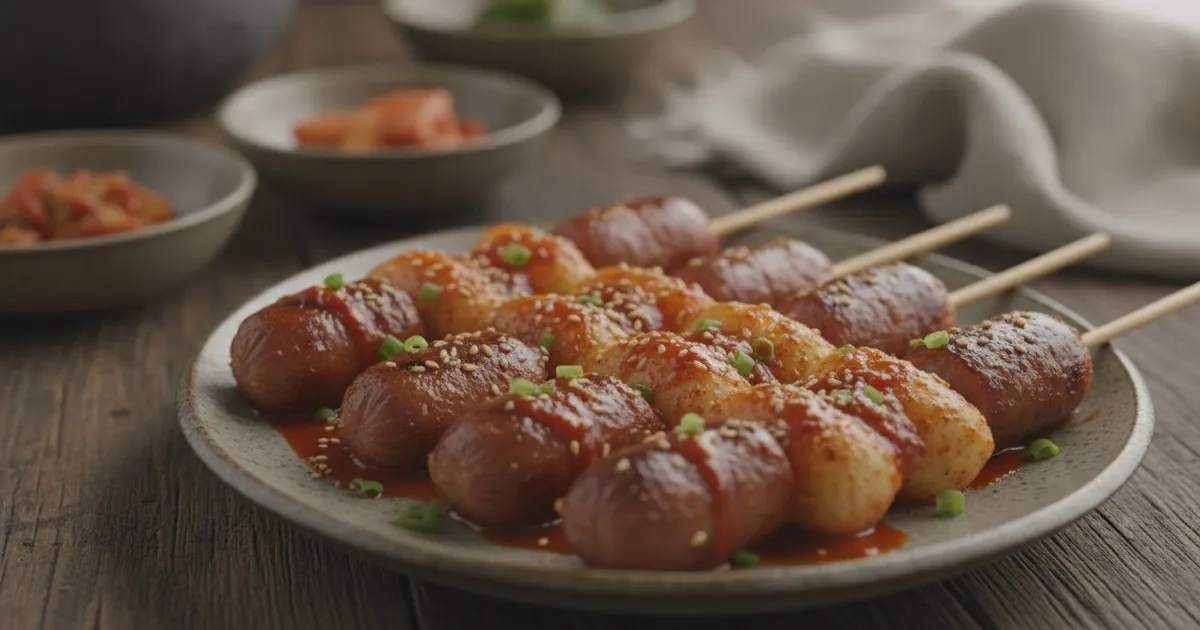
Imagine pulling off a Korean expressway late at night, following a cloud of sizzling, sweet-spicy steam to a brightly lit rest stop food stall. That atmospheric image is no exaggeration — it’s essentially the origin story of sotteok sotteok (소떡소떡), one of the most craveable snacks to emerge from Korea’s legendary highway rest stop food culture. What started as a local specialty at a single rest stop in Gyeonggi Province is now a nationwide street food phenomenon with international reach, and it happens to be one of the most achievable Korean recipes you can make at home in under 30 minutes.
The technique is simple. The ingredients are accessible. The result is genuinely addictive.
What Is Sotteok Sotteok?
The name is a portmanteau and reduplication: 소 (so) is clipped from 소시지 (sosiji, “sausage”), and 떡 (tteok) means rice cake. Repeating the two syllables — “so-tteok so-tteok” — creates a name that echoes the alternating pattern on the skewer itself. Whether that parallel was intentional wordplay or just a happy coincidence is open to interpretation rather than documented fact, but it makes the name impossible to forget either way.
The dish is straightforward: short cylindrical rice cakes and small cocktail sausages, threaded alternately onto a skewer, pan-fried or grilled until golden, then glazed with a sticky sauce built on ketchup and gochujang. That sweet-spicy lacquered finish is what pulls everything together.
From One Rest Stop to International Food Festivals
Sotteok sotteok’s journey from regional curiosity to national icon has a clear catalytic moment. The dish existed at a highway rest stop in Anseong, Gyeonggi Province before most of Korea knew about it. In March 2018, comedian Lee Young-ja (이영자) featured it on a television program during a road trip segment — and the Anseong rest stop’s numbers transformed almost overnight. By the end of 2018, that single location had climbed to third place in total sales across all Korean highway rest stops, which is a staggering result for one food item.
The spread from there was swift and organic. Rest stop → street cart → bunsikjip (분식집, Korean casual snack shops) → convenience store chains including GS25 and CU. Vendors began experimenting: cheese fills, dalgona (honeycomb candy) drizzles, whole spicy pork sausages instead of cocktail wieners. When BTS mentioned sotteok at a rest stop during their COVID-era domestic travels, a new wave of international curiosity followed. By 2024, the dish had been included in South Korea’s Hallyu tourism promotional program and represented the country at the 2023 ASEAN Food Festival in the Philippines, where it reportedly drew long queues. It has since appeared on Korean restaurant menus in Malaysia.
It is, in other words, a very serious snack.
Why This Combination Works So Well
Sotteok sotteok succeeds because it’s built on a textural contrast that Korean cuisine understands and executes brilliantly: chewy against snappy, neutral against bold. The garae-tteok rice cake has an elastic, pillowy chew and a flavor that’s mild almost to the point of blankness — but that neutrality is an asset, because it absorbs sauce deeply and lets the other components lead. The Vienna sausage brings salt, fat, and the satisfying snap of a cooked casing. The gochujang-ketchup glaze ties it together with heat, tang, and sweetness in proportions that read as familiar and exciting at the same time.
That approachability is part of why this dish travels so well beyond Korea. There’s no fermented funk to navigate (that’s gochujang’s job, and it’s mild here), no unfamiliar protein, no technique that requires specialized equipment. If you’ve ever glazed chicken wings or caramelized a hot dog on a griddle, the mechanics are already in your hands.
Ingredients: What You Need and Where to Find It
Rice Cakes: The Right Shape Matters
You need cylindrical rice cakes — specifically the short-cut tteokbokki variety, sometimes labeled as tteokbokki tteok or garae-tteok (가래떡). They’re smooth white cylinders approximately 4–5 cm (about 2 inches) long and 1.5 cm (just over half an inch) in diameter. If you can only find the longer rope-style garae-tteok at your Korean grocery, cut them to size before skewering — pieces much longer than 5 cm will be awkward on the skewer and cook unevenly.
Where to buy: H Mart is your most reliable option across the US. Look in the refrigerated section, usually near the tofu and pre-marinated meats. 99 Ranch, Zion Market, and any Korean supermarket will carry them. Online, Weee! and Umamicart stock them with reliable shipping.
Frozen vs. refrigerated: Both work. Frozen rice cakes must be fully thawed before use — running them under cool water speeds this up. Refrigerated ones sometimes stiffen up; a quick 3–5 minute warm water soak brings them back. Fresh, room-temperature-soft rice cakes go straight into the pan without any prep.
If you love rice cakes and want to understand how central they are across Korean cooking, our deep-dive tteokbokki guide covers the full range of styles and textures.
Sausages: Korean vs. Western Options
The traditional choice is Korean Vienna sausages (비엔나 소시지), sold in vacuum packs at Korean grocery stores. They have a firmer, snappier casing than the canned American cocktail wieners, and a cleaner pork flavor without the heavy smoke that characterizes many American varieties. If you’re in range of H Mart, grab a pack — the difference in snap is noticeable.
That said, canned cocktail wieners (Libby’s, Heinz) or mini smoked sausages like Li’l Smokies both work well in a home kitchen. Li’l Smokies in particular caramelize beautifully in the pan thanks to their fat content, and their smokiness pairs well with the sweet-spicy glaze. These are genuine Western substitutes, not compromises.
Building the Sauce: Two Approaches
The ketchup-gochujang base is consistent across Korean recipes for this dish, but the ratio and supporting ingredients vary. Here’s how to think about it:
The mild-sweet version (great for first-timers, kids, or spice-averse guests): 3 tablespoons ketchup to 1 tablespoon gochujang, with 2 tablespoons of honey. The result is glossy, sweet-tangy, and warm rather than hot. This is the more approachable gateway version.
The full street-food version: Closer to a 1:1 or even 2:1 gochujang-to-ketchup ratio. Bolder fermented heat, more savory depth, the kind of punch you’d expect from a Korean bunsikjip. A single minced garlic clove stirred in adds extra dimension.
Both versions benefit from soy sauce (umami and salt balance) and sesame oil — added at the end after the pan is off heat to preserve its fragrance. For the shiniest, most lacquered finish, Korean corn syrup (mulyeot / 물엿) or oligodang (올리고당, oligosaccharide syrup) — both sold at Korean grocery stores — give a mirror-like glossiness that honey approximates but doesn’t quite replicate. Honey is a fine home substitute.
If gochujang is new to you or you’re unsure which brand to buy, our complete gochujang guide covers everything from heat levels to how to store it after opening.
How to Make Sotteok Sotteok: Step by Step
(Full quantities are in the recipe card at the top of this post.)
Prep: Dry, Then Score
After soaking rice cakes if needed, pat them completely dry — not just damp-dry, but genuinely dry. Lay them on paper towels and press firmly. Any residual moisture on the surface will cause the oil to spatter and will steam the rice cake instead of frying it.
While the rice cakes air-dry, score each sausage. You’ll see the cuts fan open slightly as they cook — that’s the visual cue that your sausages are cooking through properly and building surface area for the glaze.
Building and Cooking the Skewers
The classic assembly is rice cake → sausage → rice cake → sausage → rice cake: three rice cakes and two sausages per skewer. Push each piece firmly against its neighbor — gaps mean the ends cook faster than the middle and the whole thing becomes unwieldy.
Preheat your pan for a full minute before adding oil, then let the oil shimmer before the skewers go in. The test: lay a skewer in the pan and listen. A firm, active sizzle means the temperature is right. Silence or very gentle fizzing means the pan is underpowered — pull the skewers out, wait another minute, and try again.
Cook without moving the skewers for 3–4 minutes per side. The rice cakes will stick initially and then release cleanly once a crust forms underneath. If you force them, they’ll tear. Patience pays here.
The Glaze Window
Once the skewers are golden and cooked through, reduce the heat and add the sauce. This is the most time-sensitive part of the whole recipe: the sugars in gochujang and ketchup can scorch in under a minute over heat that’s even slightly too high. Medium-low heat, constant attention, 1–2 minutes maximum. The finished surface should look lacquered — shiny and slightly tacky — and smell of sweet caramelized chili. If you see black spots developing and the smell shifts toward acrid, get them off the heat immediately.
Variations Worth Trying
Cheese sotteok: After glazing, transfer skewers to a foil-lined baking sheet, drape a strip of mozzarella (or a slice of processed cheese for the full Korean experience) over each one, and broil for 60–90 seconds until the cheese is bubbly and starting to brown. The molten cheese pulls dramatically when you take a bite and tempers the spice beautifully.
Grilled version: Cook over medium-hot charcoal or a gas grill. The smokiness adds a dimension the pan version can’t quite reach. Apply sauce only in the final 2 minutes — over direct flame the sugars scorch even faster than in a pan.
Dalgona drizzle: Drizzle melted dalgona (honeycomb candy) over finished skewers for a crackling, bittersweet caramel contrast against the spicy sauce. It sounds like an unusual pairing, but it’s a documented Korean variation that works. See our dalgona candy guide for the base technique.
Common Mistakes to Avoid
1. Not Drying the Rice Cakes Thoroughly (The Splatter Problem)
Wet rice cakes hitting hot oil don’t just create an annoying mess — the steam forces the oil to erupt and spit, the surface temperature of the pan drops, and the rice cakes end up pale and gummy instead of lightly golden. After any soaking or rinsing, press the rice cakes firmly between layers of paper towel and let them sit for at least a minute before skewering. This single step makes a measurable difference in the final texture.
2. Starting With an Underpowered or Under-Preheated Pan
Rice cakes have a dense, starchy surface that bonds to inadequately hot pans almost instantly. The fix isn’t more oil — it’s heat. Preheat the dry pan for 1–2 minutes before adding oil, then let the oil shimmer (small ripples across the surface, wisps of vapor) before the skewers go in. A properly hot pan forms a crust on the rice cake quickly, and that crust releases cleanly. A cold pan means the starch grabs the metal and tears when you try to turn the skewer.
3. Adding the Sauce Too Early
The sauce needs roughly 300°C of pan surface to caramelize properly, but the same temperature that caramelizes in 90 seconds will carbonize in 3 minutes. Adding sauce before the rice cakes are fully cooked means you’re running out the clock before everything is done. Always cook the skewers first to golden on both sides, then add sauce only at the end as a quick glaze.
4. Using the Wrong Rice Cake Format
Flat oval tteok, large round tteok, or anything much longer than 5 cm will cause problems: they don’t balance well on a skewer, they cook unevenly (the exposed tips dry out while the center stays cold), and the surface-to-sauce ratio is off. The dish is specifically designed around short cylindrical garae-tteok at approximately the same diameter as a cocktail sausage. If that’s what you use, everything lines up — literally.
5. Overcrowding the Pan
Pack too many skewers into a small skillet and you’ve turned a frying operation into a steaming one. The rice cakes release moisture as they heat; that steam needs somewhere to go. A 30 cm (12-inch) skillet holds 4–5 skewers comfortably. If you’re making a larger batch, cook in two rounds and keep the first batch warm in a low oven (100°C / 210°F) on a rack — not on a plate, where they’ll steam themselves soft.
6. Waiting Too Long to Serve
Sotteok sotteok is categorically not a make-ahead dish. Once the heat leaves, the sauce sets into a sticky coating that loses its glossy appeal, and the rice cakes — which were springy and chewy hot — gradually firm into something denser and less pleasant. This is a serve-immediately dish. Have your plates ready, your garnishes prepared, and your eaters at the table before the skewers come off the heat.
Frequently Asked Questions
Can I prepare anything ahead of time? Yes — the sauce keeps in a sealed jar in the refrigerator for up to a week, and the raw skewers can be assembled and refrigerated loosely covered for up to 4 hours before cooking. But the actual frying and glazing must happen right before serving. There is no graceful way to reheat cooked sotteok sotteok.
My rice cakes keep sticking to the pan even after I preheat it. What’s happening? Three likely causes: the pan wasn’t hot enough (heat for longer before adding oil), the rice cakes were still damp (more aggressive drying), or you’re using a thin-bottomed pan that loses heat fast when cold food hits it. A heavy non-stick or a cast-iron skillet holds temperature much better than a lightweight aluminum pan. Also: don’t force the skewer to release — wait another 30 seconds. If a crust has formed, the rice cake will lift cleanly on its own.
Can I substitute gochugaru (red pepper flakes) for gochujang in the sauce? Not directly — they perform very different roles. Gochujang brings fermented umami, body, and natural sweetness alongside the heat; gochugaru adds heat and color but has no body or sticky texture. Without gochujang, your sauce will be thin and one-dimensional. A rough substitute if you’re genuinely out: 1 tablespoon sriracha plus 1 teaspoon white or yellow miso will approximate the body and fermented depth. Our gochujang guide explains the full difference between the two and how to use each.
How spicy is this dish, really? With the mild-sweet sauce ratio (3 tablespoons ketchup, 1 tablespoon gochujang, generous honey), it registers as a warm, sweet heat — something most people would call “mild spicy.” A standard Korean gochujang like Haechandle Medium or CJ Beksul sits at a moderate heat level; starting with 1–2 teaspoons and tasting as you go is a reasonable approach if you’re uncertain. The full street-food version with a 1:1 gochujang-ketchup ratio has genuine kick.
What do you serve with sotteok sotteok? In Korea it’s typically eaten as a standalone snack. At home, pickled yellow radish (단무지, danmuji) works beautifully — the cool, bright acidity cuts through the richness of the glaze and cleanses the palate between bites. If you’re assembling a broader Korean snack spread, sotteok sits naturally alongside tteokbokki and Korean fried chicken, which share the same sweet-spicy flavor territory without duplicating textures.