
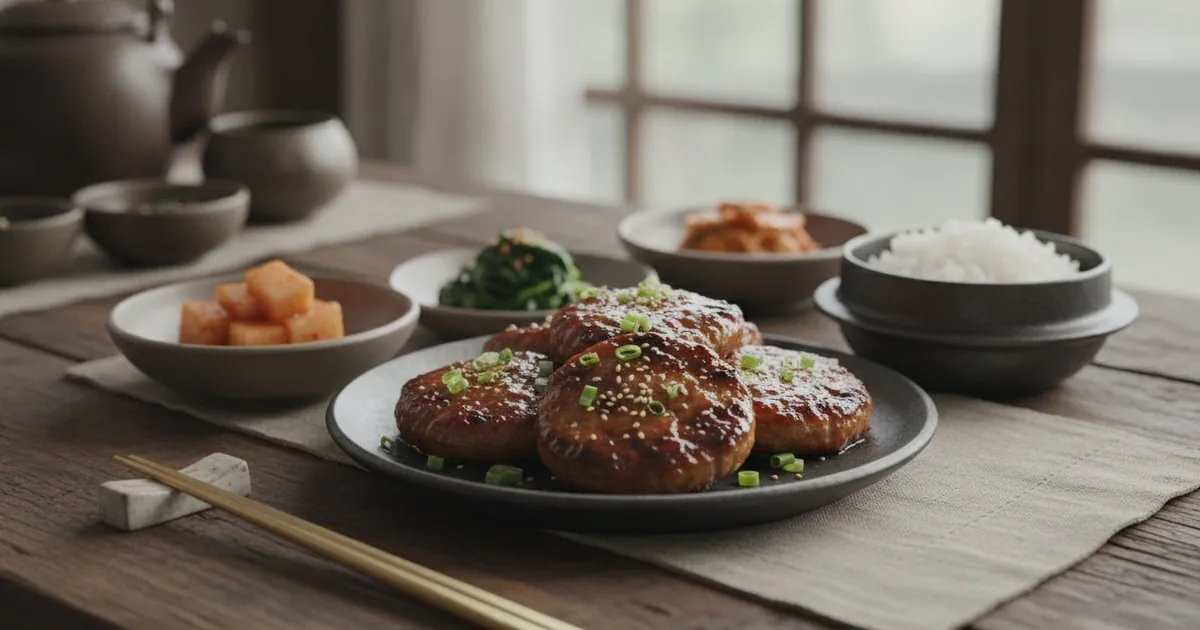
Tteok galbi (떡갈비) is one of those Korean dishes that stops you mid-bite. The outside is dark, lacquered, and caramelized into a glossy crust — the kind that crackles ever so slightly when you press a fork through it. The inside is tender, juicy, and carries a subtle springiness unlike anything you’ll find in a Western burger patty or meatball. This is Korea’s iconic grilled short rib patty, and once you’ve made it at home, you’ll understand why entire regions of the country have staked their culinary reputations on perfecting it.
This recipe comes with a few genuinely worthwhile tricks — and yes, I will explain exactly what that sweet rice flour is doing in the meat mixture, because it’s the ingredient that makes everything come together.
What Is Tteok Galbi (떡갈비)?
The name breaks down beautifully: tteok (떡) means “rice cake” and galbi (갈비) means “rib.” Don’t let the name confuse you — there’s no rice cake in this dish. The name refers entirely to texture. When short rib meat is hand-minced, seasoned, and kneaded with sweet rice flour, it develops a bouncy, slightly chewy consistency so reminiscent of tteok that the comparison became the dish’s name. If you already love the springy chew of rice cake in dishes like classic tteokbokki, you’ll immediately recognize and appreciate that same satisfying bite appearing in a completely unexpected form — pressed into an oval patty and glazed over a hot grill.
Tteok galbi sits at a fascinating intersection of humble home cooking and refined culinary tradition. It’s the dish Korean grandmothers make from scratch on a Sunday afternoon, and it’s also the centerpiece of dedicated tteok galbi restaurants that draw pilgrimage-level crowds in certain regions of Korea. The format is flexible — patties are typically shaped into ovals or rounds, sometimes pressed back onto the reserved rib bone for a striking presentation, and grilled while being basted repeatedly with a honey-soy glaze that caramelizes into something close to candy.
A Dish with Royal Court Roots
Food historians trace tteok galbi back to the royal court cuisine of the Joseon Dynasty (1392–1897), where it appeared as gungjung tteok galbi (궁중 떡갈비). Palace chefs would painstakingly mince the finest rib meat and season it with carefully proportioned aromatics before shaping and grilling it as an elegant dish for royalty and high-ranking officials — particularly those who found it difficult to gnaw meat directly off a rib bone. Mincing solved that problem with considerable style.
Over time, tteok galbi migrated from palace kitchens into regional street food culture and dedicated restaurants, with different areas of Korea developing their own proud signature versions. Two regions stand out:
- Damyang (담양), South Jeolla Province — renowned for a tteok galbi style that uses beef with a restrained, savory seasoning that lets the meat speak for itself.
- Songjeong (송정), near Gwangju — the Songjeong tteok galbi strip is a genuine food pilgrimage destination. Restaurants compete fiercely on plumpness, juiciness, and closely guarded recipes. Songjeong’s tradition is strongly associated with beef, and the patties there tend to be notably thick and succulent.
If you’re ever planning a trip to Korea, a detour to either region for a tteok galbi lunch is absolutely worth building into the itinerary.
The Ingredients, Explained
Good tteok galbi is about understanding what each ingredient actually does.
The Meat
Traditionally, tteok galbi is made from the meat of beef short ribs (갈비, galbi) — the ribs are partially frozen to firm them up, and the meat is hand-sliced and minced off the bone. This produces a coarser, more textured result than machine-ground beef, and the natural fat marbling of short rib meat gives the patties exceptional juiciness and richness.
That said, many excellent home versions use 80/20 ground beef and are genuinely delicious. If tracking down short ribs feels like too much effort on a weeknight, use the fattiest ground beef you can find — lean or extra-lean ground beef will give you dry, crumbly patties regardless of how carefully you follow everything else. A 60/40 beef-to-pork blend is another popular modern variation that creates a slightly softer texture, though it’s worth noting that beef remains the traditional and most widely celebrated choice.
Sourcing: Bone-in beef short ribs are available at H Mart, 99 Ranch, and most Korean or Asian grocery stores. Whole Foods, Costco (particularly in areas with large Korean communities), and well-stocked butcher shops also carry them. Ask for English-cut or flanken-style short ribs — either works fine here since you’re removing the meat from the bone anyway.
The Marinade
The seasoning base is a classic Korean sweet-savory blend: soy sauce (간장, ganjang) for depth and umami, dark brown sugar and honey for sweetness and caramelization fuel, mirin for a gentle wine note and extra gloss, sesame oil for that unmistakably nutty aroma, and a full aromatics lineup — garlic, ginger, onion, and green onion.
Aim for 2–3 tablespoons of soy sauce per 500g (1.1 lb) of meat — enough to season deeply without pushing the patties into overly salty territory. The sweeteners balance the salt and drive the caramelization when the patties hit a hot pan.
If you’re building out your Korean pantry and wondering which soy sauce to reach for, our guide to Korean soy sauce types walks through the key differences. For tteok galbi, a standard brewed soy sauce (양조간장, yangjo-ganjang) is exactly right.
An optional but highly recommended addition: 2 tablespoons of grated Asian pear (배, bae). The natural enzymes in Korean or Chinese pear gently break down the meat proteins, making the finished patties noticeably more tender. If you can’t find Asian pear, a small amount of grated green apple works as a substitute.
The Secret Weapon: Sweet Rice Flour
Here is where tteok galbi diverges from every other minced-meat patty in the world — sweet glutinous rice flour (찹쌀가루, chapssal-garu). This fine powder, milled from glutinous short-grain rice, is the ingredient responsible for the dish’s signature texture. When kneaded into the meat and then heated, it develops a subtle stickiness that binds the patty together and creates that elastic, slightly chewy bite that makes you think — yes — of tteok.
About 2 tablespoons per 500g of meat is a practical starting point. Going up to 4 tablespoons gives a more pronounced rice-cake chewiness; dropping to 1 tablespoon produces a lighter result with just a hint of the effect. Don’t skip it entirely — without sweet rice flour, patties are far more likely to crack or fall apart on the grill, and you lose the textural quality that makes this dish what it is.
Where to buy chapssal-garu: Any Korean grocery carries it; H Mart usually stocks Chung Jung One or Beksul brand bags for a few dollars. Online, search “sweet glutinous rice flour” or “sweet white rice flour.” Bob’s Red Mill Sweet White Rice Flour, available at Whole Foods and most natural grocery stores, is a reliable Western substitute.
Technique: The Two Things That Matter Most
Reading the full step-by-step in the recipe card above covers all the details, but two things in particular make or break this dish:
Knead Until It Feels Sticky
Three to four minutes of active hand-kneading isn’t optional — it’s what transforms a pile of seasoned ground meat into a cohesive, glossy mixture that holds together on the grill and delivers that springy bite. You’ll actually feel the texture change as you work it: the mixture goes from loose and crumbly to sticky and almost elastic. If you’re tempted to stop at one minute because it “looks mixed,” push through to the full four minutes. Trust the process.
Glaze in Layers
The glossy, caramelized exterior that defines great tteok galbi doesn’t come from a single swipe of glaze — it’s built up through multiple applications while the patties cook. Brush, let it cook down into the meat, brush again, repeat. Two to three glazing passes per side creates the lacquered crust that makes these patties so visually striking and so addictively good.
Grilling vs. Pan-Frying
Outdoor charcoal grilling gives the most authentically smoky result — this is how the restaurants in Damyang and Songjeong do it, and the slight char from real fire adds complexity you genuinely can’t fully replicate indoors. But a heavy cast-iron skillet or ridged grill pan over medium-high heat delivers beautifully caramelized patties with zero compromise on flavor. The key is getting the pan properly hot before the patties go in, not flipping too early, and being patient enough to let the crust form before you touch them.
For a full Korean spread at home — banchan, dipping sauces, the works — tteok galbi fits perfectly alongside everything in our guide to Korean BBQ at home.
What to Serve with Tteok Galbi
In Korea, tteok galbi almost always appears with:
- Steamed short-grain white rice (쌀밥) — the neutral base that grounds the intensely seasoned meat
- Doenjang jjigae (된장찌개, fermented soybean paste stew) as a warming counterpoint
- Banchan assortment — kimchi, spinach namul, pickled radish, bean sprout salad (kongnamul)
- Ssam wraps (쌈) — fresh perilla leaves or butter lettuce for wrapping a patty with a smear of ssamjang paste
For an easy weeknight dinner, tteok galbi over a bowl of rice with a fried egg and whatever kimchi is in your fridge is a complete, deeply satisfying meal that comes together in under 20 minutes once the marination is done.
Tips for Getting It Right Every Time
- Don’t rush the marination. Thirty minutes is the working minimum; overnight in the fridge is noticeably better. The aromatics penetrate more deeply and the pear enzymes (if using) have time to work.
- Keep patties uniform in thickness. About 1.5 cm (½ inch) ensures even cooking throughout. Thicker patties need a brief covered-pan moment at the end to cook through before the outside burns.
- Medium-high heat, not scorching. You want controlled caramelization, not carbon. Honey and sugar in the glaze will tip from gorgeous caramel to acrid bitterness quickly on a too-hot surface.
- Rest before cutting. Two minutes of resting lets juices redistribute — you’ll get a noticeably more succulent bite than cutting straight off the heat.
- Make extra. Leftovers reheat beautifully in a covered pan with a tiny splash of water, and the flavor is arguably more complex on day two.
Common Mistakes to Avoid
Using lean ground beef instead of well-marbled meat. Tteok galbi gets its characteristic juiciness from fat — the dish was historically made from short rib specifically because of its rich marbling. If you substitute 90/10 or extra-lean ground beef to save calories, the patties will cook up dry and crumbly regardless of how precisely you handle every other step. Use 80/20 ground beef at minimum, or better still, hand-mince actual short rib meat. Fat is not optional here; it’s structural.
Skipping the kneading step (or under-kneading). The signature springy, tteok-like texture comes from developing the meat’s myosin proteins through vigorous kneading — the same principle that gives fish cake its bounce. If you just mix the ingredients together loosely and shape the patties, you’ll get something closer to a crumbly burger than the cohesive, slightly elastic patty that defines this dish. Knead the seasoned meat mixture for a full 5–8 minutes, until it pulls away from the bowl cleanly and feels noticeably tacky and cohesive.
Cooking over heat that’s too high, too fast. The honey and sugar in the glaze caramelize quickly — which is exactly what you want, eventually — but if the pan or grill is screaming hot from the start, the outside scorches to bitter char before the center cooks through. Start over medium heat to let the interior set, then increase heat or apply the glaze in the final 2–3 minutes to develop that dark, lacquered crust. Burnt sugar and raw pork are both avoidable with patience.
Applying the glaze too early. This is the single most common reason home tteok galbi ends up with a blackened exterior and an undercooked center. The honey-soy basting glaze should only go on in the last 2–3 minutes of cooking, once the patty has mostly cooked through. Applied earlier, the sugars burn before the meat is done. Brush it on, let it caramelize for about a minute per side, and pull the patties off.
Making the patties too thick. Tteok galbi is traditionally shaped to about 1.5–2 cm (roughly ¾ inch) thickness. Go much thicker and you face the same problem as above — the outside overcooks chasing a cooked center. If you want a more dramatic, restaurant-style presentation by pressing the meat back onto the reserved rib bone, flatten the meat around the bone into an even layer rather than piling it up.
Under-seasoning the meat before shaping. Unlike a burger where you season the outside just before grilling, tteok galbi needs its soy sauce, garlic, ginger, and aromatics worked into the meat mixture thoroughly before shaping. The dense, compact texture of the patty means surface seasoning barely penetrates. Taste the raw mixture (a small pinch fried quickly in a pan works as a test) before shaping — it should taste slightly more seasoned than you’d expect, since the heat mellows salt and sweetness during grilling.
Frequently Asked Questions
Can I make tteok galbi ahead of time?
Yes — in two ways. The seasoned, kneaded meat mixture keeps well in the refrigerator for up to 24 hours before cooking, and the flavor actually improves significantly overnight. Alternatively, you can shape the raw patties and freeze them between sheets of parchment paper for up to one month. Cook frozen patties from cold over medium heat in a covered pan until cooked through, then uncover and finish with glaze over higher heat to caramelize the exterior.
What can I substitute for sweet rice flour (chapssal-garu)?
Regular all-purpose flour will bind the patties in a pinch, but you lose the distinctive springy texture entirely — the result will taste more like a conventional meat patty. A tablespoon of cornstarch per 500g of meat is a closer substitute and produces a lightly firmer bite. That said, chapssal-garu is genuinely worth tracking down; it’s inexpensive, keeps indefinitely in your pantry, and is one of the most versatile ingredients in Korean home cooking.
Why did my patties fall apart on the grill?
This almost always traces back to one of three things: (1) the sweet rice flour was skipped or significantly reduced; (2) the mixture wasn’t kneaded long enough to build the protein network; or (3) the patties were flipped too early before the surface had time to set and develop a crust. Make sure your mixture is visibly sticky before shaping, and resist the urge to move the patties during the first 3–4 minutes of cooking.
Can I use chicken or pork instead of beef?
You can. A 60/40 pork-to-beef blend produces a softer, slightly richer patty and is a popular modern variation. All-pork tteok galbi is mild and juicy but departs considerably from the traditional flavor profile. Chicken versions exist, though leaner meat requires an extra tablespoon of sweet rice flour and a splash of neutral oil added to the mixture to compensate for the reduced fat. Beef remains the classic and, in most opinions, the best choice.
Where can I buy Korean short ribs (galbi) outside Korea?
In the US: H Mart, 99 Ranch, Zion Market, and Mitsuwa all carry them reliably. Most Costco locations in areas with Korean communities stock flanken-cut short ribs in family packs. In the UK: Korean grocers in New Malden (London’s Korean community hub) or online via Seoul Plaza and Wing Yip. In Australia: Korean-run grocery stores in Sydney’s Strathfield or Melbourne’s Box Hill are your best bet. Any butcher can source English-cut short ribs — ask for bone-in beef short ribs. Since you’ll be removing the meat anyway, the specific cut style doesn’t matter as much as the quality and fat content.