
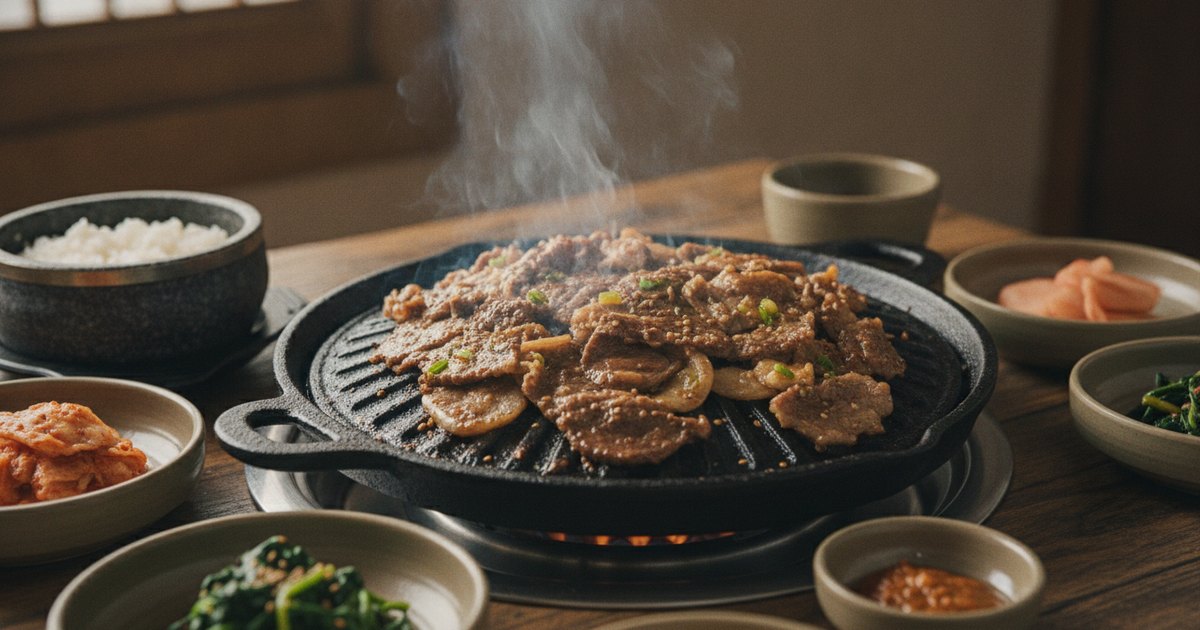
If there's a single Korean dish that has reliably converted reluctant eaters into lifelong fans of Korean cuisine, it's bulgogi (불고기). Translating literally as "fire meat" — 불 (bul) meaning fire, 고기 (gogi) meaning meat — bulgogi is thinly sliced, marinated beef cooked over high heat until its edges caramelize into something deeply savory, subtly sweet, and faintly smoky. The aroma when it hits a hot pan is distinctive: that moment when soy sauce, garlic, and sugar meet searing cast iron produces a smell that is immediately recognizable and almost impossible to resist.
This is the dish that shows up at every Korean barbecue table, in home lunchboxes, at family celebrations, and on the menus of nearly every Korean restaurant worldwide. It's approachable enough that a first-time Korean cook can nail it in a single afternoon — but the marinade balance and technique are specific enough that getting it right takes some understanding of why each element is there.
This guide covers all of it: the history, the marinade science, a fully tested recipe with both US and metric measurements, and — critically — the concrete troubleshooting detail to get the caramel-edged, tender-but-never-mushy result that makes this dish what it is.
A Brief History of Bulgogi
Bulgogi's lineage runs deeper than most Western diners realize. Its earliest traceable ancestor is maekjeok (맥적), a grilled meat dish mentioned in Chinese historical texts describing the Goguryeo kingdom (37 BCE–668 CE) — one of the earliest recorded Korean meat preparations. By the Joseon dynasty (1392–1897), a dish called neobiani (너비아니) had emerged: thinly pounded and grilled beef marinated in soy sauce, sesame oil, and green onion, served at the royal court. Food historians widely recognize neobiani as the direct predecessor of modern bulgogi.
The name "bulgogi" gained widespread everyday use in the 20th century, and the dish diversified into regional styles across the Korean peninsula. Two main forms emerged: pan bulgogi (불고기전골), cooked with vegetables and a small amount of broth in a shallow pan, which became the standard home-kitchen and restaurant version; and grill bulgogi, cooked directly over charcoal or a gas grill with more char and smoke.
Bulgogi's journey into Western kitchens accelerated through Korean immigration to the United States in the 1970s and 80s, where Korean restaurant owners discovered it was consistently the dish non-Korean diners would order on a return visit. Its sweet-savory flavor profile maps intuitively onto flavors already familiar in Western grilling tradition — which makes it an ideal gateway into broader Korean food culture.
Why Asian Pear Is Non-Negotiable
The most important — and most misunderstood — ingredient in a bulgogi marinade is Asian pear (배, bae). This isn't decorative sweetness. Asian pear contains natural proteolytic enzymes (primarily cysteine proteases) that break down muscle fiber proteins in the beef over the marination period, producing a silky tenderness you simply cannot replicate with sugar, heat, or mechanical tenderizing alone.
The practical result: meat that is genuinely tender at the center yet still holds its structure when it hits a searing-hot pan — the characteristic texture that separates properly made bulgogi from beef that has merely been sweetened.
Those same enzymes also set a hard time limit. Beyond 12 hours in an Asian pear marinade, the surface of the beef begins to soften past the ideal point toward an unpleasantly mushy, paste-like exterior. For optimal results, 2–4 hours is the sweet spot. If you need to prep further ahead, a practical workaround is to mix all the other marinade ingredients and marinate the beef with them, then grate and add the pear only during the final 2–3 hours.
Where to find Asian pear in Western cities: H Mart, Hanahreum, Zion Market, and most Asian supermarkets carry Asian pear year-round. Whole Foods often stocks it in autumn. In a pinch, a firm Bosc pear is the closest substitute — milder and slightly less effective enzymatically, but workable. Kiwi fruit is a more powerful alternative (it contains actinidin, a very aggressive protease) — use only 2–3 tablespoons of mashed kiwi and cap marination time at 1–2 hours maximum. For all sourcing questions in one trip, our H Mart shopping guide covers everything you need to pick up.
Choosing the Right Cut of Beef
Across every major recipe source tested, the cut recommendations converge on a clear hierarchy:
Ribeye (등심, deungsim) — The unanimous first choice. Its intramuscular fat keeps the meat moist through the rapid high-heat cook, and the fat itself caramelizes alongside the soy-sugar marinade to produce the most richly flavored result. If your Korean grocery carries pre-sliced bulgogi ribeye, buy it — it will be cut at the perfect 2–3 mm (⅛ inch) thickness, already across the grain.
Top sirloin (채끝살, chaekkeunsal) — A leaner, slightly firmer option that works well and is often more affordable. The pear marinade compensates meaningfully for the lower fat content.
Tenderloin — The most tender cut available, but the priciest. Best reserved for special occasions.
What to avoid: Chuck without careful trimming (too much connective tissue for this cook time), any pre-cut "stew beef," and anything thicker than 4–5 mm — you will not be able to caramelize the exterior before overcooking the interior at that thickness.
The at-home slicing method: Wrap the beef block tightly in plastic wrap and freeze for 1.5–2 hours until firm but still sliceable. Using a sharp slicing or chef's knife, cut across the grain at 2–3 mm. The firm-but-not-frozen texture allows clean, even slices without tearing. Properly cut bulgogi slices are nearly translucent when held to the light — if yours aren't, they're too thick.
The Marinade, Deconstructed
Understanding what each component does makes it easy to adjust the recipe to your palate rather than just following numbers blindly.
| Ingredient | What it does |
|---|---|
| Soy sauce | The backbone. Delivers salinity and glutamate-rich umami. All tested recipes converge on 6 tbsp (90 ml) per 2 lbs of beef. |
| Brown sugar | Sweetness and the primary caramelization agent — responsible for those golden, slightly lacquered edges. Start with 3 tbsp and add more to taste. |
| Mirin / rice wine | Adds aromatic sweetness and depth; also carries flavor compounds deeper into the meat. |
| Asian pear | Enzymatic tenderizer and natural sweetness. Use 100–155g (½–¾ medium pear) of grated or pureed pear per 2 lbs of beef. |
| Toasted sesame oil | Nutty richness and the warm, roasted aroma that defines the finish. Add it after mixing the other ingredients — never blend it at high speed with the pear. |
| Garlic | Pungency and savory depth. Five to six minced cloves per 2 lbs is the baseline; don't be shy here. |
| Green plum extract (매실액, maesil-aek) | Tangy-bright sweetness that lifts the whole marinade and adds genuine complexity. Available at H Mart and Korean grocers. Optional but worthwhile. |
| Black pepper | Background warmth. A quarter teaspoon is the right amount for most palates — enough to register, not enough to dominate. |
One key technique note borrowed from cross-recipe testing: add sesame oil by hand at the end, after all other ingredients are combined. If you blend sesame oil at high speed with pear puree, it can emulsify in a way that creates a slightly bitter, astringent note in the finished marinade. Stir it in; don't blend it.
Full Recipe: Classic Bulgogi (불고기)
Serves 3–4 | Prep: 25 min + 2–4 hrs marinating | Cook: 10 min
Ingredients
Beef and aromatics:
- 900g (2 lbs) beef ribeye or top sirloin, thinly sliced (2–3 mm / ⅛ inch) across the grain
- 1 medium yellow onion, thinly sliced
- 4 green onions (scallions), cut into 5 cm (2-inch) lengths
Marinade:
- 6 tbsp (90 ml) soy sauce
- 3–4 tbsp (36–48 g) brown sugar, start with 3 and adjust
- 2–4 tbsp (30–60 ml) mirin or Korean rice wine (cheongju)
- 2 tbsp (30 ml) toasted sesame oil (add last, by hand)
- 100–155g Asian pear, finely grated or pureed (½–¾ medium pear)
- 2 tbsp (about 5–6 cloves) garlic, minced
- 1 tsp fresh ginger, minced (optional)
- ¼ tsp (0.5 g) ground black pepper
- 1 tbsp toasted sesame seeds, plus extra for garnish
- 1–2 tbsp (15–30 ml) honey (optional, for extra gloss)
- 2 tbsp (30 ml) green plum extract / maesil-aek (optional but excellent)
Instructions
Step 1 — Slice the beef. If slicing at home, wrap the beef block in plastic wrap and freeze for 1.5–2 hours until firm but still penetrable with a knife. Using a sharp knife, cut across the grain at 2–3 mm (⅛ inch). The slices should be nearly translucent when held up to light. If you're buying from a Korean grocery, ask for bulgogi-cut beef — they'll prepare it for you.
Step 2 — Make the marinade. In a large mixing bowl, whisk together soy sauce, brown sugar, mirin, minced garlic, grated Asian pear, ginger, black pepper, sesame seeds, honey, and plum extract if using. Stir until the sugar is fully dissolved and you can no longer feel grit at the bottom of the bowl. The marinade should smell sharply savory-sweet with a pronounced garlic note and a faint fruity undertone from the pear. Stir in the sesame oil by hand at the end.
Step 3 — Marinate. Add the sliced beef, sliced onion, and green onion pieces to the marinade. Toss thoroughly with clean hands or tongs until every slice is evenly coated. Cover tightly and refrigerate.
- Minimum: 30 minutes (flavor infuses, tenderizing is partial)
- Sweet spot: 2–4 hours
- Hard maximum: 12 hours — the pear enzymes will deteriorate the meat surface beyond this point
Step 4 — Rest before cooking. Pull the beef from the refrigerator 20 minutes before cooking. This brief rest reduces the temperature delta when meat hits the hot pan, promoting more even cooking. Lift the slices from the marinade and gently shake off excess liquid — you want the surface tacky and coated, not dripping. Excess liquid in the pan drops temperature fast and causes steaming.
Step 5 — Sear in batches. Heat a large cast-iron skillet or heavy-bottomed stainless pan over high heat for 2–3 minutes until very hot — a drop of water should flash-evaporate on contact. Add a thin film of neutral oil (canola or avocado). Add beef in a single layer; do not crowd the pan. Cook 1–2 minutes per side. Watch closely: the marinade sugars are moving fast at this heat. The right moment is when the edges have turned a deep amber-brown and the surface looks glossy and slightly sticky — like lacquer. That's the caramelization you're after. Reheat the pan 30–60 seconds between batches.
Step 6 — Serve immediately. Plate hot, garnish with extra sesame seeds and sliced green onion. Bulgogi waits for no one — the caramelization softens quickly off the heat, so eat it as soon as it's plated.
How to Serve Bulgogi
The ssam setup (가장 기본적인 방식): Lay a crisp butter lettuce or perilla (kkaennip / 깻잎) leaf flat, add a small spoonful of rice, a few slices of bulgogi, a dab of ssamjang (spicy fermented paste), and optionally a thin slice of raw garlic and a sliver of green chili. Fold and eat in one bite. This is the elemental Korean BBQ experience, and it is revelatory. For a full setup, see our guide to building a Korean BBQ dinner at home.
Over rice (덮밥 style): Spoon bulgogi and all its caramelized pan juices directly over a bowl of steamed short-grain rice. Add a fried egg on top. This is the everyday workhorse version and one of the more satisfying quick meals in the Korean repertoire.
With banchan: Bulgogi pairs beautifully with a well-chosen banchan spread — sliced kimchi, blanched and seasoned spinach (sigeumchi namul), pickled daikon, and gamja jorim (sweet-soy braised potatoes) are all natural companions that balance the sweetness of the beef.
In gimbap: Cold leftover bulgogi inside gimbap rolls is a popular Korean school lunch for good reason. The soy-sesame flavor profiles are made for each other.
Common Mistakes to Avoid
1. Marinating too long → mushy, mealy texture
The Asian pear enzymes don't stop working once the beef looks right. At 2–4 hours, the surface is silky-tender with a clean bite. At 18–24 hours, the surface proteins have broken down enough that the outside takes on a paste-like softness before cooking, and after cooking it feels grainy and slightly slimy rather than tender. Set a timer when you put it in the fridge. If the slices are leaving a film on your fingers when you lift them from the marinade, they've likely gone too long.
2. Crowding the pan → grey, steamed beef with no caramelization
This is the single most common failure mode for home-cooked bulgogi, and the results are easy to diagnose: grey beef sitting in liquid with no golden edges. When too many slices go into the pan at once, the temperature drops rapidly and the moisture released from the meat can't evaporate fast enough, turning the whole thing into a braise. Cook in genuine single-layer batches — if your pan is 30 cm (12 inches), that's perhaps 200–250g of beef at a time. Let the pan reheat fully between batches.
3. Too much marinade on the surface → acrid burning before the beef cooks
The sugars in the marinade are aggressive at high heat. If you add heavily-sauced slices straight from the bowl without shaking off the excess, the pan will fill with dark smoke and the marinade sugars will scorch black — turning bitter and acrid — while the beef is still raw inside. The solution is a gentle but deliberate shake of each slice before it goes in. The beef will still carry ample flavor.
4. Wrong cut or wrong thickness → tough, stringy, or rubbery result
Bulgogi is architecturally designed around 2–3 mm slices. At that thickness, the high heat cooks the beef through in about 60–90 seconds per side, leaving the interior just past medium with edges that caramelize rather than burn. At 5–6 mm or thicker, you face an impossible choice: caramelize the exterior and leave the interior raw, or cook the interior through and destroy the exterior. Pre-cut or carefully home-sliced beef is essential; don't try to improvise with thick slices.
5. Blending sesame oil with the pear → bitter off-notes
If you throw all the marinade ingredients — including sesame oil — into a blender with the pear and run it at high speed, the sesame oil emulsifies under force in a way that generates a perceptible bitterness and astringency in the finished marinade. You'll notice it as a slightly sharp, unpleasant aftertaste that doesn't belong in bulgogi's sweet-savory profile. The fix is simple: blend or grate only the pear, mix your other marinade ingredients together, then stir in sesame oil by hand at the very end.
6. Skipping the pan preheat → uneven cook and excessive sticking
A cold or inadequately preheated pan means the beef makes extended contact with the metal before the Maillard reaction kicks in, causing it to bond with the surface, tear when turned, and cook unevenly. Two to three full minutes of preheating over high heat before the oil goes in is not optional for this dish. The pan is ready when a few drops of water tossed in evaporate almost instantaneously.
FAQ
Q: Can I substitute something for Asian pear if I can't find it?
A: Yes, with some adjustment. A firm, slightly underripe Bosc pear is the most practical Western substitute — the flavor is slightly different but close enough, and it carries some (though less) enzymatic activity. Kiwi fruit is the most powerful alternative (its actinidin enzyme is very aggressive) — use only 2–3 tablespoons of mashed kiwi per 900g of beef and limit marination to 1–2 hours maximum, or you will over-tenderize. Avoid canned pear in syrup: it's too sweet and heat processing during canning destroys the enzymes, so you get none of the tenderizing benefit.
Q: Can I make bulgogi ahead of time and reheat it?
A: Bulgogi is at its absolute best immediately off the pan. If you need to reheat it, do so in a hot skillet with a small splash of water or beef broth to re-loosen the caramelized marinade, rather than microwaving (which makes the meat rubbery and the sauce gummy). One excellent use for leftover bulgogi: the next day, toss it with cold cooked rice, a little sesame oil, and a fried egg in a hot wok. It becomes a superior fried rice almost effortlessly.
Q: Is bulgogi spicy?
A: Traditional bulgogi is not spicy at all. The flavor profile is sweet-savory with deep umami and aromatic garlic, and the black pepper contributes only very gentle background warmth. This makes it one of the most accessible Korean dishes for those who are heat-sensitive. If you want to add heat, a teaspoon or two of gochugaru (Korean red pepper flakes) worked into the marinade adds warmth without overwhelming the dish — our gochugaru guide explains the different heat grades available and how to use them.
Q: What's the difference between bulgogi and galbi?
A: Both are canonical Korean marinated beef dishes with similar soy-sesame marinade bases, but they use very different cuts and have noticeably different textures. Galbi (갈비) uses bone-in short ribs or flanken-cut ribs — the bone keeps the meat juicier through the longer cook time needed for thicker pieces, and the finished texture is substantially more chewy and substantial than the silky thin-sliced bulgogi. If bulgogi is your gateway, galbi is a natural next step.
Q: Where do I find pre-sliced bulgogi beef outside Korean neighborhoods?
A: H Mart, Hanahreum, Zion Market, and most Asian supermarkets carry pre-sliced bulgogi beef, often labeled simply "bulgogi beef" in the meat case. Many Korean grocery butcher counters will also slice it to order if you ask. Japanese grocery stores (Mitsuwa, Marukai) often carry thinly-sliced beef marketed for shabu-shabu or sukiyaki that works similarly. As a last resort, a well-equipped butcher at a mainstream grocery can slice ribeye to order if you specify the thickness — 2–3 mm, across the grain. Our H Mart shopping guide includes everything else worth picking up in the same trip. ```