
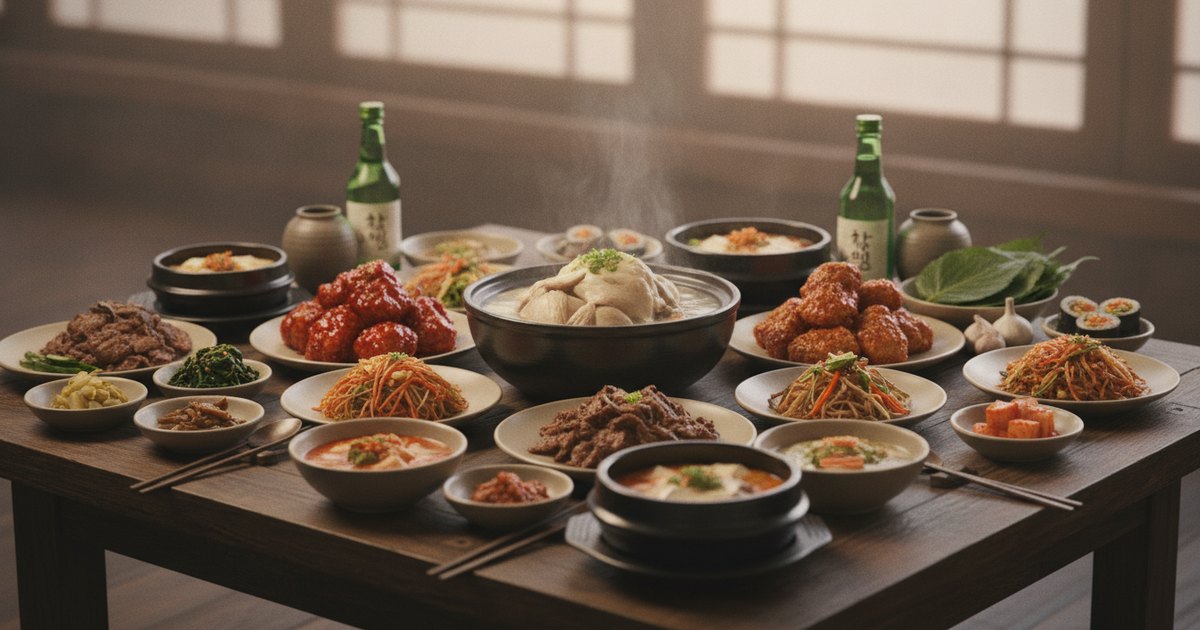
The first time you stumble across a mukbang video — someone seated alone at a camera-lit table, methodically working through a mountain of glistening Korean fried chicken while chatting casually to their audience — you might feel confused, fascinated, or inexplicably hungry. Often, all three at once. That precise combination of reactions is part of the point.
Mukbang (먹방) is one of modern Korea's most distinctive cultural exports: a genre that began on a niche Korean live-streaming platform around 2009 and evolved into a global phenomenon with hundreds of millions of views on YouTube, its own Oxford English Dictionary entry, and imitators in dozens of countries. But to understand mukbang properly, you need to understand Korean food culture first — because mukbang, at its core, isn't really about eating. It's about not eating alone.
What Does "Mukbang" Actually Mean?
The word mukbang (먹방) is a Korean portmanteau — a compressed blend of two words. Meokneun (먹는) means "eating," and bangsong (방송) means "broadcast." Smash them together, apply standard Romanization softening, and you arrive at mukbang: eating broadcast.
The format emerged on AfreecaTV, a Korean live-streaming platform that predates Twitch, somewhere around 2009–2010. Multiple broadcast jockeys — BJs, as Korean streamers are called — independently discovered the same accidental insight: when they ate on camera, viewer counts spiked and audiences stayed longer. There is no single inventor credited with mukbang. It simply appeared, a product of platform, culture, and loneliness colliding at the right moment.
By 2011 the format had a name and recognizable structure. By 2016, AfreecaTV alone hosted 3,500 mukbang channels with roughly 300,000 simultaneous daily viewers. The Oxford English Dictionary officially added mukbang in its September 2021 vocabulary update — part of a wider Korean Wave (Hallyu) batch that also canonized hallyu, manhwa, noona, and K-drama. OED's earliest documented written evidence in English dates to 2013. Collins Dictionary had already named mukbang one of its Words of 2020, and Merriam-Webster carries it as an informal entry.
The Cultural Heart: 식구, 혼밥, and the Loneliness Beneath It All
To understand why mukbang resonated so deeply and so fast, you need to know one Korean word: 식구 (sikgu).
Sikgu is the Korean word for "family member." Break it apart: sik (食/식) means "food" or "eating," and gu (口/구) means "mouth." A family member, in the Korean linguistic imagination, is literally an "eating mouth" — one of the people you share meals with. The dinner table in Korean culture is not incidental to family life; it is family life. The meal is where belonging is enacted, relationships are maintained, and identity is reinforced.
This makes the rise of 혼밥 (honbap) — eating alone — feel particularly charged. Honbap fuses honja (혼자, "alone") and bap (밥, the Korean word for both "rice" and "meal" — that the two concepts share a word is itself revealing). As recently as the early 2010s, sitting down to eat by yourself in a Korean restaurant carried a faint social stigma. It read, at least to some observers, as a signal of failed sociality.
And yet Korean households were rapidly atomizing. Single-person households made up 23.9% of all Korean households by 2010. By 2019, that figure had climbed to 30.2%. By 2024, it reached 36.1% — representing 8.04 million households living solo. Demographers project that by 2030, close to half of all Korean households will be single-person.
The loneliness that followed was measurable in ways that go well beyond statistics. A 2025 Korea Herald report found that 62.1% of Seoul's single-person households report persistent loneliness. 13.6% say they have no one to turn to in a moment of need. South Korea recorded 3,662 "lonely deaths" (godoksa, 고독사) in 2023 — people who died alone and were discovered days or weeks later, 84% of them men.
Mukbang arrived precisely when this social fracture was widening. It offered something specific and psychologically targeted: the digital simulation of a shared meal. You didn't just watch a mukbang — you sat at the table with the host, chatted, responded, contributed. The host ate; you ate with them, or at least alongside them in the sense that mattered emotionally.
How Mukbang Actually Works: Star Balloons and the Live Format
Early mukbang on AfreecaTV was fundamentally a live, interactive format — not the pre-recorded, edited YouTube uploads that most Western audiences encounter today. The host would sit at a camera-lit table with an impressive spread of food and eat in real time while the audience typed comments. Good hosts read and responded to those comments while actively eating — a skill that's more demanding than it sounds and is the primary differentiator between a forgettable stream and a must-watch personality.
Viewers supported creators through 별풍선 (byeolpungseon, "star balloons") — paid digital gifts purchased on the platform and sent to hosts during live streams. This was the economic engine of early mukbang: real money, directly from audience to creator, in real time, as a form of communal participation. Top creators could earn the equivalent of $10,000 per month from advertising alone, with star balloon income and brand sponsorships layered on top.
Today the format has split into two recognizable streams. The live interactive version still thrives on AfreecaTV, Twitch Korea, and similar platforms. The polished, pre-recorded YouTube version — better lit, edited for pacing, often subtitled for international audiences — is what most global viewers know. Both involve large quantities of photogenic food, but the live version preserves the communal dining element that gave mukbang its original emotional function.
From AfreecaTV to Global Phenomenon
Western audiences got a meaningful look at mukbang around 2015, when Fine Brothers Entertainment uploaded a video of Western YouTubers reacting to Korean eating shows. The bemusement was immediate; the curiosity was contagious.
International creators, many in the US, began adapting the format for their own audiences. Some built substantial careers doing so — Bethany Gaskin (Bloveslife) reportedly earned over $1 million from advertising on her mukbang content. The format also benefited directly from the broader Korean Wave: as K-pop, K-drama, and Korean cuisine penetrated Western mainstream consciousness, mukbang rode the same current.
If you've watched Korean food videos — whether that's detailed tteokbokki cooking tutorials or ASMR ramyeon sessions — you've already encountered mukbang's gravitational pull, whether the creator labeled it that way or not.
The Foods of Mukbang: What You'll See on Screen
Certain dishes appear on mukbang channels with such regularity they've become genre signatures. Understanding them is also a fast education in Korean food culture.
Ramyeon (라면): Instant noodles elevated through add-ins — soft-boiled eggs, wilted kimchi, processed cheese slices, chopped scallions, a pat of butter. The finished bowl should have springy, slightly translucent noodles with sheen and body. ASMR ramyeon videos live or die on the slurp.
Tteokbokki (떡볶이): Chewy rice cakes bathed in a gochujang-based sauce that should be glossy, brick-red, and thick enough to coat a spoon without running immediately. The visual drama of sauce-lacquered rice cakes is central to its mukbang appeal. Our full tteokbokki guide covers the sauce ratios and rice cake types in depth.
Korean fried chicken (치킨): Double-fried for a crunch that's almost architectural — you should be able to hear it through a phone speaker. Sauced with either a sweet-savory soy glaze or a fiery gochujang coating. The sound of a good bite is crisp and definitive, not muffled or wet. See the Korean fried chicken guide for the full double-fry breakdown.
Buldak (불닭): "Fire chicken" — intensely spicy preparations, often ramyeon, with a sauce that's almost alarmingly red. Viewer reactions are part of the entertainment.
Seafood hauls: King crab legs, live clams, oysters, shrimp. Shell-cracking and the steam rising from a just-opened shellfish are ASMR gold.
Banchan spreads: A full array of small Korean side dishes arranged around a central main — spinach namul, pickled radish, kongnamul, gyeran mari. Visually generous, texturally diverse, and a clear signal of real effort.
Recreating the Mukbang Experience at Home
You don't need to be a content creator to host your own mukbang-style dinner. A few practical notes for Western kitchens:
Source your staples strategically. H Mart and Korean grocery chains are the gold standard — see our H Mart shopping guide for a first-visit roadmap. If you're not near one, most large Whole Foods locations carry gochujang, and online retailers stock Shin Ramyun, Buldak ramyeon, and canned fish cakes.
The visual spread matters as much as the food itself. Mukbang isn't only about volume — it's about variety and visual abundance. Even three small banchan in distinct bowls alongside a main dish transforms the dinner table.
Prioritize textural contrast. The most compelling mukbang spreads combine chewy (rice cakes, glass noodles), crispy (fried chicken, dried seaweed snacks), and saucy (stews, braised meats). Each element should contribute something different to the textural conversation.
Recreate the social function. The entire origin story of mukbang is about solving the honbap problem. Put on a mukbang stream while you cook; watch it over dinner; or, best of all, invite people and recreate the communal energy that Korean food culture was always built around in the first place.
Common Mistakes to Avoid When Cooking Mukbang Staple Foods
These are the specific, recurring pitfalls when home cooks try to recreate the dishes they see on mukbang channels.
1. Tteokbokki: Sauce That's Too Thin and Too Pale
A properly made tteokbokki sauce is deep brick-red, glossy, and thick enough to coat and cling to the rice cakes — you want it to look lacquered, not soupy. If your sauce is watery and orange-pink, it hasn't reduced enough. The fix: after the initial boil, drop to medium-low and stir continuously for the last 3–4 minutes. The sauce will thicken visibly and shift to a deeper, shinier red as the sugars concentrate. If you see steam escaping rapidly and the color isn't deepening, your heat is too high and the sauce is thinning from evaporation before it can reduce properly.
2. Ramyeon: Overcooking the Noodles Until They Go Slack
Instant noodles in a well-made mukbang bowl are springy, slightly translucent, and hold their shape with a gentle resistance when bitten. Overcooked ramyeon goes soft, loses its characteristic sheen, and absorbs so much broth that the bowl looks dry and dull. Package timing is the minimum, not a target — Shin Ramyun, for example, calls for 4 minutes, but pull it closer to 3 minutes if you're adding it to a vessel that retains heat. Noodles will continue softening in the bowl after plating; account for carry-over cooking.
3. Korean Fried Chicken: Skipping the Double Fry
The crackling, structural crunch that makes Korean fried chicken compelling on camera — and in the mouth — is entirely a product of double frying. First fry at 160°C (320°F) to cook the interior through without burning the crust; rest the chicken on a rack for several minutes; then fry again at 190°C (375°F) until the exterior blisters and sets. Single-fry produces chicken that's cooked but not shattering. You'll hear the diagnostic difference immediately: a properly double-fried piece should crack audibly when you bite through, not compress softly.
4. Gochujang-Based Sauces: Using Pure Gochujang Without Balancing
Gochujang straight from the tub is dense, fermented, and intensely salty. The glossy, complex sauces you see on mukbang channels are almost always a blend: gochujang loosened and balanced with soy sauce, garlic, a sweetener (honey or sugar), and sesame oil. Using pure gochujang as a sauce produces a one-dimensional, aggressive result with no brightness or lift. A workable starting ratio: 2 tablespoons (30g) gochujang : 1 tablespoon (15ml) soy sauce : 1 teaspoon (4g) sugar : 1 teaspoon (5ml) sesame oil. Taste, then adjust. Our gochujang guide covers the full sauce-building logic.
5. Banchan: Dressing Namul Too Far in Advance
Many banchan look low-effort but require timing. Spinach namul, bean sprout salad (kongnamul muchim), and cucumber namul all continue to salt themselves as they sit — what tastes perfectly seasoned at 20 minutes becomes aggressively salty at 4 hours, and the texture degrades from yielding to visibly mushy. Dress these no more than 30 minutes before serving, or hold the seasoning separately and toss just before the table.
6. Seafood Spreads: Misreading Freshness Signals
If you're attempting the shellfish-heavy mukbang format, freshness indicators are non-negotiable. Live clams and mussels should close tightly when tapped — open shells that don't respond are dead and should be discarded. Oysters should smell of cold seawater, clean and briny; ammonia or sourness is a disqualifier regardless of appearance. Mussels should be bright, moist, and tightly shut or barely cracked open. Trust your nose over your eyes with raw shellfish — the olfactory tell comes before any visual sign of deterioration.
FAQ
What does "mukbang" mean in Korean?
Mukbang (먹방) is a portmanteau of meokneun (먹는, "eating") and bangsong (방송, "broadcast"). It translates directly as "eating broadcast."
Why do people watch strangers eat on camera?
The most substantive answer is cultural and psychological. In Korean culture, shared meals are the primary form of social bonding — the word for "family member" (sikgu, 식구) literally means "eating mouth." As single-person households increased and loneliness became measurable at a societal scale in South Korea, mukbang offered something practical: a digitally simulated shared meal. Academic research published in JMIR and PMC/NCBI frames mukbang as a response to the precarious social conditions facing Korean youth in the 2010s — honbap culture turned inside out.
Is mukbang only popular in Korea?
No. While mukbang originated on Korea's AfreecaTV around 2009–2010, it now has a substantial global following, particularly on YouTube. International creators in the US, UK, Southeast Asia, and elsewhere have built significant audiences with the format. The OED's September 2021 addition of the word — alongside a slate of other Hallyu vocabulary — reflects genuine cross-cultural entrenchment.
What are the most popular foods on mukbang shows?
Recurring staples include tteokbokki (spicy rice cake), Korean fried chicken, ramyeon (elevated instant noodles), buldak (fire chicken), seafood hauls (king crab, clams, oysters), and generous banchan spreads. Food selection prioritizes visual richness, volume, and strong ASMR qualities — crunch, slurp, the sound of sauce coating rice cakes.
Can I make mukbang-style food at home without a Korean grocery store nearby?
Yes, with some substitutions. Gochujang is now stocked at most Whole Foods, Target, and many mainstream supermarkets. Shin Ramyun and Buldak ramyeon are widely available on Amazon. Japanese-style kamaboko (fish cake) works as a textural substitute for Korean eomuk in a pinch. For a more complete pantry, our H Mart shopping guide covers everything to grab on your first visit to a Korean grocery. ```